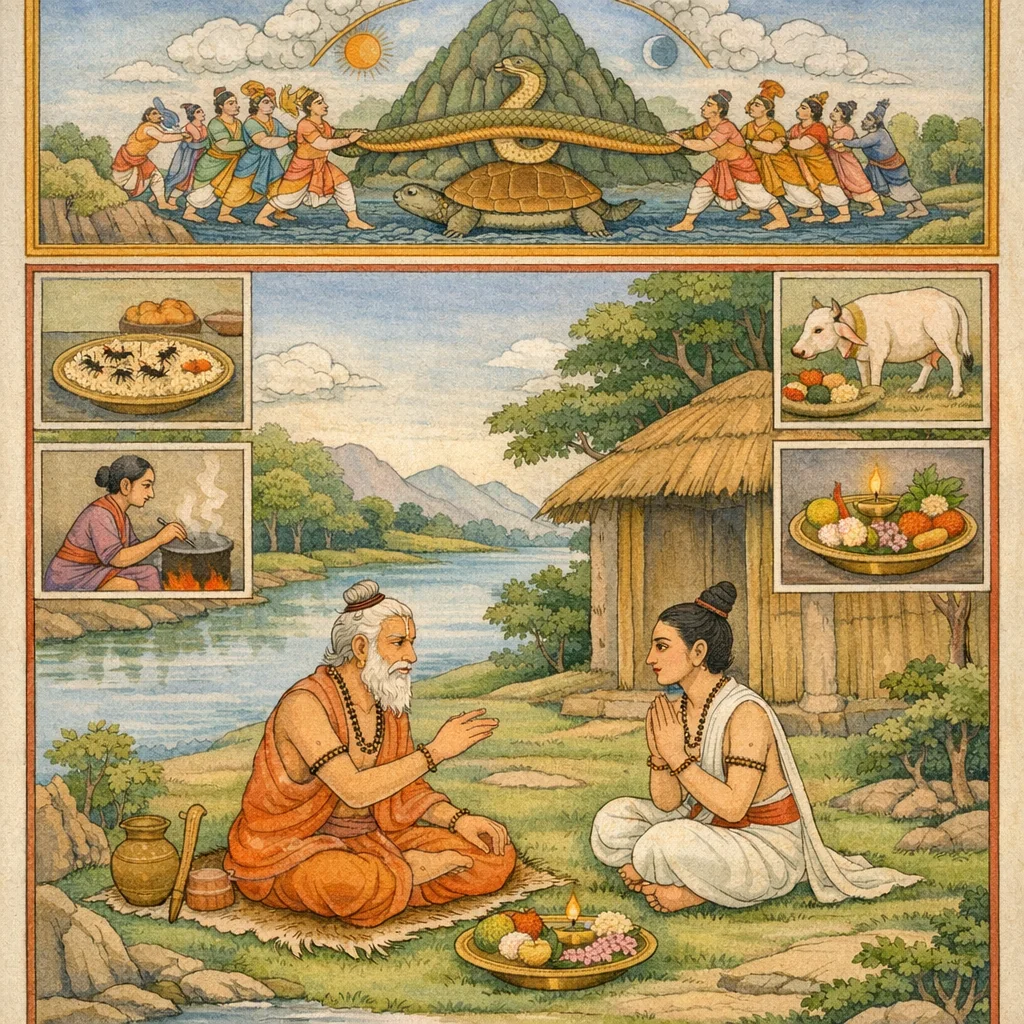
Adhyaya 17
Rules of Food, Acceptance, and Purity for the Twice-Born (Dvija-Śauca and Anna-Doṣa)
Continuing the Uttara-bhāga’s dharma teachings, Vyāsa sets out strict rules on food (anna), donors, and states of impurity, treating eating as a moral-ritual channel through which sin and social/ritual status may be transmitted. The chapter warns that consuming censured food—especially that tied to śūdra sources outside emergency—brings degradation and harmful rebirth, extending the idea even to digestion at death (rebirth linked to the food-owner’s womb/species). A long catalogue lists whose food must be avoided (certain occupations, ritually impure households, morally blameworthy persons), which gifts are unacceptable, and which vegetables, fungi, meats, fishes, and dairy are forbidden or conditionally permitted. It then details contamination rules (hair/insects, animals sniffing, re-cooking, contact with outcastes or menstruation, staleness) and closes with strong prohibitions on liquor for dvijas, with consequences and the logic of purification (impurity remains until expelled). The teaching tightens śauca and self-restraint as prerequisites for greater ritual efficacy and for Yoga–Vedānta practice in the Uttara-bhāga.
Shlokas
Verse 1
इति श्रीकूर्मपुराणे षट्साहस्त्र्यां संहितायामुपरिविभागे षोडशो ऽध्यायः व्यास उवाच नाद्याच्छूद्रस्य विप्रो ऽन्नं मोहाद् वा यदि वान्यतः / स शूद्रयोनिं व्रजति यस्तु भुङ्क्ते ह्यनापदि
Thus, in the Śrī Kūrma Purāṇa, in the six-thousand-verse Saṃhitā, in the latter division. Vyāsa said: “A brāhmaṇa should not eat the food of a śūdra—whether out of delusion or for any other reason. Whoever eats it when there is no emergency falls into a śūdra birth.”
Verse 2
षण्मासान् यो द्विजो भुङ्क्ते शूद्रस्यान्नं विगर्हितम् / जीवन्नेव भवेच्छूद्रो मृतः श्वा चाभिजायते
If a twice-born man eats, for six months, the censured food of a Śūdra, then even while living he becomes as a Śūdra; and after death he is born as a dog.
Verse 3
ब्राह्मणक्षत्रियविशां शूद्रस्य च मुनीश्वराः / यस्यान्नेनोदरस्थेन मृतस्तद्योनिमाप्नुयात्
O best of sages, whether one be a brāhmaṇa, kṣatriya, vaiśya, or śūdra—if a person dies with another’s food remaining undigested within the belly, he attains rebirth in the very womb (species/line) of the one whose food it was.
Verse 4
राजान्नं नर्तकान्नं च तक्ष्णो ऽन्नं चर्मकारिणः / गणान्नं गणिकान्नं च षण्ढान्नं चैव वर्जयेत्
One should avoid food received from a king, from dancers, from a carpenter, and from a leather-worker; likewise food from temple-attendants (gaṇas), from a courtesan, and from an impotent/eunuch—these are to be shunned.
Verse 5
चक्रोपजीविरजकतस्करध्वजिनां तथा / गान्धर्वलोहकारान्नं सूतकान्नं च वर्जयेत्
One should avoid the food of those who live by making wheels, of washermen, thieves, and standard-bearers; likewise, one should avoid the food of singers/performers and iron-workers, and also food associated with a sūtaka (period of ritual impurity).
Verse 6
कुलालचित्रकर्मान्नं वार्धुषेः पतितस्य च / पौनर्भवच्छत्रिकयोरभिशस्तस्य चैव हि
One should shun food (or cooked offerings) connected with a potter or a painter‑craftsman, and also that of a usurer; likewise the food of one fallen from dharma, of a remarried woman and of a chātrikā, and also of one publicly accused or condemned for grave wrongdoing.
Verse 7
सुवर्णकारशैलूषव्याधबद्धातुरस्य च / चिकित्सकस्य चैवान्नं पुंश्चल्या दण्डिकस्य च
Food obtained from a goldsmith, an actor, a hunter, one kept in bondage, one afflicted by disease, a physician, a promiscuous woman, or a condemned criminal is to be avoided.
Verse 8
स्तेननास्तिकयोरन्नं देवतानिन्दकस्य च / सोमविक्रयिणश्चान्नं श्वपाकस्य विशेषतः
Food from a thief and from a nāstika (unbeliever), and also from one who reviles the gods; likewise food from one who sells Soma—especially from a dog‑cooker (outcaste)—is to be avoided as impure.
Verse 9
भार्याजितस्य चैवान्नं यस्य चोपपतिर्गृहे / उत्सृष्टस्य कदर्यस्य तथैवोच्छिष्टभोजिनः
Food belonging to a man dominated by his wife, and food from a house where a paramour is kept; likewise the food of one cast out, of a miser, and of one who eats leavings should be regarded as unfit for the righteous.
Verse 10
अपाङ्क्त्यान्नं च सङ्घान्नं शस्त्राजीवस्य चैव हि / क्लीबसंन्यासिनोश्चान्नं मत्तोन्मत्तस्य चैव हि / भीतस्य रुदितस्यान्नमवक्रुष्टं परिक्षुतम्
One should avoid food from those unfit to sit in the dining row, communal food distributed to a crowd, and the food of one who lives by weapons; the food of an impotent person and of a renunciant; likewise the food of the intoxicated or the mad; and the food of one who is frightened or weeping—also food that has been reviled or sneezed upon.
Verse 11
ब्रह्मद्विषः पापरुचेः श्राद्धान्नं सूतकस्य च / वृथापाकस्य चैवान्नं शावान्नं श्वशुरस्य च
One should shun the food of one who hates the Veda/Brahman (a brāhmaṇa), of one who delights in sin; food prepared for the Śrāddha rite; the food of one under birth-impurity (sūtaka); food cooked in vain, without proper purpose or ritual propriety; food from a house tainted by death-impurity (śāva); and also the food of one’s father-in-law.
Verse 12
अप्रजानां तु नारीणां भृतकस्य तथैव च / कारुकान्नं विशेषेण शस्त्रविक्रयिणस्तथा
Likewise, one should avoid accepting food or gifts belonging to women without male guardianship, to a hired servant, and especially to artisans; and also to those who make their living by selling weapons.
Verse 13
शौण्डान्नं घाटिकान्नं च भिषजामन्नमेव च / विद्धप्रजननस्यान्नं परिवित्त्यन्नमेव च
Food from a drunkard, from a professional gambler, and from physicians; likewise the food of one who has violated the proper order of procreation, and food connected with a man who married before his elder brother—all such food is to be regarded as unfit.
Verse 14
पुनर्भुवो विशेषेण तथैव दिधिषूपतेः / अवज्ञातं चावधूतं सरोषं विस्मयान्वितम् / गुरोरपि न भोक्तव्यमन्नं संस्कारवर्जितम्
In particular, one should not eat food from a remarried woman, nor from the husband of a woman taken again in marriage. Food offered with contempt, thrown down, given in anger, or with improper astonishment should not be eaten. Even food from one’s own teacher should not be eaten if it lacks the proper sanctifying rites (saṃskāra).
Verse 15
दुष्कृतं हि मनुष्यस्य सर्वमन्ने व्यवस्थितम् / यो यस्यान्नं समश्नाति स तस्याश्नानि किल्बिषम्
Indeed, a person’s wrongdoing is, as it were, lodged in their food. Whoever eats another’s food partakes of that person’s sin.
Verse 16
आर्धिकः कुलमित्रश्च स्वगोपालश्च नापितः / एते शूद्रेषु भोज्यान्ना यश्चात्मानं निवेदयेत्
A tenant-farmer, a “household friend” who lives by ingratiating himself, one’s own cowherd, and a barber—these, among the Śūdras, are fit to be fed; and likewise anyone who offers his very person in service to another.
Verse 17
कुशीलवः कुम्भकारः क्षेत्रकर्मक एव च / एते शूद्रेषु भोज्यान्ना दत्त्वा स्वल्पं पणं बुधैः
A minstrel or performer, a potter, and a worker of the fields—these, among the Śūdras, are fit to be fed; and the wise should also give them a small wage.
Verse 18
पायसं स्नेहपक्वं यद् गोरसं चैव सक्तवः / पिण्याकं चैव तैलं च शूद्राद् ग्राह्यं द्विजातिभिः
Milk-rice (pāyasa) cooked with ghee, together with milk and flour-preparations, and also oil-cake and oil—these may be accepted by the twice-born (dvija) from a Śūdra.
Verse 19
वृन्ताकं नालिकाशाकं कुसुम्भाश्मन्तकं तथा / पलाण्डुं लशुनं शुक्तं निर्यासं चैव वर्जयेत्
One should avoid eggplant, the vegetable called nālikā-śāka, safflower (kusumbha) and the leafy green known as āśmantaka; likewise onions, garlic, sour or fermented foods, and resinous exudations.
Verse 20
छत्राकं विड्वराहं च शेलं पेयूषमेव च / विलयं सुमुखं चैव कवकानि च वर्जयेत्
One should avoid the mushroom called chatrāka, the boar known as viḍvarāha, and the items called śela, peyūṣa, vilaya, and sumukha; and one should also avoid all fungi and molds (kavaka).
Verse 21
गृञ्जनं किंशुकं चैव ककुभाण्डं तथैव च / उदुम्बरमलाबुं च जग्ध्वा पतति वै द्विजः
A twice-born man truly falls from his dharmic standing if he eats gṛñjana, kiṃśuka, kakubhāṇḍa, udumbara, or alābu.
Verse 22
वृथा कृशरसंयावं पायसापूपमेव च / अनुपाकृतमांसं च देवान्नानि हवींषि च
One should not offer in vain—without proper rite and purpose—kṛśara and saṃyāva, nor payasa (milk-rice) and apūpa cakes; nor should one improperly present uncooked meat, devānna (food for the gods), or havīṃṣi (sacrificial oblations).
Verse 23
यवागूं मातुलिङ्गं च मत्स्यानप्यनुपाकृतान् / नीपं कपित्थं प्लक्षं च प्रयत्नेन विवर्जयेत्
With deliberate care one should avoid yavāgū (thin rice-gruel), mātuliṅga (citron), and even fish that is not properly cooked; likewise one should refrain from nīpa, kapittha, and plakṣa.
Verse 24
पिण्याकं चोद्धृतस्नेहं देवधान्य तथैव च / रात्रौ च तिलसंबद्धं प्रयत्नेन दधि त्यजेत्
One should carefully avoid pīṇyāka (oil-cake), foods from which the fat has been extracted, and also deva-dhānya; likewise, at night one should avoid anything prepared with sesame, and curd (dahi) as well.
Verse 25
नाश्नीयात् पयसा तक्रं न बीजान्युपजीवयेत् / क्रियादुष्टं भावदुष्टमसत्संसर्गि वर्जयेत्
One should not take buttermilk (takkra) together with milk, nor make one’s livelihood by dealing in seeds. One should avoid a person whose actions are corrupt, whose intentions are corrupt, and anyone who keeps company with the wicked.
Verse 26
केशकीटावपन्नं च सहृल्लेखं च नित्यशः / श्वाघ्रातं च पुनः सिद्धं चण्डालावेक्षितं तथा
Food into which hair or insects have fallen, and food habitually tainted by contact; food sniffed by a dog; food once prepared and then cooked again; and likewise food upon which a Caṇḍāla has cast his gaze—all these are to be deemed impure and avoided.
Verse 27
उदक्यया च पतितैर्गवा चाघ्रातमेव च / अनर्चितं पुर्युं षितं पर्यायान्नं च नित्यशः
Food touched by a menstruating woman, by outcast persons, or sniffed by a cow; food not ritually honored, food that has gone stale, or food cooked and kept for the next day—such food should be avoided at all times.
Verse 28
काककुक्कुटसंस्पृष्टं कृमिभिश्चैव संयुतम् / मनुष्यैरप्यवघ्रातं कुष्ठिना स्पृष्टमेव च
That which has been touched by crows or fowls, infested with worms, smelled by people, or even touched by one afflicted with kuṣṭha (leprosy)—is to be regarded as impure.
Verse 29
न रजस्वलया दत्तं न पुंश्चाल्या सरोषया / मलबद्वाससा वापि परवासो ऽथ वर्जयेत्
One should not accept a gift given by a menstruating woman, nor by a wanton woman who gives in anger; likewise one should avoid a gift from one wearing soiled garments, and also anything that belongs to another.
Verse 30
विवत्सायाश्च गोः क्षीरमौष्ट्रं वानिर्दशं तथा / आविकं सन्धिनीक्षीरमपेयं मनुरब्रवीत्
Manu declared unfit for drinking: the milk of a cow whose calf has died, camel’s milk, milk drawn before ten days have passed, sheep’s milk, and the milk of a cow in the ‘sandhinī’ condition.
Verse 31
बलाकं हंसदात्यूहं कलविङ्कं शुकं तथा / कुररं च चकोरं च जालपादं च कोकिलम्
Also (there are) the crane (balāka), the swan (haṃsa) and the dātyūha-bird, the kalaviṅka and the parrot (śuka); likewise the kurara, the cakora-bird, the web‑footed waterfowl (jālapāda), and the kokila, the cuckoo.
Verse 32
वायसं खञ्जरीटं च श्येनं गृध्रं तथैव च / उलूकं चक्रवाकं च भासं पारावतानपि / कपोतं टिट्टिभं चैव ग्रामकुक्कुटमेव च
“(These birds are to be counted:) the crow (vāyasa), the khanjariṭa (wagtail), the hawk (śyena), and likewise the vulture (gṛdhra); the owl (ulūka), the cakravāka (ruddy goose), the bhāsa (a raptor), and the pigeons; the dove (kapota), the ṭiṭṭibha-bird, and also the domestic fowl.”
Verse 33
सिंहव्याघ्रं च मार्जारं श्वानं शूकरमेव च / शृगालं मर्कटं चैव गर्दभं च न भक्षयेत्
One should not eat the flesh of a lion (siṃha), a tiger (vyāghra), a cat (mārjāra), a dog (śvāna), a pig (śūkara), a jackal (śṛgāla), a monkey (markaṭa), or a donkey (gardabha).
Verse 34
न भक्षयेत् सर्वमृगान् पक्षिणो ऽन्यान् वनेचरान् / जलेचरान् स्थलचरान् प्राणिनश्चेति धारणा
One should not eat animals of any kind—nor other birds and forest-creatures—nor creatures that move in water or on land; such is the prescribed restraint (dhāraṇā).
Verse 35
गोधा कूर्मः शशः श्वाविच्छल्यकश्चेति सत्तमाः / भक्ष्याः पञ्चनखा नित्यं मनुराह प्रिजापतिः
O best of the virtuous, the lizard (godhā), the tortoise (kūrma), the hare (śaśa), the porcupine (śvāvit), and the animal called chalyaka—these five clawed creatures are declared as always fit to be eaten; so said Manu, Prajāpati, Lord of progeny.
Verse 36
मत्स्यान् सशल्कान् भुञ्जीयान् मांसं रौरवमेवच / निवेद्य देवताभ्यस्तु ब्राह्मणेभ्यस्तु नान्यथा
One may eat fish only when it still bears its scales; and if meat is taken, only that which is permitted by rule. Yet it must be done only after first offering it as naivedya to the deities and to the brāhmaṇas—never otherwise.
Verse 37
मयूरं तित्तिरं चैव कपोतं च कपिञ्जलम् / वाध्रीणसं बकं भक्ष्यं मीनहंसपराजिताः
Peacock, partridge, pigeon, and francolin are fit to be eaten; likewise the vādhrīṇasa and the crane are permissible as food—these birds being spoken of as those “overcome by fish and swans.”
Verse 38
शफरं सिंहतुण्डं च तथा पाठीनरोहितौ / मत्स्याश्चैते समुद्दिष्टा भक्षणाय द्विजोत्तमाः
“Śaphara, Siṃhatuṇḍa, and likewise Pāṭhīna and Rohita—these fishes are specifically prescribed as fit for eating, O best of the twice-born.”
Verse 39
प्रोक्षितं भक्षयेदेषां मांसं च द्विजकाम्यया / यथाविधि नियुक्तं च प्राणानामपि चात्यये
If their meat has been ritually sprinkled (prokṣita) and thus made fit, one may eat it to meet the needs of the twice-born; and when duly enjoined according to rule—even in an emergency when life itself is at stake.
Verse 40
भक्षयेन्नैव मांसानि शेषभोजी न लिप्यते / औषधार्थमशक्तौ वा नियोगाद् यज्ञकारणात्
One should not eat meat at all. Yet one who partakes only of what remains (śeṣa) after a rite or offering is not tainted—likewise when it is taken for medicinal need, in a state of incapacity, or when enjoined (niyoga) for the sake of a yajña.
Verse 41
आमन्त्रितस्तु यः श्राद्धे दैवे वा मांसमुत्सृजेत् / यावन्ति पशुरोमाणि तावतो नरकान् व्रजेत्
But one who, after being invited to a Śrāddha or to a rite for the gods (daiva-yajña), rejects the meat offering, goes to as many hells as there are hairs upon the animal.
Verse 42
अदेयं चाप्यपेयं च तथैवास्पृश्यमेव च / द्विजातीनामनालोक्यं नित्यं मद्यमिति स्थितिः
For the twice-born, liquor is firmly established as something never to be given, never to be drunk, indeed never even to be touched; it is to be avoided even by sight at all times—such is the settled rule.
Verse 43
तस्मात् सर्वप्रकारेण मद्यं नित्यं विवर्जयेत् / पीत्वा पतति कर्मभ्यस्त्वसंभाष्यो भवेद् द्विजः
Therefore, in every way one should always abstain from intoxicating liquor. Having drunk it, a twice-born person falls away from prescribed duties and becomes unfit to be spoken to, socially shunned.
Verse 44
भक्षयित्वा ह्यभक्ष्याणि पीत्वापेयान्यपि द्विजः / नाधिकारी भवेत् तावद् यावद् तन्न जहात्यधः
A twice-born man who has eaten what is forbidden to be eaten and drunk what is forbidden to be drunk is not eligible for sacred rites and disciplined practice so long as he has not cast that impurity out from below.
Verse 45
तस्मात् परिहरेन्नित्यमभक्ष्याणि प्रयत्नतः / अपेयानि च विप्रो वै तथा चेद् याति रौरवम्
Therefore, a brāhmaṇa should always, with deliberate effort, avoid what is forbidden to eat and what is forbidden to drink; for if he acts otherwise, he goes to the hell called Raurava.
Frequently Asked Questions
That moral and ritual qualities adhere to food and transfer through consumption: “another’s sin” is metaphorically lodged in their food, so eating improperly sourced or contaminated food disrupts śauca, damages dharmic standing, and can shape karmic outcome and rebirth.
It discourages meat broadly, yet permits limited cases: when the meat is ritually processed and first offered as naivedya to deities and brāhmaṇas, when enjoined by sacrificial context, for medicinal need, incapacity, or in emergencies—never as casual enjoyment.
As absolutely prohibited—never to be given, drunk, or even touched; drinking causes fall from prescribed duties and social exclusion, and impurity remains until physically expelled, with hell-consequence stated for persistent transgression.
Contamination by hair/insects/worms, animal sniffing (dog/cow), crow/fowl contact, staleness or next-day cooking, re-cooking, touch by menstruating persons or outcastes, being sneezed on/reviled, or association with sūtaka/śāva households and improperly performed rites.