Adhyaya 19
Bhojana-vidhi and Nitya-karman: Directions for Eating, Prāṇa-Oblations, Sandhyā, and Conduct Leading to Apavarga
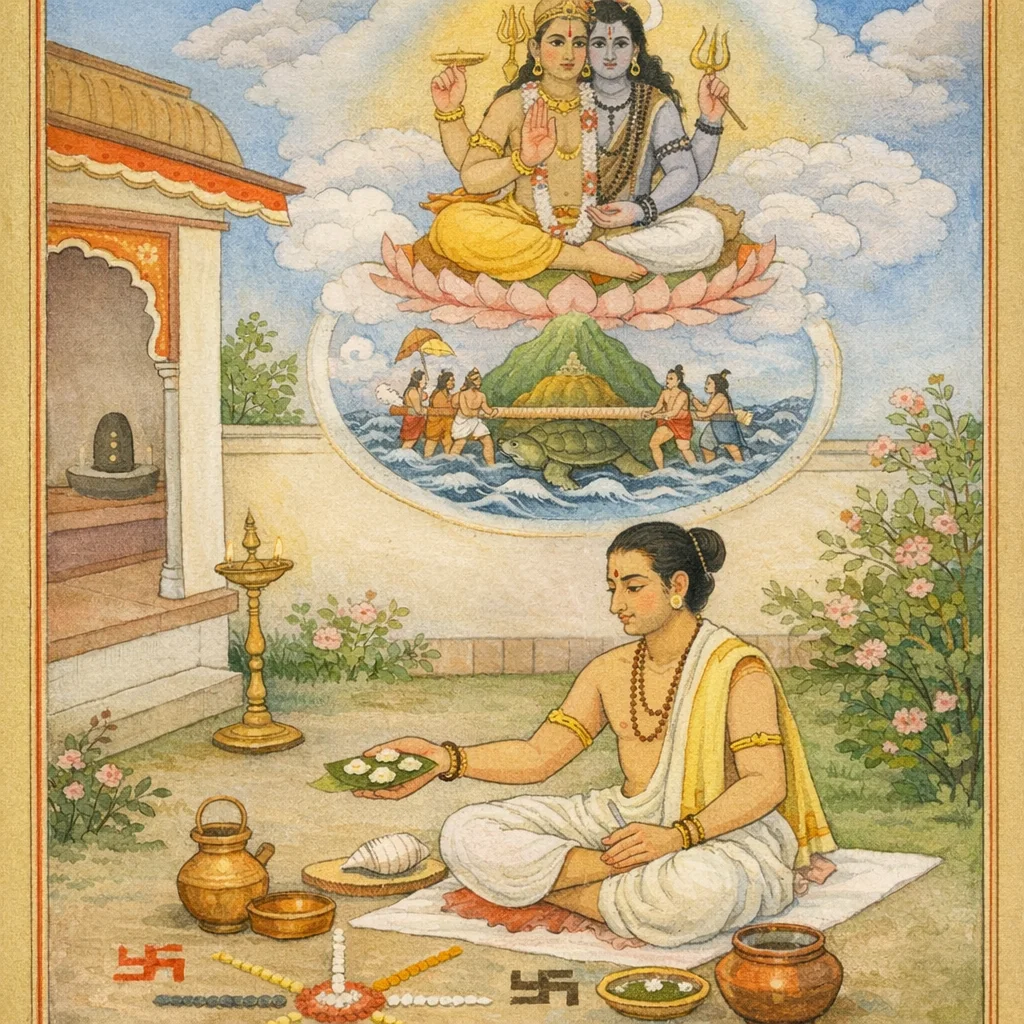
Continuing the Uttara-bhāga’s teaching on regulated life within varṇāśrama, Vyāsa sets out a Brahmin’s daily discipline that sanctifies ordinary acts—especially eating—into a consecrated rite. He begins with rules about the direction one should face while eating and the fruits thereof, then prescribes preparatory purity: a clean seat, washed feet and hands, ācamana, and a calm mind. Food is ritually enclosed with water and the vyāhṛtis, followed by āpośana and the prāṇa-homa sequence—offerings to Prāṇa, Apāna, Vyāna, Udāna, and Samāna—culminating in meditative assimilation of the remainder as worship of the Divine Self (Prajāpati). The chapter then tightens conditions for purity and recitation—proper times, posture, vessels, clothing, company, and emotional states—linking bodily order to Vedic efficacy. Evening sandhyā and Gāyatrī-japa are reaffirmed as indispensable marks of dharma, followed by rules for sleeping place and posture. It closes with a strong soteriological claim: there is no complete liberation (apavarga) apart from one’s prescribed āśrama-discipline, performed to please Parameṣṭhin, preparing the way for subsequent chapters to map duty into liberation in a yoga–vedānta frame.
Shlokas
Verse 1
इति श्रीकूर्मपुराणे षट्साहस्त्र्यां संहितायामुपरिविभागे अष्टादशो ऽध्यायः व्यास उवाच प्राङ्मुखो ऽन्नानि भुञ्जीत सूर्याभिमुख एव वा / आसीनस्त्वासने शुद्धे भूम्यां पादौ निधाय तु
Thus, in the Śrī Kūrma Purāṇa, in the Ṣaṭsāhasrī Saṃhitā, in the latter division, the eighteenth chapter begins. Vyāsa said: One should eat facing east, or else facing the sun; seated upon a clean seat, placing one’s feet upon the ground.
Verse 2
आयुष्यं प्राङ्मुखो भुङ्क्ते यशस्यं दक्षिणामुखः / श्रियं प्रत्यङ्मुखो भुङ्क्ते ऋतं भुङ्क्ते उदङ्मुखाः
Facing east while eating, one gains longevity; facing south, one gains fame. Facing west, one gains prosperity; and facing north while eating, one partakes of ṛta—the power of truth and right order.
Verse 3
पञ्चार्द्रे भोजनं कुर्याद् भूमौ पात्रं निधाय तु / उपवासेन तत्तुल्यं मनुराह प्रजापतिः
One should take a meal only at the fifth part of the day, placing the vessel upon the ground; Prajāpati Manu declares that such a practice is equal in merit to fasting.
Verse 4
उपलिप्ते शुचौ देशे पादौ प्रक्षाल्य वै करौ / आचम्यार्द्राननो ऽक्रोधः पञ्चार्द्रे भोजनं चरेत्
In a clean place that has been freshly smeared and purified, one should wash the feet and also the hands; having performed ācamanam (sipping water for purification), with the face still moist and free from anger, one should then take the meal at the fifth part of the day in the proper manner.
Verse 5
महाव्यहृतिभिस्त्वन्नं परिधायोदकेन तु / अमृतोपस्तरणमसीत्यापोशानक्रियां चरेत्
Having encircled (consecrated) the food with water while reciting the great vyāhṛtis, one should perform the āpośana rite, uttering: “You are the upastaraṇa, the covering of immortality (amṛta).”
Verse 6
स्वाहाप्रणवसंयुक्तां प्राणायाद्याहुतिं ततः / अपानाय ततो हुत्वा व्यानाय तदनन्तरम्
Then one should first offer an oblation to Prāṇa, joined with the syllable Oṃ and the exclamation “svāhā”. After that, having offered to Apāna, one should next offer to Vyāna.
Verse 7
उदानाय ततः कुर्यात् समानायेति पञ्चमीम् / विज्ञाय तत्त्वमेतेषां जुहुयादात्मनि द्विजः
Then he should perform the fifth (breath-offering) for Udāna, and (also) for Samāna. Having understood the true principle of these vital currents, the twice-born should offer them as oblations into the Self.
Verse 8
शेषमन्नं यथाकामं भुञ्जीतव्यं जनैर्युतम् / ध्यात्वा तन्मनसा देवमात्मानं वै प्रजापतिम्
Then, together with the people present, one may eat the remaining food as one wishes—after meditating with that very mind upon the Divine Self, Prajāpati.
Verse 9
अमृतापिधानमसीत्युपरिष्टादपः पिबेत् / आचान्तः पुनराचामेदायं गौरिति मन्त्रतः
Reciting, “You are the covering of immortality (amṛta),” one should sip water from above in the prescribed manner. Having performed ācamana, one should again perform ācamana with the mantra, “This is the cow,” according to rule.
Verse 10
द्रुपदां वा त्रिरावर्त्य सर्वपापप्रणाशनीम् / प्राणानां ग्रन्थिरसीत्यालभेद् हृदयं ततः
Or else, reciting the purifying formula three times—said to destroy all sins—one should then touch the heart, contemplating: “You are the knot of the vital breaths”; thereafter one proceeds with the rite.
Verse 11
आचम्याङ्गुष्ठमात्रेति पादाङ्गुष्ठे ऽथ दक्षिणे / निः स्त्रवयेद् हस्तजलमूर्ध्वहस्तः समाहितः
Having performed ācamana, one should take only a thumb-measure of water and then, at the right big toe, let the water from the hand drip off—keeping the hand raised and remaining composed and attentive.
Verse 12
हुतानुमन्त्रणं कुर्यात् श्रद्धायामिति मन्त्रतः / अथाक्षरेण स्वात्मानं योजयेद् ब्रह्मणेति हि
With the mantra beginning “śraddhāyām…”, one should duly perform anumantraṇa to consecrate the oblation already offered. Then, by the sacred syllable Oṃ, one should yoke one’s own self to Brahman—indeed, by the mantra “brahmaṇe”.
Verse 13
सर्वेषामेव यागानामात्मयागः परः स्मृतः / यो ऽनेन विधिना कुर्यात् स याति ब्रह्मणः क्षयम्
Among all sacrifices, the offering of one’s own self—the inner sacrifice—is remembered as the highest. Whoever performs it according to this discipline attains the imperishable state of Brahman.
Verse 14
यज्ञोपवीती भुञ्जीत स्त्रग्गन्धालङ्कृतः शुचिः / सायंप्रापर्नान्तरा वै संध्यायां तु विशेषतः
Wearing the sacred thread (yajñopavīta), one should take one’s meal in purity, adorned with a garland, fragrance, and fitting ornaments. This is to be done in the evening—during the interval between afternoon and night—especially at the time of Sandhyā, the twilight worship.
Verse 15
नाद्यात् सूर्यग्रहात् पूर्वमह्नि सायं शशिग्रहात् / ग्रहकाले च नाश्नीयात् स्नात्वाश्नीयात् तु मुक्तयोः
One should not eat early in the day before a solar eclipse, nor in the evening before a lunar eclipse. During the eclipse one should not eat; when it is released and ended, one should bathe for purification and then take food.
Verse 16
मुक्ते शशिनि भुञ्जीत यदि न स्यान्महानिशा / अमुक्तयोरस्तङ्गतयोरद्याद् दृष्ट्वा परे ऽहनि
When the moon has risen, one may eat—provided it is not the “great night,” the prescribed night of fasting. But if both (sun and moon) have not yet risen, or have already set, one should eat only on the next day, after seeing them rise.
Verse 17
नाश्नीयात् प्रेक्षमाणानामप्रदायैव दुर्मतिः / न यज्ञशिष्टादन्द् वा न क्रुद्धो नान्यमानसः
A person of foolish mind should not eat while others look on, without first offering them a share. Nor should one eat food that is not the remnant of yajña (sacrifice); and one should not eat in anger, nor with the mind fixed elsewhere.
Verse 18
आत्मार्थं भोजनं यस्य रत्यर्थं यस्य मैथुनम् / वृत्यर्थं यस्य चाधीतं निष्फलं तस्य जीवितम्
For one who eats only for oneself, unites sexually only for pleasure, and studies only for livelihood—such a person’s life is fruitless.
Verse 19
यद्भुङ्क्ते वेष्टितशिरा यच्च भुङ्क्ते उदङ्मुखः / सोपानत्कश्च यद् भुङ्क्ते सर्वं विद्यात् तदासुरम्
Whatever food one eats with the head covered, whatever one eats facing north, and whatever one eats while wearing footwear—know all of that to be asuric in nature (impure and undisciplined).
Verse 20
नार्धरात्रे न मध्याह्ने नाजीर्णे नार्द्रवस्त्रधृक् / न च भिन्नासनगतो न शयानः स्थितो ऽपि वा
One should not perform japa or sacred recitation at midnight, nor at midday; nor when food is undigested, nor while wearing wet garments; nor while seated on a broken or unfit seat; nor while lying down—nor even while standing.
Verse 21
न भिन्नभाजने चैव न भूम्यां न च पाणिषु / नोच्छिष्टो घृतमादद्यान्न मूर्धानं स्पृशेदपि
One should not take ghee in a broken vessel, nor from the ground, nor from the hands. One who is impure due to leftover food should not take ghee; and one should not even touch the head.
Verse 22
न ब्रह्म कीर्तयन् वापि न निः शेषं न भार्यया / नान्धकारे न चाकाशे न च देवालयादिषु
One should not recite or praise Brahman in an improper way—neither carelessly nor without reverence; nor in the company of one’s wife. Not in darkness, not in exposed places under the open sky, and not within temples and similar precincts when such recitation is inappropriate there.
Verse 23
नैकवस्त्रस्तु भुञ्जीत न यानशयनस्थितः / न पादुकानिर्गतो ऽथ न हसन् विलपन्नपि
One should not eat while wearing only a single garment; nor while seated on a vehicle or lying on a bed. Nor should one eat after stepping out wearing footwear; and one should not eat while laughing, nor while weeping.
Verse 24
भुक्त्वैवं सुखमास्थाय तदन्नं परिणामयेत् / इतिहासपुराणाभ्यां वेदार्थानुपबृंहयेत्
Having thus eaten, one should sit at ease and allow the food to be properly digested; and one should enrich and clarify the meaning of the Veda through the Itihāsas and Purāṇas.
Verse 25
ततः संध्यामुपासीत पूर्वोक्तविधिना द्विजः / आसीनस्तु जपेद् देवीं गायत्रीं पश्चिमां प्रति
Thereafter, the twice-born should perform the twilight worship (sandhyā) according to the method taught earlier; and, seated, he should repeat in japa the Divine Goddess Gāyatrī, facing toward the west.
Verse 26
न तिष्ठति तु यः पुर्वां नास्ते संध्यां तु पश्चिमाम् / स शूद्रेण समो लोके सर्वधर्मविवर्जितः
Whoever does not perform the morning Sandhyā and does not observe the evening Sandhyā is regarded in the world as equal to a Śūdra—one who has fallen away from all dharma (Vedic duties).
Verse 27
हुत्वाग्निं विधिवन्मन्त्रैर्भुक्त्वा यज्ञावशिष्टकम् / सभृत्यबान्धवजनः स्वपेच्छुष्कपदो निशि
Having duly offered into the sacred fire with the prescribed mantras, and having eaten what remains from the sacrifice, he should at night sleep—together with servants, relatives, and dependents—on a dry, plain sleeping-place, as he chooses.
Verse 28
नोत्तराभिमुखः स्वप्यात् पश्चिमाभिमुखो न च / न चाकाशे न नग्नो वा नाशुचिर्नासने क्वचित्
One should not sleep facing the north, nor facing the west. Nor should one sleep out in the open sky, nor naked; nor while impure, nor ever upon an unclean seat.
Verse 29
न शीर्णायां तु खट्वायां शून्यागारे न चैव हि / नानुवंशं न पालाशे शयने वा कदाचन
One should never lie down to sleep on a broken bed, nor in a deserted house; nor upon a bamboo frame, nor upon a couch made of palāśa-wood—at any time.
Verse 30
इत्येतदखिलेनोक्तमहन्यहनि वै मया / ब्राह्मणानां कृत्यजातमपवर्गफलप्रदम्
Thus, day after day, I have fully declared the entire body of duties prescribed for the Brāhmaṇas—those observances that bestow the fruit of apavarga, final liberation.
Verse 31
नास्तिक्यादथवालस्यात् ब्राह्मणो न करोति यः / स याति नरकान् घोरान् काकयोनौ च जायते
That Brāhmaṇa who, out of disbelief in dharma or out of sloth, fails to perform his prescribed duties—he goes to dreadful hells, and is also born again in the womb of a crow.
Verse 32
नान्यो विमुक्तये पन्था मुक्त्वाश्रमविधिं स्वकम् / तस्मात् कर्माणि कुर्वोत तुष्टये परमेष्ठिनः
There is no other path to complete liberation apart from one’s own prescribed discipline of āśrama. Therefore, one should perform one’s duties so as to please Parameṣṭhin, the Supreme Lord.
Frequently Asked Questions
That daily life—especially eating—must be converted into disciplined worship through śauca, mantra, ācamana/āpośana, and prāṇa-offerings, and that such āśrama-based discipline is presented as the indispensable route to apavarga when performed for Parameṣṭhin.
It explicitly states that among sacrifices, offering one’s own self is highest, and links correct performance of this interiorized yajña—supported by prāṇa-homa and Brahman-yoking mantras—to attainment of the imperishable state of Brahman.
After digestion and study through Itihāsa–Purāṇa to illuminate Veda, the twice-born is to perform evening sandhyā as previously taught and repeat the Divine Gāyatrī seated and facing west; neglect of morning and evening sandhyā is treated as a fall from Vedic dharma.
Yes—alongside washing and ācamana, it insists on eating without anger or distraction, and restricts japa/recitation during improper times, postures, clothing states, and contexts, implying that mental composure is part of śauca and mantra efficacy.