Adhyaya 49
Manvantaras, Indras, Saptarṣis, and the Seven Sustaining Manifestations; Vyāsa as Nārāyaṇa
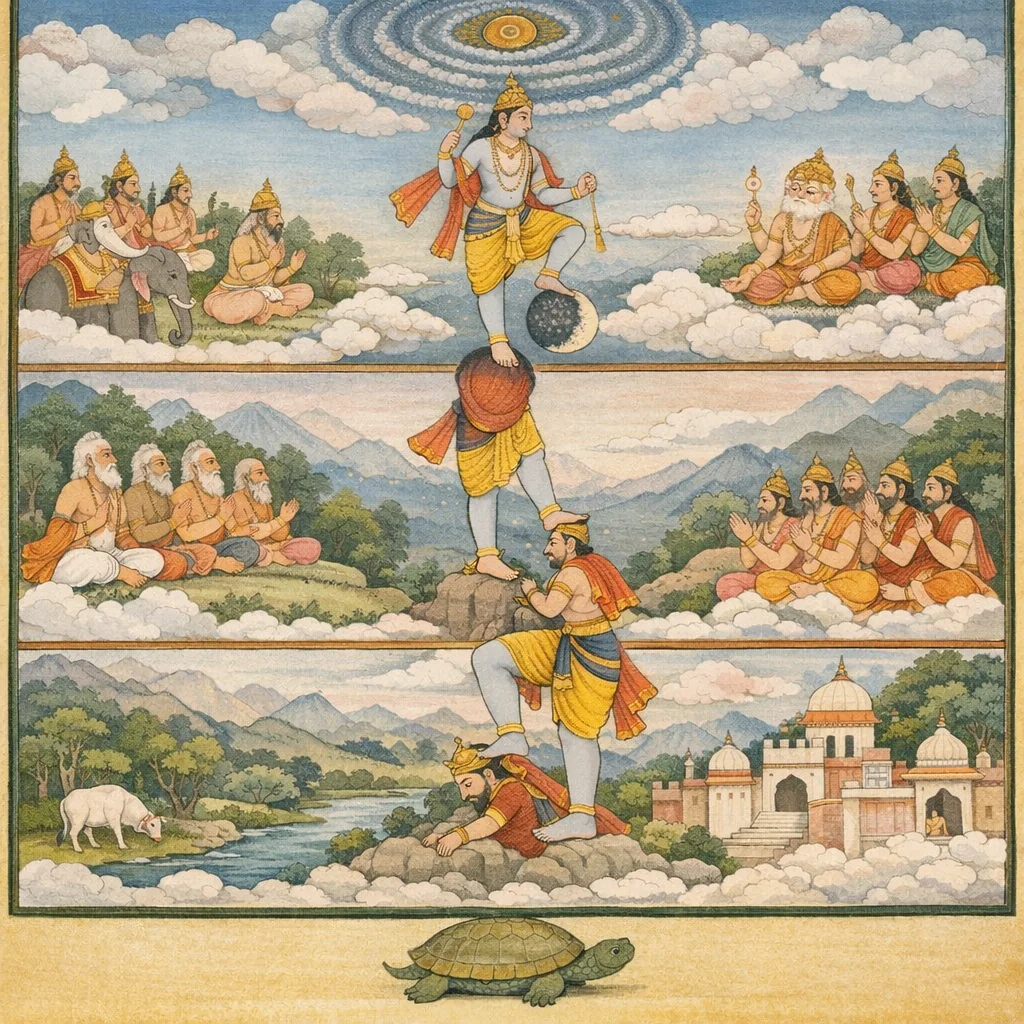
Continuing the Purāṇic account of cosmic governance, the sages ask for a concise description of the past and future manvantaras and of Vyāsa’s manifestations in the Dvāpara age, with special focus on how dharma is upheld in Kali through the branching of the Veda and through avatāras. Sūta lists the first six Manus who have passed and identifies the present as the seventh, the Vaivasvata Manvantara, naming for each manvantara its divine hosts (gaṇas), the Indra of the period, and the seven Saptarṣis. The chapter then turns from administrative cosmology to avatāra theology: in every manvantara the Lord appears as a sustaining portion (aṃśa), culminating in the Vaivasvata manifestation as Vāmana, who reorders sovereignty by granting the three worlds to Indra. From this arises a doctrinal synthesis—Keśava/Nārāyaṇa is creator, preserver, and dissolver, all-pervading, and described in a fourfold mode (Vāsudeva, Saṅkarṣaṇa/Śeṣa as Time, Pradyumna, Aniruddha) that integrates guṇa-based functions. The chapter closes by declaring Kṛṣṇa-Dvaipāyana Vyāsa to be Nārāyaṇa Himself, the singular knower of the beginningless Supreme, thus linking cosmology, Vedic revelation (division of the Veda), and liberating knowledge as the ground for the philosophical teaching to follow.
Shlokas
Verse 1
इति श्रीकूर्मपुराणे षट्साहस्त्र्यां संहितायां पूर्वविभागे अष्टचत्वारिंशो ऽध्यायः ऋषय ऊचुः अतीतानागतानीह यानि मन्वन्तराणि तु / तानि त्वं कथयास्माकं व्यासांश्च द्वापरे युगे
Thus, in the Śrī Kūrma Purāṇa, in the six-thousand-verse Saṃhitā, in the Pūrva-bhāga, the forty-eighth chapter begins. The sages said: “Tell us of the Manvantaras—those that have passed and those yet to come—and also of the manifestations of Vyāsa in the Dvāpara age.”
Verse 2
वेदशाखाप्रणयनं देवदेवस्य धीमतः / तथावतारान् धर्मार्थमीशानस्य कलौ युगे
In the Kali age, the wise Lord of lords, the God of gods, establishes the various branches of the Veda; and likewise He manifests His descents (avatāras) for the sake of upholding dharma.
Verse 3
कियन्तो देवदेवस्य शिष्याः कलियुगेषु वै / एतत् सर्वं समासेन सूत वक्तुमिहार्हसि
How many disciples of the God of gods will there be in the ages of Kali? O Sūta, you should tell all this to us here, briefly and in summary.
Verse 4
सूत उवाच मनुः स्वायंभुवः पूर्वं ततः स्वारोचिषो मनुः / उत्तमस्तामसश्चैव रैवतश्चाक्षुषस्तथा
Sūta said: First was Svāyambhuva Manu; after him came Svārociṣa Manu. Then came Uttama, Tāmasa, Raivata, and likewise Cākṣuṣa (Manu).
Verse 5
षडेते मनवो ऽतीताः सांप्रतं तु रवेः सुतः / वैवस्वतो ऽयं यस्यैतत् सप्तमं वर्तते ऽन्तरम्
These six Manus have already passed; at present, the son of the Sun—Vaivasvata—rules. Under him this is the seventh Manvantara that is now in progress.
Verse 6
स्वायंभुवं तु कथितं कल्पादावन्तरं मया / अत ऊर्ध्वं निबोधध्वं मनोः स्वारोचिषस्य तु
I have already spoken to you of the Svāyambhuva Manvantara that arose at the beginning of the kalpa. Now listen further, as I recount the Manvantara of Manu Svārociṣa.
Verse 7
पारावताश्च तुषिता देवाः स्वारोचिषे ऽन्तरे / विपश्चिन्नाम देवेन्द्रो बभूवासुरसूदनः
In the Svārociṣa Manvantara, the gods were the Pārāvatas and the Tuṣitas; and the lord of the gods was Indra named Vipaścit, slayer of the Asuras.
Verse 8
ऊर्जस्तम्भस्तथा प्राणो दान्तो ऽथ वृषभस्तथा / तिमिरश्चार्वरीवांश्च सप्त सप्तर्षयो ऽभवन्
Ūrjastambha, Prāṇa, Dānta, Vṛṣabha, Timira, and Ārvarīvān—together with one more—became the seven Saptarishis, the Seven Great Sages.
Verse 9
चैत्रकिंपुरुषाद्याश्च सुताः स्वारोचिषस्य तु / द्वितीयमतदाख्यातमन्तरं शृणु चोत्तरम्
Caitra, Kiṃpuruṣa, and others were indeed the sons of Svārociṣa (Manu). Thus having described that second Manvantara, now listen to the next account that follows.
Verse 10
तृतीये ऽप्यन्तरे विप्रा उत्तमो नाम वै मनुः / सुशान्तिस्तत्र देवेन्द्रो बभूवामित्रकर्षणः
O brāhmaṇas, in the third Manvantara as well, the Manu was indeed named Uttama; and in that period Suśānti became Indra, lord of the gods, the subduer of foes.
Verse 11
सुधामानस्तथा सत्याः शिवाश्चाथ प्रतर्दनाः / वशवर्तिनश्च पञ्चैते गणा द्वादशकाः स्मृताः
Likewise, the Sudhāmānas, the Satyas, the Śivas, the Pratardanas, and the Vaśavartins—these five are remembered as gaṇas (divine hosts), each consisting of twelve.
Verse 12
रजोर्ध्वश्चोर्ध्वबाहुश्च सबलश्चानयस्तथा / सुतपाः शुक्र इत्येते सप्त सप्तर्षयो ऽभवन्
Rajōrdhva, Ūrdhvabāhu, Sabala, Anaya, Sutapā, and Śukra—these became the seven great seers (Saptarṣis).
Verse 13
तामसस्यान्तरे देवाः सुरा वाहरयस्तथा / सत्याश्च सुधियश्चैव सप्तविंशतिका गणाः
In the Manvantara of Tāmasa, the divine hosts were the Suras, the Vāharayas, and likewise the Satyas and the Sudhiyas—these constituted a set of twenty-seven gaṇas.
Verse 14
शिबिरिन्द्रस्तथैवासीच्छतयज्ञोपलक्षणः / बभूव शङ्करे भक्तो महादेवार्चने रतः
Likewise, Śibirindra was renowned as the performer of a hundred sacrifices; he became a devoted worshipper of Śaṅkara, constantly engaged in the adoration of Mahādeva.
Verse 15
ज्योतिर्धर्मा पृथुः काव्यश्चैत्रोग्निर्वनकस्तथा / पीवरस्त्वृषयो ह्येते सप्त तत्रापि चान्तरे
Jyotirdharmā, Pṛthu, Kāvya, Caitrogni, Vanaka, and also Pīvara—these are the seven sages who were present there as well in that intervening period (antara).
Verse 16
पञ्चमे चापि विप्रेन्द्रा रैवतो नाम नामतः / मनुर्वसुश्च तत्रेन्द्रो बभूवासुरमर्दनः
O best of brāhmaṇas, in the fifth Manvantara the Manu was named Raivata; and in that age Vasu became Indra, the crusher of the Asuras.
Verse 17
अमिताभा भूतरया वैकुण्ठाः स्वच्छमेधसः / एते देवगणास्तत्र चतुर्दश चतुर्दश
There (in Vaikuṇṭha) are the deva-hosts known as the Amitābhā, the Bhūtarayā, and the Vaikuṇṭhas—pure in intellect. Each of these divine orders is counted in groups of fourteen and fourteen.
Verse 18
हिरण्यरोमा वेदश्रीरूर्ध्वबाहुस्तथैव च / वेदबाहुः सुधामा च पर्जन्यश्च महामुनिः / एते सप्तर्षयो विप्रास्तत्रासन् रैवते ऽन्तरे
Hiraṇyaromā, Vedaśrī, and likewise Ūrdhvabāhu; Vedabāhu, Sudhāmā, and Parjanya—the great sage: these were the seven Ṛṣis, O brāhmaṇas, who dwelt there in the Raivata Manvantara.
Verse 19
स्वारोचिषश्चोत्तमश्च तामसो रैवतस्तथा / प्रियव्रतान्वया ह्येते चत्वारो मनवः स्मृताः
Svārociṣa, Uttama, Tāmasa, and likewise Raivata—these four Manus are remembered as belonging to the lineage of Priyavrata.
Verse 20
षष्ठे मन्वन्तरे चासीच्चाक्षुषस्तु मनुर्द्विजाः / मनोजवस्तथैवेन्द्रो देवानपि निबोधतः
O twice-born sages, in the sixth Manvantara the Manu was Cākṣuṣa; likewise the Indra was Manojava. Now understand also the assembly of gods of that period.
Verse 21
आद्याः प्रसूता भाव्याश्च पृथुगाश्च दिवौकसः / महानुभावा लेख्याश्च पञ्चैते ह्यष्टका गणाः
The Ādyas, the Prasūtas, the Bhāvyas, the Pṛthugas, and the heavenly Divaukas; likewise the Mahānubhāvas and the Lekhyas—these are the principal gaṇas reckoned among the Aṣṭakās, the eightfold divine groups.
Verse 22
सुमेधा विरजाश्चैव हविष्मानुत्तमो मधुः / अतिनामा सहिष्णुश्च सप्तासन्नृषयः शुभाः
Sumedhā, Virajā, Haviṣmān, Uttama, Madhu, Atināmā, and Sahiṣṇu—these seven were auspicious sages.
Verse 23
विवस्वतः सुतो विप्राः श्राद्धदेवो महाद्युतिः / मनुः स वर्तते धीमान् सांप्रतं सप्तमे ऽन्तरे
O brāhmaṇas, the illustrious Śrāddhadeva—son of Vivasvān—is the wise Manu who presides at present in the seventh Manvantara.
Verse 24
आदित्या वसवो रुद्रा देवास्तत्र मरुद्गणाः / पुरन्दरस्तथैवेन्द्रो बभूव परवीरहा
There were the Ādityas, the Vasus, the Rudras, and the companies of the Maruts among the gods; and there too was Indra—Purandara—who became a slayer of the heroes of the opposing side.
Verse 25
वसिष्ठः कश्यपश्चात्रिर्जमदग्निश्च गौतमः / विश्वामित्रो भरद्वाजः सप्त सप्तर्षयो ऽभवन्
Vasiṣṭha, Kaśyapa, Atri, Jamadagni, Gautama, Viśvāmitra, and Bharadvāja—these became the seven great seers, the Saptarṣis.
Verse 26
विष्णुशक्तिरनौपम्या सत्त्वोद्रिक्ता स्थिता स्थितौ / तदंशभूता राजानः सर्वे च त्रिदिवौकसः
The incomparable Śakti of Viṣṇu—abounding in sattva—abides in the state of sustenance. From a portion of that Śakti arise all ruling powers, including all the gods who dwell in the three heavens.
Verse 27
स्वायंभुवे ऽन्तरे पूर्वमाकूत्यां मानसः सुतः / रुचेः प्रजापतेर्यज्ञस्तदंशेनाभवद् द्विजाः
In the earlier Svāyambhuva Manvantara, O twice-born ones, Yajña—born as a mind-born son in Ākūti and belonging to Prajāpati Ruci—manifested as a partial incarnation (aṃśa).
Verse 28
ततः पुनरसौ देवः प्राप्ते स्वारोचिषे ऽन्तरे / तुषितायां समुत्पन्नस्तुषितैः सह दैवतैः
Then again, when the Svarociṣa Manvantara arrived, that very Lord manifested in Tuṣitā, together with the Tuṣita deities.
Verse 29
औत्तमे ऽप्यन्तरे विष्णुः सत्यैः सह सुरोत्तमैः / सत्यायामभवत् सत्यः सत्यरूपो जनार्दनः
In the Auttama Manvantara as well, Viṣṇu—together with the exalted gods called the Satyas—manifested in Satyā, becoming Satya himself: Janārdana, whose very form is Truth.
Verse 30
तामसस्यान्तरे चैव संप्राप्ते पुनरेव हि / हर्यायां हरिभिर्देवैर्हरिरेवाभवद्धरिः
And again, when the Tāmasa Manvantara arrived, in the period called Haryā—amid the gods known as the Haris—Hari Himself once more became manifest as Dhari, the Sustainer.
Verse 31
रैवते ऽप्यन्तरे चैव संभूत्यां मानसो ऽभवत् / संभूतो मानसैः सार्धं देवैः सह महाद्युतिः
In the Raivata Manvantara too, in the cycle presided over by Saṃbhūti, the deity Mānasā came into manifestation; and Saṃbhūta, of great radiance, appeared together with the Mānasas, along with the gods.
Verse 32
चाक्षुषे ऽप्यन्तरे चैव वैकुण्ठः पुरुषोत्तमः / विकुण्ठायामसौ जज्ञे वैकुण्ठैर्दैवतैः सह
In the Cākṣuṣa Manvantara too, Vaikuṇṭha—the Supreme Person, the Highest Lord—was manifested; he was born of Vikuṇṭhā together with the deities known as the Vaikuṇṭhas.
Verse 33
मन्वन्तरे ऽत्र संप्राप्ते तथा वैवस्वते ऽन्तरे / वामनः कश्यपाद् विष्णुरदित्यां संबभूव ह
When this Manvantara arrived—indeed, in the Vaivasvata period—Viṣṇu was born from Kaśyapa in Aditi as Vāmana, the Dwarf incarnation.
Verse 34
त्रिभिः क्रमैरिमांल्लोकाञ्जित्वा येन महात्मना / पुरन्दराय त्रैलोक्यं दत्तं निहतकण्टकम्
That great-souled Lord, having conquered these worlds in three strides, bestowed the three worlds upon Purandara (Indra), with all thorns—hostile obstacles—removed.
Verse 35
इत्येतास्तनवस्तस्य सप्त मन्वन्तरेषु वै / सप्त चैवाभवन् विप्रा याभिः संरक्षिताः प्रजाः
Thus, in the seven Manvantaras, there were indeed seven sustaining forms of Him; and, O Brahmins, there were likewise seven corresponding agencies by which the creatures were preserved and protected.
Verse 36
यस्माद् विष्टमिदं कृत्स्नं वामनेन महात्मना / तस्मात् स वै स्मृतो विष्णुर्विशेर्धातोः प्रवेशनात्
Because the great-souled Vāmana entered into and pervaded this entire universe, therefore He is remembered as “Viṣṇu,” from the verbal root viś (“to enter, to pervade”), on account of that entering.
Verse 37
एष सर्वं सृजत्यादौ पाति हन्ति च केशवः / भूतान्तरात्मा भगवान् नारायण इति श्रुतिः
It is He—Keśava—who in the beginning creates all, who preserves, and who also brings about dissolution. The Śruti declares that this Blessed Lord is Nārāyaṇa, the Inner Self within all beings.
Verse 38
एकांशेन जगत् सर्वं व्याप्य नारायणः स्थितः / चतुर्धा संस्थितो व्यापी सगुणो निर्गुणो ऽपि च
Nārāyaṇa abides, pervading the entire universe by a single portion of Himself. The all-pervading Lord is established in a fourfold mode—both with attributes (saguṇa) and also without attributes (nirguṇa).
Verse 39
एका भगवतो मूर्तिर्ज्ञानरूपा शिवामला / वासुदेवाभिधाना सा गुणातीता सुनिष्कला
There is one form of the Blessed Lord—made of pure knowledge, auspicious and stainless. That form is called Vāsudeva; it transcends the guṇas and is perfectly partless, without division.
Verse 40
द्वितीया कालसंज्ञान्या तामसी शेषसंज्ञिता / निहन्ति सकलं चान्ते वैष्णवी परमा तनुः
The second power, known as Time, is tāmasic in nature and is also called Śeṣa. At the end of the age, the supreme Vaiṣṇavī form destroys the entire universe.
Verse 41
सत्त्वोद्रिक्ता तथैवान्या प्रद्युम्नेति च संज्ञिता / जगत् स्थापयते सर्वं स विष्णुः प्रकृतिर्ध्रुवा
Another power of Prakṛti, in which sattva predominates, is indeed called Pradyumna. By that steadfast nature, Viṣṇu establishes and upholds the whole universe—He is the stable, enduring Prakṛti.
Verse 42
चतुर्थो वासुदेवस्य मूर्तिर्ब्राह्मीति संज्ञिता / राजसी चानिरुद्धाख्या प्रद्युम्नः सृष्टिकारिका
The fourth manifestation of Vāsudeva is known as the “Brāhmī” form. That rājasa potency is called Aniruddha; and Pradyumna is the operative cause that sets creation in motion.
Verse 43
यः स्वपित्यखिलं भूत्वा प्रद्युम्नेन सह प्रभुः / नारायणाख्यो ब्रह्मासौ प्रिजासर्गं करोति सः
That Lord who, becoming the very Self and Father of all, together with Pradyumna, is known as Nārāyaṇa—He indeed is Brahmā, and He brings forth the creation of beings, the progeny-creation.
Verse 44
या सा नारायणतनुः प्रद्युम्नाख्या मुनीश्वराः / तया संमोहयेद् विश्वं सदेवासुरमानुषम्
O best of sages, that form of Nārāyaṇa known as Pradyumna—by that very power He bewilders the entire universe, including the gods, the asuras, and human beings.
Verse 45
सैव सर्वजगत्सूतिः प्रकृतिः परिकीर्तिता / वासुदेवो ह्यनन्तात्मा केवलो निर्गुणो हरिः
She alone is proclaimed as Prakṛti, the generative source of the entire universe; and Vāsudeva—whose Self is infinite—is Hari alone: the pure, attribute-less (nirguṇa) Supreme.
Verse 46
प्रधानं पुरुषः कालस्तत्त्वत्रयमनुत्तमम् / वासुदेवात्मकं नित्यमेतद् विज्ञाय मुच्यते
Pradhāna (primordial Nature), Puruṣa (the conscious Self), and Time—this unsurpassed triad of principles—is eternally of the very nature of Vāsudeva. Knowing this, one is liberated.
Verse 47
एकं चेदं चतुष्पादं चतुर्धा पुनरच्युतः / बिभेद वासुदेवो ऽसौ प्रद्युम्नो हरिरव्ययः
This single Veda, though four-footed in its structure, was again divided into four parts by the infallible Lord—Vāsudeva Himself, Pradyumna, Hari, the imperishable One.
Verse 48
कृष्णद्वैपायनो व्यासो विष्णुर्नारायणः स्वयम् / अपान्तरतमाः पूर्वं स्वेच्छया ह्यभवद्धरिः
Kṛṣṇa-Dvaipāyana Vyāsa is verily Viṣṇu—Nārāyaṇa Himself. Formerly he was Apāntaratamā; and by His own free will Hari became manifest as him.
Verse 49
अनाद्यन्तं परं ब्रह्म न देवा नर्षयो विदुः / एको ऽयं वेद भगवान् व्यासो नारायणः प्रभुः
The Supreme Brahman—without beginning or end—is not known in its fullness even by the gods or the seers. Only this one knows it: the Blessed Lord Vyāsa, who is Nārāyaṇa Himself, the sovereign Master.
Verse 50
इत्येतद् विष्णुमाहात्म्यमुक्तं वो मुनिपुङ्गवाः / एतत् सत्यं पुनः सत्यमेवं ज्ञात्वा न मुह्यति
Thus, O foremost of sages, the greatness of Viṣṇu has been declared to you. This is truth—truth indeed; knowing it in this way, one is no longer deluded.
Frequently Asked Questions
It presents a repeatable schema for each manvantara—Manu, the period’s Indra, the principal deva-gaṇas, and the seven Saptarṣis—then anchors the schema in theology by naming the Lord’s sustaining manifestation for each cycle.
The chapter frames ultimate reality as Vāsudeva/Nārāyaṇa, with Pradhāna (Prakṛti), Puruṣa, and Kāla as an eternal triad of principles ‘of the nature of Vāsudeva’; liberation is tied to knowing this hierarchy, where functional powers operate without compromising the Lord’s transcendence.
Because Veda-preservation and right knowledge are treated as divine interventions: Vyāsa is portrayed as a deliberate manifestation (formerly Apāntaratamā) through whom Nārāyaṇa divides and transmits the one Veda for Kali-yuga continuity.