Adhyaya 50
Lineage of Vyāsas, Division of the Veda, and Vāsudeva/Īśāna as the Veda-Known Supreme
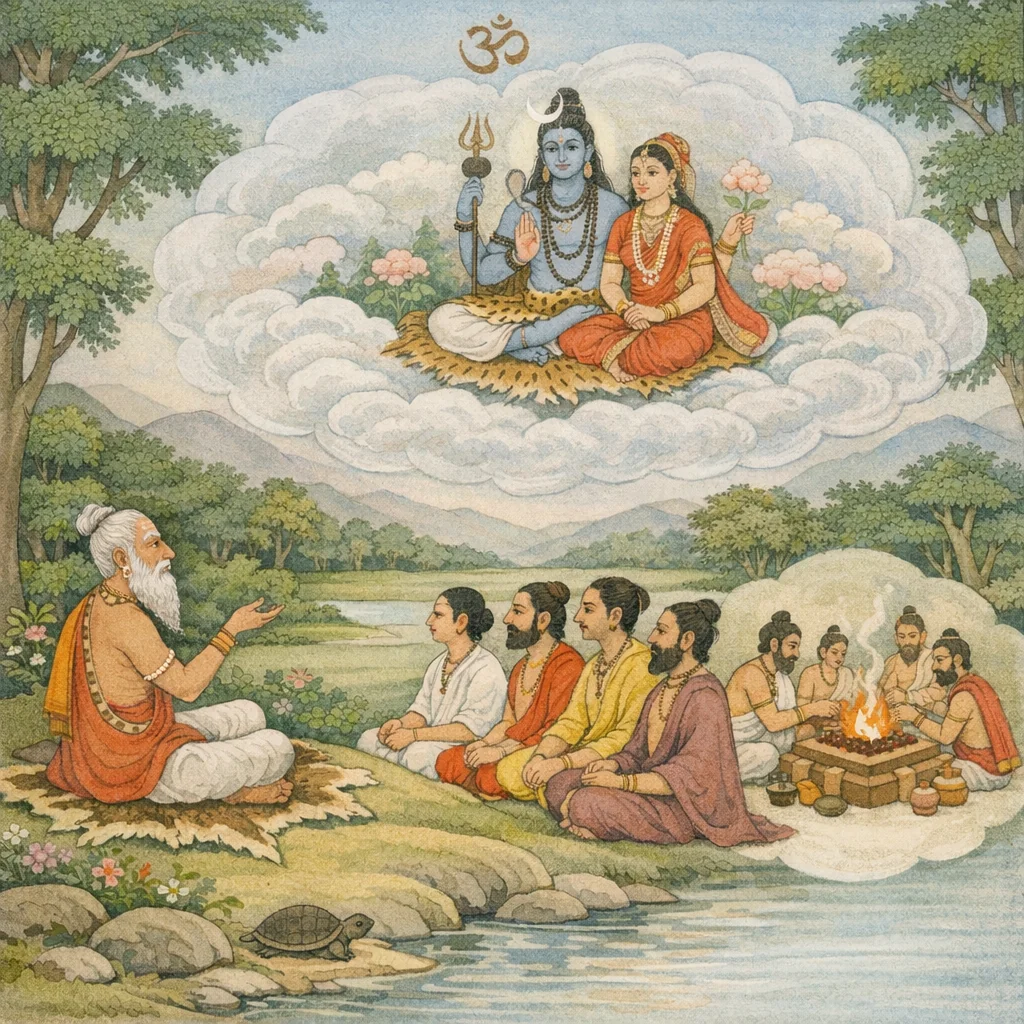
Sūta continues the Purāṇic account of how dharma and Vedic revelation are preserved through time, recalling earlier arrangements of the Veda in successive manvantaras and Dvāpara cycles and listing the line of Vyāsas culminating in Kṛṣṇa Dvaipāyana, son of Parāśara. Vyāsa’s authority rests not only on lineage but on grace: after worshipping Īśāna and beholding Sāmba (Śiva), he becomes the arranger and divider of the Vedas. The chapter then describes the instructional distribution—Paila (Ṛg), Vaiśampāyana (Yajur), Jaimini (Sāma), Sumantu (Atharva), and Sūta for Itihāsa–Purāṇa—followed by the ritual rationale of the cāturhotra priesthood. It closes with a metaphysical climax: Oṁkāra arises from Brahman, Vāsudeva is the Supreme taught by the Vedas, and Mahādeva is Veda-formed, expressing the Kurma Purāṇa’s Hari–Hara harmony and preparing the move from lineage and ritual into deeper Vedāntic knowing beyond mere recitation.
Shlokas
Verse 1
इति श्रीकूर्मपुराणे षट्साहस्त्र्यां संहितायां पूर्वविभागे एकोनपञ्चाशो ऽध्यायः सूत उवाच अस्मिन् मन्वन्तरे पूर्वं वर्तमाने महान् विभुः / द्वापरे प्रथमे व्यासो मनुः स्वायंभुवो मतः
Thus, in the Śrī Kūrma Purāṇa, in the six-thousand-verse Saṃhitā, in the Pūrva-bhāga, begins the forty-ninth chapter. Sūta said: “Formerly, in this present Manvantara, the great all-pervading Lord established the sacred succession; and in the first Dvāpara age, the Vyāsa is held to be Svāyambhuva Manu.”
Verse 2
बिभेद बहुधा वेदं नियोगाद् ब्रह्मणः प्रभोः / द्वितीये द्वापरे चैव वेदव्यासः प्रजापतिः
By the command of the Lord Brahmā, he divided the single Veda into many portions. And in the second Dvāpara age, the Prajāpati known as Vedavyāsa carried out that division.
Verse 3
तृतीये चोशना व्यासश्चतुर्थे स्याद् बृहस्पतिः / सविता पञ्चमे व्यासः षष्ठे मृत्युः प्रकीर्तितः
In the third, Uśanā is declared to be the Vyāsa; in the fourth, Bṛhaspati is said (to be the Vyāsa). In the fifth, Savitṛ is the Vyāsa; and in the sixth, Mṛtyu is proclaimed (as the Vyāsa).
Verse 4
सप्तमे च तथैवेन्द्रो वसिष्ठश्चाष्टमे मतः / सारस्वतश्च नवमे त्रिधामा दशमे स्मृतः
In the seventh, Indra is likewise (so named). In the eighth, Vasiṣṭha is regarded (as Indra). In the ninth, (the Indra) is Sārasvata; and in the tenth, he is remembered as Tridhāman.
Verse 5
एकादशे तु त्रिवृषः शततेजास्ततः परः / त्रयोदशे तथा धर्मस्तरक्षुस्तु चतुर्दशे
In the eleventh cycle is Trivṛṣa; after him is Śata-tejas. In the thirteenth cycle is Dharma, and in the fourteenth is Tarakṣu.
Verse 6
त्र्यारुणिर्वै पञ्चदशे षोडशे तु धनञ्जयः / कृतञ्जयः सप्तदशे ह्यष्टादशे ऋतञ्जयः
Indeed, in the fifteenth cycle is Tryāruṇi; in the sixteenth, Dhanañjaya. In the seventeenth is Kṛtañjaya, and in the eighteenth, Ṛtañjaya.
Verse 7
ततो व्यासो भरद्वाजस्तस्मादूर्ध्वं तु गौतमः / राजश्रवाश्चैकविंशस्तस्माच्छुष्मायणः परः
From him came Vyāsa, and from Vyāsa came Bharadvāja. From Bharadvāja, in the succeeding line, arose Gautama. From Gautama came Rājaśravā, the twenty-first in that succession; and after him was Chuṣmāyaṇa.
Verse 8
तृणबिन्दुस्त्रयोविंशे वाल्मीकिस्तत्परः स्मृतः / पञ्चविशे तथा शक्तिः षड्विंशे तु पराशरः
In the twenty-third generation was Tṛṇabindu; after him, Vālmīki is remembered. In the twenty-fifth likewise was Śakti, and in the twenty-sixth, Parāśara.
Verse 9
सप्तविंशे तथा व्यासो जातूकर्णो महामुनिः / अष्टाविंशे पुनः प्राप्ते ह्यस्मिन् वै द्वापरे द्विजाः / पराशरसुतो व्यासः कृष्णद्वैपायनो ऽभवत्
In the twenty-seventh Dvāpara, the great sage Jātūkarṇa became the Vyāsa. And now, in this twenty-eighth Dvāpara, O twice-born sages, Vyāsa is the son of Parāśara—Kṛṣṇa Dvaipāyana.
Verse 10
स एव सर्ववेदानां पुराणानां प्रदर्शकः / पाराशर्यो महायोगी कृष्णद्वैपायनो हरिः
He alone is the revealer and expounder of all the Vedas and the Purāṇas—Parāśara’s son, the great yogin, Kṛṣṇa Dvaipāyana (Vyāsa), who is Hari himself.
Verse 11
आराध्य देवमीशानं दृष्ट्वा साम्बं त्रिलोचनम् / तत्प्रसादादसौ व्यासं वेदानामकरोत् प्रभुः
Having worshipped the Lord Īśāna and beholding Sāmba—Śiva, the Three‑eyed One—by His grace that mighty one became Vyāsa, the arranger of the Vedas.
Verse 12
अथ शिष्यान् प्रिजग्राह चतुरो वेदपारगान् / जैमिनिं च सुमन्तुं च वैशम्पायनमेव च / पैलं तेषां चतुर्थं च पञ्चमं मां महामुनिः
Then the great sage accepted five disciples—masters of Vedic learning: Jaimini, Sumantu, and Vaiśampāyana; Paila as the fourth among them; and as the fifth, he accepted me.
Verse 13
ऋग्वेदश्रावकं पैलं जग्राह स महामुनिः / यजुर्वेदप्रवक्तारं वैशम्पायनमेव च
That great sage accepted Paila as the reciter and transmitter of the Ṛgveda, and likewise Vaiśampāyana as the teacher and expounder of the Yajurveda.
Verse 14
जैमिनिं सामवेदस्य श्रावकं सोन्वपद्यत / तथैवाथर्ववेदस्य सुमन्तुमृषिसत्तमम् / इतिहासपुराणानि प्रवक्तुं मामयोजयत्
He appointed Jaimini as the reciter and transmitter of the Sāma Veda; likewise, for the Atharva Veda he appointed the excellent sage Sumantu. And he commissioned me to expound the Itihāsas and the Purāṇas.
Verse 15
एक आसीद्यजुर्वेदस्तं चतुर्धा व्यकल्पयत् / चातुर्हेत्रमभूद् यस्मिंस्तेन यज्ञमथाकरोत्
The Yajurveda was once a single corpus; then it was arranged into four divisions. From that arrangement arose the fourfold priestly system (cāturhotra), and by means of it the sacrificial rite (yajña) was duly performed.
Verse 16
आध्वर्यवं यजुर्भिः स्यादृग्भिर्हेत्रं द्विजोत्तमाः / औद्गात्रं सामभिश्चक्रे ब्रह्मत्वं चाप्यथर्वभिः
O best of the twice-born, the office of the Adhvaryu is carried out through the Yajur‑Veda; the Hotṛ’s function through the Ṛg‑Veda; the Udgātṛ’s through the Sāma‑Veda; and the Brahman‑priesthood likewise through the Atharva‑Veda.
Verse 17
ततः स ऋच उद्धृत्य ऋग्वेदं कृतवान् प्रभुः / यजूंषि च यजुर्वेदं सामवेदं च सामभिः
Thereafter, the Lord drew forth the Ṛc‑verses and thus composed the Ṛg‑Veda; likewise, from the Yajus formulas He formed the Yajur‑Veda, and from the Sāman chants He fashioned the Sāma‑Veda.
Verse 18
एकविंशतिभेदेन ऋग्वेदं कृतवान् पुरा / शाखानां तु शतेनैव यजुर्वेदमथाकरोत्
In ancient times He arranged the Ṛg‑Veda into twenty‑one divisions; and then He organized the Yajur‑Veda as well into a full hundred branches (śākhās).
Verse 19
सामवेदं सहस्त्रेण शाखानां प्रबिभेद सः / अथर्वाणमथो वेदं बिभेद नवकेन तु
He subdivided the Sāma‑Veda into a thousand branches (śākhās); and likewise He divided the Atharva‑Veda into nine branches.
Verse 20
भेदैरष्टादशैर्व्यासः पुराणं कृतवान् प्रभुः / सो ऽयमेकश्चतुष्पादो वेदः पूर्वं पुरातनात्
Through eighteen divisions, the venerable Vyāsa composed the Purāṇa. This teaching was formerly one Veda with four “feet,” handed down from the most ancient antiquity.
Verse 21
ओङ्कारो ब्रह्मणो जातः सर्वदोषविशोधनः / वेदवेद्यो हि भगवान् वासुदेवः सनातनः
Oṁkāra is born from Brahman and purifies all faults. Truly, the Blessed Lord Vāsudeva—eternal—is the One to be known through the Vedas.
Verse 22
स गीयते परो वेदे यो वेदैनं स वेदवित् / एतत् परतरं ब्रह्म ज्योतिरानन्दमुत्तमम्
He is sung of in the Veda as the Supreme. Whoever truly knows Him is a knower of the Veda. This is the Brahman beyond all—the highest Light and the unsurpassed Bliss.
Verse 23
वेदवाक्योदितं तत्त्वं वासुदेवः परं पदम् / वेदवेद्यमिमं वेत्ति वेदं वेदपरो मुनिः
The reality proclaimed by the Vedic utterances is this: Vāsudeva is the supreme state, the highest abode. The sage devoted to the Veda truly knows this Veda-taught truth—Vāsudeva, the One to be known through the Veda.
Verse 24
अवेदं परमं वेत्ति वेदनिष्ठः सदेश्वरः / स वेदवेद्यो भगवान् वेदमूर्तिर्महेश्वरः / स एव वेदो वेद्यश्च तमेवाश्रित्य मुच्यते
He who is steadfast in the Veda and devoted to the Lord comes to know the Supreme beyond mere recitation. That Blessed One—Mahādeva, Mahēśvara, whose very form is the Veda—is knowable through the Veda. He alone is both the Veda and what is to be known; taking refuge in Him alone, one is liberated.
Verse 25
इत्येदक्षरं वेद्यमोङ्कारं वेदमव्ययम् / अवेदं च विजानाति पाराशर्यो महामुनिः
Thus the great sage Pārāśarya understands that the knowable Imperishable is Oṁkāra—the Veda itself, undecaying—and he also knows what is called “not-Veda”, that which lies outside true Vedic knowing.
Frequently Asked Questions
It presents a cyclical model: in successive manvantaras and Dvāpara ages, different Vyāsas arise to re-arrange the one Veda into teachable divisions and lineages, culminating here in Kṛṣṇa Dvaipāyana as the current Vyāsa.
It articulates samanvaya: Vāsudeva is affirmed as the Supreme taught by the Vedas, while Mahādeva/Īśāna is described as Veda-form and knowable through the Veda—presented as complementary expressions of the same highest reality rather than competing sectarian claims.
Oṁkāra is said to arise from Brahman and purify faults; true Vedic knowing culminates in realizing the Supreme (Vāsudeva), and taking refuge in the Lord—who is both the Veda and the object of knowledge—leads beyond mere recitation to mokṣa.