Adhyaya 48
Puṣkara-dvīpa, Lokāloka, and the Measure of the Brahmāṇḍa (Cosmic Egg)
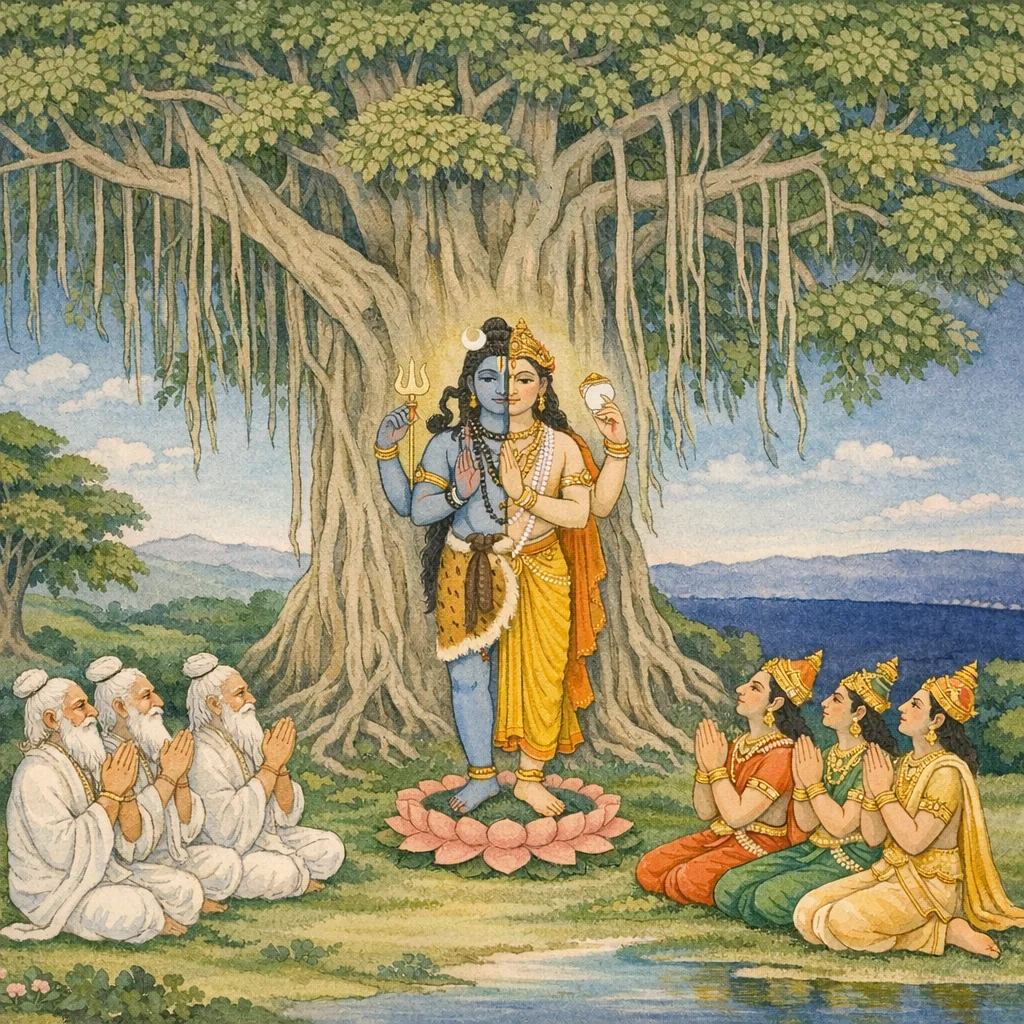
The chapter continues the Purāṇic sequence of continents and oceans, completing the world-system’s horizontal layout by describing Puṣkara-dvīpa—twice the size of Śāka-dvīpa—encircled by an ocean of sweet water. It introduces Manasottara as the single circular ring-mountain and notes the continent’s internal naming and division (the Mānasya region and the district around the mountain; Mahāvīta/Dhātakīkhaṇḍa). The account then turns from geography to theology: a mighty nyagrodha stands as a worship-worthy axis; Brahmā’s presence is affirmed along with the abodes of Śiva and Nārāyaṇa, culminating in Hari-Hara (half Hara, half Hari) revered by gods and yogic sages. Beyond Puṣkara it speaks of the golden boundary-land and the Lokāloka mountain, the limit between the luminous world and the surrounding darkness. Finally it expands into brahmāṇḍa doctrine: countless cosmic eggs arise from imperishable Pradhāna/Prakṛti, each containing the fourteen worlds and their presiding deities. Thus a cosmographic unit closes and the text moves toward deeper metaphysics—Avyakta as Brahman and the Supreme’s all-pervasion—preparing the next discourse to treat cosmology as contemplative knowledge, not mere description.
Shlokas
Verse 1
इति श्रीकूर्मपुराणे षट्साह्स्त्र्यां संहितायां पूर्वविभागे सप्तचत्वारिंशोध्यायः सूत उवाच शाकद्वीपस्य विस्ताराद् द्विगुणेन व्यवस्थितः / क्षीरार्णवं समाश्रित्य द्वीपः पुष्करसंवृतः
Thus, in the Śrī Kūrma Purāṇa, in the six-thousand-verse Saṃhitā, in the Pūrva-bhāga—Sūta said: Pushkara-dvīpa is arranged as twice the extent of Śāka-dvīpa; resting upon the Ocean of Milk, the island-continent is encircled by the lotus-like Pushkara region.
Verse 2
एक एवात्र विप्रेन्द्राः पर्वतो मानसोत्तरः / योजनानां सहस्त्राणि सार्धं पञ्चाशदुच्छ्रितः / तावदेव च विस्तीर्णः सर्वतः परिमण्डलः
O best of brahmins, here there is a single mountain called Manasottara. It rises to one thousand and fifty yojanas in height, and it is of the same measure in breadth; it forms a perfectly circular ring on all sides.
Verse 3
स एव द्वीपः पश्चार्धे मानसोत्तरसंज्ञितः / एक एव महासानुः संनिवेशाद् द्विधा कृतः
That very continent, in its western half, is known as Mānasottara. Though it is one single great ridge, by its very arrangement it is described as being divided into two.
Verse 4
तस्मिन् द्वीपे स्मृतौ द्वौ तु पुण्यौ जनपदौ शुभौ / अपरौ मानसस्याथ पर्वतस्यानुमण्डलौ / महावीतं स्मृतं वर्षं धातकीखण्डमेव च
In that dvīpa, two auspicious and meritorious regions are remembered: one is called Mānasya, and the other is the district encircling the mountain. There, the varṣa is known as Mahāvīta, and also as Dhātakīkhaṇḍa.
Verse 5
स्वादूदकेनोदधिना पुष्करः परिवारितः / तस्मिन् द्वीपे महावृक्षो न्यग्रोधो ऽमरपूजितः
Encircled by the ocean of sweet water lies Puṣkara. Upon that island stands a mighty nyagrodha (banyan), revered and worshipped even by the immortal devas.
Verse 6
तस्मिन् निवसति ब्रह्मा विश्वात्मा विश्वभावनः / तत्रैव मुनिशार्दूलाः शिवनारायणालयः
In that very place dwells Brahmā—the Soul of the universe and the sustainer who brings forth the worlds. There itself, O tiger-like sages, is the abode of Śiva and Nārāyaṇa.
Verse 7
वसत्यत्र महादेवो हरोर्ऽद्धहरिरव्ययः / संपूज्यमानो ब्रह्माद्यैः कुमाराद्यैश्च योगिभिः / गन्धर्वैः किन्नरैर्यक्षैरीश्वरः कृष्णपिङ्गलः
Here abides Mahādeva—the imperishable Lord who is half Hara and half Hari—reverently worshipped by Brahmā and the other gods, by Sanatkumāra and the Yoga-devoted sages, and also by Gandharvas, Kinnaras, and Yakṣas: Īśvara of dark and tawny hue.
Verse 8
स्वस्थास्तत्र प्रजाः सर्वा ब्रह्मणा सदृशत्विषः / निरामया विशोकाश्च रागद्वेषविवर्जिताः
There, all the people are well-established in health and wholeness, radiant like Brahmā; free from disease and sorrow, and devoid of attachment and aversion.
Verse 9
सत्यानृते न तत्रास्तां नोत्तमाधममध्यमाः / न वर्णाश्रमधर्माश्च न नद्यो न च पर्वताः
There, neither truth nor falsehood obtains; nor are there distinctions of superior, inferior, or middling. There too are no duties of varṇa and āśrama—no rivers and no mountains.
Verse 10
परेण पुष्करस्याथ स्थितो महान् / स्वादूदकसमुद्रस्तु समन्ताद् द्विजसत्तमाः
To the west of Puṣkara lies the great Ocean of Sweet Water, encircling that region on every side, O best among the twice-born.
Verse 11
परेण तस्य महती दृश्यते लोकसंस्थितिः / काञ्चनी द्विगुणा भूमिः सर्वा चैव शिलोपमा
Beyond that, a vast ordering of worlds is beheld. There lies a golden land, twice as extensive, and everywhere it is like solid rock.
Verse 12
तस्याः परेण शैलस्तु मर्यादात्मात्ममण्डलः / प्रकाशश्चाप्रकाशश्च लोकालोकः स उच्यते
Beyond that region stands a mountain whose very nature is a boundary encircling the sphere of the Self (Ātman). It is both luminous and non-luminous; therefore it is called Lokāloka, the divider of world and non-world, of light and darkness.
Verse 13
योजनानां सहस्त्राणि दश तस्योच्छ्रयः स्मृतः / तावानेव च विस्तारो लोकालोको महागिरिः
The great mountain Lokāloka is said to rise to a height of ten thousand yojanas, and its breadth is of exactly the same extent.
Verse 14
समावृत्य तु तं शैलं सर्वतो वै तमः स्थितम् / तमश्चाण्डकटाहेन समन्तात् परिवेष्टितम्
But when that mountain was covered over, darkness stood on every side; and that darkness, like a vast cauldron, surrounded it completely all around.
Verse 15
एतै सप्त महालोकाः पातालाः सप्तकीर्तिताः / ब्रह्माण्डस्यैष विस्तारः संक्षेपेण मयोदितः
Thus the seven great worlds and the seven nether realms (Pātālas) have been declared. This, in brief, is the extent and ordering of the Brahmāṇḍa—the Cosmic Egg—as I have spoken.
Verse 16
अण्डानामीदृशानां तु कोट्यो ज्ञेयाः सहस्त्रशः / सर्वगत्वात् प्रधानस्य कारणस्याव्ययात्मनः
Know that there are millions—indeed thousands upon thousands—of such Brahmāṇḍas; for Pradhāna, the primal cause, imperishable in its very nature, is all-pervading.
Verse 17
अण्डेष्वेतेषु सर्वेषु भुवनानि चतुर्दश / तत्र तत्र चतुर्वक्त्रा रुद्रा नारायणादयः
Within all these Brahmāṇḍas are the fourteen worlds (bhuvanas); and in each of them dwell four-faced Brahmā, Rudra, Nārāyaṇa, and the other divine powers.
Verse 18
दशोत्तरमथैकैकमण्डावरणसप्तकम् / समन्तात् संस्थितं विप्रा यत्र यान्ति मनीषिणः
And then, O brāhmins, there are seventeen sets of seven concentric enclosures (maṇḍala-āvaraṇas), established all around on every side—toward which the wise proceed in contemplation and sacred journey.
Verse 19
अनन्तमेकमव्यक्तनादिनिधनं महत् / अतीत्य वर्तते सर्वं जगत् प्रकृतिरक्षरम्
This imperishable Prakṛti is infinite, one, unmanifest, and great—without beginning and without end. It transcends, and yet pervades, the whole world; the entire universe abides beyond it and also through it.
Verse 20
अनन्तत्वमनन्तस्य यतः संख्या न विद्यते / तदव्यक्तमिति ज्ञेयं तद् ब्रह्म परमं पदम्
Because the Infinite is endless in nature—there being no number or measure for It—know That as the Unmanifest (Avyakta). That is Brahman, the Supreme Abode.
Verse 21
अनन्त एष सर्वत्र सर्वस्थानेषु पठ्यते / तस्य पूर्वं मयाप्युक्तं यत्तन्माहात्म्यमव्ययम्
This teaching/hymn of Ananta is recited everywhere, in all places. Its imperishable greatness (māhātmya) has also been declared by me earlier.
Verse 22
गतः स एष सर्वत्र सर्वस्थानेषु वर्तते / भूमौ रसातले चैव आकाशे पवने ऽनले / अर्णवेषु च सर्वेषु दिवि चैव न सशयः
Having gone forth as the all-pervading principle, He indeed abides everywhere, in all places—on the earth and in Rasātala (the netherworld), in space, in wind and in fire, in all oceans, and in heaven as well—of this there is no doubt.
Verse 23
तथा तमसि सत्त्वे च एष एव महाद्युतिः / अनेकधा विभक्ताङ्गः क्रीडते पुरुषोत्तमः
Likewise, within tamas and within sattva, this very One—of great radiance—appears. Dividing His limbs in many ways, the Supreme Person (Puruṣottama) sports (līlā), manifesting the cosmos as His play.
Verse 24
महेश्वरः परो ऽव्यक्तादण्डमव्यक्तसंभवम् / अण्डाद् ब्रह्मा समुत्पन्नस्तेन सृष्टमिदं जगत्
Mahēśvara, the Supreme Lord, brought forth the cosmic Egg, born of the Unmanifest (Avyakta). From that Egg arose Brahmā; and by him this entire universe was created.
Frequently Asked Questions
Lokāloka is the boundary-mountain encircling the cosmic sphere, described as both luminous and non-luminous because it divides the realm where light (loka) is present from the surrounding darkness (aloka).
By presenting Avyakta (the Unmanifest) as immeasurable, beginningless, and the Supreme Abode, the chapter implies that all manifest worlds—including jīvas within countless brahmāṇḍas—are pervaded and grounded in Brahman, to be realized through contemplative discernment beyond mere cosmographic measure.