Adhyaya 46
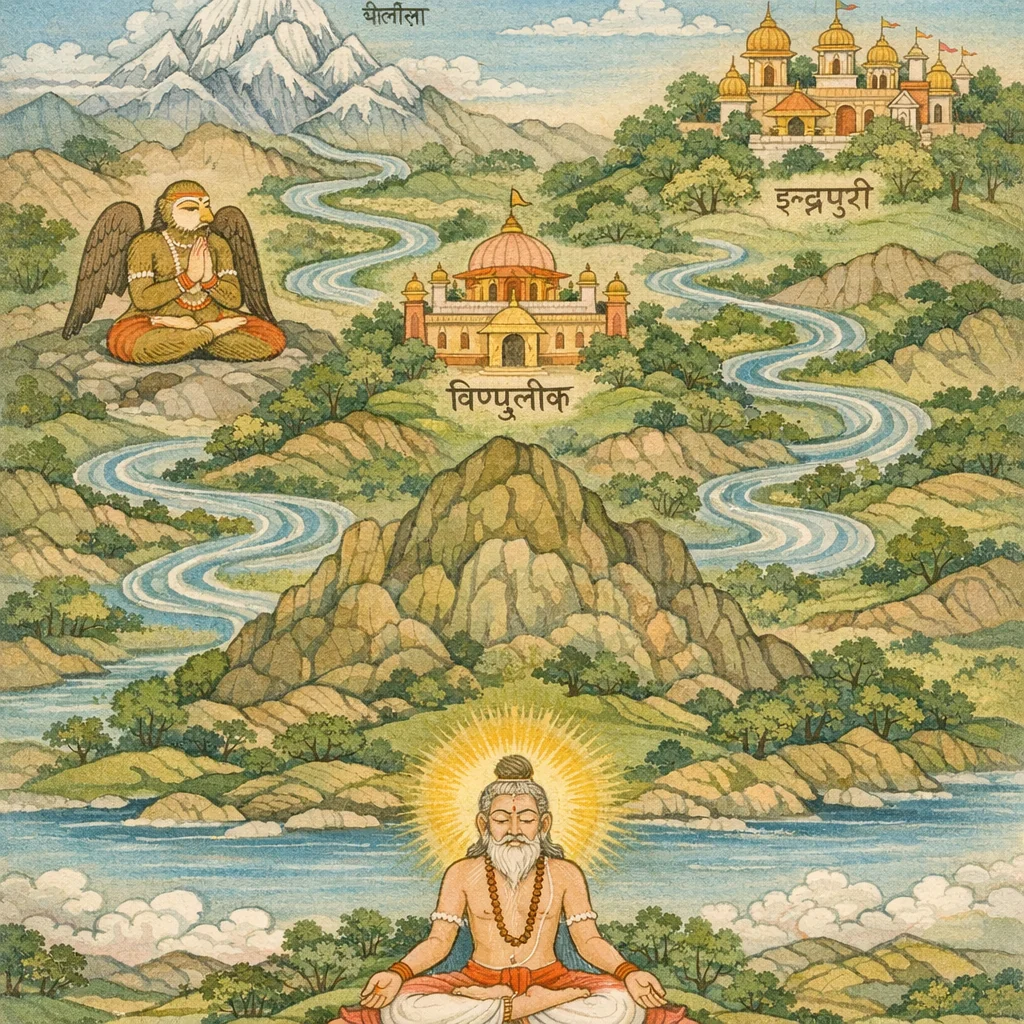
Divine Abodes on the Mountains — A Sacred Survey of Jambūdvīpa (Kailāsa to Siddha Realms)
Continuing the Purāṇic cosmography, Sūta portrays a sublime mountain region of Jambūdvīpa as a living sacred landscape inhabited by gods, siddhas, yakṣas, gandharvas, and great yogins. It opens with crystal-like aerial palaces and daily worship of Bhūteśa/Śiva, then turns to Kailāsa and the Mandākinī, praising rivers and lotus-filled waters as sources of purity and merit. A sequence of divine and semi-divine abodes follows: Viṣṇu with Lakṣmī, Indra with Śacī, Brahmā with Sāvitrī, Durgā as Maheśvarī, Garuḍa absorbed in meditation on Viṣṇu, and the cities of Vidyādharas, Gandharvas, Apsarases, Yakṣas, and Rākṣasas. Yogic hermitages—especially Jaigīṣavya and his disciples—anchor the terrain in inner discipline, explicitly teaching meditation on Īśāna at the crown of the head. The chapter ends by acknowledging the innumerable siddha-liṅgas and āśramas, summarizing Jambūdvīpa’s vastness and preparing for further cosmographic or doctrinal elaboration beyond what can be fully enumerated.
Shlokas
Verse 1
इति श्रीकूर्मपुराणे षट्साहस्त्र्यां संहितायां पूर्वविभागे पञ्चचत्वारिंशो ऽध्यायः सूत उवाच हेमकूटगिरेः शृङ्गे महाकूटैः सुशोभनम् / स्फाटिकं देवदेवस्य विमानं परमेष्ठिनः
Thus, in the Śrī Kūrma Purāṇa—within the six-thousand-verse Saṃhitā, in the Pūrva-bhāga—(begins) the forty-sixth chapter. Sūta said: On the peak of Mount Hemakūṭa, splendid with mighty summits, there stood a crystal (sphāṭika) aerial palace (vimāna) of the God of gods, the Supreme Lord.
Verse 2
अथ देवादिदेवस्य भूतेशस्य त्रिशूलिनः / देवाः सिद्धगणा यक्षाः पूजां नित्यं प्रकुर्वते
Then, the gods, the hosts of Siddhas, and the Yakṣas continually perform daily worship of the God of gods—Bhūteśa, the Trident-bearer.
Verse 3
स देवो गिरिशः सार्धं महादेव्या महेश्वरः / भूतैः परिवृतो नित्यं भाति तत्र पिनाकधृक्
There, that divine Lord of the mountains—Girīśa, Mahādeva, the great sovereign Mahēśvara—shines eternally together with Mahādevī, surrounded by the hosts of beings, bearing the bow Pināka.
Verse 4
विभक्तचारुशिखरः कैलासो यत्र पर्वतः / निवासः कोटियक्षाणां कुबेरस्य च धीमतः / तत्रापि देवदेवस्य भवस्यायतनं महत्
There stands Mount Kailāsa, its lovely peaks rising in distinct ridges—the dwelling of crores of Yakṣas and of the wise Kubera. There too is the vast sanctuary of Bhava (Śiva), the God of gods.
Verse 5
मन्दाकिनी तत्र दिव्या रम्या सुविमलोदका / नदी नानाविधैः पद्मैरनेकैः समलङ्कृता
There flows the Mandākinī—divine and delightful—whose waters are exceedingly pure. That river is beautifully adorned with many lotuses of diverse kinds.
Verse 6
देवदानवगन्धर्वयक्षराक्षसकिंनरैः / उपस्पृष्टजला नित्यं सुपुण्या सुमनोरमा
Its waters are ever touched (and hallowed) by gods, dānavas, gandharvas, yakṣas, rākṣasas, and kiṃnaras; thus it is perpetually most meritorious and exceedingly delightful to behold.
Verse 7
अन्याश्च नद्यः शतशः स्वर्णपद्मैरलङ्कृताः / तासां कूलेषु देवस्य स्थानानि परमेष्ठिनः / देवर्षिगणजुष्टानि तथा नारायणस्य च
And there are hundreds of other rivers, adorned with golden lotuses. Upon their banks are the sacred abodes of the Lord—the Supreme Creator (Parameṣṭhin)—frequented by hosts of divine seers; and likewise there are sanctuaries of Nārāyaṇa as well.
Verse 8
सितान्तशिखरे चापि पारिजातवनं शुभम् / तत्र शक्रस्य विपुलं भवनं रत्नमण्डितम् / स्फाटिकस्तम्भसंयुक्तं हेमगोपुरसंयुतम्
And upon the White-Peaked summit there lies the auspicious Pārijāta grove. There stands Śakra’s vast mansion, adorned with jewels—fitted with crystal pillars and crowned with golden gateways.
Verse 9
तत्राथ देवदेवस्य विष्णोर्विश्वामरेशितुः / सुपुण्यं भवनं रम्यं सर्वरत्नोपशोभितम्
There indeed stood the supremely holy and delightful mansion of Viṣṇu—the God of gods, Lord of the whole universe and of the immortals—resplendent with every kind of jewel.
Verse 10
तत्र नारायणः श्रीमान् लक्ष्म्या सह जगत्पतिः / आस्ते सर्वामरश्रेष्ठः पूज्यमानः सनातनः
There the blessed Nārāyaṇa—the Lord of the universe—abides together with Lakṣmī. The Eternal One, supreme among all the gods, remains seated, being worshipped.
Verse 11
तथा च वसुधारे तु वसूनां रत्नमण्डितम् / स्थानानामष्टकं पुण्यं दुराधर्षं सुरद्विषाम्
Likewise, in Vasudhārā there is a sacred set of eight holy abodes of the Vasus, adorned with jewels—an auspicious, tīrtha-like cluster of places, inviolable and hard to assail even for the enemies of the gods.
Verse 12
रत्नधारे गिरिवरे सप्तर्षोणां महात्मनाम् / सप्ताश्रमाणि पुण्यानि सिद्धावासयुतानि तु
On the excellent mountain Ratnadhara, belonging to the great-souled Seven Sages, there are seven holy hermitages—each endowed with the dwellings of perfected beings (siddhas).
Verse 13
तत्र हैमं चतुर्द्वारं वज्रनीलादिमण्डितम् / सुपुण्यं सुमहत् स्थानं ब्रह्मणो ऽव्यक्तजन्मनः
There stands a golden city with four gates, adorned with diamond, sapphire, and other jewels—an exceedingly holy and vast abode of Brahmā, whose origin is unmanifest.
Verse 14
तत्र देवर्षयो विप्राः सिद्धा ब्रह्मर्षयो ऽपरे / उपासते सदा देवं पितामहमजं परम्
There, divine seers and brahmin sages—Siddhas and other great Brahmarṣis—unceasingly worship the God, Pitāmaha, the cosmic Progenitor, unborn and supreme.
Verse 15
स तैः संपूजितो नित्यं देव्या सह चतुर्मुखः / आस्ते हिताय लोकानां शान्तानां परमा गतिः
Ever worshipped by them, the four-faced Lord (Brahmā), together with the Goddess, abides for the welfare of the worlds—he is the supreme refuge and final goal of the tranquil, self-controlled ones.
Verse 16
अथैकशृङ्गशिखरे महापद्मैरलङ्कृतम् / स्वच्छामृतजलं पुण्यं सुगन्धं सुमहत् सरः
Then, upon the summit of Ekaśṛṅga, there was a vast sacred lake, adorned with great lotuses; its water was clear like nectar, holy, fragrant, and exceedingly expansive.
Verse 17
जैगीषव्याश्रमं तत्र योगीन्द्रैरुपशोभितम् / तत्रासौ भगवान् नित्यमास्ते शिष्यैः समावृतः / प्रशान्तदोषैरक्षुद्रैर्ब्रह्मविद्भिर्महात्मभिः
There stood the hermitage of Jaigīṣavya, adorned by foremost yogins. There the Blessed Lord ever dwelt, surrounded by his disciples—great-souled knowers of Brahman, free from faults, serene, and never petty in spirit.
Verse 18
शङ्खो मनोहरश्चैव कौशिकः कृष्ण एव च / सुमना वेदनादश्च शिष्यास्तस्य प्रधानतः
Śaṅkha, Manohara, Kauśika, and Kṛṣṇa—as well as Sumanā and Vedanāda—were his foremost disciples.
Verse 19
सर्वे योगरताः शान्ता भस्मोद्धूलितविग्रहाः / उपासते महावीर्या ब्रह्मविद्यापरायणाः
All of them are absorbed in Yoga, tranquil, their bodies dusted with sacred ash; endowed with great spiritual strength, they worship—wholly devoted to the knowledge of Brahman.
Verse 20
तेषामनुग्रिहार्थाय यतीनां शान्तचेतसाम् / सान्निध्यं कुरुते भूयो देव्या सह महेश्वरः
To bestow grace upon those tranquil-minded ascetics, Mahādeva—together with the Goddess—again makes His living presence known, drawing near to them.
Verse 21
अन्यानिचाश्रमाणि स्युस्तस्मिन् गिरिवरोत्तमे / मुनीनां युक्तमनसां सरांसि सरितस्तथा
On that most excellent of mountains there are also other hermitages—belonging to sages whose minds are disciplined in yoga—along with lakes and likewise flowing rivers.
Verse 22
तेषु योगरता विप्रा जापकाः संयतेन्द्रियाः / ब्रह्मण्यासक्तमनसो रमन्ते ज्ञानतत्पराः
Among them, the Brahmin sages—absorbed in Yoga, devoted to mantra-recitation, and self-restrained in their senses—delight with minds attached to Brahman, intent upon liberating knowledge.
Verse 23
आत्मन्यात्मानमाधाय शिखान्तान्तरमास्थितम् / धायायन्ति देवमीशानं येन सर्वमिदं ततम्
Placing the Self within the Self, they meditate on the Lord Īśāna, abiding in the inner space at the crown of the head—He by whom all this universe is pervaded.
Verse 24
सुमेघे वासवस्थानं सहस्त्रादित्यसंनिभम् / तत्रास्ते भगवानिन्द्रः शच्या सह सुरेश्वरः
In the excellent realm of clouds stands the abode of Vāsava (Indra), radiant as a thousand suns. There the blessed Indra, lord of the gods, dwells together with Śacī.
Verse 25
गजशैले तु दुर्गाया भवनं मणितारणम् / आस्ते भगवती दुर्गा तत्र साक्षान्महेश्वरी
On Gajaśaila stands Durgā’s jewel-adorned sanctuary. There the Blessed Goddess Durgā abides, manifest in person as Maheśvarī, the great sovereign Lady.
Verse 26
उपास्यमाना विविधैः शक्तिभेदैरितस्ततः / पीत्वा योगामृतं लब्ध्वा साक्षादानन्दमैश्वरम्
Worshipped through diverse forms of Śakti, here and there in many ways, the seeker—having drunk the nectar of Yoga—attains directly the sovereign bliss of Īśvara.
Verse 27
सुनीलस्य गिरेः शृङ्गे नानाधातुसमुज्ज्वले / राक्षसानां पुराणि स्युः सरांसि शतशो द्विजाः
On the peak of Mount Sunīla, resplendent with many kinds of minerals, stand ancient strongholds of the Rākṣasas; and there are hundreds of lakes there, O twice-born ones.
Verse 28
तथा पुरशतं विप्राः शतशृङ्गे महाचले / स्फाटिकस्तम्भसंयुक्तं यक्षाणाममितौजसाम्
Likewise, O brāhmaṇas, upon the great mountain Śataśṛṅga there are a hundred cities, adorned with crystal pillars, belonging to the Yakṣas of immeasurable might.
Verse 29
श्वेतोदरगिरेः शृङ्गे सुपर्णस्य महात्मनः / प्राकारगोपुरोपेतं मणितोरणमण्डितम्
On the summit of Śvetodara Mountain stood the abode of the great-souled Suparṇa (Garuḍa), furnished with enclosing ramparts and gate-towers, and adorned with jeweled archways.
Verse 30
स तत्र गरुडः श्रीमान् साक्षाद् विष्णुरिवापरः / ध्यात्वास्ते तत् परं ज्योतिरात्मानं विष्णुमव्ययम्
There, the glorious Garuḍa—appearing as though he were another Vishnu in person—remained absorbed in meditation, contemplating that Supreme Light: the imperishable Vishnu, the very Self (Ātman).
Verse 31
अन्यच्च भवनं पुण्यं श्रीशृङ्गे मुनिपुङ्गवाः / श्रीदेव्याः सर्वरत्नाढ्यं हैमं सुमणितोरणम्
And there is yet another sacred mansion there on Śrīśṛṅga, O foremost of sages—belonging to the auspicious Goddess (Śrī Devī): a golden abode rich with every kind of jewel, adorned with an archway of exquisite gems.
Verse 32
तत्र सा परमा शक्तिर्विष्णोरतिमनोरमा / अनन्तविभवा लक्ष्मीर्जगत्संमोहनोत्सुका
There, that supremely enchanting Power of Viṣṇu—Lakṣmī of endless majesty—stands eager to enchant and captivate the worlds.
Verse 33
अध्यास्ते देवगन्धर्वसिद्धचारणवन्दिता / विचिन्त्य जगतोयोनिं स्वशक्तिकिरणोज्ज्वला
She abides there, adored by the Devas, Gandharvas, Siddhas, and Cāraṇas—contemplating the womb-source of the universe, radiant with the rays of her own innate power.
Verse 34
तत्रैव देवदेवस्य विष्णोरायतनं महत् / सरांसि तत्र चत्वारि विचित्रकमलाश्रया
Right there stands a great sanctuary of Viṣṇu, the God of gods; and there are four lakes as well, adorned with wondrous lotuses.
Verse 35
तथा सहस्त्रशिखरे विद्याधरपुराष्टकम् / रत्नसोपानसंयुक्तं सरोभिश्चोपशोभितम्
Likewise, upon Sahasraśikhara (the ‘Thousand-peaked’ mountain) stood the eightfold city of the Vidyādharas—furnished with stairways of jewels and beautified by its lakes.
Verse 36
नद्यो विमलपानीयाश्चित्रनीलोत्पलाकराः / कर्णिकारवनं द्विव्यं तत्रास्ते शङ्करोमया
There are rivers with pure, clear waters, adorned with variegated blue-lotus beds. There also stands a divine forest of karṇikāra trees; there I abide—Śaṅkara—by my own power.
Verse 37
पारियात्रे महाशैले महालक्ष्म्याः पुरं शुभम् / रम्यप्रासादसंयुक्तं घण्टाचामरभूषितम्
On the great mountain Pāriyātra there is the auspicious city of Mahālakṣmī—adorned with delightful mansions, and embellished with bells and ceremonial fly-whisks.
Verse 38
नृत्यद्भिरप्सरः सङ्घैरितश्चेतश्च शोभितम् / मृदङ्गमुरजोद्घुष्टं वीणावेणुनिनादितम्
Adorned on every side by troupes of dancing Apsarases, it resounded with the beat of mṛdaṅgas and murajas, and was filled with the music of vīṇās and flutes.
Verse 39
गन्धर्वकिंनराकीर्णं संवृतं सिद्धपुङ्गवैः / भास्वद्भित्तिसमाकीर्णं महाप्रासादसंकुलम्
It was filled with Gandharvas and Kiṃnaras, and enclosed by the foremost among the Siddhas; thronged with radiant walls, and crowded with lofty great palaces.
Verse 40
गणेश्वराङ्गनाजुष्टं धार्मिकाणां सुदर्शनम् / तत्र सा वसते देवी नित्यं योगपरायणा
Graced by the noble women of Gaṇeśvara and lovely to behold for the righteous, in that place the Goddess dwells—ever devoted to Yoga.
Verse 41
महालक्ष्मीर्महादेवी त्रिशूलवरधारिणी / त्रिनेत्रा सर्वशसक्तीभिः संवृता सदसन्मया / पश्यन्ति तत्र मुनयः सिद्धा ये ब्रह्मवादिनः
There the sages—accomplished siddhas who proclaim Brahman—behold Mahālakṣmī, the Great Goddess: bearing the excellent trident, three-eyed, encompassed by all divine powers (śaktis), and constituted of both the manifest (sat) and the unmanifest (asat).
Verse 42
सुपार्श्वस्योत्तरे भागे सरस्वत्याः पुरोत्तमम् / सरांसि सिद्धजुष्टानि देवभोग्यानि सत्तमाः
To the north of Mount Supārśva lies the most excellent holy place of Sarasvatī. There are lakes there, frequented by Siddhas—fit for the enjoyment of the gods, O best of the good.
Verse 43
पाण्डुरस्य गिरेः शृङ्गे विचित्रद्रुमसंकुले / सन्धर्वाणां पुरशतं दिव्यस्त्रीभिः समावृतम्
On the peak of Mount Pāṇḍura—thick with trees of many wondrous kinds—there lies a hundredfold city of the Gandharvas, encircled by celestial women.
Verse 44
तेषु नित्यं मदोत्सिक्ता वरनार्यस्तथैव च / क्रीडन्ति मुदिता नित्यं विलासैर्भोगतत्पराः
Among them, the excellent women—ever intoxicated with delight—continually sport in joy, absorbed in pleasures and devoted to playful amusements.
Verse 45
अञ्जनस्य गिरेः शृङ्गे नारीणां पुरमुत्तमम् / वसन्ति तत्राप्सरसो रम्भाद्या रतिलालसाः
On the peak of Mount Añjana stands the most excellent city of women. There dwell the Apsarās—led by Rambhā—ever eager for delight and amorous play.
Verse 46
चित्रसेनादयो यत्र समायान्त्यर्थिनः सदा / सा पुरी सर्वरत्नाढ्या नैकप्रस्त्रवणैर्युता
In that place, Citrasena and others constantly come as petitioners. That city is rich in every kind of jewel and is endowed with many flowing springs and cascades.
Verse 47
अनेकानि पुराणि स्युः कौमुदे चापि सुव्रताः / रुद्राणां शान्तरजसामीश्वरार्पितचेतसाम्
Many Purāṇas exist; and in the Kaumudī tradition as well, O you of excellent vows, they are taught for the Rudras—those whose rajas has been pacified, whose minds are offered to the Lord (Īśvara).
Verse 48
तेषु रुद्रा महायोगा महेशान्तरचारिणः / समासते परं ज्योतिरारूढाः स्थानमुत्तमम्
Among them, the Rudras—great Yogins who move within the consciousness of Mahādeva—abide, having ascended to the Supreme Light, the highest state.
Verse 49
पिञ्जरस्य गिरेः शृङ्गे गणेशानां पुरत्रयम् / नन्दीश्वरस्य कपिले तत्रास्ते सुयशा यतिः
On the summit of Mount Piñjara stands the triple city of the Gaṇeśas; and there, at Kapila—belonging to Nandīśvara—dwells the ascetic Suyaśā, renowned for his good fame.
Verse 50
तथा च जारुधैः शृङ्गे देवदेवस्य धीमतः / दीप्तमायतनं पुण्यं भास्करस्यामितौजसः
Likewise, on the peak called Jārudha there is a radiant and holy sanctuary of the wise Lord of Lords—Bhāskara, the Sun, whose splendour is immeasurable.
Verse 51
तस्यैवोत्तरदिग्भागे चन्द्रस्थानमनुत्तमम् / रमते तत्र रम्यो ऽसौ भगवान् शीतदीधितिः
In that very region, toward the northern quarter, lies the unsurpassed abode of the Moon. There the delightful Lord—he of the cool-rayed light—sports and abides in beauty.
Verse 52
अन्यच्च भवनं दिव्यं हंसशैले महर्षयः / सहस्त्रयोजनायामं सुवर्णमणितोरणम्
And further, O great sages, there is another celestial mansion upon Haṃsaśaila—stretching for a thousand yojanas, with gateways adorned with gold and radiant gems.
Verse 53
तत्रास्ते भगवान् ब्रह्मा सिद्धसङ्घैरभिष्टुतः / सावित्र्या सह विश्वात्मा वासुदेवादिभिर्युतः
There the blessed Lord Brahmā abides, praised by hosts of Siddhas—together with Sāvitrī; the Universal Self, attended by Vāsudeva and the other divine beings.
Verse 54
तस्य दक्षिणदिग्भागे सिद्धानां पुरमुत्तमम् / सनन्दनादयो यत्र वसन्ति मुनिपुङ्गवाः
In its southern quarter lies the supreme city of the Siddhas, where Sanandana and the other foremost sage-seers dwell.
Verse 55
पञ्चशैलस्य शिखरे दानवानां पुरत्रयम् / नातिदूरेण तस्याथ दैत्यचार्यस्य धीमतः
On the summit of Pañcaśaila stood the Dānavas’ threefold city, Tripura; and not far from it was the abode of the wise preceptor of the Daityas.
Verse 56
सुगन्धशैलशिखरे सरिद्भिरुपशोभितम् / कर्दमस्याश्रमं पुण्यं तत्रास्ते भगवानृषिः
On the summit of Sugandha Mountain, adorned by flowing rivers, lies the sacred hermitage of Kardama; there the revered sage Kardama resides.
Verse 57
तस्यैव पूर्वदिग्भागे किञ्चिद् वै दक्षिणाश्रिते / सनत्कुमारो भगवांस्तत्रास्ते ब्रह्मवित्तमः
In its eastern quarter—slightly inclined toward the south—there dwells the Blessed Sanatkumāra, the foremost knower of Brahman.
Verse 58
सर्वेष्वेतेषु शैलेषु ततान्येषु मुनीश्वराः / सरांसि विमला नद्यो देवानामालयानि च
O best of sages, upon all these mountains—and upon many others—there are pure lakes, spotless rivers, and also the dwelling-places of the gods.
Verse 59
सिद्धलिङ्गानि पुण्यानि मुनिभिः स्थापितानि तु / वन्यान्याश्रमवर्याणि संख्यातुं नैव शक्नुयाम्
Truly, the holy Siddha-liṅgas established by the sages, and the excellent forest hermitages, are so many that I am not able even to count them.
Verse 60
एष संक्षेपतः प्रोक्तो जम्बूद्वीपस्य विस्तरः / न शक्यं विस्तराद् वक्तुं मया वर्षशतैरपि
Thus, in brief, the expanse of Jambūdvīpa has been described. To narrate it in full detail is not possible for me—even over hundreds of years.
Frequently Asked Questions
They are portrayed as perpetually purified by divine contact and thus inherently meritorious (puṇya-prada); their beauty and sanctity support worship, tapas, and yogic contemplation, linking external tīrtha to inner purification.
By “placing the Self within the Self” and meditating on Īśāna pervading the universe, the chapter implies an inward turn where individual identity is disciplined into recognition of the all-pervading Lord/Ātman, aligning devotion with a Vedāntic-yogic movement toward non-separation.