Adhyaya 47
Sapta-dvīpa Cosmography and the Vision of Śvetadvīpa–Vaikuṇṭha
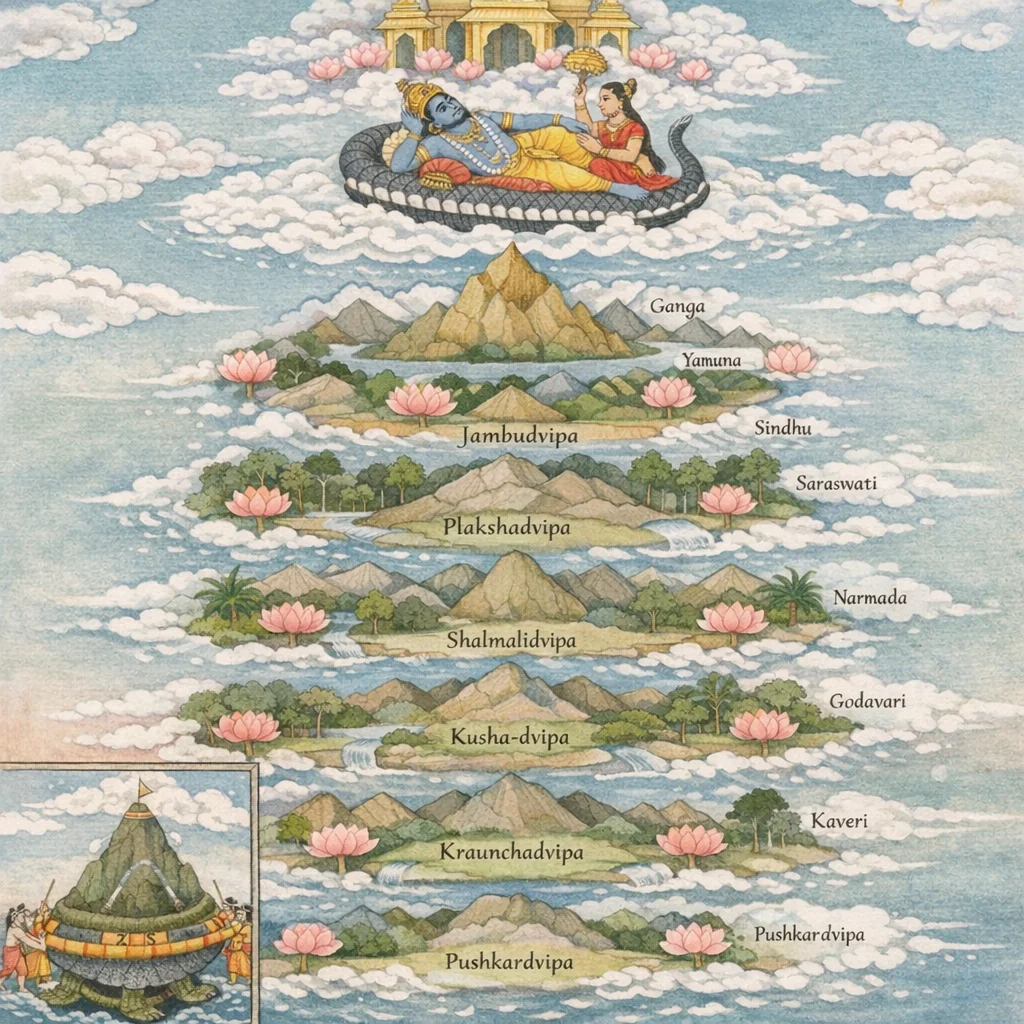
Continuing the Purāṇic mapping of the cosmos, Sūta extends sacred geography beyond Jambūdvīpa to successive island-continents, each doubling in size and bounded by a distinct ocean. Plakṣadvīpa is detailed with its kulaparvatas and rivers, where dharmic ease prevails and Soma-worship grants soma-sāyujya and longevity. Then follow Śālmalī, Kuśa, Krauñca, and Śāka-dvīpas, each with seven mountains, seven chief rivers, named peoples/varṇas, and a governing devotional focus—Vāyu, Brahmā, Rudra (Mahādeva), and Sūrya—bestowing graded attainments such as sārūpya, sālokatā, and nearness by grace. The chapter culminates in the Kṣīroda (Milk Ocean) enclosing Śvetadvīpa, where beings are free from disease, fear, greed, and deceit, devoted to Nārāyaṇa through yoga, mantra, tapas, and jñāna. A vivid vision of Nārāyaṇapura/Vaikuṇṭha follows: Hari reclining on Śeṣa with Śrī at His feet, and the doctrinal seal that from Nārāyaṇa the universe arises, in Him it abides, and into Him it returns at pralaya—He alone is the supreme destination, preparing the way for more explicit theological and yogic teaching.
Shlokas
Verse 1
इति श्रीकूर्मपुराणे षट्साहस्त्र्यां संहितायां पूर्वविभागे षट्चत्वारिशो ऽध्यायः सूत उवाच जम्बूद्वीपस्य विस्ताराद् द्विगुणेन समन्ततः / संवेष्टयित्वा क्षारोदं प्लक्षद्वीपो व्यवस्थितः
Sūta said: Surrounding Jambūdvīpa on every side, with a breadth twice its extent, lies Plakṣadvīpa, encircling the Kṣāroda, the Ocean of saline waters.
Verse 2
प्लक्षद्वीपे च विप्रेन्द्राः सप्तासन् कुलपर्वताः / ऋज्वायताः सुपर्वाणः सिद्धसङ्घनिषेविताः
And in Plakṣadvīpa, O best of brahmins, there were seven clan-mountains (kulaparvatas)—lofty and straight-stretching, well-ridged and well-formed, frequented by hosts of Siddhas.
Verse 3
गोमेदः प्रथमस्तेषां द्वितीयश्चन्द्र उच्यते / नारादो दुन्दुभिश्चैव सोमश्च ऋषभस्तथा / वैभ्राजः सप्तमः प्रोक्तो ब्रह्मणो ऽत्यन्तवल्लभः
Among them, Gomeda is said to be the first, and Candra is declared the second. Nārada and Dundubhi are also counted, as well as Soma and Ṛṣabha. Vaibhrāja is proclaimed as the seventh—exceedingly dear to Brahmā.
Verse 4
तत्र देवर्षिगन्धर्वैः सिद्धैश्च भगवानजः / उपास्यते स विश्वात्मा साक्षी सर्वस्य विश्वसृक्
There, the Blessed Lord Aja, the Unborn, is worshipped by divine seers, Gandharvas, and Siddhas. He is the Universal Self, the witness of all, and the creator of the cosmos.
Verse 5
तेषु पुण्या जनपदा नाधयो व्याधयो न च / न तत्र पापकर्तारः पुरुषा वा कथञ्चन
Among them are holy and blessed lands: there are no afflictions of sorrow, nor any diseases; and in those regions there are, in no way at all, men who commit sinful deeds.
Verse 6
तेषां नद्यश्च सप्तैव वर्षाणां तु समुद्रगाः / तासु ब्रह्मर्षयो नित्यं पितामहपुपासते
For those regions (varṣas), there are indeed seven rivers, and the rivers of those varṣas flow into the ocean. In those sacred waters, the Brahma-sages ever worship and venerate Pitāmaha, the Grandsire Brahmā.
Verse 7
अनुतप्ता शिखी चैव विपापा त्रिदिवा कृता / अमृता सुकृता चैव नामतः परिकीर्तिताः
They are celebrated by name as Anutaptā, Śikhī, Vipāpā, Tridivā, Kṛtā, Amṛtā, and Sukṛtā.
Verse 8
क्षुद्रनद्यस्त्वसंख्याताः सरांसि सुबहून्यपि / न चैतेषु युगावस्था पुरुषा वै चिरायुषः
Countless are the minor rivers, and very many are the lakes as well; yet in these regions the proper order of the Yugas is not manifest, and men there are not long-lived.
Verse 9
आर्यकाः कुरवाश्चैव विदशा भाविनस्तथा / ब्रह्मक्षत्रियविट्शूद्रास्तस्मिन् द्वीपे प्रकीर्तिताः
In that dvīpa are said to dwell the Āryakas, the Kurus, the Vidaśas, and the Bhāvinas; and there too the four social orders—Brāhmaṇa, Kṣatriya, Vaiśya, and Śūdra—are traditionally enumerated.
Verse 10
इज्यते भगवान् सोमो वर्णैस्तत्र निवासिभिः / तेषां च सोमसायुज्यं सारूप्यं मुनिपुङ्गवाः
There, the divine Lord Soma is worshipped by the people of all social orders who dwell in that region; and for them, as its fruit, there arises union with Soma (sāyujya) and likeness of form to him (sārūpya), O foremost of sages.
Verse 11
सर्वे धर्मपरा नित्यं नित्यं मुदितमानसाः / पञ्चवर्षसहस्त्राणि जीवन्ति च निरामयाः
All of them are ever devoted to dharma, with minds continually joyful; and they live for five thousand years, free from disease.
Verse 12
प्लक्षद्वीपप्रमाणं तु द्विगुणेन समन्ततः / संवेष्ट्येक्षुरसाम्भोधिं शाल्मलिः संव्यवस्थितः
But Śālmalī-dvīpa, being double the extent of Plakṣa-dvīpa on every side, is situated encircling the ocean whose waters are like sugarcane-juice.
Verse 13
सप्त वर्षाणि तत्रापि सप्तैव कुलपर्वताः / ऋज्वायताः सुपर्वाणः सप्त नद्यश्च सुव्रताः
There, too, are seven regions (varṣas), and likewise seven clan-mountains (kulaparvatas); they are straight-stretching and well-ridged. And there are seven rivers as well—O you of excellent vows.
Verse 14
कुमुदश्चोन्नतश्चैव तृतीयश्च बलाहकः / द्रोणः कङ्कस्तु महिषः ककुद्वान् सप्त पर्वताः
Kumuda, Unnata, and thirdly Balāhaka; then Droṇa, Kaṅka, Mahiṣa, and Kakudvān—these are the seven mountains.
Verse 15
योनी तोया वितृष्णा च चन्द्रा शुक्ला विमोचनी / निवृत्तिश्चैति ता नद्यः स्मृता पापहरा नृणाम्
Yoni, Toyā, Vitṛṣṇā, Candrā, Śuklā, Vimocanī, and Nivṛtti—these rivers are remembered as sin-destroying for human beings.
Verse 16
न तेषु विद्यते लोभः क्रोधो वा द्विजसत्तमाः / न चैवास्ति युगावस्था जना जीवन्त्यनामयाः
Among them, O best of the twice-born, neither greed nor anger is found. Nor is there the condition of decline belonging to the ages; people live free from illness and affliction.
Verse 17
यजन्ति सततं तत्र वर्णा वायुं सनातनम् / तेषां तस्याथ सायुज्यं सारूप्यं च सलोकता
There, the people of all the varṇas continually worship the eternal Vāyu. As a result, they attain sāyujya (union with him), sārūpya (likeness of form), and sālokatā (residence in his world).
Verse 18
कपिला ब्राह्मणाः प्रोक्ता राजानश्चारुणास्तथा / पीता वैश्याः स्मृताः कृष्णा द्वीपे ऽस्मिन् वृषला द्विजाः
In this island-continent, the Brahmins are said to be kapila (tawny); the kings are likewise fair and comely; the Vaiśyas are remembered as yellowish; while the Śūdras are dark. Here, even those who are twice-born are regarded as “vṛṣala” (fallen from proper conduct).
Verse 19
शाल्मलस्य तु विस्ताराद् द्विगुणेन समन्ततः / संवेष्ट्य तु सुरोदाब्धिं कुशद्वीपो व्यवस्थितः
Kuśadvīpa lies all around, twice the breadth of Śālmaladvīpa; on every side it encircles the Ocean of Sura, the sea of liquor and nectar.
Verse 20
विद्रुमश्चैव हेमश्च द्युतिमान् पुष्पवांस्तथा / कुशेशयो हरिश्चाथ मन्दरः सप्त पर्वताः
Vidruma and Hema, Dyutimān and Puṣpavān; Kuśeśaya and Hari; and Mandara—these are the seven mountains.
Verse 21
धुतपापा शिवा चैव पवित्रा संमता तथा / विद्युदम्भा मही चेति नद्यस्तत्र जलावहाः
There the water-bearing rivers are named Dhutapāpā, Śivā, Pavitrā, Saṃmatā, Vidyudambhā, and Mahī—streams that flow through that sacred land.
Verse 22
अन्याश्च शतशोविप्रा नद्यो मणिजलाः शुभाः / तासु ब्रह्माणमीशानं देवाद्याः पर्युपासते
And, O Brahmins, there are hundreds of other auspicious rivers, their waters gleaming like jewels; in those waters the foremost of the gods worship Īśāna—the Lord who is also Brahmā.
Verse 23
ब्राह्मणा द्रविणो विप्राः क्षत्रियाः शुष्मिणस्तथा / वैश्याः स्नेहास्तु मन्देहाः शूद्रास्तत्र प्रकीर्तिताः
In that account, Brahmins are said to incline toward wealth and means; Kshatriyas toward vigor and fiery valor; Vaishyas toward affection and attachment; and Shudras toward duller understanding—thus are they characterized there.
Verse 24
सर्वे विज्ञानसंपन्ना मैत्रादिगुणसंयुताः / यथोक्तकारिणः सर्वे सर्वे भूतहिते रताः
All were endowed with true discernment, possessed of virtues beginning with friendliness; all acted as enjoined, and all were devoted to the welfare of living beings.
Verse 25
यजन्ति विविधैर्यज्ञैर्ब्रह्माणं परमेष्ठिनम् / तेषां च ब्रह्मसायुज्यं सारूप्यं च सलोकता
They worship Brahmā, the Supreme Lord upon the cosmic seat (Parameṣṭhin), through many kinds of sacrifices; for them arise the attainments of union with Brahmā, likeness of form, and dwelling in the same world (Brahma-loka).
Verse 26
कुशद्वीपस्य विस्ताराद् द्विगुणेन समन्ततः / क्रौञ्चद्वीपस्ततो विप्रा वेष्टयित्वा घृतोदधिम्
O Brāhmaṇas, surrounding Kuśa-dvīpa on every side with twice its extent, there lies Krauñca-dvīpa, encircling the ocean of clarified butter (ghṛta-samudra).
Verse 27
क्रौञ्चो वामनकश्चैव तृतीयश्चान्धकारकः / देवावृच्च विविन्दश्च पुण्डरीकस्तथैव च / नाम्ना च सप्तमः प्रोक्तः पर्वतो दुन्दुभिस्वनः
Krauñca and Vāmanaka, and the third named Andhakāraka; Devāvṛk and Vivinda, and likewise Puṇḍarīka—these are declared in order. And the seventh mountain is proclaimed as Dundubhisvana, “the one whose sound is like a drum.”
Verse 28
गौरी कुमुद्विती चैव संध्या रात्रिर्मनोजवा / ख्यातिश्च पुण्डरीकाच नद्यः प्राधान्यतः स्मृताः
Gaurī, Kumudvatī, Saṃdhyā, Rātri, Manojavā, Khyāti, and Puṇḍarīkā—these rivers are remembered as the principal ones.
Verse 29
पुष्कराः पुष्कला धन्यास्तिष्यास्तस्य क्रमेण वै / ब्राह्मणाः क्षत्रिया वैश्याः शूद्राश्चैव द्विजोत्तमाः
Puṣkara, Puṣkala, Dhanya, and Tiṣya—these arose in his succession, each in due order. From him came the Brāhmaṇas, Kṣatriyas, Vaiśyas, and also the Śūdras, O best among the twice-born.
Verse 30
अर्चयन्ति महादेवं यज्ञदानसमाधिभिः / व्रतोपवासैर्विविधैर्हेमैः स्वाध्यायतर्पणैः
They worship Mahādeva through sacrificial rites, through charity and through absorption in samādhi; through many kinds of vows and fasts; through offerings of gold; and through svādhyāya, the sacred self-study, and through tarpaṇa, the rite of ritual satisfaction.
Verse 31
तेषां वै रुद्रसायुज्यं सारूप्यं चातिदुर्लभम् / सलोकता च सामीप्यं जायते तत्प्रसादतः
For them, by His grace, there arises union with Rudra (sāyujya), and even the exceedingly rare attainment of Rudra’s own form (sārūpya). Likewise, dwelling in Rudra’s world (salokatā) and nearness to Him (sāmīpya) are granted through His favor.
Verse 32
क्रौञ्चद्वीपस्य विस्ताराद् द्विगुणेन समन्ततः / शाकद्वीपः स्थितो विप्रा आवेष्ट्य दधिसागरम्
O brāhmaṇas, surrounding Krauñca-dvīpa on every side and exceeding its extent by twice the measure, Śāka-dvīpa is situated, encircling the Ocean of Curd (Dadhi-sāgara).
Verse 33
उदयो रैवतश्चैव श्यामाको ऽस्तगिरिस्तथा / आम्बिकेयस्तथा रम्यः केशरी चेति पर्वताः
The mountains are named Udaya, Raivata, Śyāmāka, and Astagiri; also Āmbikeya, Ramya, and Keśarī—these are the mountains so called.
Verse 34
सुकुमारी कुमारी च नलिनी रेणुका तथा / इक्षुका धेनुका चैव गभस्तिश्चेति निम्नगाः
Sukumārī, Kumārī, Nalinī, and likewise Reṇukā; Ikṣukā, Dhenukā, and also Gabhasti—these are the sacred rivers (nimnagās).
Verse 35
आसां पिबन्तः सलिलं जीवन्ते तत्र मानवाः / अनामया ह्यशोकाश्च रागद्वेषविवर्जिताः
Drinking the waters of these sacred streams, the people who dwell there live on—free from disease and sorrow, and wholly devoid of attachment and aversion.
Verse 36
मगाश्च मगधाश्चैव मानवा मन्दगास्तथा / ब्राह्मणाः क्षत्रिया वैश्याः शूद्राश्चात्र क्रमेण तु
Here, in due order, are mentioned the Magas and the Magadhas, as well as the Mānavas and the Mandagas; and likewise the four social classes—Brāhmaṇas, Kṣatriyas, Vaiśyas, and Śūdras—arranged sequentially.
Verse 37
यजन्ति सततं देवं सर्वलोकैकसाक्षिणम् / व्रतोपवासैर्विविधैर्देवदेवं दिवाकरम्
They continually worship the God who is the sole Witness of all worlds—Divākara, the Sun, the God of gods—by means of many kinds of sacred vows and disciplined fasts.
Verse 38
तेषां सूर्येण सायुज्यं सामीप्यं च सरूपता / सलोकता च विप्रेन्द्रा जायते तत्प्रसादतः
By his grace, O best of brāhmaṇas, they attain union with the Sun (sāyujya), nearness to him (sāmīpya), likeness of form (sārūpya), and residence in his world (sālokya).
Verse 39
शाकद्वीपं समावृत्य क्षीरोदः सागरः स्थितः / श्वेतद्वीपश्च तन्मध्ये नारायणपरायणाः
Encircling Śākadvīpa lies the Ocean of Milk (Kṣīroda). Within it is Śvetadvīpa, whose inhabitants are wholly devoted to Nārāyaṇa.
Verse 40
तत्र पुण्या जनपदा नानाश्चर्यसमन्विताः / श्वेतास्तत्र नरा नित्यं जायन्ते विष्णुतत्पराः
There lie blessed provinces, endowed with many wonders. There, men are ever born fair-complexioned, and they are constantly devoted to Lord Viṣṇu.
Verse 41
नाधयो व्याधयस्तत्र जरामृत्युभयं न च / क्रोधलोभविनिर्मुक्ता मायामात्सर्यवर्जिताः
There, neither mental afflictions nor bodily diseases exist, nor is there any fear of old age and death. The beings there are free from anger and greed, and are devoid of deceit (māyā) and envy.
Verse 42
नित्यपुष्टा निरातङ्का नित्यानन्दाश्च भोगिनः / नारायणपराः सर्वे नारायणपरायणाः
Ever nourished, free from fear and affliction, and ever rejoicing—such are those who enjoy true well-being. All of them are devoted to Nārāyaṇa as their highest goal, wholly taking refuge in Nārāyaṇa alone.
Verse 43
केचिद् ध्यानपरा नित्यं योगिनः संयतेन्द्रियाः / केचिज्जपन्ति तप्यन्ति केचिद् विज्ञानिनो ऽपरे
Some yogins, ever intent on meditation, keep their senses restrained. Some practice mantra-recitation and undertake austerities; while others, again, are devoted to discriminative spiritual knowledge.
Verse 44
अन्ये निर्बोजयोगेन ब्रह्मभावेन भाविताः / ध्यायन्ति तत् परं व्योम वासुदेवं परं पदम्
Others, ripened through seedless yoga and suffused with the state of Brahman, meditate upon that supreme expanse—the highest sky—Vāsudeva, the supreme abode and highest station.
Verse 45
एकान्तिनो निरालम्बा महाभागवताः परे / पश्यन्ति परमं ब्रह्म विष्णवाख्यं तमसः परं
Those supreme devotees—one-pointed and unsupported by anything external—behold the Supreme Brahman, called Viṣṇu, who transcends the darkness of ignorance.
Verse 46
सर्वे चतुर्भुजाकाराः शङ्खचक्रगदाधराः / सुपीतवाससः सर्वे श्रीवत्साङ्कितवक्षसः
All bore four-armed forms, holding the conch, discus, and mace; all were clad in radiant yellow garments, and all had their chests marked with the auspicious Śrīvatsa sign.
Verse 47
अन्ये महेश्वरपरास्त्रिपुण्ड्राङ्कितमस्तकाः / स्वयोगोद्भूतकिरणा महागरुडवाहनाः
Others are devoted to Maheśvara (Śiva), their foreheads marked with the tripuṇḍra—three lines of sacred ash; from their own yogic discipline rays of spiritual radiance arise, and they move mounted upon the great Garuḍa.
Verse 48
सर्वशक्तिसमायुक्ता नित्यानन्दाश्च निर्मलाः / वसन्ति तत्र पुरुषा विष्णोरन्तरचारिणः
Endowed with every power, ever established in bliss and stainless—there dwell the perfected beings who move within the inner presence of Viṣṇu.
Verse 49
तत्र नारायणस्यान्यद् दुर्गमं दुरतिक्रमम् / नारायणं नाम पुरं व्यासाद्यैरुपशोभितम्
There, too, is another realm of Nārāyaṇa—hard to reach and difficult to cross. It is a city called “Nārāyaṇa,” made splendid by Vyāsa and other great sages.
Verse 50
हेमप्राकारसंसुक्तं स्फाटिकैर्मण्डपैर्युतम् / प्रभासहस्त्रकलिलं दुराधर्षं सुशोभनम् / हर्म्यप्राकारसंयुक्तमट्टालकसमाकुलम्
Enclosed by golden ramparts and furnished with crystal pavilions, it was filled with the radiance of a thousand lights—beautiful, unassailable, and splendid—joined to the walls of lofty mansions and crowded with watchtowers.
Verse 51
हेमगोपुरसाहस्त्रैर्नानारत्नोपशोभितैः / शुभ्रास्तरणसंयुक्तं विचित्रैः समलङ्कृतम्
It was adorned with thousands of golden gateways, resplendent with many kinds of jewels; furnished with spotless white coverings, and exquisitely decorated with variegated ornaments.
Verse 52
नन्दनैर्विविधाकारैः स्त्रवन्तीभीश्च शोभितम् / सरोभिः सर्वतो युक्तं वीणावेणुनिनादितम्
It was adorned with Nandana-like pleasure-groves of many forms, beautified by flowing streams, encircled on every side by lotus-lakes, and resonant with the music of vīṇās and flutes.
Verse 53
पताकाभिर्विचित्राभिरनेकाभिश्च शोभितम् / वीथीभिः सर्वतो युक्तं सोपानै रत्नभूषितैः
Adorned with many varied and colorful banners, it was furnished on every side with galleries and walkways, and with stairways embellished with jewels.
Verse 54
नारीशतसहस्त्राढ्यं दिव्यगोयसमन्वितम् / हंसकारण्डवाकीर्णं चक्रवाकोपशोभितम् / चतुर्द्वारमनौपम्यमगम्यं देवविद्विषाम्
That city/abode abounded in hundreds of thousands of women, endowed with divine cattle and heavenly riches; it was thronged with swans and kāraṇḍava-birds, and beautified by cakravāka-ducks. Four-gated and without equal, it was unreachable to the foes of the Devas.
Verse 55
तत्र तत्राप्सरः सङ्धैर्नृत्यद्भिरुपशोभितम् / नानागीतविधानज्ञैर्देवानामपि दुर्लभैः
Here and there it was adorned by companies of Apsarases dancing; and by masters skilled in many modes and arrangements of song—performers so rare that even the Devas can scarcely obtain them.
Verse 56
नानाविलाससंपन्नैः कामुकैरतिकोमलैः / प्रभूतचन्द्रवदनैर्नूपुरारावसंयुतैः
They were endowed with many kinds of graceful arts and playful charms—amorous and exceedingly delicate—bearing many moon-like faces, and attended by the clear, tinkling resonance of anklets (nūpura).
Verse 57
ईषत्स्मितैः सुबिम्बोष्ठैर्बालमुग्धमृगेक्षणैः / अशेषविभवोपेतैर्भूषितैस्तनुमध्यमैः
With gentle smiles, with lips like the ripe bimba-fruit, with doe-like eyes bearing an innocent youthful charm—adorned with every kind of splendor and ornament, and possessed of slender waists.
Verse 58
सुराजहंसचलनैः सुवेषैर्मधुरस्वनैः / संलापालापकुशलैर्दिव्याभरणभूषैतैः
Adorned with divine ornaments, they moved with the graceful gait of noble swans; finely dressed, sweet-voiced, and skilled in courteous conversation and elegant speech.
Verse 59
स्तनभारविनम्रैश्च मदघूर्णितलोचनैः / नानावर्णविचित्राङ्गैर्नानाभोगरतिप्रियैः
With bodies bowed beneath the weight of their breasts, their eyes rolling in intoxication, their limbs adorned in many hues and ornaments, they delighted in diverse pleasures and rejoiced in sensual play.
Verse 60
प्रफुल्लकुसुमोद्यानैरितश्चेतश्च शोभितम् / असंख्येयगुणं शुद्धमागम्यं त्रिदशैरपि
Adorned on every side by gardens of fully blossomed flowers, it shines everywhere—pure, possessed of innumerable excellences, and inaccessible even to the gods.
Verse 61
श्रीमत्पवित्रं देवस्य श्रीपतेरमितौजसः / तस्य मध्ये ऽतितेजस्कमुच्चप्राकारतोरणम्
Glorious and supremely pure is the sacred abode of the Lord—Śrīpati, of immeasurable splendor. In its very midst stands a dazzling, lofty gateway-arch set upon high ramparts.
Verse 62
स्थानं पद् वैष्णवं दिव्यं योगिनामपि दुर्लभम् / तन्मध्ये भगवानेकः पुण्डरीकदलद्युतिः / शेते ऽशेषजगत्सूतिः शेषाहिशयने हरिः
There is a divine Vaiṣṇava station (Vaikuṇṭha), difficult to attain even for yogins. In its very midst lies the One Blessed Lord, radiant like a lotus petal. Hari, the source from whom the entire universe is brought forth, reposes upon the serpent-bed of Śeṣa.
Verse 63
विचिन्त्यमानो योगीन्द्रैः सनन्दनपुरोगमैः / स्वात्मानन्दामृतं पीत्वा परं तत् तमसः परम्
Contemplated by the foremost Yogins led by Sanandana, having drunk the nectar of bliss that is one’s own Self, that Supreme Reality stands beyond even darkness (tamas), transcendent above all.
Verse 64
सुपीतवसनो ऽनन्तो महामायो महाभुजः / क्षीरोदकन्यया नित्यं गृहीतचरणद्वयः
Clad in radiant yellow garments, the Infinite One—of mighty Māyā and mighty arms—has both His feet ever held in devotion by the Daughter of the Ocean of Milk (Śrī/Lakṣmī).
Verse 65
सा च देवी जगद्वन्द्या पादमूले हरिप्रिया / समास्ते तन्मना नित्यं पीत्वा नारायणामृतम्
And that Goddess—revered by the whole world, beloved of Hari—abides at the very base of His feet; ever absorbed in Him, she remains there continually, having drunk the nectar that is Nārāyaṇa.
Verse 66
न तत्राधार्मिका यान्ति न च देवान्तराश्रयाः / वैकुण्ठं नाम तत् स्थानं त्रिदशैरपि वन्दितम्
To that realm the unrighteous do not go, nor do those who seek refuge in other deities. That place is called Vaikuṇṭha—revered even by the thirty-three gods.
Verse 67
न मे ऽत्र भवति प्रज्ञा कृत्स्नशस्तन्निरूपणे / एतावच्छक्यते वक्तुं नारायणपुरं हि तत्
In describing it in full detail, my understanding does not suffice here. Only this much can be said: it is indeed the city of Nārāyaṇa—Nārāyaṇapura.
Verse 68
स एव परमं ब्रह्म वासुदेवः सनातनः / शेते नारायणः श्रीमान् मायया मोहयञ्जगत्
He alone is the Supreme Brahman—Vāsudeva, the Eternal. As the glorious Nārāyaṇa He abides (reclines), and by His Māyā He causes the world to fall into delusion.
Verse 69
नारायणादिदं जातं तस्मिन्नेव व्यवस्थितम् / तमेवाभ्येति कल्पान्ते स एव परमा गतिः
From Nārāyaṇa this universe is born; in Him alone it is established and sustained. At the end of the kalpa it returns to Him—He alone is the supreme destination.
Frequently Asked Questions
The chapter moves outward from Jambūdvīpa to Plakṣadvīpa (salt ocean), Śālmalīdvīpa (sugarcane-juice-like ocean), Kuśadvīpa (sura/nectar-liquor ocean), Krauñcadvīpa (ghṛta/clarified-butter ocean), Śākadvīpa (dadhi/curd ocean), and then the Kṣīroda (milk ocean) containing Śvetadvīpa.
Each dvīpa presents a legitimate devotional center—Soma, Vāyu, Brahmā, Rudra, Sūrya—granting classical fruits (sāyujya, sārūpya, sālokatā, sāmīpya). Yet the narrative apex is Śvetadvīpa/Vaikuṇṭha, where devotion culminates in Nārāyaṇa/Vāsudeva as the ultimate origin and end at pralaya.
They are depicted as free from affliction and moral impurities, devoted to Nārāyaṇa through meditation with restrained senses, mantra-japa and tapas, discriminative knowledge (jñāna), and advanced seedless yoga culminating in Brahman-abidance focused on Vāsudeva.
It concludes with an ontological claim: from Nārāyaṇa the universe is born, in Him it is sustained, and at the end of the aeon it returns to Him—thereby identifying Nārāyaṇa/Vāsudeva as the supreme destination beyond all.