Adhyaya 4
Prākṛta Sṛṣṭi and Pralaya: From Pradhāna to Brahmāṇḍa; Trimūrti Samanvaya
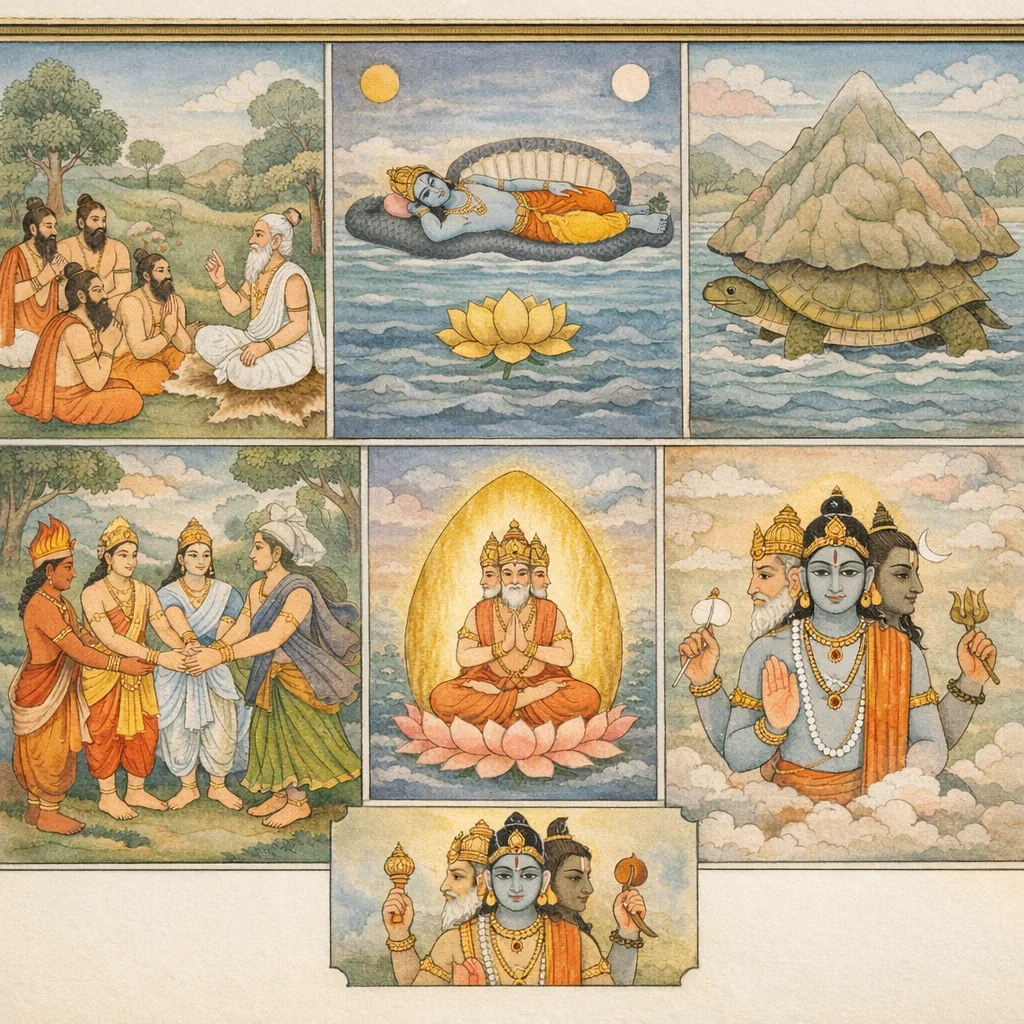
After the teaching on the four āśramas (end of Adhyāya 3), the sages ask about cosmic origin, dissolution (pralaya), and the supreme ruler. Nārāyaṇa as Śrī Kūrma replies by defining the Supreme (Mahēśvara/Parameśvara) as the unmanifest, eternal Antaryāmin, and explains prākṛta pralaya as the guṇas returning to equilibrium during Brahmā’s “night.” Through divine Yoga the Lord stirs Prakṛti and Puruṣa, producing Mahat, then the threefold ahaṅkāra, mind, tanmātras, and the gradual arising and mutual interpenetration of the five mahābhūtas. Since the tattvas cannot create separately, they unite to form the cosmic egg (brahmāṇḍa), within which Hiraṇyagarbha/Brahmā appears; its seven coverings and cosmic structure are described. The chapter culminates in a theological synthesis: the one Supreme manifests as Brahmā (rajas) for creation, Viṣṇu (sattva) for preservation, and Rudra (tamas) for dissolution, while remaining attributeless. It closes by turning to the next topic—brāhmī sṛṣṭi, Brahmā-born creation, to be taught in the following chapter.
Shlokas
Verse 1
इति श्रीकूर्मपुराणे षट्साहस्त्र्यां संहितायां पूर्वविभागे तृतीयो ऽध्यायः सूत उवाच श्रुत्वाऽश्रमविधिं कृत्सनमृषयो हृष्टमानसाः / नमस्कृत्य हृषीकेशं पुनर्वचनमब्रुवन्
Thus ends the third chapter in the First Part of the Śrī Kūrma Purāṇa, in the Ṣaṭsāhasrī Saṃhitā. Sūta said: Having heard in full the ordinance concerning the āśramas, the sages—gladdened in mind—bowed to Hṛṣīkeśa and then spoke again.
Verse 2
मुनय ऊचुः भाषितं भवता सर्वं चातुराश्रम्यमुत्तमम् / इदानीं श्रोतुमिच्छामो यथा संभवते जगत्
The sages said: “You have expounded completely the excellent doctrine of the four āśramas. Now we wish to hear how the universe comes into being.”
Verse 3
कुतः सर्वमिदं जातं कस्मिंश्च लयमेष्यति / नियन्ता कश्च सर्वेषां वदस्व पुरुषोत्तम
“From what has all this arisen, and into what will it finally dissolve? And who is the ruler of all? Tell us, O Puruṣottama, the Supreme Person.”
Verse 4
श्रुत्वा नारायणो वाक्यमृषीणां कूर्मरूपधृक् / प्राह गम्भीरया वाचा भूतानां प्रभवाप्ययौ
Having heard the sages’ words, Nārāyaṇa—bearing the form of the Tortoise—spoke in a deep voice of the arising and dissolution of all beings.
Verse 5
श्रीकूर्म उवाच महेश्वरः परो ऽव्यक्तश्चतुर्व्यूहः सनातनः / अनन्तश्चाप्रमेयश्च नियन्ता विश्वतोमुखः
Śrī Kūrma said: “Mahēśvara is the Supreme—unmanifest and eternal, revealed as the fourfold divine emanation; endless and immeasurable, the inner Ruler, whose face is turned to all directions (present everywhere).”
Verse 6
अव्यक्तं कारणं यत्तन्नित्यं सदसदात्मकम् / प्रधानं प्रकृतिश्चेति यदाहुस्तत्त्वचिन्तकाः
That unmanifest principle spoken of as the causal ground—eternal, and of the nature of both being and non-being—is what the contemplators of reality call Pradhāna, or Prakṛti.
Verse 7
गन्धवर्णरसैर्हेनं शब्दस्पर्शविवर्जितम् / अजरं ध्रुवमक्षय्यं नित्यं स्वात्मन्यवस्थितम्
He is apprehended through scent, colour, and taste, yet is devoid of sound and touch; unborn and ageless, steadfast and imperishable—eternal, abiding in His own Self.
Verse 8
जगद्योनिर्महाभूतं परं ब्रह्म सनातनम् / विग्रहः सर्वभूतानामात्मनाधिष्ठितं महत्
The eternal Supreme Brahman is the womb of the universe—the Great Being. It is the embodied ground of all creatures, the vast Reality established and upheld by the Self within.
Verse 9
अनाद्यन्तमजं सूक्ष्मं त्रिगुणं प्रभवाप्ययम् / असांप्रतमविज्ञेयं ब्रह्माग्रे समवर्तत
That Brahman—beginningless and endless, unborn, subtle, constituted of the three guṇas, the source and also the dissolution of all—now beyond perception and unknowable—existed at the very outset, before Brahmā (the creator) arose.
Verse 10
गुणसाम्ये तदा तस्मिन् पुरुषे चात्मनि स्थिते / प्राकृतः प्रलयो ज्ञेयो यावद् विश्वसमुद्भवः
When the guṇas return to equilibrium and Puruṣa—the Self—abides established in itself, that state is to be known as Prākṛta Pralaya (dissolution into Prakṛti), lasting until the universe arises again.
Verse 11
ब्राह्मी रात्रिरियं प्रोक्ता अहः सृष्टिरुदाहृता / अहर्न विद्यते तस्य न रात्रिर्ह्युपचारतः
This is declared to be Brahmā’s ‘night’, and the time of manifestation is called his ‘day’. Yet for That Supreme Reality, in truth there is neither day nor night—these are merely conventional expressions.
Verse 12
निशान्ते प्रतिबुद्धो ऽसौ जगदादिरनादिमान् / सर्वभूतमयो ऽव्यक्तो ह्यन्तर्यामीश्वरः परः
At the end of the night, He awakens—the primordial source of the universe, beginningless. He is the essence of all beings, unmanifest, and indeed the Supreme Lord who dwells within as the Inner Ruler (Antaryāmin).
Verse 13
प्रकृतिं पुरुषं चैव प्रविश्याशु महेश्वरः / क्षोभयामास योगेन परेण परमेश्वरः
Entering swiftly into both Prakṛti (primordial Nature) and Puruṣa (the conscious Principle), the Great Lord—the Supreme Ruler—stirred them into activity by His transcendent Yoga.
Verse 14
यथा मदो नरस्त्रीणां यथा वा माधवो ऽनिलः / अनुप्रविष्टः क्षोभाय तथासौ योगमूर्तिमान्
Just as intoxication unsettles men and women, and as the spring wind of Mādhava enters and stirs all things, so too that One—whose very form is Yoga—having entered within, becomes the cause of inner disturbance in embodied beings.
Verse 15
स एव क्षोभको विप्राः क्षोभ्यश्च परमेश्वरः / स संकोचविकासाभ्यां प्रधानत्वे ऽपि च स्थितः
O Brahmins, that very Supreme Lord is both the agitator and the one to be agitated; and even while abiding as Pradhāna, primordial Nature, He remains established through contraction and expansion.
Verse 16
प्रधानात् क्षोभ्यमाणाच्च तथा पुंसः पुरातनात् / प्रादुरासीन्महद् बीजं प्रधानपुरुषात्मकम्
From Pradhāna, primordial Nature, when it is set into agitation, and from the ancient Puruṣa, primordial Consciousness, there manifested the great seed—Mahat—whose character partakes of both Pradhāna and Puruṣa.
Verse 17
महानात्मा मतिर्ब्रह्मा प्रबुद्धिः ख्यातिरीश्वरः / प्रज्ञाधृतिः स्मृतिः संविदेतस्मादिति तत् स्मृतम्
He is called the Great Self; He is Intellect and Brahman; He is Awakening, Renown, and the Lord. He is Wisdom, Steadfastness, Memory, and Consciousness—therefore He is remembered and spoken of by these names.
Verse 18
वैकारिकस्तैजसश्च भूतादिश्चैव तामसः / त्रिविधो ऽयमहङ्कारो महतः संबभूव ह
From Mahat, cosmic intelligence, arose this threefold Ahaṅkāra, the ego-principle: the sāttvika called Vaikārika, the rājasa called Taijasa, and the tāmasa known as Bhūtādi.
Verse 19
अहङ्कारो ऽबिमानश्च कर्ता मन्ता च स स्मृतः / आत्मा च पुद्गलो जीवो यतः सर्वाः प्रवृत्तयः
Ahaṅkāra, the sense of “I,” and abhimāna, the grasping of “mine,” are remembered as that principle which deems itself the doer and the thinker. It is also called the Ātman, the pudgala (person), the jīva (living being), from which all activities arise.
Verse 20
पञ्चभूतान्यहङ्कारात् तन्मात्राणि च जज्ञिरे / इन्द्रियाणि तथा देवाः सर्वं तस्यात्मजं जगत्
From ahaṅkāra arose the five great elements and the tanmātras, the subtle essences; likewise the sense-faculties and the gods. Truly, this entire world is born as its progeny.
Verse 21
मनस्त्वव्यक्तजं प्रोक्तं विकारः प्रथमः स्मृतः / येनासौ जायते कर्ता भूतादींश्चानुपश्यति
Mind (manas) is said to arise from the Unmanifest (avyakta) and is remembered as the first modification; through it the embodied jīva is regarded as an agent (kartā) and it cognizes the elements and the other created principles.
Verse 22
वैकारिकादहङ्कारात् सर्गो वैकारिको ऽभवत् / तैजसानीन्द्रियाणि स्युर्देवा वैकारिका दश
From the vaikārika (sāttvika) form of ahaṅkāra arose the sāttvika creation; from the taijasa (rājasa) aspect arise the sense-faculties, and the ten deities presiding over those faculties are said to be vaikārika (sāttvika).
Verse 23
एकादशं मनस्तत्र स्वगुणेनोभयात्मकम् / भूततन्मात्रसर्गो ऽयं भूतादेरभवन् प्रजाः
There, as the eleventh principle, Mind (manas) arose—by its own inherent quality it is of a twofold nature. This is the emanation of the tanmātras and the bhūtas; and from bhūtādi, the primordial source of the elements, the beings (prajās) came into existence.
Verse 24
भूतादिस्तु विकुर्वाणः शब्दमात्रं ससर्ज ह / आकाशं शुषिरं तस्मादुत्पन्नं शब्दलक्षणम्
Then Bhūtādi (the tamasic principle of ahaṅkāra), undergoing transformation, brought forth only the subtle essence of sound. From that arose ākāśa (ether/space), hollow and all-pervading, whose defining mark is sound.
Verse 25
आकाशस्तु विकुर्वाणः स्पर्शमात्रं ससर्ज ह / वायुरुत्पद्यते तस्मात् तस्य स्पर्शो गुणो मतः
Ākāśa, undergoing transformation, produced only the subtle principle of touch; from that arose vāyu (wind), and touch is held to be its defining quality.
Verse 26
वायुश्चापि विकुर्वाणो रूपमात्रं ससर्ज ह / ज्योतिरुत्पद्यते वायोस्तद्रूपगुणमुच्यते
Vāyu too, undergoing transformation, brought forth only the tanmātra of form; from vāyu fire—jyotis/tejas, light—was produced, and form is said to be its quality.
Verse 27
ज्योतिश्चापि विकुर्वाणं रसमात्रं ससर्ज ह / संभवन्ति ततो ऽम्भांसि रसाधाराणि तानि तु
Light—tejas, undergoing transformation, produced only the subtle principle of taste (rasa). From that arose the waters (āpas), the waters whose basis is taste.
Verse 28
आपश्चापि विकुर्वन्त्यो गन्धमात्रं ससर्जिरे / संघातो जायते तस्मात् तस्य गन्धो गुणो मतः
The waters too, undergoing transformation, produced only the subtle essence of smell. From that arises solidity—compaction into a mass; therefore smell is regarded as its defining quality.
Verse 29
आकाशं शब्दमात्रं यत् स्पर्शमात्रं समावृणोत् / द्विगुणस्तु ततो वायुः शब्दस्पर्शात्मको ऽभवत्
Ākāśa (ether), whose sole sensible quality is sound, was then overlaid by the quality of touch; from that arose Vāyu (air) as a twofold element, defined by sound and touch.
Verse 30
रूपं तथैवाविशतः शब्दस्पर्शौ गुणावुभौ / त्रिगुणः स्यात् ततो वह्निः स शब्दस्पर्शरूपवान्
Then form (rūpa) likewise entered, together with the two qualities—sound and touch. Thus it became threefold in qualities, and from that arose Vahni (fire), endowed with sound, touch, and form.
Verse 31
शब्द स्पर्शश्च रूपं च रसमात्रं समाविशन् / तस्माच्चतुर्गुणा आपो विज्ञेयास्तु रसात्मिकाः
Integrating sound, touch, form, and the tanmātra of taste (rasa), from that arise the waters (Āpas), to be known as possessing four qualities and having taste as their defining essence.
Verse 32
शब्दः स्पर्शश्च रूपं च रसो गन्धं समाविशन् / तसमात् पञ्चगुणा भूमिः स्थूला भूतेषु शब्द्यते
When sound, touch, form, taste, and smell enter into it, therefore earth (Bhūmi)—endowed with five qualities—is called the grossest among the elements.
Verse 33
शान्ता घोराश्च मूढाश्च विशेषास्तेन ते स्मृताः / परस्परानुप्रवेशाद् धारयन्ति परस्परम्
Therefore they are remembered as distinct modes—peaceful, fierce, and deluded; and because they mutually enter into one another, they sustain one another in turn.
Verse 34
एते सप्त महात्मानो ह्यन्योन्यस्य समाश्रयात् / नाशक्नुवन् प्रजाः स्त्रष्टुमसमागम्य कृत्स्नशः
These seven great-souled ones, mutually dependent upon one another, could not create living beings so long as they had not come together in full and complete union.
Verse 35
पुरुषाधिष्ठितात्वाच्च अव्यक्तानुग्रहेण च / महादादयो विशेषान्ता ह्मण्डमुत्पादयन्ति ते
Presided over by Puruṣa, the Supreme Person, and through the enabling grace of the Unmanifest (Avyakta/Prakṛti), the principles from Mahat to the particularized viśeṣas together bring forth the cosmic egg, the Brahmāṇḍa.
Verse 36
एककालसमुत्पन्नं जलबुद्बुदवच्च तत् / विशेषेभ्यो ऽण्डमभवद् बृहत् तदुदकेशयम्
Arising all at once, like a bubble upon water, from the viśeṣas there came into being the vast cosmic Egg; and that great Egg lay resting upon the waters.
Verse 37
तस्मिन् कार्यस्य करणं संसिद्धिः परमेष्ठिनः / प्राकृते ऽण्डे विवृत्तः स क्षेत्रज्ञो ब्रह्मसंज्ञितः
Within that cosmic Egg, the means for the work of creation and the complete accomplishment of the Supreme Lord’s purpose came to be. In the primordial (prākṛta) egg, the Knower of the Field (kṣetrajña) manifested, known by the name Brahmā.
Verse 38
स वै शरीरी प्रथमः स वै पुरुष उच्यते / आदिकर्ता स भूतानां ब्रह्माग्रे समवर्तत
He indeed was the first embodied one; he is called the Puruṣa. As the primordial maker of beings, he manifested before Brahmā.
Verse 39
यमाहुः पुरुषं हंसं प्रधानात् परतः स्थितम् / हिरण्यगर्भं कपिलं छन्दोमूर्ति सनातनम्
They proclaim Him as the Supreme Puruṣa—the Haṃsa—abiding beyond Pradhāna, primordial Nature; as Hiraṇyagarbha, Kapila, the Eternal One whose very form is Chandas, the Vedas of metre and hymn.
Verse 40
मेरुरुल्बमभूत् तस्य जरायुश्चापि पर्वताः / गर्भोदकं समुद्राश्च तस्यासन् परमात्मनः
For that Supreme Self, Meru became the womb (ulba), the mountains the enclosing membranes (jarāyu), and the oceans the waters of gestation (garbhodaka).
Verse 41
तस्मिन्नण्डे ऽभवद् विश्वं सदेवासुरमानुषम् / चन्द्रादित्यौ सनक्षत्रौ सग्रहौ सह वायुना
Within that cosmic Egg the whole universe came forth—together with gods, asuras, and humankind; with Moon and Sun, the constellations, the planets, and also the Wind, Vāyu.
Verse 42
अद्भिर्दशगुणाभिश्च बाह्यतो ऽण्डं समावृतम् / आपो दशगुणेनैव तेजसा बाह्यतो वृताः
The cosmic Egg (brahmāṇḍa) is outwardly wrapped in waters, tenfold in measure; and those waters, likewise tenfold, are outwardly enclosed by fire (tejas).
Verse 43
तेजो दशगुणेनैव बाह्यतो वायुनावृतम् / आकाशेनावृतो वायुः खं तु भूतादिनावृतम्
Fire (tejas) is outwardly enveloped by air, increased tenfold; air is enveloped by space (ākāśa); and space, in turn, is enveloped by the primal source, bhūtādi, beginning with the elements.
Verse 44
भूतादिर्महता तद्वदव्यक्तेनावृतो महान् / एते लोका महात्मनः सर्वतत्त्वाभिमानिनः
O great-souled one, the principle that begins with the elements (bhūta) is encompassed by Mahat; and Mahat itself is veiled by the Unmanifest (Avyakta). These worlds, O magnanimous one, are pervaded by identification with all the tattvas, the cosmic principles.
Verse 45
वसन्ति तत्र पुरुषास्तदात्मानो व्यवस्थिताः / ईश्वरा योगधर्माणो ये चान्ये तत्त्वचिन्तकाः
There dwell the Purushas, steadfast and established in that very Self. There also abide the lordly ones, of the nature of Īśvara, endowed with the disciplines of Yoga, and other contemplatives who reflect upon tattva, the ultimate Reality.
Verse 46
सर्वज्ञाः शान्तरजसो नित्यं मुदितमानसाः / एतैरावरणैरण्डं सप्तभिः प्राकृतैर्वृतम्
All-knowing, with the turbulence of rajas stilled, and with minds ever serene and joyful—thus the sages describe the cosmic Egg (aṇḍa) as enclosed by these seven primordial coverings born of prakṛti.
Verse 47
एतावच्छक्यते वक्तुं मायैषा गहना द्विजाः / एतत् प्राधानिकं कार्यं यन्मया बीजमीरितम् / प्रजापतेः परा मूर्तिरितीयं वैदिकी श्रुतिः
Only this much can be stated, O twice-born: this Māyā is profoundly inscrutable. This is the effect belonging to Pradhāna, the seed that I have declared. And this indeed is the Vedic Śruti: that it is the supreme form of Prajāpati.
Verse 48
ब्रह्माण्डमेतत् सकलं सप्तलोकतलान्वितम् / द्वितीयं तस्य देवस्य शरीरं परमेष्ठिनः
This entire Brahmāṇḍa, furnished with the seven worlds and the nether regions, is said to be the second body of that divine Supreme Lord—Parameṣṭhin, the Great Creator.
Verse 49
हिरण्यगर्भो भगवान् ब्रह्मा वै कनकाण्डजः / तृतीयं भगवद्रूपं प्राहुर्वेदार्थवेदिनः
Hiraṇyagarbha—indeed Brahmā, the Blessed Lord born from the golden egg—is proclaimed by those who know the true purport of the Vedas to be the third manifestation of Bhagavān.
Verse 50
रजोगुणमयं चान्यद् रूपं तस्यैव धीमतः / चतुर्मुखः स भगवान् जगत्सृष्टौ प्रवर्तते
Another form of that very Wise Supreme Lord is constituted of rajas; as the four-faced Lord (Brahmā), He sets forth in the creation of the universe.
Verse 51
सृष्टं च पाति सकलं विश्वात्मा विश्वतोमुखः / सत्त्वं गुणमुपाश्रित्य विष्णुर्विश्वेश्वरः स्वयम्
Vishnu—Himself the Lord of the universe, the Self of all, and the One whose faces are everywhere—preserves the entire created world, taking refuge in the quality of sattva (purity and luminosity).
Verse 52
अन्तकाले स्वयं देवः सर्वात्मा परमेश्वरः / तमोगुणं समाश्रित्य रुद्रः संहरते जगत्
At the time of dissolution, the very Lord—Supreme Ruler and the Self of all—assuming the mode of tamas, becomes Rudra and withdraws the universe.
Verse 53
एको ऽपि सन्महादेवस्त्रिधासौ समवस्थितः / सर्गरक्षालयगुणैर्निर्गुणो ऽपि निरञ्जनः / एकधा स द्विधा चैव त्रिधा च बहुधा पुनः
Though truly One, that auspicious Mahādeva abides here in a threefold manner. Through the functions of creation, protection, and dissolution, He appears as if possessed of attributes—yet He remains attribute-less and stainless. He is One; and again He becomes twofold, threefold, and manifold.
Verse 54
योगेश्वरः शरीराणि करोति विकरोति च / नानाकृतिक्रियारूपनामवन्ति स्वलीलया
The Lord of Yoga brings bodies into being and also transforms them; by His own divine līlā He makes them bear manifold forms, activities, appearances, and names.
Verse 55
हिताय चैव भक्तानां स एव ग्रसते पुनः / त्रिधा विभज्य चात्मानं त्रैकाल्ये संप्रवर्तते / सृजते ग्रसते चैव वीक्षते च विशेषतः
For the welfare of His devotees, He alone again withdraws the universe into Himself. Dividing His own Self threefold, He operates through the three times—past, present, and future. In particular, He creates, He reabsorbs, and He oversees all beings with conscious regard.
Verse 56
यस्मात् सृष्ट्वानुगृह्णाति ग्रसते च पुनः प्रजाः / गुणात्मकत्वात् त्रैकाल्ये तस्मादेकः स उच्यते
Because, having created, He thereafter sustains and bestows grace, and again withdraws the beings; and because, as the very essence of the guṇas, He functions through the three times—therefore He is said to be One.
Verse 57
अग्रे हिरण्यगर्भः स प्रादुर्भूतः सनातनः / आदित्वादादिदेवो ऽसौ अजातत्वादजः स्मृतः
In the beginning, that eternal Hiraṇyagarbha manifested. Because he is the first, he is called Ādideva, the Primeval God; and because he is unborn, he is remembered as Aja, “the Unborn.”
Verse 58
पातियस्मात् प्रजाः सर्वाः प्रजापतिरिति स्मृतः / देवेषु च महादेवो माहदेव इति स्मृतः
Because he protects all beings, he is remembered as Prajāpati, the Lord of creatures. And among the gods, the Great God is remembered as Mahādeva, the Supreme Deva.
Verse 59
बृहत्त्वाच्च स्मृतो ब्रह्मा परत्वात् परमेश्वरः / वशित्वादप्यवश्यत्वादीश्वरः परिभाषितः
Because of His vastness He is remembered as Brahmā; because of His transcendence He is called the Supreme Lord, Parameśvara. And because He possesses sovereign mastery—and is never subject to another’s control—He is defined as Īśvara.
Verse 60
ऋषिः सर्वत्रगत्वेन हरिः सर्वहरो यतः / अनुत्पादाच्च पूर्वत्वात् स्वयंभूरिति स स्मृतः
He is called Ṛṣi because He moves everywhere; He is called Hari because He takes away all. And since He is unborn and prior to all, He is remembered as Svayambhū, the Self-born.
Verse 61
नराणामयनो यस्मात् तेन नारायणः स्मृतः / हरः संसारहरणाद् विभुत्वाद् विष्णुरुच्यते
Because He is the refuge and final resort (ayana) of all beings (naras), He is remembered as Nārāyaṇa. Because He removes transmigratory existence, He is called Hara; and because of His all-pervading lordly majesty, He is called Viṣṇu.
Verse 62
भगवान् सर्वविज्ञानादवनादोमिति स्मृतः / सर्वज्ञः सर्वविज्ञानात् सर्वः सर्वमयो यतः
He is remembered as “Bhagavān” because He possesses all knowledge and because He protects all beings; He is also “Om”. He is called “Sarvajña” (the All-knowing) due to His omniscience; and He is “Sarva” (the All) because He pervades and becomes everything.
Verse 63
शिवः स निर्मलो यस्माद् विभुः सर्वगतो यतः / तारणात् सर्वदुः खानां तारकः परिगीयते
He is called Śiva because He is stainless and pure; and because He is the all-pervading Lord, present everywhere. And since He ferries beings across all forms of suffering, He is celebrated as Tāraka, the Deliverer.
Verse 64
बहुनात्र किमुक्तेन सर्वं ब्रह्ममयं जगत् / अनेकभेदभिन्नस्तु क्रीडते परमेश्वरः
What need is there to say much here? This entire universe is pervaded by Brahman; yet the Supreme Lord (Parameśvara), as though divided into countless distinctions, plays in His divine līlā.
Verse 65
इत्येष प्राकृतः सर्गः संक्षेपात् कथितो मया / अबुद्धिपूर्वको विप्रा ब्राह्मीं सृष्टिं निबोधत
Thus I have briefly described this material (prākṛta) creation. Now, O brāhmaṇa sages, understand the Brahmā-born creation (brāhmī sṛṣṭi)—the creation that proceeds from a prior, non-deliberate impulse.
Frequently Asked Questions
It is the dissolution into Prakṛti when the guṇas return to equilibrium and Puruṣa abides in itself; it corresponds to Brahmā’s ‘night’ and lasts until manifestation begins again.
Ahaṅkāra is described as the principle of doership and identification (jīva/pudgala language), yet the Supreme Brahman remains the Antaryāmin who pervades and governs all tattvas; functional individuality arises within Prakṛti’s evolutes under the Lord’s impetus.
It presents a samanvaya: one Supreme Lord is named with both Śaiva and Vaiṣṇava epithets and manifests functionally as Brahmā (rajas), Viṣṇu (sattva), and Rudra (tamas), while remaining nirguṇa and one.