Adhyaya 5
Time-Reckoning (Kāla-gaṇanā): Yugas, Manvantaras, Kalpas, and Prākṛta Pralaya
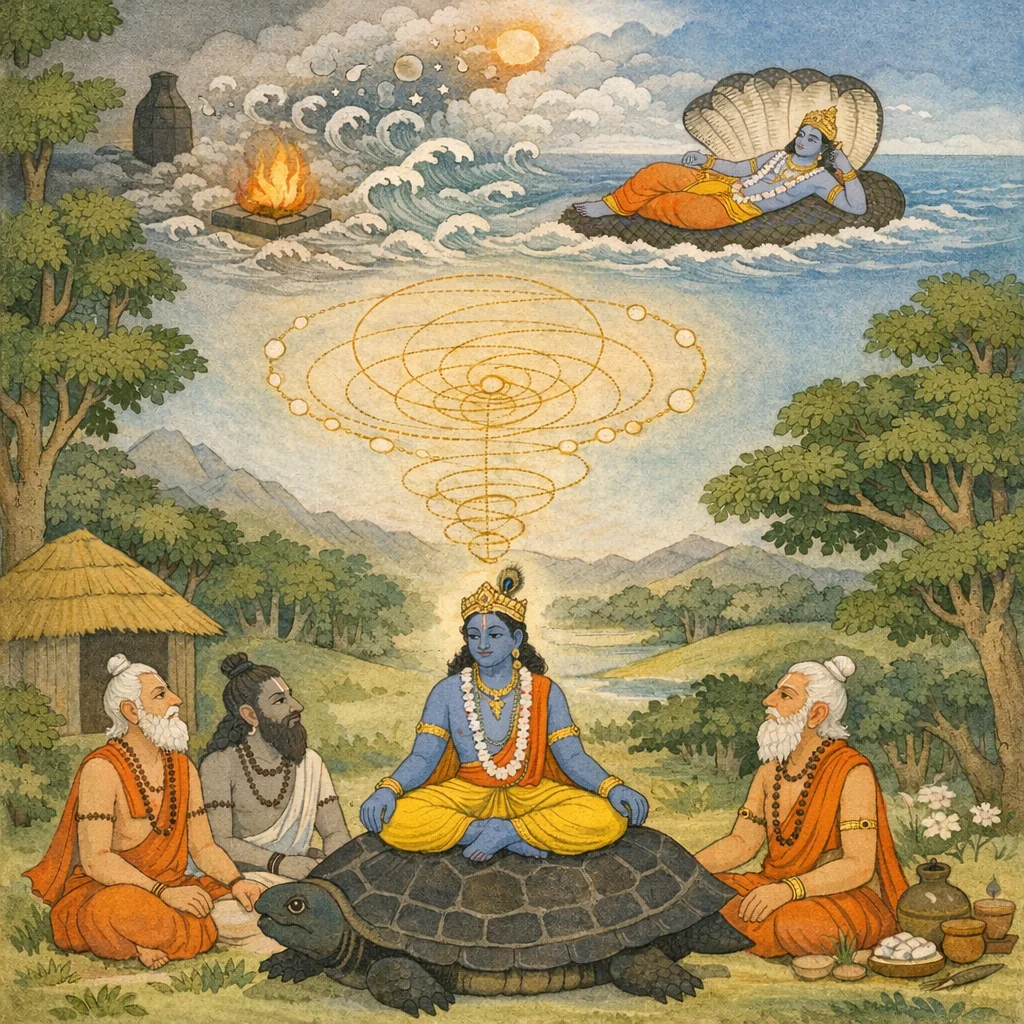
Continuing the Kūrma-avatāra’s instruction to the assembled twice-born, this chapter turns from general cosmology to exact time-reckoning. It begins with minute units (nimeṣa, kāṣṭhā, kalā, muhūrta), rises to human months and years, then to the gods’ day and night (ayana), and finally to the four-yuga cycle with the proportions of sandhyā and sandhyāṃśa. It places the yugas within manvantaras (seventy-one caturyugas) and the manvantaras within Brahmā’s day (kalpa) of a thousand yuga-cycles, showing the world’s repeated governance by successive Manus. From this quantitative cosmology the teaching becomes theological: at the end of Brahmā’s hundred-year measure, all tattvas return to Prakṛti in prākṛta pratisaṃcara, and even Brahmā, Nārāyaṇa, and Īśāna arise and dissolve by Kāla. The chapter closes by locating the present in Brahmā’s latter parārdha and naming the current Vārāha Kalpa (preceded by the Pādma Kalpa), preparing for the next chapter’s detailed account.
Shlokas
Verse 1
इति श्रीकूर्मपुराणे षट्साहस्त्र्यां संहितायां पूर्वंविभागे चतुर्थो ऽध्यायः श्रीकूर्म उवाच स्वयंभुवो विवृत्तस्य कालसंख्या द्विजोत्तमाः / न शक्यते समाख्यातुं बहुवर्षैरपि स्वयम्
Thus, in the Śrī Kūrma Purāṇa, in the six-thousand-verse Saṃhitā, in the Pūrva-bhāga, the Fourth Chapter begins. Śrī Kūrma said: “O best of the twice-born, the enumeration of time for the unfolding of Svāyambhuva’s cycle cannot truly be fully recounted—even by me—though one were to speak for many years.”
Verse 2
कालसंख्या समासेन परार्धद्वयकल्पिता / स एव स्यात् परः कालः तदन्ते प्रतिसृज्यते
In brief, the reckoning of time is conceived as consisting of two parārdhas. That alone is called the supreme measure of Time; and at its end, creation is brought forth again.
Verse 3
निजेन तस्य मानेन आयुर्वर्षशतं स्मृतम् / तत् पराख्यं तदर्धं च परार्धमभिदीयते
By its own standard of measurement, its lifespan is remembered as a hundred years; that is called a ‘para’, its half is termed ‘tad-ardha’, and its further half is described as ‘parārdha’.
Verse 4
काष्ठा पञ्चदश ख्याता निमेषा द्विजसत्तमाः / काष्ठास्त्रिंशत् कला त्रिंशत् कला मौहूर्तिकी गतिः
O best of the twice-born, fifteen nimeṣas are known as one kāṣṭhā; thirty kāṣṭhās make one kalā; and thirty kalās constitute the time-measure called a muhūrta.
Verse 5
तावत्संख्यैरहोरात्रं मुहूर्तैर्मानुषं स्मृतम् / अहोरात्राणि तावन्ति मासः पक्षद्वयात्मकः
By that number of muhūrtas, the human day-and-night is understood; and by that number of day-and-nights, a month—consisting of two fortnights (two pakṣas)—is constituted.
Verse 6
तैः षड्भिरयनं वर्षं द्वे ऽयने दक्षिणोत्तरे / अयनं दक्षिणं रात्रिर्देवानामुत्तरं दिनम्
By those six seasons, an ayana constitutes a year; and the two ayanas are the southern and the northern courses. The southern course is the night of the gods, and the northern course is their day.
Verse 7
दिव्यैर्वर्षसहस्त्रैस्तु कृतत्रेतादिसंज्ञितम् / चतुर्युगं द्वादशभिः तद्विभागं निबोधत
Measured in thousands of divine years, the cycle known as Kṛta, Tretā, and the rest is called the four-yuga age (caturyuga). Understand its division as consisting of twelve parts.
Verse 8
चत्वार्याहुः सहस्त्राणि वर्षाणां तत्कृतं युगम् / तस्य तावच्छती सन्ध्या सन्ध्यांशश्च कृतस्य तु
They declare that the Kṛta (Satya) Yuga consists of four thousand years; and for that yuga, the opening twilight (sandhyā) is of the same measure in hundreds of years, and likewise the concluding twilight portion (sandhyā-aṁśa) of the Kṛta Yuga.
Verse 9
त्रिशती द्विशती सन्ध्या तथा चैकशती क्रमात् / अंशकं षट्शतं तस्मात् कृसन्ध्यांशकं विना
In due order, the Sandhyā rite is enjoined with three hundred, two hundred, and then one hundred recitations. Therefore the total is six hundred portions—excluding the portion assigned to the kṛ-sandhyā, the deficient or abbreviated Sandhyā.
Verse 10
त्रिद्व्येकसाहस्त्रमतो विना सन्ध्यांशकेन तु / त्रेताद्वापरतिष्याणां कालज्ञाने प्रकीर्तितम्
Thus, in the science of time-reckoning it is taught that the spans of the Tretā, Dvāpara, and Tiṣya (Kali) ages are three, two, and one thousand years respectively, excluding the twilight portions (sandhyā and sandhyāṃśa).
Verse 11
एतद् द्वादशसाहस्त्रं साधिकं परिकल्पितम् / तदेकसप्ततिगुणं मनोरन्तरमुच्यते
This cycle is determined as twelve thousand years, with an additional portion; and that, multiplied by seventy-one, is said to be the interval of a Manu—a Manvantara.
Verse 12
ब्रह्मणो दिवसे विप्रा मनवः स्युश्चतुर्दश / स्वायंभुवादयः सर्वे ततः सावर्णिकादयः
O brāhmaṇas, within a single day of Brahmā there are fourteen Manus. They are all reckoned beginning with Svāyambhuva, and thereafter continuing with those beginning with Sāvarṇi.
Verse 13
तैरियं पृथिवी सर्वा सप्तद्वीपा सपर्वता / पूर्णं युगसहस्त्रं वै परिपाल्या नरेश्वरैः
By them, this entire earth—together with its seven continents and its mountains—was to be protected and governed by the lords of men for a complete thousand yugas.
Verse 14
मन्वन्तरेण चैकेन सर्वाण्येवान्तराणि वै / व्याख्यातानि न संदेहः कल्पं कल्पेन चैव हि
By explaining even a single Manvantara, all the intervening eras are thereby explained—have no doubt. In the same way, by describing one Kalpa, the Kalpas are explained as well.
Verse 15
ब्राह्ममेकमहः कल्पस्तावती रात्रिरिष्यते / चतुर्युगसहस्त्रं तु कल्पमाहुर्मनीषिणः
One day of Brahmā is called a Kalpa, and an equally long period is held to be his night. The wise declare that a Kalpa consists of a thousand cycles of the four yugas.
Verse 16
त्रीणि कल्पशतानि स्युः तथा षष्टिर्द्विजोत्तमाः / ब्रह्मणः कथितं वर्षं पराख्यं तच्छतं विदुः
O best of the twice-born, three hundred kalpas—and a further sixty—constitute what is called a ‘year of Brahmā’; that total is known as the measure reckoned in hundreds.
Verse 17
तस्यान्ते सर्वतत्त्वानां स्वहेतौ प्रकृतौ लयः / तेनायं प्रोच्यते सद्भिः प्राकृतः प्रतिसंचरः
At the end of that cycle, all the principles of reality (tattvas) dissolve back into their own causal source—Prakṛti. Therefore, the wise call this process the ‘prākṛta pratisaṃcara,’ the return (dissolution) into primordial Nature.
Verse 18
ब्रह्मनारायणेशानां त्रयाणां प्रकृतौ लयः / प्रोच्यते कालयोगेन पुनरेव च संभवः
It is taught that Brahmā, Nārāyaṇa, and Īśāna (Śiva)—these three—dissolve back into Prakṛti; and by the conjunction of Time (Kāla), they arise once again.
Verse 19
एवं ब्रह्मा च भूतानि वासुदेवो ऽपि शङ्करः / कालेनैव तु सृज्यन्ते स एव ग्रसते पुनः
Thus even Brahmā, all beings, Vāsudeva, and also Śaṅkara are brought forth by Time (Kāla) alone—and that very Time again consumes them.
Verse 20
अनादिरेष भगवान् कालो ऽनन्तो ऽजरो ऽमरः / सर्वगत्वात् स्वतन्त्रत्वात् सर्वात्मासौ महेश्वरः
He is beginningless—this Blessed Lord as Time (Kāla): infinite, undecaying, and deathless. Because He pervades all and is absolutely independent, that Mahā-īśvara is the Self (Ātman) within all beings.
Verse 21
ब्रह्माणो बहवो रुद्रा ह्यन्ये नारायणादयः / एको हि भगवानीशः कालः कविरिति श्रुति
Many are the Brahmās, many the Rudras, and likewise other divine rulers such as the Narāyaṇas; yet the Lord (Īśa) is one alone—He is Time itself, the all-knowing Seer (Kavi): so declares the Śruti.
Verse 22
एकमत्र व्यतीतं तु परार्धं ब्रह्मणो द्विजाः / सांप्रतं वर्तते तद्वत् तस्य कल्पो ऽयमष्टमः
O twice-born sages, one parārdha—half of Brahmā’s lifespan—has already elapsed; and now the corresponding latter half is likewise in progress—this present kalpa is the eighth of that series.
Verse 23
यो ऽतीतः सप्तमः कल्पः पाद्म इत्युच्यते बुधैः / वाराहो वर्तते कल्पः तस्य वक्ष्यामि विस्तरम्
The seventh kalpa that has passed is known by the wise as the Pādma (Lotus) Kalpa. The Vārāha (Boar) Kalpa is now in progress; I shall describe its details at length.
Frequently Asked Questions
It gives Kṛta as 4000 (divine) years with proportional dawn and dusk (sandhyā and sandhyāṃśa), and states Tretā, Dvāpara, and Kali as 3000, 2000, and 1000 years respectively, with twilight portions treated separately, yielding a 12,000-year yuga-cycle framework.
They are presented as cosmic functions that dissolve into Prakṛti at the end of the grand cycle and arise again through Kāla; the chapter emphasizes a samanvaya view where the one Lord as Time underlies and transcends these divine offices.