Adhyaya 3
Varnāśrama-Krama, Vairāgya as the Ground of Saṃnyāsa, and Brahmārpaṇa Karma-yoga
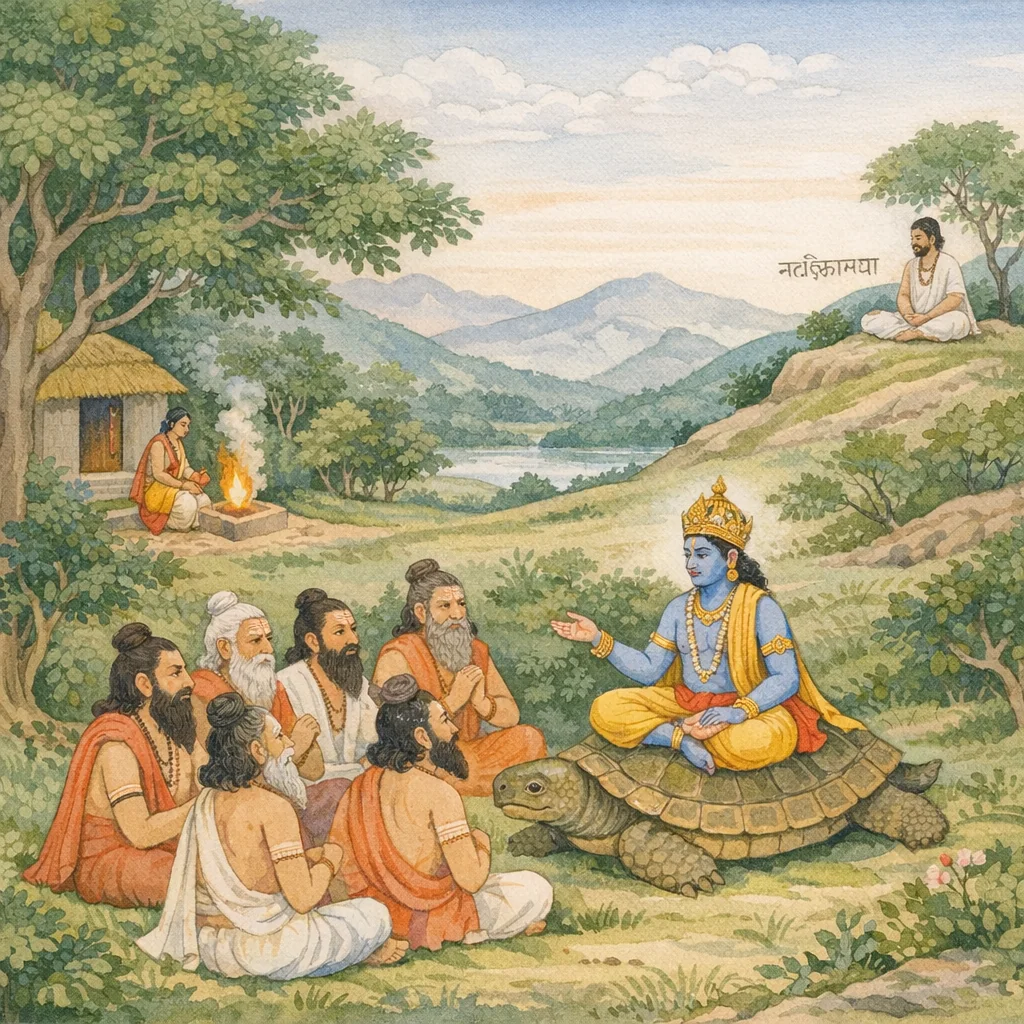
After the prior chapter’s teaching on the four varṇas and four āśramas, the sages ask for a step-by-step account of āśrama-dharma. Lord Kūrma sets forth the normal progression—brahmacarya, gṛhastha, vānaprastha, and yati/saṃnyāsa—allowing exceptions only for a “valid cause,” chiefly the rise of true knowledge, discernment, and intense vairāgya (dispassion). He details household duties—marriage, sacrifice, and progeny—yet concedes that overpowering vairāgya may authorize immediate renunciation even if customary rites are unfinished, and he states rules against reverting between āśramas. The teaching then turns from social-ritual order to inner liberation: renunciation is grounded in vairāgya; karma done without attachment to fruits becomes liberative; and the highest stance is brahmārpaṇa—offering all actions and their results to Brahman/Īśvara. From purified action arises serenity, from serenity Brahman-realization; knowledge and disciplined action together yield true yoga and naiṣkarmya, culminating in jīvanmukti and absorption in the Supreme Self (Maheśvara/Parameśvara). The chapter closes by affirming that spiritual siddhi depends on honoring, not transgressing, this integrated ordinance, preparing for further teachings on dharma, yoga, and realization.
Shlokas
Verse 1
इति श्रीकूर्मपुराणे षट्साहस्त्र्यां संहितायां पूर्वविभागे द्वितीयो ऽध्यायः ऋषय ऊचुः वर्णा भगवतोद्दिष्टाश्चत्वारो ऽप्याश्रमास्तथा / इदानीं क्रममस्माकमाश्रमाणां वद प्रभो
Thus, in the Śrī Kūrma Purāṇa, in the Ṣaṭsāhasrī Saṃhitā, in the Pūrvabhāga, the second chapter concludes. The sages said: “The Blessed Lord has taught the four varṇas, and likewise the four āśramas. Now, O Lord, tell us in due order about our āśramas.”
Verse 2
श्रीकूर्म उवाच ब्रह्मचारी गृहस्थश्च वानप्रस्थो यतिस्तथा / क्रमेणैवाश्रमाः प्रोक्ताः कारणादन्यथा भवेत्
Śrī Kūrma said: The āśramas are taught in their proper order—brahmacarya (student life), gṛhastha (householder), vānaprastha (forest-dweller), and yati/saṃnyāsa (renunciant). Only for a valid cause may one proceed otherwise.
Verse 3
उत्पन्नज्ञानविज्ञानो वैराग्यं परमं गतः / प्रव्रजेद् ब्रह्मचर्यात् तु यदिच्छेत् परमां गतिम्
When true knowledge and realized discernment arise, and supreme dispassion (vairāgya) is attained, one who seeks the highest goal should renounce the world even from the stage of brahmacarya.
Verse 4
दारानाहृत्य विधिवदन्यथा विविधैर्मखैः / यजेदुत्पादयेत् पुत्रान् विरक्तो यदि संन्यसेत्
Having taken a wife in the proper manner, one should perform sacrifices through various makha rites and beget sons; and when dispassion arises, one may then enter saṃnyāsa, renunciation.
Verse 5
अनिष्ट्वा विधिवद् यज्ञैरनुत्पाद्य तथात्मजम् / नगार्हस्थ्यं गृहीत्यक्त्वा संन्यसेद् बुद्धिमान् द्विजः
A wise twice-born (dvija) should not renounce the world after abandoning household life if he has not first performed the prescribed sacrifices according to rule and likewise has not begotten a son.
Verse 6
अथ वैराग्यवेगेन स्थातुं नोत्सहते गृहे / तत्रैव संन्यसेद् विद्वाननिष्ट्वापि द्विजोत्तमः
Then, when driven by the surge of dispassion (vairāgya), if he can no longer remain in householder life, the learned best of the twice-born should renounce right there—even if he has not performed the customary sacrifices.
Verse 7
अन्यथा विविधैर्यज्ञैरिष्ट्वा वनमथाक्षयेत् / तपस्तप्त्वा तपोयोगाद् विरक्तः संन्यसेद् यदि
Otherwise, having duly performed various sacrifices, one should withdraw to the forest; and after practising austerities—through the discipline of ascetic yoga—if dispassion (vairāgya) arises, one may renounce the world and enter sannyāsa.
Verse 8
वानप्रस्थाश्रमं गत्वा न गृहं प्रविशेत् पुनः / न संन्यासी वनं चाथ ब्रह्माचर्यं न साधकः
Having entered the āśrama of the forest-dweller (vānaprastha), one should not return again to the householder’s home. Likewise, a renunciant (saṃnyāsin) should not revert to the forest-dweller’s mode; nor should a spiritual aspirant (sādhaka) abandon his proper discipline and slip back into the brahmacarya stage.
Verse 9
प्राजापत्यां निरूप्येष्टिमाग्नेयीमथवा द्विजः / प्रव्रजेत गृही विद्वान् वनाद् वा श्रुतिचोदनात्
A learned twice-born householder, having duly arranged and performed the Prajāpatya sacrifice—or else the rite connected with Agni—should renounce and go forth (pravrajyā); or, after dwelling in the forest, he may take up renunciation in accordance with the injunction of the Śruti (the Veda).
Verse 10
प्रकर्तुमसमर्थो ऽपि जुहोतियजतिक्रियाः / अन्धः पङ्गुर्दरिद्रो वा विरक्तः संन्यसेद् द्विजः
Even if a twice-born man is unable to carry out the rites of juhoti and yajati (offerings and sacrifices), if he is blind, lame, poor, or inwardly detached with vairāgya, he should renounce and take up sannyāsa.
Verse 11
सर्वेषामेव वैराग्यं संन्यासाय विधीयते / पतत्येवाविरक्तो यः संन्यासं कर्तुमिच्छति
For everyone, dispassion (vairāgya) is prescribed as the essential basis for renunciation (saṃnyāsa). He who lacks vairāgya yet wishes to undertake saṃnyāsa surely falls.
Verse 12
एकस्मिन्नथवा सम्यग् वर्तेतामरणं द्विजः / श्रद्धावनाश्रमे युक्तः सो ऽमृतत्वाय कल्पते
Even if he abides properly in only one āśrama, a twice-born man—endowed with faith and disciplined in that stage of life—becomes fit for immortality (liberation).
Verse 13
न्यायागतधनः शान्तो ब्रह्मविद्यापरायणः / स्वधर्मपालको नित्यं सो ऽमृतत्वाय कल्पते
He whose wealth is gained by righteous means, who is tranquil, devoted to the knowledge of Brahman, and who continually upholds his own dharma—such a person becomes fit for immortality.
Verse 14
ब्रह्मण्याधाय क्रमाणि निःसङ्गः कामवर्जितः / प्रसन्नेनैव मनसा कुर्वाणो याति तत्पदम्
One who places all one’s actions in Brahman—remaining unattached, free from desire, and acting with a serene mind—attains that supreme state (the highest abode).
Verse 15
ब्रह्मणा दीयते देयं ब्रह्मणे संप्रदीयते / ब्रह्मैव दीयते चेति ब्रह्मार्पणमिदं परम्
The gift is offered by Brahman; it is offered into Brahman; and Brahman alone is what is offered—this is the supreme offering into Brahman.
Verse 16
नाहं कर्ता सर्वमेतद् ब्रह्मैव कुरुते तथा / एतद् ब्रह्मार्पणं प्रोक्तमृषिभिः तत्त्वदर्शिभिः
“I am not the doer. All of this is done by Brahman alone, in that very manner.” This has been taught by the seers who behold the Truth as “offering everything into Brahman” (brahmārpaṇa).
Verse 17
प्रीणातु भगवानीशः कर्मणानेन शाश्वतः / करोति सततं बुद्ध्या ब्रह्मार्पणमिदं परम्
May the Blessed Lord, the Eternal Īśa, be pleased by this act. For one who, with steady understanding, continually performs this supreme offering—dedicating all action unto Brahman.
Verse 18
यद्वा फलानां संन्यासं प्रकुर्यात् परमेश्वरे / कर्मणामेतदप्याहुः ब्रह्मार्पणमनुत्तमम्
Or else, one should renounce the fruits of actions unto Parameśvara, the Supreme Lord; this too, the wise declare, is the unsurpassed offering of one’s deeds to Brahman.
Verse 19
कार्यमित्येव यत्कर्म नियतं सङ्गवर्जितम् / क्रियते विदुषा कर्म तद्भवेदपि मोक्षदम्
That action which is fixed as one’s ordained duty and is performed solely because it ought to be done—free from attachment—is, when undertaken by the wise, capable even of granting liberation (mokṣa).
Verse 20
अन्यथा यदि कर्माणि कुर्यान्नित्यमपि द्विजः / अकृत्वा फलसंन्यासं बध्यते तत्फलेन तु
Otherwise, even if a twice-born (dvija) performs actions every day, if he does not renounce attachment to their fruits, he is indeed bound by those very results.
Verse 21
तस्मात् सर्वप्रयत्नेन त्यक्त्वा कर्माश्रितं फलम् / अविद्वानपि कुर्वोत कर्माप्नोत्यचिरात् पदम्
Therefore, with every effort, having abandoned the fruit that depends on action, even one who is not learned should still perform one’s duties; by action done without attachment, one quickly attains the Supreme state.
Verse 22
कर्मणा क्षीयते पापमैहिकं पौर्विकं तथा / मनः प्रसादमन्वेति ब्रह्म विज्ञायते ततः
By righteous action, sin is worn away—both that arising in this life and that carried over from the past. Then serenity of mind follows, and from that, Brahman is truly realized.
Verse 23
कर्मणा सहिताज्ज्ञानात् सम्यग् योगो ऽबिजायते / ज्ञानं च कर्मसहितं जायते दोषवर्जितम्
From knowledge conjoined with disciplined action, true Yoga is born; and knowledge itself, when united with action, arises free from doṣa—faults and impurities.
Verse 24
तस्मात् सर्वप्रयत्नेन तत्र तत्राश्रमे रतः / कर्माणीश्वरतुष्ट्यर्थं कुर्यान्नैष्कर्म्यमाप्नुयात्
Therefore, with every effort, devoted to the duties of one’s own āśrama (stage of life), one should act for the sake of pleasing the Lord (Īśvara); thus one attains naiṣkarmya, the state beyond action.
Verse 25
संप्राप्य परमं ज्ञानं नैष्कर्म्यं तत्प्रसादतः / एकाकी निर्ममः शान्तो जीवन्नेव विमुच्यते
Having attained the supreme knowledge and naiṣkarmya through His grace, one becomes solitary in inward absorption, free from possessiveness, and tranquil—and is liberated even while still living.
Verse 26
वीक्षते परमात्मानं परं ब्रह्म महेश्वरम् / नित्यानन्दं निराभासं तस्मिन्नेव लयं व्रजेत्
One should behold the Supreme Self—the highest Brahman, the Great Lord Maheśvara—as eternal bliss, beyond all appearances; and, in Him alone, one should enter absorption (laya).
Verse 27
तस्मात् सेवेत सततं कर्मयोगं प्रसन्नधीः / तृप्तये परमेशस्य तत् पदं याति शाश्वतम्
Therefore, with a clear and tranquil mind, one should constantly practice Karma-yoga; for the satisfaction of Parameśvara, one thereby attains That eternal state, the supreme abode.
Verse 28
एतद् वः सथितं सर्वं चातुराश्रम्यमुत्तमम् / न ह्येतत् समतिक्रम्य सिद्धिं विन्दति मानवः
Thus has the entire, highest ordinance of the four āśramas been set forth for you. For a human being does not attain siddhi—spiritual fulfillment—by transgressing this.
Frequently Asked Questions
Saṃnyāsa is authorized primarily by the rise of true knowledge (jñāna), realized discernment, and intense vairāgya; without dispassion, taking renunciation is said to lead to a fall.
It presents the normative expectation for a twice-born householder—proper marriage, prescribed sacrifices, and progeny—yet permits renunciation when overpowering dispassion makes household life untenable, even if customary sacrifices are incomplete.
Brahmārpaṇa is the inner offering in which the agent, action, and oblation are contemplated as Brahman; one acts without doership and offers deeds (or their fruits) to the Supreme, making karma itself a means toward purification and liberation.
Ordained duty performed without attachment to results purifies sin, yields serenity, and supports Brahman-realization; action bound to desire and fruit-binding attachment produces bondage, whereas niṣkāma karma can be liberative.
It speaks of the Supreme Self as highest Brahman and also as Maheśvara/Parameśvara, reflecting the Purāṇa’s Samanvaya tendency—uniting Vedāntic Brahman-realization with Īśvara-devotion vocabulary.