Adhyaya 93
Yājñavalkya on the Sources of Dharma and the Saṁskāras of the Twice-Born
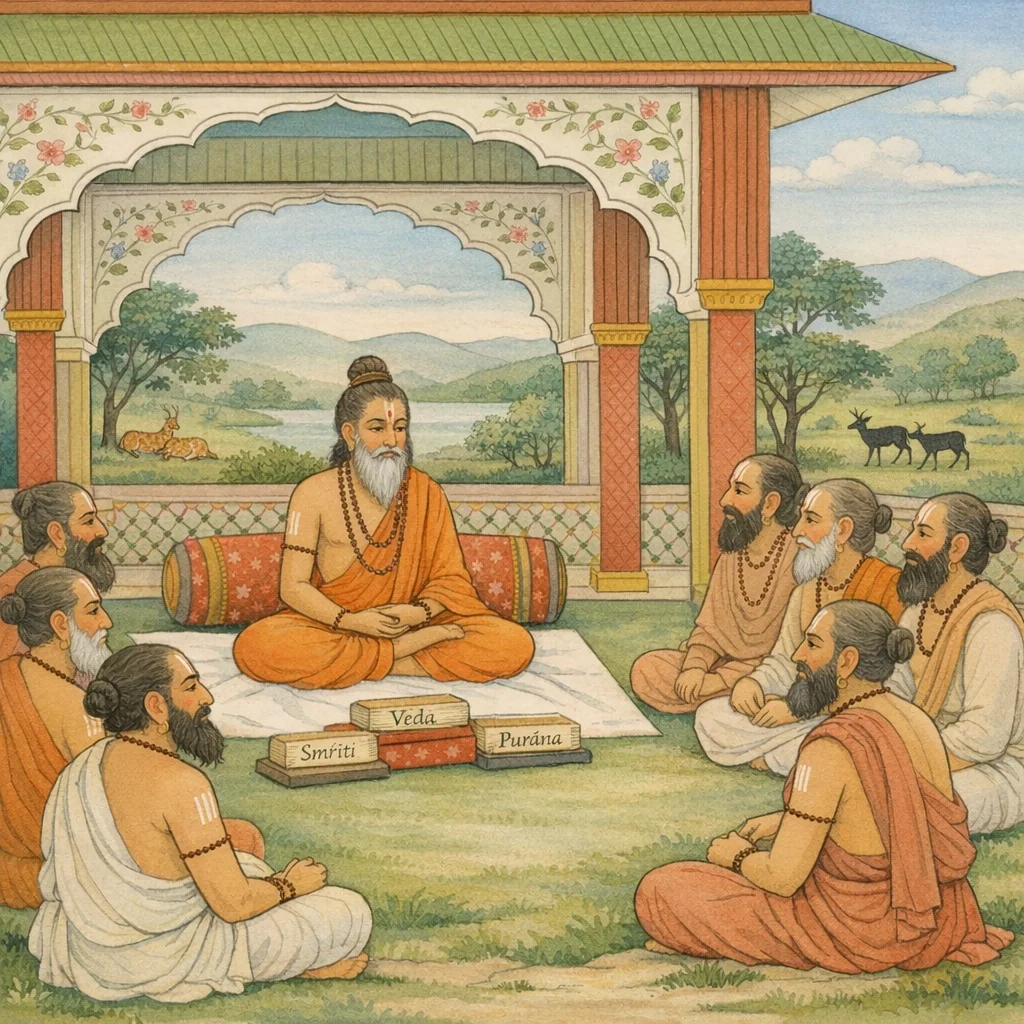
Continuing the Ācāra Khaṇḍa’s concern with normative life, Maheśvara asks Hari to recount how Yājñavalkya taught Dharma in ancient times. Hari tells of sages approaching Yājñavalkya in Mithilā and receiving instruction while he abides in a Viṣṇu-centered contemplative state. Yājñavalkya first locates Dharma geographically and interpretively—where the black antelope ranges, and where Dharma is understood in harmony with the Purāṇas, Nyāya, Mīmāṃsā, and the auxiliaries of Dharmaśāstra. He then establishes the Veda as the foundation, names major Dharmaśāstra authorities, and sets a lineage-based framework for judging right conduct. Dharma is enacted through principled dāna and virtues such as self-restraint and ahiṃsā, culminating in yoga-realization as the highest Dharma. When doubt arises, decisions are authorized through a council of Veda–Dharma experts or a foremost knower of the Self. The chapter then turns to varṇa-based duties, defining the four orders and introducing the saṁskāra sequence for the twice-born, preparing for later discussion of household rites, obligations, and life-stage disciplines.
Shlokas
Verse 1
द्विनवतितमो ऽध्यायः महेश्वर उवाच / याज्ञवल्क्येन यत्पूर्वं धर्मं प्रोक्तं कयं हरे ! / तन्मे काथय केशिघ्न ! यथा तत्त्वेन माधव !
Chapter Ninety-Two. Maheśvara said: “O Hari, how was that Dharma formerly taught by Yājñavalkya? Tell it to me, O slayer of Keśin—O Mādhava—exactly as it truly is.”
Verse 2
हरिरुवाच / याज्ञवल्क्यं नमस्कृत्य मिथिलायां समास्थितम् / अपृच्छन्नॄषयो गत्वा वर्णधर्माद्यशेषतः / तेभ्यः स कथयामास विष्णुं ध्यात्वा जितेन्द्रियः
Hari said: Having bowed to Yājñavalkya, who was residing in Mithilā, the sages went to him and questioned him in full about the duties of the social orders and all related matters. He then explained it to them—meditating on Viṣṇu and with his senses fully restrained.
Verse 3
याज्ञवल्क्य उवाच / यस्मिन्देशे मृगः कृष्णस्तस्मिन्धर्मान्निबोधत / पुराणन्यायमीमांसाधर्मशास्त्राङ्गमिश्रिताः
Yājñavalkya said: In whatever land the black antelope is found, know that there the teachings of Dharma are to be understood—Dharma blended with the Purāṇas, Nyāya, Mīmāṁsā, and the auxiliary limbs of the Dharmaśāstras.
Verse 4
वेदाः स्थानानि विद्यानां धर्मस्य च चतुर्दश / वक्तारो धर्मशास्त्राणां मनुर्विष्णुर्यमो ऽङ्गिराः
The Vedas are the foundations of all branches of knowledge, and the sources of Dharma are said to be fourteen. The authoritative expounders of the Dharma-śāstras are Manu, Viṣṇu, Yama, and Aṅgiras.
Verse 5
वसिष्ठदक्षसंवर्तशातातपपराशराः / आपस्तम्बोशनोव्यासाः कात्यायनबृहस्पती
Vasiṣṭha, Dakṣa, Saṃvarta, Śātātapa, and Parāśara; Āpastamba, Uśanā (Śukra), Vyāsa, Kātyāyana, and Bṛhaspati—these revered sages and teachers are cited as authorities.
Verse 6
गौतमः शङ्खलिखितो हारीतो ऽत्रिरहं तथा / एते विष्णुं समाराध्य जाता धर्मोपदेशकाः
Gautama, Śaṅkha and Likhita, Hārīta, Atri, and I as well—having duly worshipped Viṣṇu—became teachers who instruct the world in Dharma.
Verse 7
देशकाल उपायेन द्रव्यं श्रद्धासमन्वितम् / पात्रे प्रदीयते यत्तत्सकलं धर्मलक्षणम्
Whatever offering of wealth is given—according to proper place, time, and appropriate means—endowed with faith and bestowed upon a worthy recipient: all of that is regarded as the true mark of dharma.
Verse 8
इज्याचारो दमो ऽहिंसा दानं स्वाध्यायकर्म च / अयं च परमो धर्मो यद्योगेनात्मदर्शनम्
Worshipful conduct, self-restraint, ahiṃsā (non-violence), charity, and the practice of svādhyāya—sacred study—are dharma as well; yet the supreme dharma is that by which, through yoga, one attains the direct vision of the Self (Ātman).
Verse 9
चत्वारो वेदधर्मज्ञाः पर्षत्त्रैविद्यमेव वा / सा ब्रूते यत्स्वधर्मः स्यादेको वाध्यात्मवित्तमः
Alternatively, let there be an assembly of four who know the Veda and Dharma (or a council proficient in the three Vedas). That council should declare what one’s svadharma—one’s proper duty—may be; or else a single person foremost in knowledge of the Self (adhyātma) may determine it.
Verse 10
ब्रह्मक्षात्त्रियविट्शूद्रा वर्णास्त्वाद्यास्त्रयो द्विजाः / निषेकाद्याः श्मशानान्तास्तेषां वै मन्त्रतः क्रियाः
The four social orders are Brāhmaṇa, Kṣatriya, Vaiśya, and Śūdra; among them, the first three are called dvija, “twice-born.” For them, the prescribed rites—from conception onward up to the final rites at the cremation-ground—are to be performed with Vedic mantras.
Verse 11
गर्भाधानमृतौ पुंसः सवनं स्पन्दनात्पुरा / षष्ठे ऽष्टमे वा सीमन्तः प्रसवे जातकर्म च
At the proper season for conception, the rite of garbhādhāna is performed for the man; and before the foetus begins to stir, the savana rite is done. In the sixth month—or else in the eighth—the sīmanta rite is performed; and at the time of birth, the jātakarma rite as well.
Verse 12
अहन्येकादशे नाम चतुर्थे मासि निष्क्रमः / षष्ठे ऽन्नप्राशनं मासि चूडां कुर्याद्यथाकुलम्
On the eleventh day (after birth) the naming rite should be performed; in the fourth month the child should be taken out for the first time; in the sixth month the annaprāśana—the first feeding of solid food—should be done; and the cūḍā rite (first shaving/tuft) should be performed in the proper month according to one’s family tradition.
Verse 13
एवमेनः शमं याति बीजगर्भसमुद्भवम् / तूष्ण ईमेताः क्रियाः स्त्रीणां विवाहश्च समन्त्रकः
Thus the sin born of seed and womb (sexual or gestational transgression) comes to rest. These rites for women are to be performed in silence; and marriage, too, is to be conducted with the proper mantras.
Frequently Asked Questions
It functions as a traditional marker of the land where Vedic practice is established and where Dharma teachings are culturally and ritually intelligible—signaling a normative geography for Vedic-Dharma instruction.
The text recommends either an assembly of four Veda–Dharma experts (or a council proficient in the three Vedas) to declare one’s proper duty, or, alternatively, a single person foremost in Self-knowledge to determine it.
It lists garbhādhāna (conception rite), savana/puṁsavana (before fetal stirring), sīmanta (6th or 8th month), jātakarma (at birth), nāmakaraṇa (11th day), niṣkramaṇa (4th month outing), annaprāśana (6th month first solid food), and cūḍākaraṇa (tonsure), covering conception through early childhood.