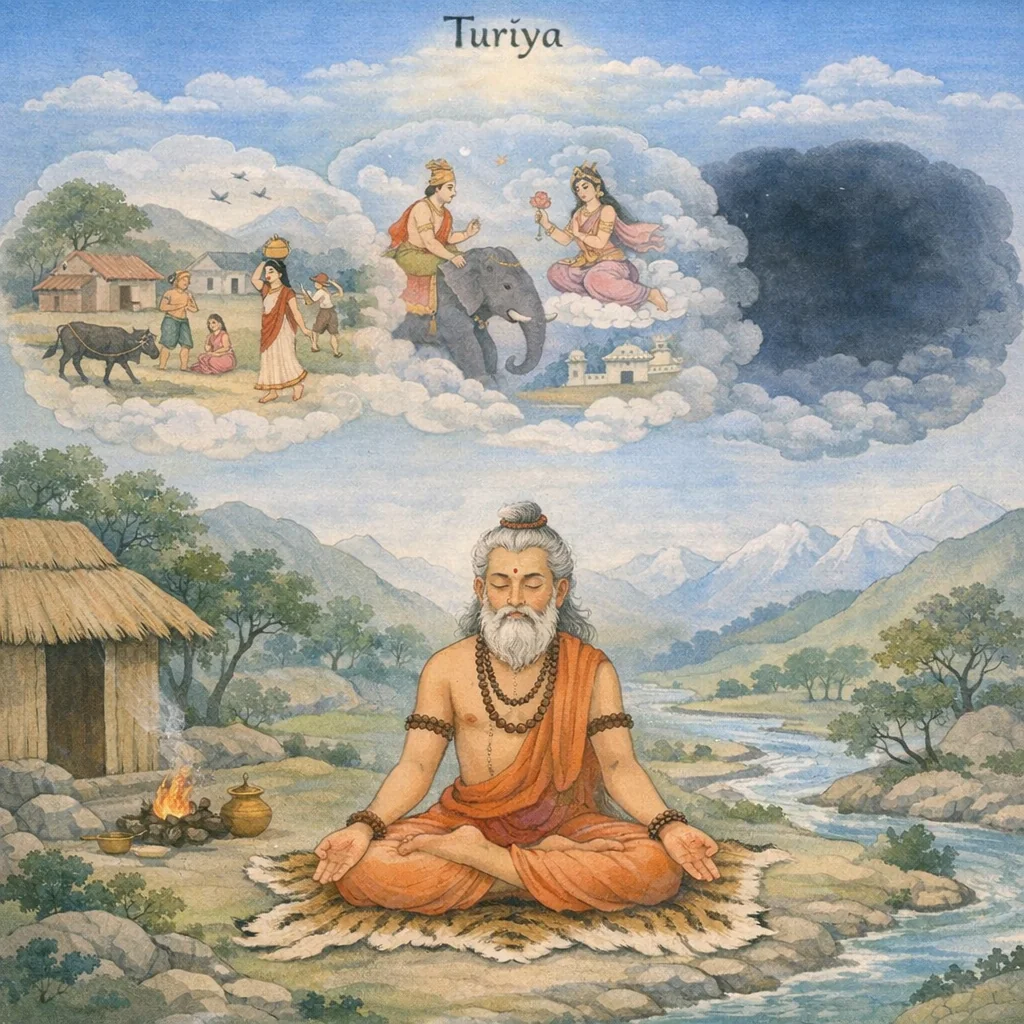
Adhyaya 91
Brahman Beyond the Elements and the Three States (Turīya) — Dhyāna Leading to Brahma-realization
The chapter begins with Sūta praising sages devoted to vows, disciplined conduct, worship, contemplation, hymns, and mantra-recitation as ways of meditating on Hari. It then gives a rigorous apophatic portrayal of the Supreme—beyond the body-mind apparatus, beyond space and elemental qualities, untouched by guṇas, vāsanās, grief, delusion, aging, death, origin, and dissolution. Blending cosmic lordship (ruler of beings and states of consciousness) with non-dual transcendence (partless, nameless, beyond causality), it culminates in identifying the Supreme as Turīya. Vedānta is affirmed as the means to know this Reality; sensory-transcendence beyond sound, taste, touch, form, and scent is stressed; and the teaching peaks in the realization, “I am Brahman.” The instruction then turns to practice: a self-controlled seeker should meditate on Mahādeva to become established in Brahman. The final verse signals continuation through a question addressed to Vṛṣadhvaja, carrying the dialogue into the next chapter’s inquiry.
Shlokas
Verse 1
तस्यां तस्य सुतो जज्ञे महावीर्यो महाद्युतिः / सूत उवाच / स्वायम्भुवाद्या मुनयो हरिं ध्यायन्ति कर्मणा / व्रताचारार्चनाध्यानस्तुतिजप्यपरायणाः
In her, his son was born—of great valor and great splendor. Sūta said: The sages beginning with Svāyambhuva meditate upon Hari through their sacred duties—devoted to vows and disciplined conduct, worship, contemplation, hymns of praise, and the recitation of mantras (japa).
Verse 2
देहेन्द्रियमनोबुद्धिप्राणाहङ्कारवर्जितम् / आकशेन विहीनं वै तेजसा परिवर्जितम्
It is devoid of body, senses, mind, intellect, vital breath (prāṇa), and ego (ahaṅkāra); indeed, it is without ākāśa (space) and bereft of tejas (fire/heat).
Verse 3
उदकेन विहीनं वै तद्धर्मपरिवर्जितम् / पृथिवीरहितं चैव सर्वभतविवर्जितम्
Indeed, that which is devoid of water is bereft of its proper dharma and rites; and that which is without earth is likewise abandoned—deprived of all beings, of all living support.
Verse 4
भूताध्यक्षं तथा बद्धनियन्तारं प्रभुं विभुम् / चैतन्यरूपतारूपं सर्वाध्यक्षं निरञ्जनम्
He is the Overseer of all beings; the controller even of bound souls; the Lord, the all-pervading Sovereign—of the very nature of pure consciousness, the form underlying all forms—Ruler of all, stainless and untainted.
Verse 5
मुक्तसङ्गं महेशानं सर्वदेवप्रपूजितम् / तेजोरूपमसत्त्वं च तपसा परिवर्जितम्
He is Maheśāna, the Great Lord—free from all attachment, worshipped by all the gods; of the very form of radiance, untouched by material qualities, and not to be reached by austerity alone.
Verse 6
रहितं रजसा नित्यं व्यतिरिक्तं गुणैस्त्रिभिः / सर्वरूपविहीनं वै कर्तृत्वादिविवर्जितम्
It is ever free from rajas, distinct from the three guṇas; indeed, it is devoid of all forms and bereft of agency and the like.
Verse 7
वासनारहितं शुद्धं सर्वदोषविवर्जितम् / पिपासावर्जितं तत्तच्छो कमोहविवर्जितम्
It is free from vāsanās, pure, and devoid of all faults; free from thirst, and also free from grief and delusion.
Verse 8
जरामरणहीनं वै कूटस्थं मोहवर्जितम् / उत्पत्तिरहितं चैव प्रलयेन विवर्जितम्
Indeed, (the Self/Brahman) is free from old age and death—unchanging, devoid of delusion; without origin, and also untouched by dissolution (pralaya).
Verse 9
सत्यं सर्वाचारहीनं निष्कलं परमेश्वरम् / जाग्रत्स्वप्नसुषुप्त्यादिवर्जितं नामवर्जितम्
He is Truth itself—beyond all conventional observances; partless and the Supreme Lord—free from the states of waking, dreaming, and deep sleep, and beyond all names.
Verse 10
अध्यक्षं जाग्रदादीनां शान्तरूपं सुरेश्वरम् / जाग्रदादिस्थितं नित्यं कार्यकारणवर्जितम्
He is the overseer of the waking state and the other states, the Lord of the gods whose very nature is peace; ever present in waking and the rest, eternal, and free from the chain of cause and effect.
Verse 11
सर्वदृष्टं तथा मूर्तं सूक्ष्मं सूक्ष्मतरं परम् / ज्ञानदृक् श्रोत्रविज्ञानं परमानन्दरूपकम्
It is the seer of all, and also the manifest (formed); it is subtle, subtler still, and supreme—known through the eye of knowledge and the discerning power of hearing—its very nature being the highest bliss.
Verse 12
विश्वेन रहितं तद्वत्तैजसेन विवर्जितम् / प्राज्ञेन रहितञ्चैव तुरीयं परमाक्षरम्
That (Supreme) is devoid of the waking state (viśva), likewise free from the dream state (taijasa), and also devoid of the deep-sleep state (prājña); it is the Fourth (turīya)—the supreme, imperishable Reality.
Verse 13
सर्वगोप्तृ सर्वहन्तृ सर्वभूतात्मरूपि च / बुद्धिधर्मविहीनं वै निराधारं शिवं हरिम्
He is the protector of all and the destroyer of all; He assumes the form of the Self within all beings. Truly, He is beyond the attributes of intellect and dharma—supportless (without any other ground), auspicious, Hari (Viṣṇu).
Verse 14
विक्रियारहितं चैव वेदान्तैर्वेद्यमेव च / वेदरूपं परं भूतमिन्द्रियेभ्यः परं शुभम्
That Supreme Reality is indeed free from all modification; it is knowable through the Vedānta. It is of the very nature of the Veda, the highest Being—auspicious and beyond the senses.
Verse 15
शब्देन वर्जितञ्चैव रसेन च विवर्जितम् / स्पर्शेन रहितं देवं रूपमात्रविवर्जितम्
That Divine Reality is devoid of sound and also devoid of taste; it is without touch, and it transcends mere form as well.
Verse 16
रूपेण रहितं ञ्चैव गन्धेन परिवर्जितम् / अनादि ब्रह्म रन्ध्रान्तमहं ब्रह्मास्मि केवलम्
Devoid of form and also free from scent, I am the beginningless Brahman that abides within the inner aperture of consciousness. I am Brahman alone.
Verse 17
एवं ज्ञात्वा महादेवध्यानं कुर्याज्जितेन्द्रियः / ध्यानं यः कुरुते ह्येवं स भवेद्बह्म मानवः
Knowing thus, a self-controlled person should practice meditation on Mahādeva. Whoever meditates in this manner becomes a person established in Brahman.
Verse 18
अधुना कथयाम्यन्यत्किन्तद्ब्रूहि वृषध्वज
Now I shall tell you something else; but tell me this, O Vṛṣadhvaja.
Frequently Asked Questions
It describes the Supreme as lacking body, senses, mind, intellect, prāṇa, and ego, and as beyond sensory objects (sound, taste, touch, form, scent). This is a Vedāntic strategy: denying limiting adjuncts while affirming the Supreme as pure consciousness, bliss, and the overseer of all.
Because tapas without right knowledge and contemplation can remain within the sphere of guṇas and doership. The chapter emphasizes Vedānta-based knowing and disciplined meditation as the direct means to realization, with austerity serving as support rather than the sole cause.