Adhyaya 77
Pulaka-Lakṣaṇa (Auspicious Horripilation), Sacred Designs, and Inauspicious Omens
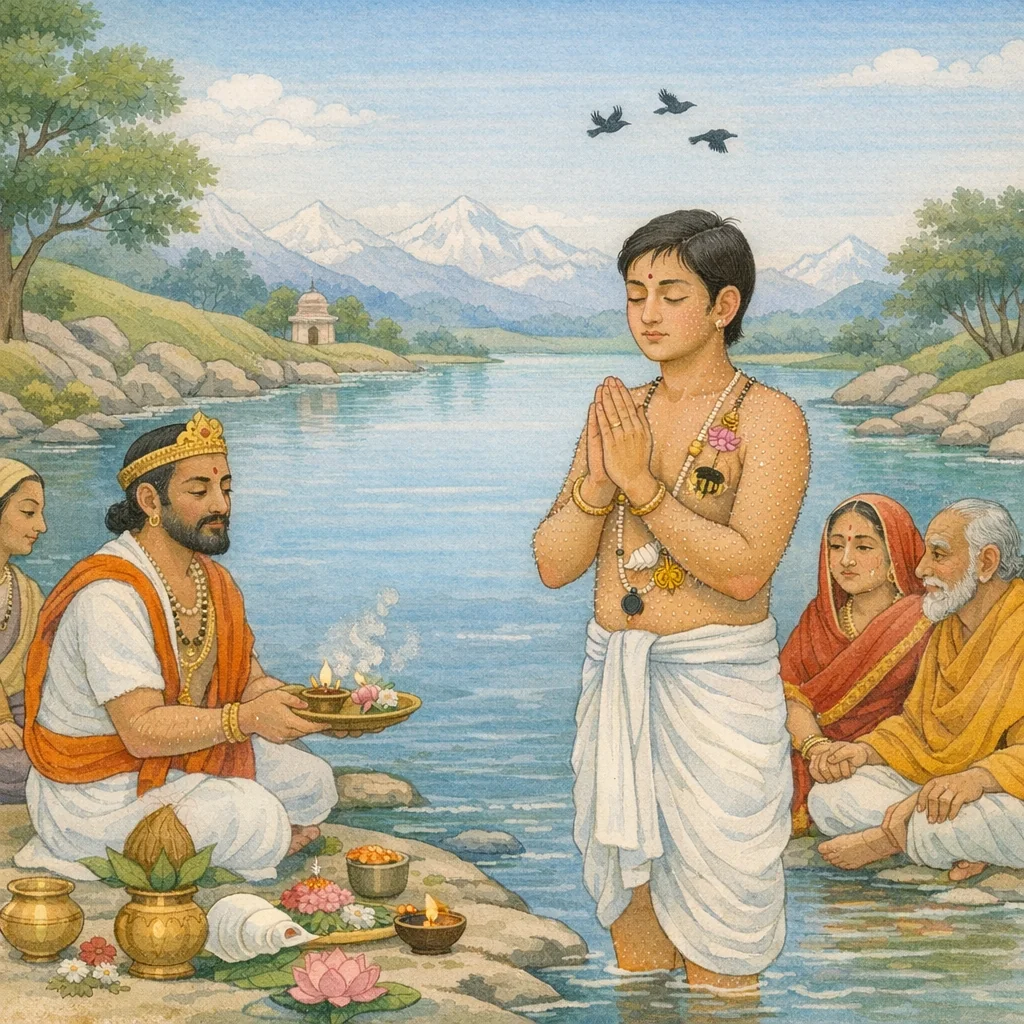
Sūta describes devotees journeying through sacred landscapes—mountains, rivers, and northern holy regions—who establish and honor a radiant manifestation, stressing tīrtha-based consecration and bhakti. The teaching then turns to śārīrika-lakṣaṇa, listing auspicious forms of pulaka (horripilation), likened to flowers, seeds, collyrium, honey, lotus-fiber, Gandharva-fire, and the glow of a plantain stem, showing that devotional feeling is read through bodily signs. Next, sacred marks or ornaments bearing conch, lotus, bee, and sun motifs, threaded with sacred cords, are praised as pure and prosperity-giving when they express devotion. The chapter ends with a warning of inauspicious nimitta: crows and flesh-smeared scavengers (dogs, jackals, wolves, vultures) are said to bring death and should be avoided, followed by a brief practical note on the stated price of a pala. Thus the lore of signs bridges tīrtha worship to broader dharma-guidance on auspiciousness and daily discernment.
Shlokas
Verse 1
नाम षट्सप्ततितमो ऽध्यायः सूत उवाच / पुण्येषु पर्वतवरेषु च निम्नगासु स्थानान्तरेषु च तथोत्तरदेशगत्वात् / संस्थापिताः स्वनखबाहुगतेः प्रकाशं संपूज्य दानवपतिं प्रथिते प्रदेशे
Sūta said: In sacred regions—on excellent mountains, beside rivers, and in other holy places—and having also gone to the northern country, they established and worshipped the radiant manifestation that had appeared through the power of their own nails and arms, and duly honored the lord of the Dānavas in that renowned land.
Verse 2
दाशार्णवागदर (व) मेकलकालगादौ गुञ्जाञ्जनक्षौद्रमृणालवर्णाः / गन्धर्ववह्निकदलीसदृशावभासा एते प्रशस्ताः पुलकाः प्रसूताः
These are the auspicious kinds of pulaka (devotional horripilation) that arise: those colored like the Dāśārṇa flower, the āgada plant, and the Mekalā-kālagā; like guñjā seeds, añjana (collyrium), honey, and lotus-fiber; and those whose radiance resembles the fire of the Gandharvas and the plantain stem—such pulakas are held to be commendable.
Verse 3
शङ्खाब्जभृङ्गार्कविचित्रभङ्गा सूत्रैरुर् (व्य) पेताः परमाः पवित्राः / मङ्गल्ययुक्ता बहुभक्तिचित्रा वृद्धिप्रदास्ते पुलका भवन्ति
Adorned with varied designs of conch, lotus, bee, and sun, and strung together with sacred threads, they are supremely pure. Auspicious in nature and displaying many forms of bhakti, those sacred marks (or ornaments) are called ‘pulakā’ and grant increase and prosperity.
Verse 4
काका (क।)श्वरासभसृगालवृकोग्ररूपैर्गृध्रैः समांसरुधिरार्द्रमुखैरुपेताः / मृत्युप्रदाश्च विदुषा परिवर्जनीया मूल्यं पलस्य कथितं च शतानि पञ्च
Crows—together with terrifying forms such as dogs, jackals, wolves, and vultures—whose mouths are smeared with flesh and blood, are said to be death-bringing; therefore, the wise should avoid them. The price of a pala is stated to be five hundred (units).
Frequently Asked Questions
By foregrounding worship performed in mountains, riverbanks, and renowned northern regions, the chapter reinforces the Purāṇic view that tīrtha-sevā and consecration intensify devotional practice—place and rite acting as supports for inner transformation.
The chapter frames pulaka as a commendable sign when it manifests with auspicious qualities, implying a sattvic inner condition shaped by prior saṁskāras and devotional orientation. While not a direct karma-vipāka ledger, it treats the body as reflecting inner spiritual maturation.