Adhyaya 61
Candra-sthiti, Dvādaśa-avasthā, Nakṣatra-śubha-aśubha, Yātrā-dik, and Graha-bhāva-phala
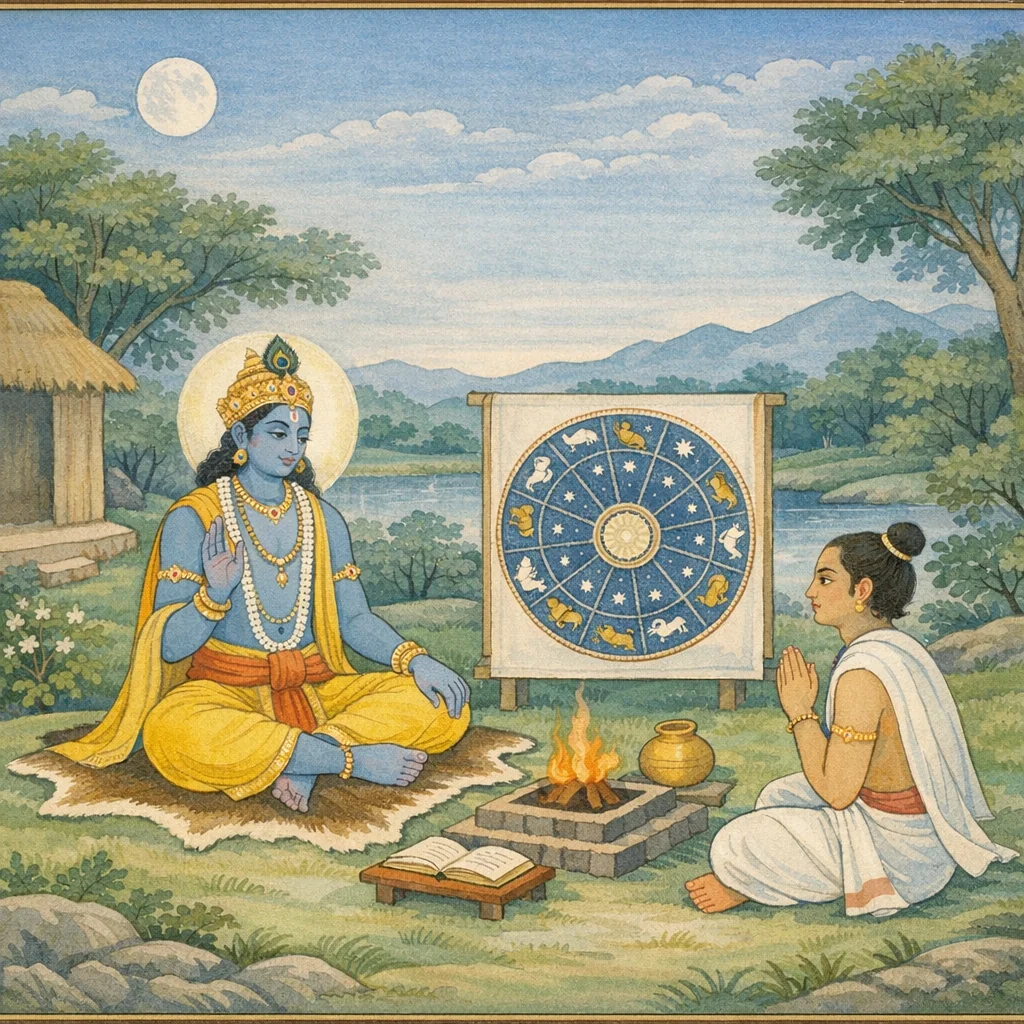
Continuing the Purāṇic mode of instruction in which Hari teaches practical dharma, this chapter turns from general auspicious conduct to lunar-based time selection (muhūrta). It describes favorable Moon placements—especially the Moon in the seventh position and in upacaya houses—and highlights certain śukla tithis as highly auspicious. Hari then sets out twelve lunar “states,” each tied to definite results: grief, enjoyment, fever, trembling, happiness, royal honor, quarrel, gain of relationships, wealth, worship, danger, accomplishment, victory, and finally, in the twelfth, an unavoidable death-result. The teaching expands to nakṣatra omens, including reunion and recovery, and gives travel-direction sequences keyed to starting stars (Kṛttikā, Maghā, Anurādhā), along with a northward-journey set and a list of always-auspicious nakṣatras for marriage, travel, and consecration. It closes with house-wise effects of planetary placements (lagna through twelfth) and sign-pair comparisons (including the 6/8 relation) to judge affection and relative excellence, preparing for the next discussions on applied astrological results and timing rules.
Shlokas
Verse 1
नाम षष्टितमो ऽध्यायः हरिरुवाच / सप्तमोपचयाद्यस्थश्चन्द्रः सर्वत्र शोभनः / शुक्लपक्षे द्वितीयस्तु पञ्चमो नवमस्तथा
Hari said: “The Moon, when situated in the seventh position and in the upacaya (growth-giving) places, is auspicious everywhere. In the bright fortnight (Śukla-pakṣa), the 2nd, 5th, and 9th lunar days (tithi) are likewise especially auspicious.”
Verse 2
संपूज्यमानो लोकैस्तु गुरुवद्दृश्यते शशी / चन्द्रस्य द्वादशावस्था भवन्ति शृणु ता अपि
When the Moon is duly worshipped by people, Śaśī (the Moon) appears like a venerable guru. Hear also: the Moon has twelve distinct states.
Verse 3
त्रिषुत्रिषु च ऋक्षेषु अश्विन्यादि वदाम्यहम् / प्रवासस्थं पुनर्दृष्टं मृतावस्थं जयावहम्
Now I shall declare the fruits connected with the lunar mansions beginning with Aśvinī—set forth in groups of three constellations: seeing again one who is away from home, meeting one thought lost, and even gaining victory over a condition that seems like death.
Verse 4
हास्यावस्थं नता(क्रीडा) वस्थं प्रमोदावस्थमेव च / विषादावस्थभोगस्थे ज्वरावस्थं व्यवस्थितम्
There are states such as laughter, the state of performance and play, and the state of delight; likewise, amid sorrow and amid indulgence, the state of fever is also said to arise and become established.
Verse 5
कम्पा(न्या) वस्थं सुखावस्थं द्वादशावस्थगं भवेत् / प्रवासो हानिमृन्यृ च जयो हासेरतिः सुखम्
Within the twelvefold order of conditions there are states of agitation and states of ease. From them arise outcomes such as being away from home, loss and even death; and also victory, laughter, delight, and happiness.
Verse 6
शोको भोगो ज्वरः कम्पः सुखं चेति क्रमात्फलम् / जन्मस्थः कुरुते तुष्टिं द्वितीये नास्ति निर्वृतिः
In proper sequence the results are: grief, enjoyment, fever, trembling, and then happiness. In the first state, the being situated in birth feels satisfaction; in the second, there is no true contentment.
Verse 7
तृतीये राजसन्मानं चतुर्थे कलहागमः / पञ्चमेन मृगाङ्केन स्त्रीलाभो वै तथा भवेत्
In the third phase there is honour from the king; in the fourth, the arising of quarrel; and in the fifth, marked by the Moon, there indeed occurs the gain of a woman—attainment of a wife or a destined bond.
Verse 8
घनधान्यागमः षष्ठे रतिः पूजा च सप्तमे / अष्टमे प्राणसन्देहो नवमे कोशसञ्चयः
On the sixth (day) there is the coming of abundant grain and wealth; on the seventh there is delight and worship; on the eighth there is peril to the life-breath (fear for one’s life); and on the ninth there is the gathering of a treasury (savings).
Verse 9
दशमे कार्यनिष्पत्तिध्रुवमेकादशे जयः / द्वादशेन शशाङ्केन मृत्युरेव न संखयः
In the tenth (period) the intended work is surely accomplished; in the eleventh there is victory. But in the twelfth, under the Moon’s influence, there is only death—no escape can be counted.
Verse 10
कृत्तिकादौ च पूर्वेण सप्तर्क्षाणि च वै व्रजेत् / मघादौ दक्षिणे गच्छेदनुराधादि पश्चिमे
Beginning from Kṛttikā, one should proceed eastward through the seven stars of the Saptarṣi cycle; beginning from Maghā one should go southward; and beginning from Anurādhā one should go westward.
Verse 11
प्रशस्ता चोत्तर यात्रा धनिष्ठादिषु सप्तसु / अश्विनी रेवती चित्रा धनिष्ठा समलङ्कृतौ
A northward journey is deemed auspicious when begun during seven nakṣatras starting with Dhaniṣṭhā; among them Aśvinī, Revatī, Citrā, and Dhaniṣṭhā are regarded as especially favorable.
Verse 12
मृगाश्विचित्रापुष्याश्च मूला हस्ता शुभाः सदा / कन्याप्रदाने यात्रायां प्रतिष्ठादिषु कर्मसु
Mṛgaśīrṣa, Aśvinī, Citrā, Puṣya, Mūlā, and Hastā are ever auspicious nakṣatras—especially for giving a daughter in marriage, for setting out on a journey, and for rites such as pratiṣṭhā (consecration) and related ceremonies.
Verse 13
शुक्रचन्द्रौ हि जन्मस्थौ शुभदौ च द्वितीयके / शशिज्ञशुक्रजीवाश्च राशौ राशौ चाथ तृतीयके
If Venus and the Moon are placed in the birth‑ascendant (lagna), they are auspicious; and in the second house as well they bestow good results. Moreover, when the Moon, Mercury, Venus, and Jupiter each abide in their own signs, then in the third house too they yield favorable outcomes.
Verse 14
भौममन्दशशाङ्कार्का बुधः श्रेष्ठश्चतुर्थके / शुक्रजीवौ पञ्चमे च चन्द्रकेतुसमाहितौ
In the fourth house are Mars, Saturn, the Moon, and the Sun, and there too are Mercury and the excellent one. In the fifth house are Venus and Jupiter; and there the Moon and Ketu are also found together.
Verse 15
मन्दाकारै च कुजः षष्ठे गुरुचन्द्रौ च सप्तमे / ज्ञशुक्रावष्टमे श्रेष्ठौ नवमस्थो गुरुः शुभः
When Saturn and Mars occupy the sixth house, Jupiter and the Moon the seventh, Mercury and Venus shine forth in the eighth, and Jupiter is auspicious when placed in the ninth.
Verse 16
अर्कार्किचन्द्रा दशमे ग्रहा एकादशे खिलाः / बुधो ऽथ द्वादशे चैव भार्गवः सुखदो भवेत्
When the Sun, Saturn, and the Moon are situated in the tenth house, and the remaining planets in the eleventh, then—if Mercury is in the twelfth—Venus indeed becomes a giver of happiness.
Verse 17
सिंहेन मकरः श्रेष्ठः कन्यया मेष उत्तमः / तुलया सह मीनस्तु कुम्भेन सहकर्कटः
With Leo, Capricorn is regarded as the best; with Virgo, Aries is the most excellent. With Libra, Pisces is favorable; and with Aquarius, Cancer is likewise favorable.
Verse 18
धनुषा वृषभः श्रेष्ठो मिथुनेन च वृश्चिकः / एतत्षडष्टकं?प्रीत्यै भवत्येव न संशयः
Compared with Sagittarius, Vṛṣabha (Taurus) is superior; and compared with Mithuna (Gemini), Vṛścika (Scorpio) is superior. This six-and-eight (6/8) relation indeed brings forth affection—of this there is no doubt.
Frequently Asked Questions
The chapter presents a sequential results-map spanning grief and enjoyment through fever, trembling, happiness, royal honor, quarrel, relationship gain, wealth/grain, worship/pleasure, danger to life, treasury accumulation, assured accomplishment, victory, and finally a twelfth state culminating in death as an unavoidable outcome in that condition.
Mṛgaśīrṣa, Aśvinī, Citrā, Puṣya, Mūlā, and Hastā are stated as always auspicious—especially for giving a daughter in marriage, setting out on a journey, and consecration-type ceremonies.
It lists combinations such as Venus and Moon in lagna/second as auspicious, specifies favorable configurations for the third and onward, and concludes with tenth–twelfth house placements (including Mercury in the twelfth) where Venus becomes a giver of happiness—illustrating bhāva-based evaluation of outcomes.