Adhyaya 35
Gāyatrī-nyāsa, Pāda-bheda, and Purificatory Power in Sādhana
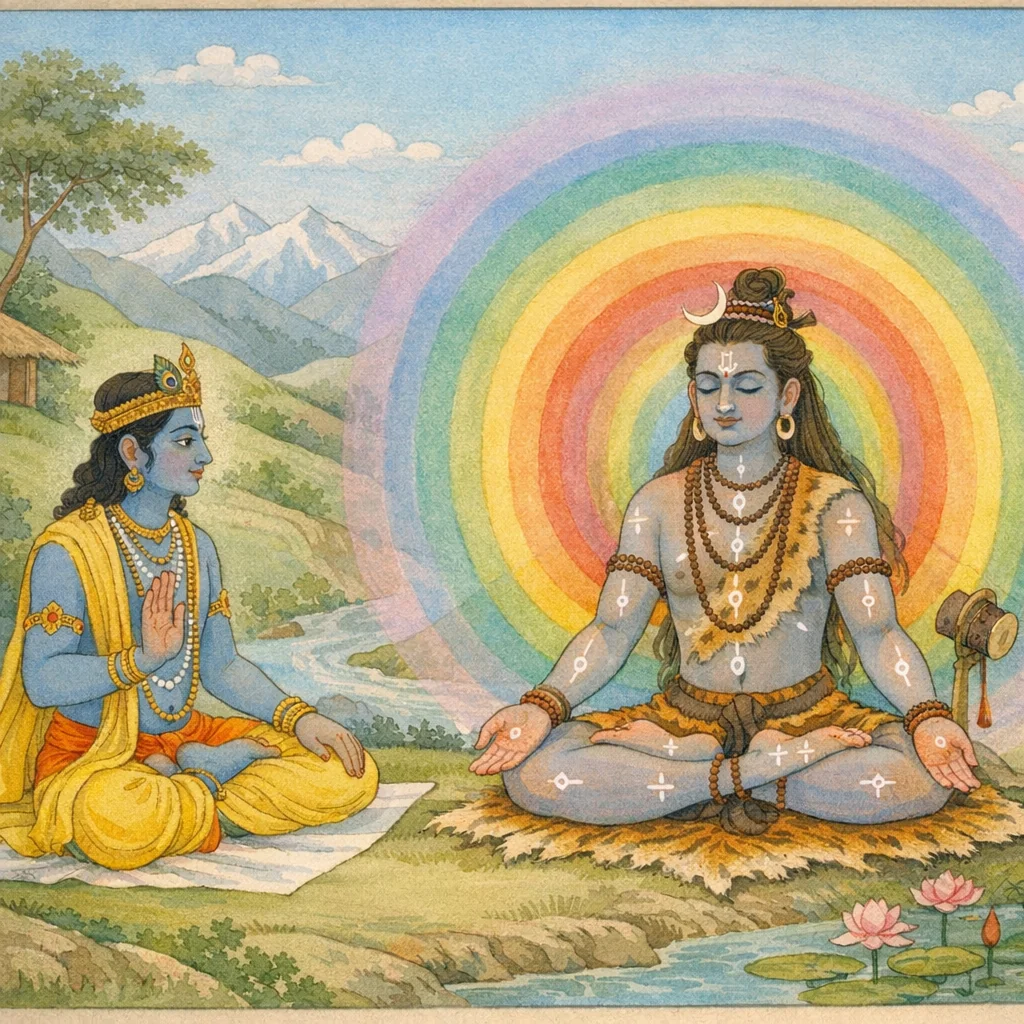
Continuing the Ācāra-khaṇḍa’s concern with right religious discipline, Hari teaches Śaṅkara the preliminary rites for Gāyatrī—affirming her Vedic authority (ṛṣi Viśvāmitra; devatā Savitṛ) and her theological place within the Trimūrti (Brahmā as head, Rudra as crest, abiding in Viṣṇu’s heart). The chapter then joins doctrine (“support of the three worlds”) to practice through an extensive japa regimen (twelve lakhs). It clarifies mantra-form by distinguishing pāda usage—three pādas for japa, four for arcana—so worship accords with phonetic structure. A detailed bodily map follows, prescribing vinyāsa/nyāsa placements from the feet upward through vital regions to the head, with further distribution by directions. It also notes color-visions and variant chromatic sequences, implying meditative experiences accompanying sādhana. The chapter concludes with a sweeping claim of purification: whatever the hand touches and the eyes behold becomes sanctified, presenting Gāyatrī as the supreme purifier and preparing for later chapters to expand ritual applications of mantra and worship.
Shlokas
Verse 1
चतुस्त्रिंशो ऽध्यायः हरिरुवाच / न्यासादिकं प्रवक्ष्यामि गायत्त्र्याः शृणु शङ्कर / विश्वामित्रऋषिश्चैव सविता चाथ देवता
Hari said: “I shall explain the preliminary rites such as nyāsa for the Gāyatrī; listen, O Śaṅkara. The seer (ṛṣi) is Viśvāmitra, and the deity is Savitṛ.”
Verse 2
ब्रह्मशीर्षा रुद्रशिखा विष्णोर्हृदयसंश्रिता / विनियोगैकनयना कात्यायनसगोत्रजा
She bears Brahmā as her head and Rudra as her crest; she abides within the heart of Viṣṇu. In viniyoga she is single-eyed—wholly intent—and she is of the Kātyāyana lineage.
Verse 3
त्रैलोक्यचरणा ज्ञेया पृथिवीकुक्षिसंस्थिता / एवं ज्ञात्वा तु गायत्त्रीं जपेद्द्वादशलक्षकम्
Know Gāyatrī as the “support of the three worlds”, abiding in the womb of the Earth. Having understood her thus, one should recite the Gāyatrī twelve lakṣas—1.2 million times.
Verse 4
त्रिपदाष्टाक्षरा ज्ञेया चतुष्पादा षडक्षरा / जेप च त्रिपदा ग्रोक्ता अर्चने च चतुष्पदा
Know the eight-syllabled mantra to be of three pādas, and the six-syllabled mantra to be of four pādas. In japa it is taught as three-pāda, while in arcana (worship) it is employed as four-pāda.
Verse 5
न्यासे जपे तथा ध्याने अग्निकार्ये तथार्चने / गायत्त्रीं विन्यसेन्नित्यं सर्वपापग्रणाशिनीम्
In nyāsa, japa, meditation, fire-rites (agni-kārya), and worship (arcana), one should always perform the vinyāsa of Gāyatrī, for she destroys the multitude of all sins.
Verse 6
पादांसुष्ठे गुल्फमध्ये जङ्घयोर्विद्धि जानुनोः / ऊर्वोर्गुह्ये च वृषणे नाड्यां नाभौ तनूदरे
Know (these vital points) to be in the feet and toes, in the middle of the ankle, in the calves and at the knees; in the thighs, in the groin and the testicles; and along the nāḍīs, at the navel and within the abdomen.
Verse 7
स्तनयोर्हृदि कण्ठौष्ठमुखे तालुनि चांसयोः / नेत्रे भुवार्ललाटे च पूर्वस्यां दक्षिणोत्तरे
On the two breasts, on the heart, on the throat, on the lips and mouth, on the palate and the shoulders; on the eyes, the eyebrows, and the forehead—these are to be arranged/marked toward the east, and likewise on the southern and northern sides.
Verse 8
पश्चमे मूर्ध्नि चाकारं न्यसेद्वर्णान्वदाम्यहम् / इन्द्रनीलं च वह्निं च पीतं श्यामं च कापिलम्
In the fifth placement, one should set the syllable “ā” upon the crown of the head. Now I declare the associated colors: indranīla (sapphire-blue), the fiery hue (red), yellow, the dark (blackish), and kāpila (tawny-brown).
Verse 9
श्वेतं विद्युत्प्रभं तारं कृष्णं रक्तं क्रमेण तत् / श्यामं शुक्लं तथा पीतं श्वेतं वै पद्मरागवत्
In proper order it appears as: white; lightning-lustrous; star-bright; black; and red. Again it is seen as dark-blue, white, yellow, and white—shining like padmarāga, the ruby.
Verse 10
शङ्खवर्णं पाण्डुरं च रक्तं चासवसन्निभम् / अर्कवर्णसमं सौम्यं शङ्खाभं श्वेतमेव च
“It appears conch-colored; pale; red like fermented liquor; gentle, like the hue of the sun; conch-like—and indeed white as well.”
Verse 11
यद्यत्स्पृशति हस्तेन यच्च पश्यति चक्षुषा / पूतं भवति तत्सर्वं गायत्त्र्या न परं विदुः
Whatever one touches with the hand, and whatever one beholds with the eyes—all of it becomes purified; for they know nothing higher than the Gāyatrī.
Frequently Asked Questions
This is a theological integration that presents Gāyatrī as a unifying Vedic power operating through creation (Brahmā), transformation (Rudra), and preservation (Viṣṇu). In ritual terms it legitimizes her as universally worship-worthy and suitable for multiple rites (japa, homa, arcana) without sectarian limitation.
The placements function to consecrate the body as a ritual locus, stabilize attention, and ‘install’ mantra-śakti into the practitioner’s limbs and centers. The chapter’s stepwise mapping (lower limbs, groin/abdomen/navel channels, chest/throat/mouth, eyes/forehead, crown) reflects an ascent of awareness and a systematic purification of action, speech, and perception.