Adhyaya 33
The Ninefold Rite (Navavidhi): Worship of Sudarśana-Cakra and the Disease-Destroying Hymn
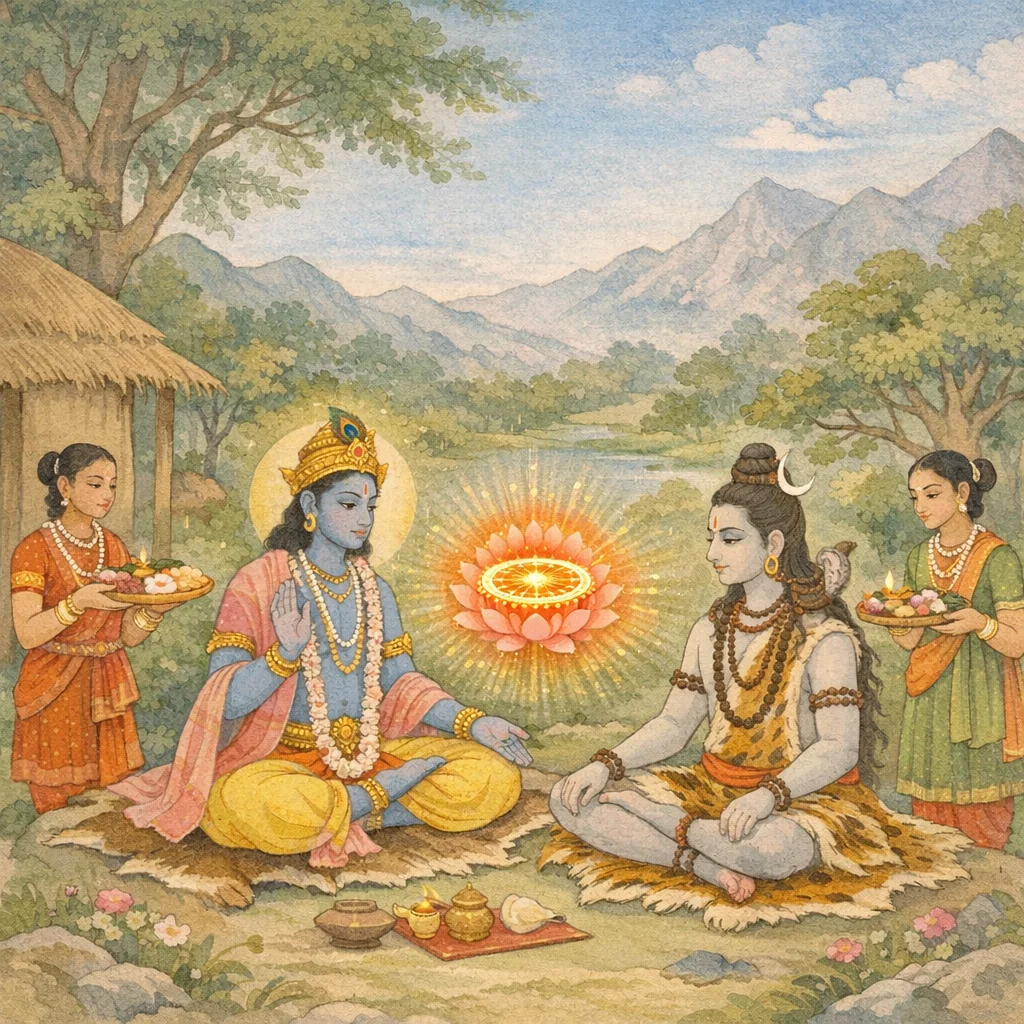
Continuing the Ācāra-based teaching on protective rites, Rudra asks Hari for the Sudarśana-Cakra worship that destroys planetary afflictions (grahas) and disease. Hari gives the ordered method: purify by bathing, perform nyāsa with the praṇava-prefixed Sudarśana root-mantra, meditate on the divine Disc in the heart-lotus, and invoke the crown-wearing Lord into the ritual maṇḍala, offering worship with a prescribed japa of 108. The chapter then presents a stotra praising Sudarśana as blazing like a thousand suns, the thousand-spoked “eye,” destroyer of sin and demons, transcending the grahas while embodying Time, Death, and the Terrifying One—yet also a gentle protector granting grace. It concludes with promised fruits: freedom from illness, sins burned away through disciplined practice, and fitness to attain Viṣṇu’s realm, maintaining the ritual-ethical continuity of the surrounding Ācāra material.
Shlokas
Verse 1
च नविधिर्नाम द्वात्रिंशो ऽध्यायः रुद्र उवाच / सुदर्शनस्य पूजां मे वद शङ्खगदाधर / ग्रहरोगादिकं सर्वं यत्कृत्वा नाशमेति वै
Thus begins the thirty-second chapter called “The Ninefold Rite.” Rudra said: “O bearer of conch and mace, tell me the worship of Sudarśana—by performing which all afflictions such as planetary troubles and diseases indeed come to destruction.”
Verse 2
हरिरुवाच / सुदर्शनस्य चक्रस्य शृणु पूजां वृषध्वज / स्नानमादौ प्रकुर्वीत पूजयेच्च हरिं तत
Hari said: “O Vṛṣadhvaja, listen to the method of worship of the Sudarśana Disc. First one should perform bathing for purification, and then worship Hari thereafter.”
Verse 3
मूलमन्त्रेण वै न्यासं मूलमन्त्रं शृणुष्वच / सहस्रारं हुं फट् नमो मन्त्रः प्रणवपूर्वकः
Perform the nyāsa with the root-mantra; and now listen to the root-mantra: “Oṃ … sahasrāraṃ huṃ phaṭ namaḥ”—a mantra preceded by the praṇava (Oṃ).
Verse 4
कथितः सर्वदुष्टानां नाशको मन्त्रभेदकः / ध्यायेत्मुदर्शनं देवं हृदि पद्मे ऽमले शुभे
He is declared the destroyer of all evil beings and the one who breaks hostile spells; one should meditate on the divine Sudarśana within the heart, in the pure and auspicious lotus.
Verse 5
शङ्कचक्रगदापद्मधरं सौम्यं किरीटिनम् / आवाह्य मण्डले देवं पूर्वोक्तविधिना हर
O Hara, according to the method taught earlier, invoke into the ritual maṇḍala the gentle Lord, crowned, who bears the conch, discus, mace, and lotus.
Verse 6
पूजयेद्रन्धपुष्पाद्यैरुपचारैर्महेश्वर / पूजयित्वा जपेन्मन्त्रं शतमष्टोत्तरं नरः
O Maheśvara, one should worship Maheśvara (Śiva) with fragrant flowers and other ritual offerings; having worshipped, one should recite the mantra one hundred and eight times.
Verse 7
एवं यः कुरुते रुद्र ! चक्रस्यार्चनमुत्तमम् / सर्वरोगविनिर्मुक्तो विष्णुलोकं समाप्नुयात्
O Rudra, whoever thus performs the excellent worship of the Divine Discus is freed from all diseases and attains the world of Viṣṇu.
Verse 8
एतत्स्तोत्रं जपेत्पश्चात्सर्वव्याधिविनाशनम् / नमः सुदर्शनायैव सहस्रादित्यवर्चसे
Thereafter, one should recite this hymn that destroys all diseases: “Salutations to Sudarśana, whose radiance is like that of a thousand suns.”
Verse 9
ज्वालामालाप्रदीप्ताय सहस्राराय चक्षुषे / सर्वदुष्टविनाशाय सर्वपातकमर्दिने
Salutations to the One whose garland blazes with flames, whose eye is the thousand-spoked wheel; the destroyer of all wickedness, the crusher of every sin.
Verse 10
सुचक्राय विचक्राय सर्वमन्त्रविभेदिने / प्रसवित्रे जगद्धात्रे जगद्विध्वंसिने नमः
Salutations to Him of the auspicious discus and the wondrous discus; to the One who distinguishes and ordains all mantras; to Savitṛ, the divine Impeller, the Sustainer of the worlds and the Dissolver of the worlds—namah.
Verse 11
पालनार्थाय लोकानां दुष्टासुरविनाशिने / उग्राय चैव सौम्याय चण्डाय च नमोनमः
Salutations again and again to Him who protects the worlds and destroys the wicked asuras—who is at once fierce and gentle, and terrible in His might—namo namah.
Verse 12
नमश्चक्षुः क्वरूपाय संसारभयभेदिने / मायापञ्जरभेत्रे च शिवाय च नमोनमः
Salutations again and again to Śiva—whose form is the all-seeing Eye, who rends apart the fear of saṃsāra, and who breaks open the cage of māyā (illusion)—namo namah.
Verse 13
ग्रहातिग्रहरूपाय ग्रहाणां पतेय नमः / कालाय मृत्यवे चैव भीमाय च नमोनमः
Salutations to the One whose form transcends and overrules the planets, the Lord of the planets. Salutations again and again to Time (Kāla), to Death (Mṛtyu), and to the Terrifying One, Bhīma—namo namah.
Verse 14
भक्तानुग्रहदात्रे च भक्तगोप्त्रे नमोनमः / विष्णुरूपाय शान्ताय चायुधानां धराय च
Salutations again and again to the giver of grace to devotees and the protector of devotees; salutations to Him whose form is Viṣṇu, to the peaceful One, and to the bearer of the divine weapons (āyudhas).
Verse 15
विष्णुशस्त्राय चक्राय नमो भूयो नमोनमः / इति स्तोत्रं महापुण्यं चक्रस्य तव कीर्तितम्
Again and again, salutations—salutations to the Cakra, the divine weapon of Viṣṇu. Thus has this supremely meritorious hymn praising your Cakra been proclaimed.
Verse 16
यः पठेत्परया भक्त्या विष्णुलोकं स गच्छति / चक्रपूजाविधिं यश्च पठेद्रुद्र जितोन्द्रियः / स पापं भस्मसात्कृत्वा विष्णुलोकाय कल्पते
Whoever recites this with supreme devotion goes to Viṣṇu’s realm. And, O Rudra, whoever—having mastered the senses—recites the rite of worship of the Cakra, burns sin to ashes and becomes fit to attain Viṣṇu’s world.
Frequently Asked Questions
Nyāsa functions as mantra-embodiment: the practitioner ritually ‘installs’ the mūla-mantra into the body and inner faculties, preparing the heart-lotus meditation and maṇḍala-invocation. In the chapter’s logic, efficacy depends on aligning speech (mantra), mind (dhyāna), and body (ritual acts) into one consecrated field.
The hymn identifies Sudarśana with supreme radiance, protective sovereignty over grahas, and the power that crushes sin and hostile forces. Within Purāṇic karma-ritual reasoning, such praise (stuti) coupled with devotion and discipline invokes divine protection that counteracts both visible illness and subtle causes (pāpa, graha-doṣa, abhichāra), restoring order in the embodied life.