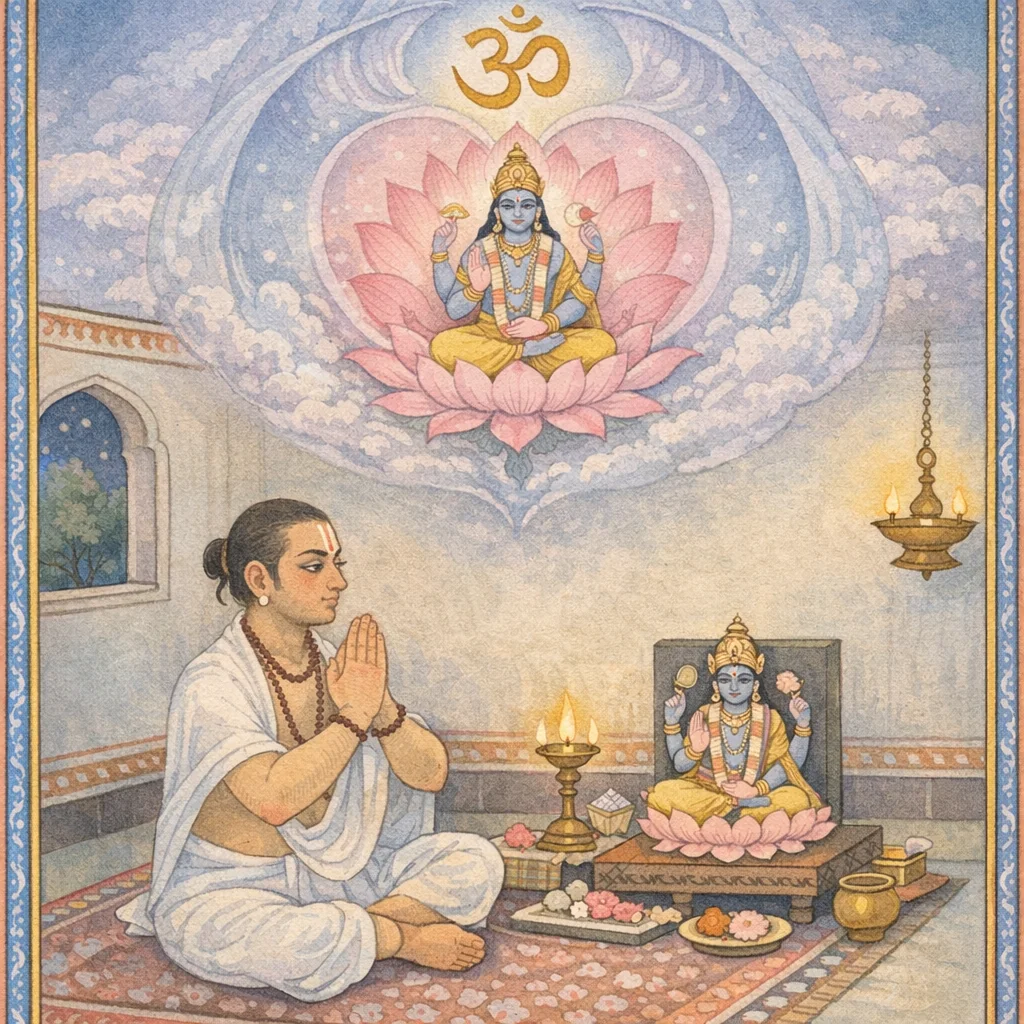
Adhyaya 31
Viṣṇu-pūjāvidhi: Śuddhi, Nyāsa, Dhyāna, Āsana-devatā Pūjā, Upacāras, and Stotra
Continuing the instructional dialogue, Rudra asks Jagannātha for a worship-method by which one may cross the hard ocean of saṃsāra. Hari teaches a systematic Viṣṇu-upāsanā: begin with bathing, sandhyā, and careful ācamana; then perform mūla-mantra nyāsa and receive the root mantra, praised for removing disease, sin, and adverse graha influences. Next come aṅga-nyāsa with prescribed bīja syllables and ritual endings (namaḥ, svāhā, vaṣaṭ, huṃ, vauṣaṭ, phaṭ), the proper mudrā, and meditation on heart-dwelling Viṣṇu—white and radiant, bearing conch and discus, marked by Śrīvatsa and Kaustubha. A cosmological visualization follows (forming the aṇḍa and splitting it by Oṁ), leading into ātma-pūjā and worship of the seat’s associated deities through an extended salutation-list (rivers, nidhi deities, gate-energies, Kūrma/Ananta, guṇas, lotus symbolism, and śaktis). The rite proceeds with standard upacāras (snāna, vastra, ācamana, gandha, puṣpa, dhūpa, dīpa, caru), circumambulation, japa, and limb-worship, culminating in a Viṣṇu-stotra proclaiming him the imperishable Brahman and ruler of the cosmos. The chapter closes by declaring that even simple repetition, hearing, or causing this teaching to be heard grants access to Viṣṇu-loka, preparing the way for further mantra-centered applications and secrets of devotion.
Shlokas
Verse 1
चनविधिर्नाम त्रिंशो ऽध्यायः श्री गरुडमहापुराणम्- ३१ रुद्र उवाच / भूय एवं जगन्नाथ पूजां कथय मे प्रभो / यया तरेयं संसारसागरं ह्यतिदुस्तरम्
Rudra said: “O Jagannātha, O Lord—please explain to me further that manner of worship by which I may cross this ocean of worldly existence, so exceedingly difficult to traverse.”
Verse 2
हरिरुवाच / अर्चनं विष्णुदेवस्य वक्ष्यामि वृषभध्वज / तच्छृणुष्व महाभाग भुक्तिमुक्तिप्रदं शुभम्
Hari (Lord Viṣṇu) said: “O bearer of the bull-emblem, I shall explain the worship of Lord Viṣṇu. Listen, O greatly fortunate one—for it is auspicious and bestows both worldly enjoyment and liberation.”
Verse 3
कृत्वा स्नानं ततः सन्ध्यां ततो यागगृहं व्रजेत् / प्रक्षाल्य पाणी पादौ च आचम्य च विशेषतः
Having bathed, one should then perform the Sandhyā rites; thereafter one should proceed to the place of worship. Washing the hands and feet, and performing ācamana with particular care, one should enter and begin the rite.
Verse 4
मूलमन्त्रं समस्तं तु हस्तयोर्व्यापकं न्यसेत् / मूलमन्त्रं च देवस्य शृणु रुद्र वदामि ते
One should perform nyāsa by placing the complete root-mantra so that it pervades both hands. Now, O Rudra, listen—I shall declare to you the deity’s root-mantra.
Verse 5
ॐ श्रीं ह्रीं श्रीधराय विष्णवे नमः / अयं मन्त्रः सुरेशस्य विष्णोरीशस्य वाचकः
“Oṃ śrīṃ hrīṃ—obeisance to Viṣṇu, Śrīdhara, the bearer of Śrī (Lakṣmī).” This mantra is a sacred appellation denoting Viṣṇu, Lord of the gods and the Supreme Ruler.
Verse 6
सर्वव्याधिहरश्चैव सर्वग्रहहरस्तथा / सर्वपापहरश्चैव बुक्तिमुक्तिप्रदायकः
He removes all diseases and likewise dispels every malignant influence of the grahas (planetary forces). He destroys all sins as well, and bestows both worldly enjoyment and liberation (mukti).
Verse 7
अङ्गन्यासं ततः कुय्यान्देभिर्मन्त्रौर्विचक्षणः / ॐ हां हृदयाय नमः / ॐ हीं शिरसे स्वाहा / ॐ हूं शिखायै वषट् / ॐ हैं कवचाय हुं / ॐ हौं नेत्रत्रयाय वौषट् / ॐ हः अस्त्राय फट्
Then the discerning practitioner should perform aṅga-nyāsa with these divine mantras: “Oṃ hāṃ—obeisance to the heart; Oṃ hīṃ—svāhā to the head; Oṃ hūṃ—vaṣaṭ to the śikhā; Oṃ haiṃ—huṃ to the kavaca (armor); Oṃ hauṃ—vauṣaṭ to the three eyes; Oṃ haḥ—phaṭ to the astra (weapon-mantra).”
Verse 8
न्यासं कृत्वात्मनो मुद्रां दर्शयेद्विजितात्मवान्
Having performed nyāsa, the self-controlled one should display the prescribed mudrā (hand-gesture) for himself.
Verse 9
ततो ध्यायेत्परं विष्णु त्दृत्कोटरसमाश्रितम् / शङ्खचक्रसमायुक्तं कुन्देन्दुधवलं हरिम्
Then one should meditate on the Supreme Viṣṇu, abiding in the hollow of the heart—Hari, radiant white like jasmine and the moon, bearing the conch and the discus.
Verse 10
श्रीवत्सकौस्तुभयुतं वनमालासमन्वितम् / रत्नहारकिरीटेन संयुक्तं परमेश्वरम्
I behold the Supreme Lord, adorned with the Śrīvatsa mark and the Kaustubha jewel, garlanded with the forest-wreath (vanamālā), and ornamented with a jeweled necklace and a crown.
Verse 11
अहं विष्णुरिति ध्यात्वा कृत्वा वै शोधनादिकम् / यं क्षैं रमिति बीजैश्च कठिनी कृत्य नामभिः
Meditating, “I am Viṣṇu,” and having performed the preliminary purifications and related rites, one should then make the mantra-formula firm and effective by means of the seed-syllables “yaṃ”, “kṣaiṃ”, and “ram”, together with the divine names.
Verse 12
अण्डमुत्पाद्य च ततः प्रणवेनैव भेदयेत् / तत्र पूर्वोक्तरूपं तु भावयित्वा वृषध्वज
Having first generated the cosmic “egg” (aṇḍa), one should then split it by the power of the Praṇava (Oṁ). There, O bearer of the bull-banner (Śiva), one should meditate upon the form described earlier.
Verse 13
आत्मपूजां ततः कुर्याद्रन्धपुष्पादिभिः शुभैः / आवाह्य पूजयेत्सर्वा देवता आसनस्य याः
Thereafter, one should perform worship of the self (ātma-pūjā) with auspicious offerings such as fragrant flowers and the like; having invoked them, one should worship all the deities associated with the seat (āsana).
Verse 14
मन्त्रैरेभिर्महादेव तन्मन्त्रं शृणु शङ्कर / विष्णवासनदेवता आगच्छत
O Mahādeva—listen, O Śaṅkara, to that mantra together with these (preceding) mantras: “May the deity presiding over Viṣṇu’s seat and abode come forth.”
Verse 15
ॐ समस्तपरिवारायाच्युताय नमः / ॐ धात्रे नमः / ॐ विधात्रे नमः / ॐ गङ्गायै नमः / ॐ यमुनायै नमः / ॐ शङ्खनिधये नमः / ॐ पद्मनिधये नमः / ॐ चण्डाय नमः / ॐ प्रचण्डाय नमः / ॐ द्वारश्रियै नमः / ॐ आधारशक्त्यै नमः / ॐ कूर्ंमाय नमः / ॐ अनन्ताय नमः / ॐ श्रियै नमः / ॐ धर्ंमाय नमः / ॐ ज्ञानाय नमः / ॐ वैराग्याय नमः / ॐ ऐश्वर्याय नमः / ॐ अधर्ंमाय नमः / ॐ अज्ञानाय नमः / ॐ अवैराग्याय नमः / ॐ अनैश्वर्याय नमः / ओंसं सत्त्वाय नमः / ॐ रं रजसे नमः / ॐ तं तमसे नमः / ॐ कं कन्दाय नमः / ॐ नं नालाय नमः / ॐ लां पद्माय नमः / ॐ अं अर्कमण्डलाय नमः / ॐ सों सोममण्डलाय नमः / ॐ वं वह्निमण्डलाय नमः / ॐ विमलायै नमः / ॐ उत्कर्षिण्यै नमः / ॐ ज्ञानायै नमः / ॐ क्रियायै नमः / ॐ योगायै नमः / ॐ प्रह्व्यै नमः / ॐ सत्यायै नमः / ॐ ईशानायै नमः / ॐ अनुग्रहायै नमः
Om—salutations to Acyuta together with all His divine retinue; salutations to Dhātṛ and Vidhātṛ; salutations to Gaṅgā and Yamunā; salutations to the treasures Śaṅkha-nidhi and Padma-nidhi; salutations to Caṇḍa and Pracaṇḍa; salutations to Dvāra-śrī (the Splendour at the threshold) and to Ādhāra-śakti (the supporting primal Power); salutations to Kūrma and to Ananta; salutations to Śrī; to Dharma, Jñāna, Vairāgya, and Aiśvarya; and salutations also to their opposites—Adharma, Ajñāna, Avairāgya, and Anaiśvarya. Salutations to Sattva, Rajas, and Tamas; to the root (kanda), the stalk (nāla), and the lotus (padma); to the solar orb, the lunar orb, and the fiery orb. Salutations to Vimalā, Utkarṣiṇī, Jñānā, Kriyā, Yogā, Prahvī, Satyā, Īśānā, and to Anugraha (Grace).
Verse 16
गन्धपुष्पादिभिस्त्वेतैर्मन्त्रैरेतास्तु पूजयेत् / पूजयित्वा ततो विष्णुं सृष्टिसंहारकारिणम्
With these mantras one should worship them with fragrances, flowers, and the like; and after that worship is completed, one should then worship Lord Viṣṇu—the One who brings about creation and dissolution.
Verse 17
आवाह्य मण्डले रुद्र पूजयेत्प रमेश्वरम् / अनेन विधिना रुद्र सर्वपापहरं परम्
Having invoked Rudra into the ritual maṇḍala, one should worship Parameśvara. By this prescribed method, O Rudra, the Supreme remover of all sins is propitiated (or attained).
Verse 18
यथात्मनि तथा देवे न्यासं कुर्वीत चादितः / मुद्रां प्रदर्शयेत्पश्चादर्घ्यादीनर्पयेत्ततः
First, one should perform nyāsa upon oneself and likewise upon the deity; then one should display the ritual mudrās, and thereafter offer arghya and the other offerings.
Verse 19
स्नानां कुर्यात्ततो वस्त्रं दद्यादाचमनं ततः / गन्धपुष्पं तथा धूपं दीपं दद्याच्चरुं ततः
One should first perform the ritual bath; then offer cloth and thereafter water for sipping (ācamana). Next, one should offer fragrance and flowers, as well as incense and a lamp; and after that, the cooked oblation (caru) should be offered.
Verse 20
प्रदक्षिणं ततो जप्यं ततस्तस्मिन्सर्पयेत् / अङ्गादीनां स्वमन्त्रैश्च पूजां कुर्वीत साधकः
Then one should circumambulate (it), then recite the prescribed japa; thereafter, one should make the offering there. The practitioner should perform worship of the limbs and related parts as well, using their respective mantras.
Verse 21
देवस्य मूलमन्त्रेणेत्येवं विद्धि वृषध्वज / मन्त्राञ्छृणु त्रिनेत्र त्वं कथ्यमानान्मयाधुना
Know it thus—by means of the deity’s root mantra, O Bull-bannered One. O Three-eyed Lord, listen now to the mantras as I am about to expound them.
Verse 22
ॐ हां हृदयाय नमः / ॐ हीं शिरसे नमः / ॐ हूं शिखायै नमः / ॐ हैं कवचाय नमः / ॐ हौं नेत्रत्रयाय नमः / ॐ हः अस्त्राय नमः / ॐ श्रियै नमः / ॐ शङ्काय नमः / ॐ पद्माय नमः / ॐ चक्राय नमः / ॐ गदायैनमः / ॐ श्रीवत्साय नमः / ॐ कौस्तुभाय नमः / ॐ वनमालायै नमः / ॐ पीताम्बराय नमः / ॐ खड्गाय नमः / ॐ मुसलाय नमः / ॐ पाशाय नमः / ॐ अङ्कुशाय नमः / शार्ङ्गाय नमः / ॐ शराय नमः / ॐ ब्रह्मणे नमः / ॐ नारादाय नमः / ॐ पूर्वसिद्धेभ्यो नमः / ॐ भागवतेभ्यो नमः / ॐ गुरुभ्यो नमः / ॐ परमगुरुभ्यो नमः / ॐ इन्द्राय सुराधिपतये सवाहनपरिवाराय नमः / ॐ अग्नये तेजो ऽधिपतये सवाहनपरिवाराय नमः / ॐ यमाय प्रेताधिपतये सवाहनपरिवाराय नमः / ॐ निरृतये रक्षो ऽधिपतये सवाहनपरिवाराय नमः / ॐ वरुणाय जलाधिपतये सवादनपरिवाराय नमः / ॐ वायवे प्राणाधिपतये सवाहनपरिवाराय नमः / ॐ सोमाय नक्षत्राधिपतये सवाहनपरिवाराय नमः / ॐ ईशानाय विद्याधिपतये सवाहनपरिवाराय नमः / ॐ अनन्ताय नागाधिपतये सवाहनपरिवाराय नमः / ॐ ब्रह्मणे लोकाधिपतये सवाहनपरिवाराय नमः / ॐ वज्राय हुं फट् नमः / ॐ शक्त्यै हुं फट् नमः / ॐ दण्डाय हुं फट् नमः / ॐ खड्गाय हुं फट् नमः / ॐ पाशाय हुं फट् नमः / ॐ ध्वजाय हुं फट् नमः / ॐ गदायै हुं फट् नमः / ॐ त्रिशूलाय हुं फट् नमः / ॐ चक्राय हुं फट् नमः / ॐ पद्माय हुं फट् नमः / ॐ वैं विष्वक्सेनाय नमः
Om Hāṃ Salutations to the Heart; Om Hīṃ Salutations to the Head; Om Hūṃ Salutations to the Tuft; Om Haiṃ Salutations to the Armor; Om Hauṃ Salutations to the Three Eyes; Om Haḥ Salutations to the Weapon; ... Om Vaiṃ Salutations to Vishvaksena.
Verse 23
एभिमन्त्रैर्महादेव पूज्या अङ्गादयो नरैः / पूजयित्वा महात्मानं विष्णुं ब्रह्मस्वरूपिणम्
O Mahādeva, with these mantras people should worship the (divine) limbs and related aspects; and, having thus worshipped the great-souled Viṣṇu—whose very form is Brahman—(they should proceed further in the rite).
Verse 24
स्तुवीत चानया स्तुत्या परमात्मानमव्ययम् / विष्णवे देवदेवाय नमो वै प्रभविष्णवे
With this hymn one should praise the Imperishable, unchanging Supreme Self—Vishnu, the God of gods. Salutations indeed to Prabha‑Vishnu, the all‑illuminating Vishnu.
Verse 25
विष्णवे वासुदेवाय नमः स्थितिकराय च / ग्रसिष्णवे नमश्चैव नमः प्रलयशायिने
Salutations to Vishnu, to Vasudeva; salutations also to the Sustainer who upholds the cosmos. Salutations to the All‑Devourer at pralaya, and salutations to Him who lies in yogic repose at the time of dissolution.
Verse 26
देवानां प्रभवे चैव यज्ञानां प्रभवे नमः / मुनीनां प्रभवे नित्यं यक्षाणां प्रभविष्णवे
Salutations to the Source of the Devas and the Source of all yajñas (sacrifices); everlasting salutations to the Source of the sages, to Prabhavishnu, the all‑pervading Origin of the Yakshas.
Verse 27
जिष्णवे सर्वदेवानां सर्वगाय महात्मने / ब्रह्मेन्द्ररुद्रवन्द्याय सर्वेशाय नमोनमः
Salutations again and again to the Invincible One—praised by all the gods; to the all‑pervading Lord of great soul; to Him revered by Brahmā, Indra, and Rudra; to the Supreme Lord of all.
Verse 28
सर्वलोकहितार्थाय लोकाध्यक्षाय वै नमः / सर्वगोप्त्रे सर्वकर्त्रे सर्वदुष्टविनाशिने
Salutations to the Overseer of all worlds, who acts for the welfare of every being; to the universal Protector, the universal Doer, and the Destroyer of all wickedness.
Verse 29
वरप्रदाय शान्ताय वरेण्याय नमोनमः / शरण्याय सुरूपाय धर्मकामार्थदायिने
Salutations again and again to the Bestower of boons, the Peaceful One, the Most Excellent; to the Refuge of all, the Lord of beautiful form, who grants dharma, kāma, and artha.
Verse 30
स्तुत्वा ध्यायेत्स्वहृदये ब्रह्मरूपिणमव्ययम् / एलं तु पूजयेद्विष्णुं मूलमन्त्रेण शङ्कर
Having offered praise, one should meditate within one’s own heart on the Imperishable One whose form is Brahman; then—O Śaṅkara—one should worship Viṣṇu using the root (principal) mantra.
Verse 31
मूलमन्त्रं जपेद्वापि यः स याति नरो हरिम् / एतत्ते कथितं रुद्र विष्णोरर्चनमुत्तमम्
Even if a man merely repeats the root mantra, he attains Hari (Lord Viṣṇu). Thus, O Rudra, I have told you the highest method of worship of Viṣṇu.
Verse 32
रहस्यं परमं गुह्यं भुक्तिमुक्तिप्रदं परम् / एतद्यश्च पठेद्विद्वान्विष्णुभक्तः पुमान्हर / शृणुयाच्छ्रावयेद्वापि विष्णुलोकं स गच्छति
This is the supreme secret—most hidden and most exalted—bestowing both worldly enjoyment (bhukti) and liberation (mukti). O Hara, the wise man who, devoted to Viṣṇu, recites this—or even hears it or causes it to be heard—attains the world of Viṣṇu (Viṣṇu-loka).
Frequently Asked Questions
Viṣṇu is meditated upon within the heart as radiant white like jasmine and the moon, bearing śaṅkha and cakra, adorned with Śrīvatsa and the Kaustubha jewel, with forest-garland, jeweled ornaments, and a crown.
The chapter lists ritual bath (snāna), cloth (vastra), sipping-water (ācamana), fragrance (gandha), flowers (puṣpa), incense (dhūpa), lamp (dīpa), and cooked oblation (caru), followed by circumambulation, japa, and further offerings/limb-worship.
It states that the mūla-mantra bestows both bhoga and mokṣa, and explicitly claims that even mere repetition of the root mantra leads one to Hari; hearing or transmitting the teaching is also said to grant attainment of Viṣṇu-loka.