Adhyaya 24
Gaṇa–Durgā–Tripurā Sādhanā: Bīja-Nyāsa, Śakti Arrays, Mātṛkā/Bhairava Worship, and Maṇḍala Contemplation
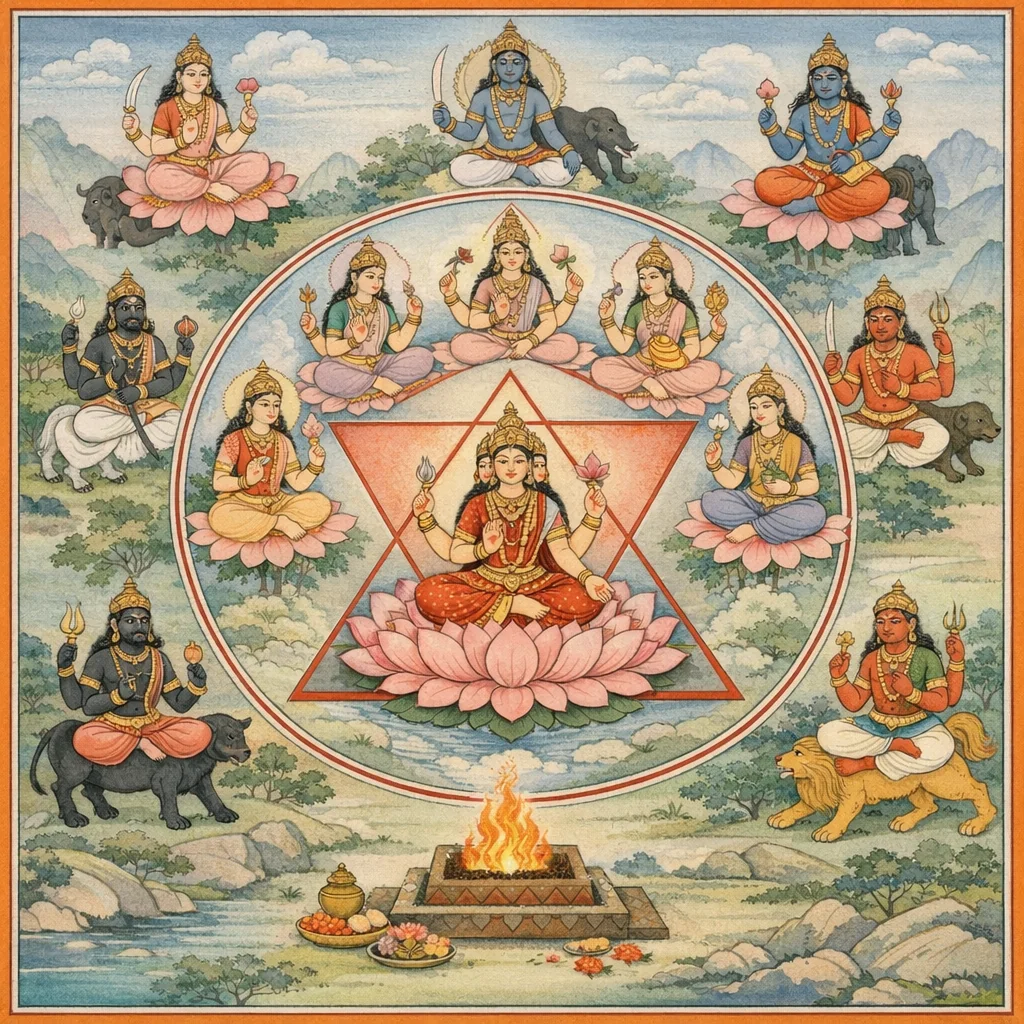
Sūta sets forth a stepwise sādhana that begins with worship of Gaṇāsana, Gaṇamūrti, and Gaṇādhipati to gain heavenly fruits and remove obstacles. The practitioner then recites bīja and performs nyāsa (placements on limbs and heart), invokes Durgā’s pādukā (the Guru’s sandals), āsana, and form, and repeats protective formulas. A ninefold array of Śakti is listed; Durgā is called as the fierce Caṇḍikā, the Protectress, and mudrās are applied in relation to the fire-space. The rite then turns to Śrī Tripurā, giving mantra formulas, lotus-seat visualization, inner placements, and worship of the Mothers (Brāhmī and others) with their presiding powers. Chamundā/Chandikā and multiple Bhairavas are worshipped, with mention of Yoginī powers and Kāma elements. Finally, within the lotus-womb triangle, the sādhaka contemplates Vaṭuka with Durgā, Vighnarāja, Guru, and Kṣetrapa, concludes with Tripurā’s form, and prescribes 100,000 japa with homa for siddhi, preparing the ground for subsequent chapters within Ācāra.
Shlokas
Verse 1
नाम त्रयोविंशो ऽध्यायः (इति शिवादिपूजा समाप्ता) / सूत उवाच / वक्ष्ये गणादिकाः पूजाः सर्वदा स्वर्गदाः पराः / गणासनं गणमूर्ति गणाधिपतिमर्चयेत्
Title of the twenty-third chapter (thus ends the worship of Śiva and the primordial deities). Sūta said: “Now I shall describe the worship of Gaṇa and the related deities—supreme rites that always bestow heaven. One should worship Gaṇāsana, Gaṇamūrti, and Gaṇādhipati.”
Verse 2
गामादिहृदयाद्यङ्गं दुर्गाया गुरुपादुकाः / दुर्गासनं च तन्मूर्तिं ह्रीं दुर्गे रक्षणीति च
(Meditate on/recite) the seed-syllable “gām” and the others up to “hṛdaya,” with the nyāsa upon the limbs; (invoke) Durgā’s guru-sandals (pādukā), Durgā’s seat, and her very form; then utter “hrīṁ”; and also the protective formula: “O Durgā, protect (me).”
Verse 3
त्दृदादिकं नव शक्त्यो रुद्रचण्डा प्रचण्डया / चण्डोग्रा चण्डनायिका चण्डा चण्डवती क्रमात्
Beginning with the one named Dṛḍā and the rest, there are nine Śaktis—Rudra-caṇḍā, Pra-caṇḍā, Caṇḍogrā, Caṇḍanāyikā, Caṇḍā, and Caṇḍavatī—enumerated in due order.
Verse 4
चणारूपा चण्डिकाख्या दुर्गेदुर्गे ऽथ रक्षिणि / वज्रखड्गादिका मुद्राः शिवाद्या वह्निदेशतः
She is of the fierce (caṇḍa) form, known as Caṇḍikā—invoked as “Durgā, Durgā,” and also as the Protectress. The hand-seals (mudrās) such as the thunderbolt (vajra) and the sword (khaḍga), beginning with the auspicious ones of Śiva and the rest, are to be applied with reference to the region of the sacred fire.
Verse 5
सदाशिवमहाप्रेतपद्मासन मथापि वा / ऐं क्लीं (ह्रीं) सौस्त्रिपुरायै नमः / ॐ ह्रां ह्रीं क्षें क्षैं स्त्रीं स्कीं रों स्फें स्फीं शां पद्मासनं च मूर्तिं च त्रिपुरात्दृदयादिकम्
Whether one visualizes the lotus-seat (padmāsana) of Sadāśiva upon the great corpse (mahā-preta) or otherwise, one should recite: “Aiṃ, Klīṃ (Hrīṃ), obeisance to Śrī Tripurā.” Then recite: “Oṃ hrāṃ hrīṃ kṣeṃ kṣaiṃ strīṃ skīṃ roṃ spheṃ sphīṃ śāṃ,” and meditate on Tripurā’s lotus-seat and divine form (mūrti), beginning with the inner placement at the heart (hṛdaya) and the rest.
Verse 6
पीठाम्बुजे तु ब्राहयादीर्ब्रह्माणी च महेश्वरी / कौमारी वैष्णवी पूज्या वाराही चेन्द्रदेवता
Upon the lotus-seat are to be worshipped the Mothers (Mātṛs) beginning with Brāhmī—namely Brahmāṇī and Maheśvarī; also Kaumārī and Vaiṣṇavī; the venerable Vārāhī, and Indra as the presiding deity.
Verse 7
चामुण्डा चण्डिका पूज्या भैरवाख्यांस्ततो यजेत् / असिताङ्गोरुरुश्चण्डः क्रोध उन्मत्तभैरवः
Chamundā and Chandikā are to be worshipped; thereafter one should offer worship to the Bhairavas—Asitāṅga, Ruru, Caṇḍa, Krodha, and Unmatta‑Bhairava.
Verse 8
कपाली भीषणश्चैव संहारश्चाष्ट भैरवाः / रतिः प्रीतिः कामदेवः पञ्च बाणाश्च योगिनी
Kapālī, Bhīṣaṇa, and Saṃhāra—these are among the eight Bhairavas. Rati and Prīti, Kāmadeva, and the five arrows (pañca-bāṇa) are also spoken of, together with the Yoginī powers.
Verse 9
वटुकं दुर्गया विघ्नराजो गुरुश्च क्षेत्रपः / पद्मगर्भे मण्डले च त्रिकोणे चिन्तयेद्धृदि
In the lotus‑womb of the maṇḍala—within the triangle—one should contemplate in the heart: Vaṭuka, the youthful deity, together with Durgā; Vighnarāja, the Lord who removes obstacles; the Guru; and Kṣetrapa, guardian of the sacred field.
Verse 10
शुक्लां वरदाक्षसूत्रपुस्ताभयसमन्विताम् / लक्षजप्याच्च होमाच्च त्रिपुरा सिद्धिदा भवेत्
Tripurā—visualized as radiant white, bearing the boon‑giving gesture, a rosary, a book, and the sign of fearlessness—becomes the bestower of siddhi when worshipped through one hundred thousand recitations and through fire‑offerings (homa).
Frequently Asked Questions
The text describes a ninefold Śakti sequence beginning with Dṛḍā and continuing through fierce Caṇḍa-designations (e.g., Rudra-caṇḍā, Pra-caṇḍā, Caṇḍogrā, Caṇḍanāyikā, Caṇḍā, Caṇḍavatī) as an ordered power-array to be invoked within the Durgā-centered protective framework.
They function as attendant and guarding strata of the maṇḍala: Mātṛkās provide cosmic-functional energies (creation, protection, etc.), while Bhairavas serve as fierce guardians and stabilizers of the rite, ensuring containment, protection, and the successful maturation of mantra-siddhi.
Tripurā is said to confer accomplishment when worship is performed through one hundred thousand recitations (japa) coupled with fire-offerings (homa), indicating a classical sādhanā threshold where mantra repetition is sealed by sacrificial oblation.