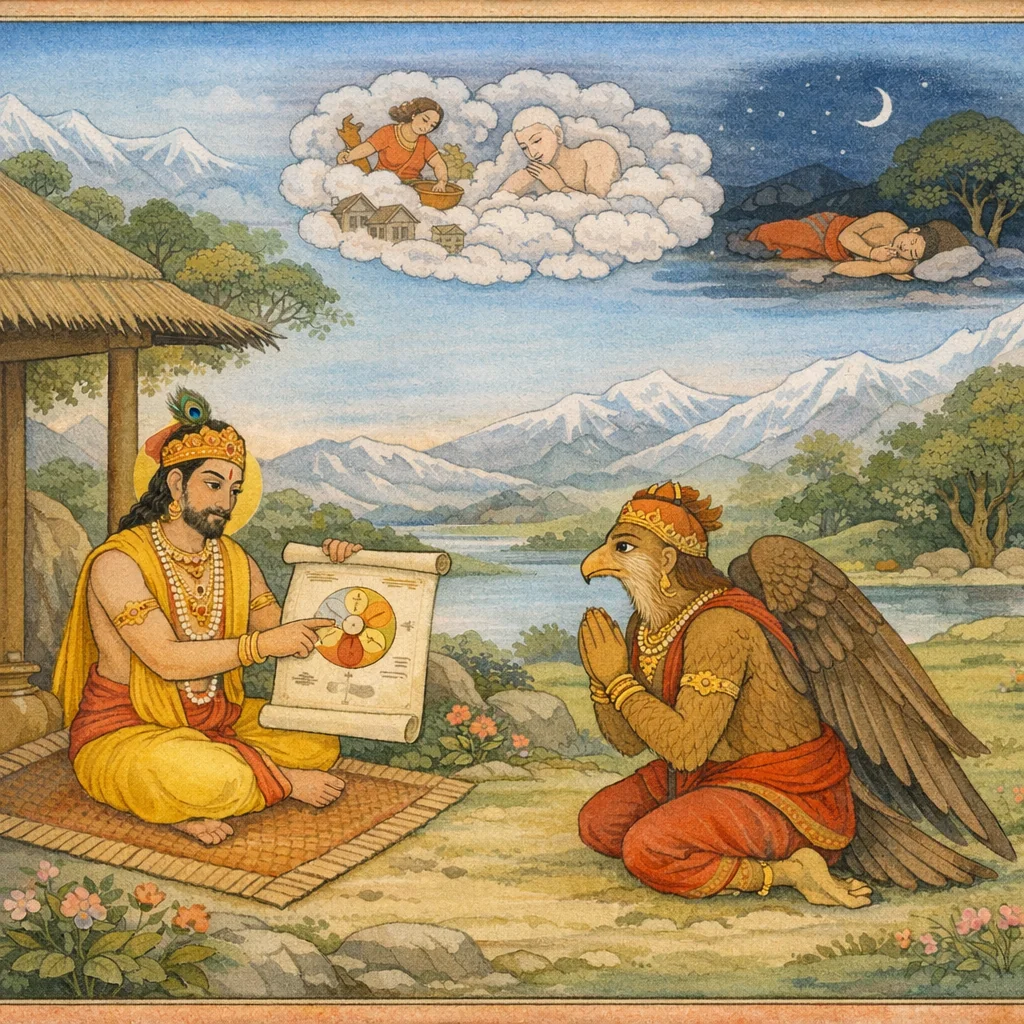
Adhyaya 239
From Brahman to the Elements: Subtle–Gross Body, Prāṇa, States of Consciousness, and Mahāvākya Realization
Continuing the Garuḍa Purāṇa’s teaching style, the Lord presents a graded account of manifestation: from Brahman to space, air, fire, water, and earth, and then the rise of the subtle apparatus—organs of action and perception, mind, intellect, and the five prāṇas. He explains pañcīkaraṇa as the process by which subtle elements become the gross cosmos and gross body, while affirming that effect is not separate from cause (pot and clay). Turning inward, the jīva is shown as the witness of waking, dream, and deep sleep, and the aspirant is urged to steady discernment so samādhi begins by dissolving the “field” of superimposed experience. The chapter culminates in explicit non-dual instruction: Brahman as eternal pure consciousness, and the mahāvākyas “tat tvam asi” and “ahaṁ brahmāsmi,” leading from cosmology to liberating self-knowledge and sustained contemplative assimilation beyond states.
Shlokas
Verse 1
नामैकोनचत्वारिंशदुत्तरद्विशततमो ऽध्यायः श्रीभगवानुवाच / सन्नपि ब्रह्म तस्मात्खं मरुत्खाच्च ततो ऽनलः
The Blessed Lord said: Though Brahman is pure Being, from That arises space; from space comes wind, and from wind then arises fire.
Verse 2
अग्नेरापस्ततः पृथ्वी प्रपञ्चाकृतिसूतिका / ततः सप्तदशं लिङ्गं पञ्चकर्मेन्द्रियाणि च
From fire arise the waters; from waters comes the earth, the womb that gives rise to the manifested universe. From that evolution emerges the seventeenfold subtle body, along with the five organs of action.
Verse 3
वाक्पाणिपादं पायुश्चाप्युपस्थमथ धीन्द्रियम् / श्रोत्रं त्वक्चक्षुषी जिह्वा घ्राणं स्यात्पञ्च वायवः
Speech, the hands, the feet, the anus, and the generative organ—along with the mind as an internal faculty; and the ears, skin, eyes, tongue, and nose—these are said to be the faculties, together with the five vital airs.
Verse 4
प्राणोपानः समानश्च व्यानस्तूदान एव च / मनोन्तः करणं धीश्च स्यान्मनः संशयात्मकम्
Prāṇa, Apāna, Samāna, Vyāna, and Udāna are the five vital airs. Mind is the inner instrument, and dhī is its discerning power; the mind, by its very nature, is the seat of doubt.
Verse 5
बुद्धिर्निश्चयरूपा तु एतत्सूक्ष्मस्वरूपकम् / हिरण्यगर्भमात्मीयसूत्रं तत्कार्यालिङ्गकम्
The buddhi (intellect) is indeed of the nature of decisive ascertainment; this is its subtle form. It is Hiraṇyagarbha—the inner “sūtra” (thread) belonging to the Self—recognized as its characteristic mark through its effects (functions).
Verse 6
पञ्चीकृतानि भूतानि ह्यपञ्चीकृतभूततः / पञ्चीकृतेभ्यो भूतेभ्यो ब्रह्माण्डं समजायत
The five gross elements become “quintuplicated” (pañcīkaraṇa) from the unquintuplicated subtle elements; and from those quintuplicated elements the cosmic egg, the brahmāṇḍa (universe), comes into being.
Verse 7
लोकप्रसिद्धं स्थूलाख्यं शरीरं चरणादिमत् / पञ्चीकृतानि भूतानि तत्कार्यं तत्स्थमेव च
The body well known in the world, called the “gross body,” is furnished with feet and other limbs. It is the product of the five elements after pañcīkaraṇa (quintuplication), and it abides in those very elements.
Verse 8
सर्वं शरीरजातं च प्राणिनां स्थूलमीरितम् / त्रिधाह्रि परमात्मस्थं शरीरं प्रोच्यते बुधैः
All that is born as the bodily frame of living beings is declared to be the gross body. Yet the wise also speak of the body as threefold, and as resting in the Supreme Self, the Paramātman.
Verse 9
देहद्वयाभिगामी च त्वमथो जीव एकतः / स्वभेदवाक्याद्ब्रह्मैव प्रविष्टं देहयोर्द्वयोः
O single jīva, you move in relation to the two bodies; yet, by the teaching that in essence there is no real difference, it is Brahman alone that has entered into both bodies.
Verse 10
जलार्क्ववद्वदरवज्जीवः प्राणादिधारणः / जाग्रत्स्वप्नसुषुप्तीनां साक्षी जीवः स च स्मृतः
The jīva, subtle like the fiber of a lotus-stalk and minute like a spark, sustains the vital forces such as prāṇa. That very jīva is remembered as the witness of the three states—waking, dreaming, and deep sleep.
Verse 11
जाग्रत्स्वप्नसुषुप्त्याख्यैर्व्यातिरिक्तश्च निर्गुणः / निर्गातावयवोसंगो नित्यशुद्धस्वभावकः
He is beyond the states called waking, dreaming, and deep sleep; He is without qualities. Free from bodily parts and unattached, His very nature is eternally pure.
Verse 12
परमात्मैव यज्जाग्रत्स्वप्नाद्यैर्यस्त्रिधा मतः / अन्तः करणराशेश्चैवान्तः करणःस्थितः
The Supreme Self alone is regarded as threefold through the states such as waking and dream; and He—being the lord of the aggregate of the inner instruments—abides within the inner instrument (mind).
Verse 13
जाग्रत्स्वप्नसुषुप्तीश्च पश्यतो विकृतिः सदा / फलक्रियाकारकयोर्जाग्रदादीन्वदाम्यहम्
For the witnessing consciousness that observes waking, dream, and deep sleep, there is always transformation in the experienced states. Now I shall explain these—beginning with waking—in terms of their results, their activities, and the agencies that perform them.
Verse 14
इन्द्रियैरथ विज्ञानं जाग्रत्स्थानमुदीरितम् / जाग्रत्संस्कारसंभूतप्रत्ययो विषयार्थिनः
When cognition functions through the sense-organs, that is declared to be the waking state. There, the seeker of objects has perceptions arising from the saṃskāras—the impressions formed in waking life.
Verse 15
स्वप्नं सुषुप्तिः करणोपसंघाते धियः (प) स्थित (ति) / ब्रह्मणः कारणावस्थायां स्थितिः कालकात्मना
Dream and deep sleep are conditions of the mind when the sense-faculties are gathered and withdrawn. Likewise, Brahman abides in the causal state, established as Time itself (Kāla), the inner principle of time.
Verse 16
क्रमतोक्रमतो जीवो जाग्रदादि स पश्यति / समाध्यारंभकाले तु पूर्वमेवावधारयेत्
Step by step, the jīva—the individual soul—perceives the states beginning with waking and the rest. But when commencing samādhi, one should first fix this understanding clearly in the mind.
Verse 17
मुमुक्षावथ संजाते अन्तः करणकेवले / विलापयेत्क्षेत्रजातं तत्क्षेत्रं परिशेषयेत्
When the longing for liberation (mumukṣā) arises and one abides purely in the antaḥkaraṇa—the inner instrument of mind and heart—one should dissolve whatever has arisen in the kṣetra, the field of body and experience; thus the ‘field’ is reduced to a mere remainder.
Verse 18
पञ्चीकृतेभ्यो भूतेभ्यो भाण्डादि व्यतिरिक्तकम् / यथा मृदो घटो भिन्नो नास्ति तत्कार्यतस्तथा
From the five elements, combined in fivefold fashion (pañcīkaraṇa), things such as pots and other vessels are not truly separate. Just as a pot is, in truth, not different from clay, so too, from the standpoint of the effect—the product—there is no real difference from its material cause.
Verse 19
पञ्चीकृतानि भूतानि अपञ्चीकृतभूततः / शंसंति व्यतिरेकेण शिष्टाः सूक्ष्मशरीरकम्
The gross elements produced by fivefold combination are declared by the wise; distinguished from the uncombined subtle elements, they are said to constitute the subtle body (sūkṣma-śarīra) as something distinct.
Verse 20
अपञ्चीकृतभूतेभ्यो न लिङ्गं व्यतिरिक्तकम् / पृथ्व्याधारं विना नास्ति विना नास्ति च तेन सा
The subtle body (liṅga-śarīra) is not separate from the uncombined elements. Without the support of earth it cannot exist—and earth likewise cannot exist without that subtle principle.
Verse 21
तेजश्च वायुना नास्ति वायुः खेन विना न हि / यद्ब्रह्मणा च खं नास्ति शुद्ध ब्रह्म विना च खम्
Fire (tejas) cannot exist without air, and air indeed cannot exist without space. If space cannot exist apart from Brahman, then space too is not truly apart from the Pure Brahman.
Verse 22
शुद्धभावस्तदा जाग्रत्स्वप्नादीनामसंभवः / जीवत्ववर्जितः प्राप्तात्मचैतन्यानुरूपतः
Then, established in pure being, the states of waking, dream, and the like no longer arise. Freed from the sense of individual jīva-hood, one abides in accordance with the consciousness of the realized Self (Ātman).
Verse 23
नित्यं शुद्धं बुद्धमुक्तं सत्यं ब्रह्माद्वितीयकम् / तत्त्वंपदान्तौ शिष्टौ च तत्कारो ब्रह्मवाचकः
Brahman is eternal, pure, of the nature of consciousness and ever-free, true, and non-dual. In the expression “tat tvam”, the words “tat” and “tvam” are the two principal terms, and the syllable “tat” denotes Brahman.
Verse 24
उकारश्च अकारश्च मकारोयमृगद्वयः / ब्रह्माहमस्म्यहं ब्रह्मज्ञानमज्ञानवर्धनम्
The syllables “u” and “a”, together with “ma”—these paired Vedic formulations are taught as the essence: “I am Brahman; Brahman am I.” This is true knowledge; its opposite increases ignorance.
Verse 25
अयमात्मा परं ज्योतिश्चिन्नामानन्दरूपकः / सत्यं ज्ञानमनतं हि त्वमसीति श्रुतीरितम्
This Self (Ātman) is the supreme Light, of the nature of Consciousness, Name, and Bliss (Ānanda). The Śruti proclaims: “You are That”—the infinite Reality that is Truth and Knowledge.
Verse 26
अहं ब्रह्मास्मि निर्लेपमहं ब्रह्मास्मि सर्वगम् / योसावादित्यपुरुषसोसावहमनादिमत् / गीतासारोर्ऽजुनायोक्तो येन ब्रह्मणि वै लयः
“I am Brahman—unstained; I am Brahman—all-pervading. That Puruṣa who abides in the Sun (Āditya-Puruṣa)—that indeed am I, beginningless in nature. This is the essence of the Gītā taught to Arjuna, by which one truly attains mergence in Brahman.”
Frequently Asked Questions
The chapter lists Prāṇa, Apāna, Samāna, Vyāna, and Udāna as the vital airs. They signify the functional life-forces that animate the embodied system and support the operations of the organs and the inner instrument.
It acknowledges the jīva’s movement in relation to bodies (subtle/gross) for explanatory purposes, yet asserts that by right teaching there is no essential difference: it is Brahman alone appearing as entered into both, with individuality understood as superimposition.