Adhyaya 217
Gāyatrī–Sandhyā Upāsanā: Śuddhi, Nyāsa, and Japa-Viniyoga
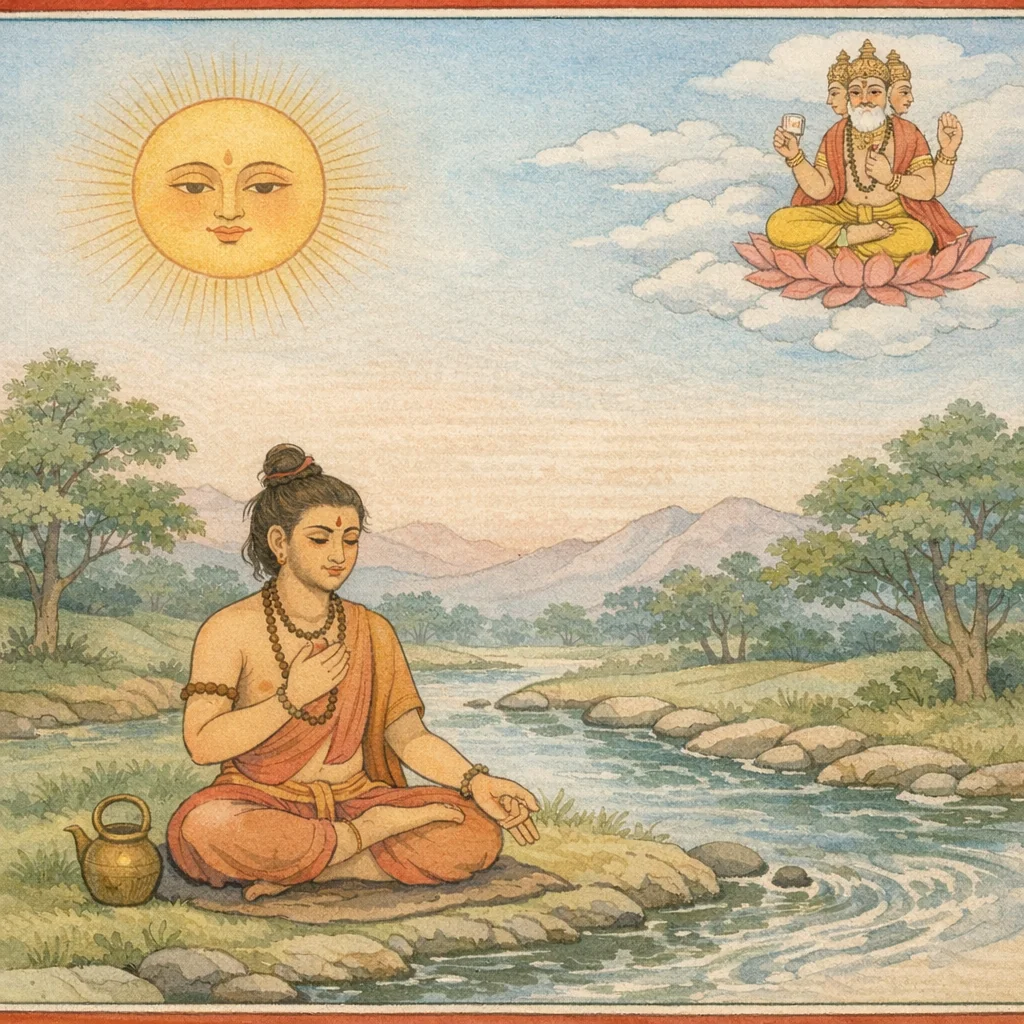
Brahmā teaches that purity is gained first by remembering Puṇḍarīkākṣa (Viṣṇu), establishing a bhakti foundation for Vedic rite. He then defines Gāyatrī’s formal marks—ṛṣi, meter, and three-pāda form—and adds a cosmic body-visualization culminating in viniyoga for upanayana. The practitioner performs nyāsa with the vyāhṛtis and higher utterances (bhūḥ through satyaṃ), followed by aṅga-mantras for protection and empowerment. A sequence of “Om” recitations with water and solar invocations unites purification by the waters with contemplation of the Sun as the divine eye and the Self of moving and unmoving beings. The chapter clarifies Gāyatrī japa-viniyoga (Viśvāmitra, Gāyatrī meter, Savitṛ deity), includes “vāte-dhāḥ” style repetition, and ends with a formal dismissal of the Goddess, completing a full liturgical arc that leads naturally into nitya-karma or further saṃskāra practice.
Shlokas
Verse 1
नाम षोडशोत्तरद्विशततमो ऽध्यायः ब्रह्मोवाच / अपवित्रः पवित्रो वा सर्वावस्थां गतो ऽपि वा
Brahmā said: “Whether one is impure or pure, or even if one has entered any condition whatsoever (of life)...”
Verse 2
यः स्मरेत्पुण्डरीकाक्षं स बाह्याभ्यन्तरः शुचिः
Whoever remembers Puṇḍarīkākṣa—Viṣṇu, the lotus‑eyed Lord—becomes pure, outwardly and inwardly.
Verse 3
गायत्त्रीच्छन्दो विश्वामित्र ऋषिस्त्रिपात् / समुद्राः कुक्षिश्चन्द्रादित्यौ लोचनौ / अग्निर्मुखम् / विष्णुर्हृदयम् / ब्रह्मरुद्रौ शिरः / रुद्रः शिखा / उपनय ने विनियोगः / ॐ भूः पादे / भुवः जानुति / स्वः हृदये / महः शिरसि / जनः शिखायाम् / तपः कण्ठे / सत्यं ललाटे / ॐ हृदयाय नमः / ॐ भूः शिरसे स्वाहा / ॐ भुवः शिखायै वौषट् / ॐ स्वः कवचाय हुं / ॐ भूर्भुवः स्वः अस्त्राय फट्
The meter is Gāyatrī; the seer is Viśvāmitra; it is tripād (three‑footed). The oceans are the belly; the Moon and Sun are the two eyes; Fire (Agni) is the mouth; Viṣṇu is the heart; Brahmā and Rudra are the head; Rudra is the topknot (śikhā). This is its application (viniyoga) for the upanayana rite. (Perform nyāsa:) place “Oṃ bhūḥ” in the feet, “bhuvaḥ” in the knees, “svaḥ” in the heart, “mahaḥ” in the head, “janaḥ” in the topknot, “tapaḥ” in the throat, “satyaṃ” in the forehead. Then recite: “Oṃ, homage to the heart”; “Oṃ bhūḥ, svāhā to the head”; “Oṃ bhuvaḥ, vauṣaṭ to the topknot”; “Oṃ svaḥ, huṃ as armor”; “Oṃ bhūr-bhuvaḥ-svaḥ, phaṭ as the missile.”
Verse 4
ॐ भूः ॐ भुवः ॐ स्वः ॐ महः ॐ जनः ॐ तपः ॐ सत्यं तत्स्त्रिपदा / ॐ आपो ज्यो ऽती रसो ऽमृतं ब्रह्म भूर्भुवः स्वरोम् / ॐ सूर्यश्चेत्यादि / ॐ आपः पुनन्त्वित्यादि / ॐ अग्निश्चेत्यादि
“Oṃ—Bhūḥ, Oṃ—Bhuvaḥ, Oṃ—Svaḥ; Oṃ—Mahaḥ, Oṃ—Janaḥ, Oṃ—Tapaḥ, Oṃ—Satyaṃ—That Reality is uttered in a threefold form (tripadā). ‘Oṃ—Waters, Light, Essence, Immortality, Brahman; Bhūḥ‑Bhuvaḥ‑Svaḥ—Oṃ.’ (Thereafter follow the mantras beginning ‘Oṃ, the Sun…’, ‘Oṃ, may the Waters purify…’, and ‘Oṃ, Agni…’).
Verse 5
ॐ आयातु वरदे देवि ! पूर्वाह्ने ब्रह्मदेवता / गायत्त्री नाम या सन्ध्या रक्ताङ्गी रक्तवाससा / वरहंससमारूढा श्रीमत्पुष्करसंस्थिता
Oṃ. May the boon‑giving Goddess come—she who, in the forenoon, is the divinity Brahmā; that Sandhyā known as Gāyatrī, red‑limbed and clad in red, mounted upon the excellent swan, abiding in the sacred, splendid Puṣkara.
Verse 6
कमण्डलुधरा शान्ता अक्षमालाविधारिणी / आयातु वरदा देवी मध्याह्ने श्वेतरूपिणी
May the boon‑giving Goddess come—peaceful, bearing the kamaṇḍalu (water‑pot) and holding the akṣamālā (rosary)—appearing at midday in a white form.
Verse 7
माहेश्वरी च सावित्री शुक्लवस्त्रादिमण्डिता / वृषस्कन्धसमारूढा त्रिशूलवरधारिणी
She is Māheśvarī, and also Sāvitrī, adorned with white garments and ornaments; mounted upon the bull’s shoulder/back, she bears the trident and bestows boons.
Verse 8
आयातु वरदा देवी अपराह्ने सरस्वती / अतसीकुसुमप्रख्या वैष्णवी गरुडासना
May the boon-giving Goddess Sarasvatī come in the afternoon—shining like the blossom of the atāsī flower; the Vaiṣṇavī power, seated upon Garuḍa.
Verse 9
पीतवस्त्रा शङ्खचक्रगदापद्मसमन्विता / श्वेतवर्णा समुद्दिष्टा रविमण्डलसंस्थिता
She is described as clad in yellow garments, bearing the conch, discus, mace, and lotus; white in complexion, and abiding in the orb of the Sun.
Verse 10
श्वेतपद्मसनासीना श्वेतपुष्पोपशोभिता / ॐ आपो हिष्ठा मयो भुवस्ता न उर्जे दधात नः
Seated upon a white lotus-seat and adorned with white flowers, one should recite: “Oṃ—O Waters, you are indeed bliss-giving; grant us nourishment and strength.”
Verse 11
महेरणाय चक्षुसे / ॐ यो वः शिवतमो रसः / तस्य भाजयेतेह नः / अशतीरिव मातरः / ॐ तस्मा अरङ्गमाम वो यस्य क्षयाय जिन्वथ / आपो जन यथा च नः / ॐ सुमित्रिया न आप ओषधयः सन्तु ॐ दुर्मित्रियास्तस्मै सन्तु यो ऽस्मान् द्वेष्टि यञ्च वयं द्विष्मः / ॐ द्रुपदादिवमुमुचानः स्विन्नः स्नातो मलादिव / पूतं पवित्रेणेवाज्यमापः शुन्धन्तु मैनसः / ॐ ऋतं च सत्यं चाभीद्धात्तपसो ऽध्यजायत / ततोरात्र्यजायत / ततः समुद्रोर्ऽणवः समुद्रादर्णवादधिसंवत्सरो अजायत / अहौरात्राणि विदधद्विश्वस्य मिषतो वशी / सूर्याचन्द्रमसौ धाता यथापूर्वमकल्पयत् / दिवं च पृथिवीं चान्तरिक्षमथो स्वः
For the great onward-moving Eye (the Sun). O Waters—whatever is the most auspicious essence within you, grant us a share of it here, like gentle mothers. O Waters, we draw near to you for protection; strengthen us, so that our dwelling and well-being do not perish—so that you may be for people, and for us as well. May the waters and healing herbs be friendly to us; but may they be unfriendly to the one who hates us, and to the one whom we hate. Like a man freed from a pillar, like one washed clean of sweat and filth, may the waters purify our inner mind, as clarified butter is purified by a strainer. From heat-born austerity arose Ṛta (cosmic order) and Satya (truth); from that arose night; from that arose the ocean and the flood; from the ocean and flood the year came forth. The Ordainer, mastering all that moves, arranged day and night; and as before, the Creator set in order the Sun and Moon, heaven and earth, the mid-region, and the higher world.
Verse 12
गायत्त्र्या विश्वामित्र ऋषिर्गायत्त्रीछन्दः / सविता देवता जपे विनियोगः / ॐ उदुत्यं जातवेदसं देवं वहन्ति केतवः / दृशे विश्वाय सूर्यम् / ॐ चित्रं देवानामुदगादनीकं चक्षुर्मित्रस्य वरुणस्याग्नेः / आप्रा द्यावापृथिवी अन्तरिक्षं सूर्य आत्मा जगतस्तस्थुषश्च / ॐ तच्चक्षर्देवहितं पुरस्ताच्छुक्रमुच्चरत् / पश्येम शरदः शतं जीवेम शरदः शतम् / शृणुयाम शरदः शतम् / ॐ विश्वतश्चक्षुरुत विश्वतोमुखोविश्वतो बाहुरुत विश्वतस्पात् / संबाहुभ्यां धमति संपत्रैद्यार्वाभूमी जनयन्देव एकः / देवा गातुविदो नाङ्गविद्वानाद्भमितमनसस्पत इमं देवयज्ञं स्वाहा वातेधाः जपेत्
For the Gāyatrī: the seer is Viśvāmitra, the metre is Gāyatrī, the deity is Savitṛ—this is the vinīyoga (application) for japa. Om. The radiant banners (rays) bear aloft Jātavedas, the divine Sun, for all to behold. Om. The wondrous face of the gods has risen—the eye of Mitra, Varuṇa, and Agni; it has filled heaven and earth and the midspace; the Sun is the very Ātman of all that moves and all that stands. Om. That beneficent, divine eye has arisen in the east, shining bright; may we see for a hundred autumns, may we live for a hundred autumns, may we hear for a hundred autumns. Om. With eyes everywhere, with faces everywhere, with arms everywhere, and with feet everywhere—one God, generating heaven and earth, breathes forth with His two arms and with His wings. O gods, knowers of the path; O Lord of the mind, guide this divine offering: svāhā. Thus should one repeat in japa with Vāte-dhāḥ (the wind-bearer invocation).
Verse 13
उत्तरे शिखरे जाते भूम्यां पर्वतवासिनी / ब्रह्मणा समनुज्ञाता गच्छ देवि ! यथासुखम्
When (you) have reached the northern peak, dwelling upon the earth as a mountain-dweller—having been duly permitted by Brahmā—go forth, O Devī, at ease, as you wish.
Frequently Asked Questions
It establishes a dhyāna/nyāsa framework where the practitioner’s body is contemplated as a microcosm of the universe, making mantra-japa an act of aligning personal consciousness with cosmic order (Ṛta) and truth (Satya), rather than mere recitation.
They function as kavaca (protective ‘armor’) and astrā (projectile/warding) components, ritually sealing the practitioner’s body and practice so that japa proceeds with steadiness, protection, and focused intent.
The water hymns ask the waters to grant auspicious essence, protection, and mental cleansing—explicitly comparing inner purification to ghee clarified through a strainer—thereby connecting external ācamana/prokṣaṇa motifs to antahkaraṇa-śuddhi (purification of mind).