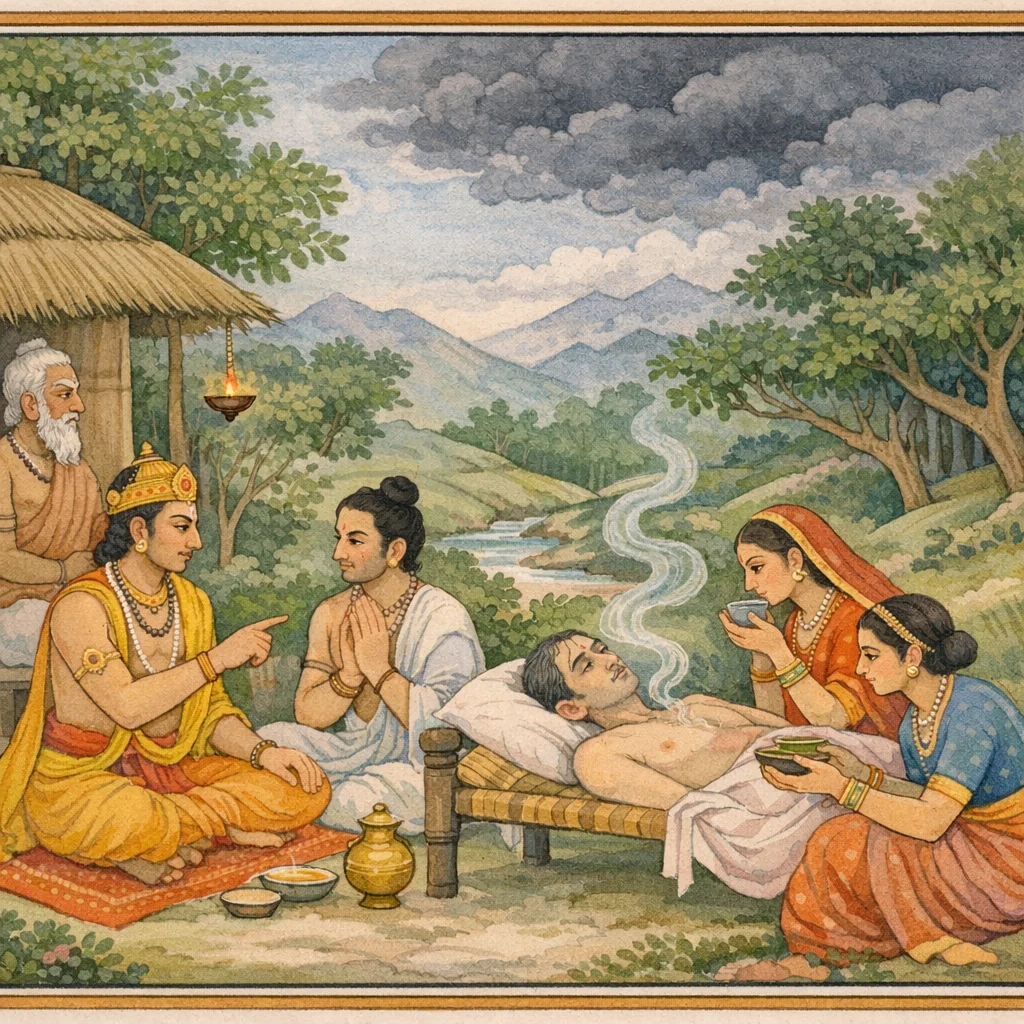
Adhyaya 151
Hikkā-nidāna: Causes, Types, and the Grave Yamalā/Veginī Hiccup
In the Purāṇic–Āyurvedic teaching style, Dhanvantari instructs Suśruta on the nidāna (causes) of hikkā (hiccup), first linking its root cause with that of śvāsa (dyspnea) and stressing recognition of prodromal signs and prakṛti-based variants. He lists distinct vāyu-driven forms and common provocations—rough, irritating foods, hunger-born spasms, and exertion after eating and drinking in equal measure—producing mild, softening hiccups that may subside with a small intake. The teaching then turns to a delayed, ominous form associated with “Yama’s attendants,” which worsens during digestion and eases only when digestion is complete. The Yamalā/Veginī/Pariṇāmavatī subtype is marked by tremors of head and neck, delirious speech, vomiting, diarrhea, rolling eyes, yawning, sensory impairment, paralysis-like weakness, loss of speech and memory, and a crushing, serpent-like force rising from the navel/intestinal region. Cautions are offered for the aged and the chronically wasted, and the chapter concludes that hikkā and śvāsa often appear at life’s end, joining clinical prognosis to Purāṇic contemplation of mortality.
Shlokas
Verse 1
ऽध्यायः धन्वन्तरिरुवाच / हिक्रारोगनिदानञ्च वक्ष्ये सुश्रुत ! तच्छृणु / श्वासैकहेतुः प्राग्रूपं संख्या प्रकृतिसंश्रया
Dhanvantari said: “O Suśruta, listen. I shall explain the causes of the disease called hikkā (hiccup). Its primary cause is the same as that of śvāsa (dyspnea); its premonitory signs should be understood, and its kinds are classified according to bodily prakṛti (constitution).”
Verse 2
हिक्रा भक्ष्योद्भवा क्षुद्रा यमला महतीति च / गम्भीरा च मरुत्तत्र त्वरयायुक्तिसेवितैः
There the winds (marut/vāyu) are of many kinds—Hikrā, Bhakṣyodbhavā, Kṣudrā, Yamalā, Mahatī, and Gambhīrā; and those who act in haste, compelled by circumstance, are driven onward by those winds.
Verse 3
रूक्षतीक्ष्णखराशान्तैरन्नपानैः प्रपीडितः / करोति हिक्रां श्वसनः मन्दशब्दां क्षुधानुगाम्
Tormented by foods and drinks that are dry, sharp, coarse, and unsoothing, he breathes with difficulty and brings forth hikkā—faint in sound and following upon hunger.
Verse 4
समं सन्ध्यान्नपानेन या प्रयाति च सान्नजा / आयासात्पवनः क्रुद्धः क्षुद्रां हिक्रां प्रवर्तयेत्
When one sets out at dusk after taking food and water in equal measure, then, through exertion, vāyu (the vital wind) is aggravated and brings forth a mild hikkā (kṣudrā hiccup).
Verse 5
जत्रुमूलात्परिसृता मन्दवेगवन्ती हि सा / वृद्धिमायासतो याति भुक्तमात्रे च मार्दबम्
Starting from the base of the throat, it spreads outward; indeed it moves with a sluggish force. It increases only with difficulty, and after one has eaten even a little, it becomes softened.
Verse 6
चिरेण यमलैर्वेगैर्या हिक्रा संप्रवर्तते / परिणामान्मुखे वृद्धिं परिणामे च गच्छति
That hiccup which arises after a long time, with the swift impulses sent by Yama’s attendants, increases in the mouth as digestion proceeds, and then subsides when the digestion is complete.
Verse 7
कम्पयन्ती शिरो ग्रीवां यमलां तां विनिर्दिशेत् / प्रलापच्छर्द्यतीसारनेत्रविप्लुतजृम्भिता
One should identify her as the ‘Yamalā’ (a Yama-born affliction): she makes the head and neck tremble, and is marked by delirious talk, vomiting, diarrhoea, rolling or upturned eyes, and repeated yawning.
Verse 8
यमला वेगिनी हिक्रा परिणामवती च सा / ध्वस्तभ्रूशङ्खयुग्मस्य श्रुतिविप्लुतचक्षुषः
She is called Yamalā, Veginī, Hikrā, and also Pariṇāmavatī; she belongs to one whose pair of temples and brows are shattered, whose hearing is ruined, and whose eyes are disturbed and impaired.
Verse 9
स्तम्भयन्ती तनुं वाचं स्मृतिं संज्ञां च मुञ्चती / तुदन्ती मार्गमाणस्य कुर्वती मर्मघट्टनम्
It paralyzes the body and the power of speech, and makes one lose memory and consciousness; it pierces the traveler on the road and strikes the vital points, causing intense agony.
Verse 10
पृष्ठतो नमनं सार्ष्यं महाहिक्रा प्रवर्तते / महाशूला महाशब्दा महावेगा महाबला
From behind, a dreadful, headlong pressure bears down, and a great serpent-like terror surges forth—armed with mighty spears, roaring with immense sound, rushing with tremendous speed, and endowed with overwhelming strength.
Verse 11
पक्राशयाच्च नाभेर्वा पूर्ववत्सा प्रवर्तते
From the digestive receptacle (the intestinal region) or from the navel, it proceeds onward just as before.
Verse 12
तद्रूपा सा महत्कुर्याञ्जृम्भणां गप्रसारणम् / गम्भीरेण निदानेन गम्भीरा तु सुसाधयेत्
Assuming that very form, she should perform the great act—yawning and the spreading (opening) of the limbs; and, by a profound cause and method, the deep one should accomplish it well.
Verse 13
आद्ये द्वे वर्जयेदन्ये सर्वलिङ्गां च वेगिनीम् / सर्वस्य संचितामस्य स्थविरस्य व्यवायिनः
For the aged man given to sexual indulgence, one should avoid the first two (items) and the other (restricted ones) as well; and one should also avoid the ‘veginī’ and the ‘sarvaliṅgā’—for these aggravate the entire stock of his accumulated (doṣas/ailments).
Verse 14
व्याधिभिः क्षीणदेहस्य भक्तच्छेदकृशस्य च / सर्वे ऽपि रोगा नाशाय न त्वेवं शाघ्रकारिणः
For one whose body has been wasted by diseases, and who has grown emaciated from cutting off (or reducing) food, all illnesses do tend toward destruction (i.e., ending), but not in a way that brings swift relief.
Verse 15
हिक्राश्वासौ यथा तौ हि मृत्युकाले कृतालयौ
Just as those two—hiccup and laboured breathing—indeed take up their abode at the time of death.
Frequently Asked Questions
The text highlights tremors of head and neck, delirious talk, vomiting and diarrhea, rolling/upturned eyes, repeated yawning, sensory disturbance (hearing/vision), paralysis-like debility, impairment of speech and memory, and a violent upward pressure described as terrifying and serpent-like, arising from the navel/intestinal region.
Harsh/sharp/coarse and unsoothing foods and drinks, hunger-driven strain, and exertion after setting out at dusk having eaten food and drunk water in equal measure are described as aggravating vāyu and producing hiccup—ranging from mild forms to more troubling patterns.