Adhyaya 133
Aśokāṣṭamī and Mahānavamī: Durgā Navamī-vrata, mantra-nyāsa, forms, weapons, and offerings
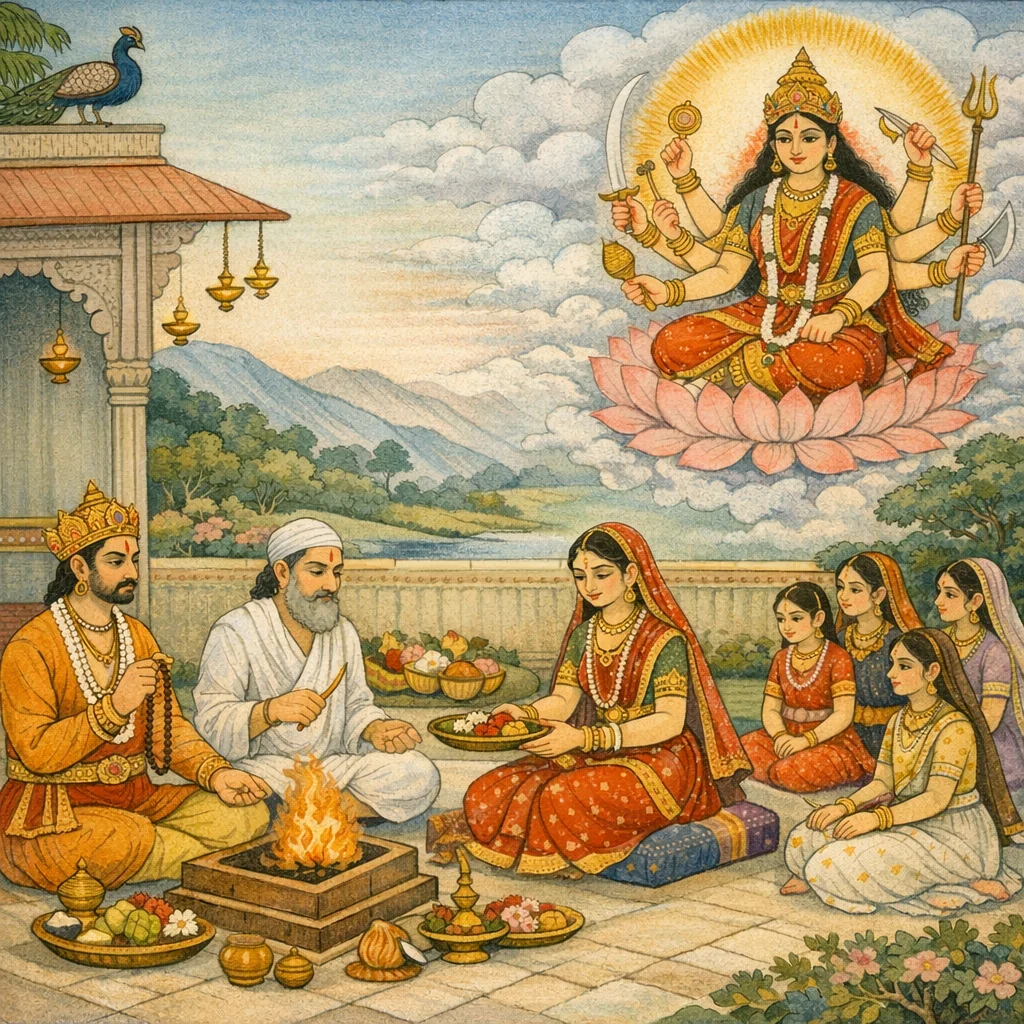
Continuing Brahmā’s instruction on dharma and observances, this chapter shifts from a plant-based śoka-nāśana rite (Aśokāṣṭamī in Caitra with Punarvasu) to a calendar-fixed festival setting (Mahānavamī in Āśvayuja with Uttarāṣāḍhā) in which snāna, dāna, and related acts become akṣaya. It then prescribes an independent Navamī fast and worship of Durgā, with auxiliary practices for kings seeking victory (japa, homa, and feeding a maiden). A Durgā mantra is given, along with nyāsa on the heart and other seats and finger placements, and the supports of worship are described—from trident and sword to book, cloth, and maṇḍala. Fierce goddess-names and iconographic weapon sets are listed, worship of a measured sword and trident is added, and the chapter ends with directional offerings to Kālī/Kālikā and other beings, pointing toward more elaborate, power-oriented rites to follow.
Shlokas
Verse 1
नाम द्वात्रिंशदुत्तरशततमो ऽध्यायः ब्रह्मोवाच / अशोककलिका ह्यष्टौ ये पिबन्ति पुनर्वसौ / चैत्रे मासि सिताष्टम्यां न ते शोकमवाप्नुयुः
Chapter one-hundred-and-thirty-three begins. Brahmā said: Those who drink eight buds/portions of the aśoka plant on the day of Punarvasu, on the bright eighth lunar day in the month of Caitra—such people do not fall into grief.
Verse 2
त्वामशोक ! हराभीष्ट ! मधुमाससमुद्भव / पिबामि शोकसन्तप्तो मामशोकं सदा कुरु
O Aśoka! O beloved of Hara (Śiva)! O one born in the spring month of Madhu! Tormented by grief, I drink you—make me forever free from sorrow.
Verse 3
(इत्यशोकाष्टमीव्रतम्) / ब्रह्मोवाच / शुक्लाष्टम्यामाश्वयुजे उत्तराषाढया युता / सा महानवमीत्युक्ता स्नानदानादि चाक्षयम्
Brahmā said: When the bright eighth lunar day in the month of Āśvayuja is conjoined with the nakṣatra Uttarāṣāḍhā, it is called Mahānavamī; on that occasion, bathing, charitable giving, and related rites become inexhaustibly fruitful.
Verse 4
नवमी केवला चापि दुर्गां चैव तु पूजयेत् / महाव्रतं महापुण्यं शङ्कराद्यैरनुष्ठितम्
On the ninth lunar day, one should also observe the Navamī fast as a distinct vow and worship Goddess Durgā. This is a great vow and highly meritorious, practiced even by Śaṅkara (Śiva) and other revered beings.
Verse 5
अयाचितादि षष्ठ्यादौ राजा शत्रुजयाया च / जपहोमसमायुक्तः कन्यां वा भोजयेत्सदा
At the beginning of the Ayācitā and other observances, and especially on the sixth lunar day (Ṣaṣṭhī), the king—seeking victory over enemies—should, together with japa and homa, always feed a maiden (kanyā) as well.
Verse 6
दुर्गेदुर्गे रक्षिणि स्वाहा मन्त्रो ऽयं पूजनादिषु / दीर्घाकारादिमात्राभिर्नव देव्यो नमो ऽन्तिकाः
“O Durgā, O Durgā, O Protectress—svāhā”: this is the mantra to be employed in worship and allied rites. With the long “ā” and the other prescribed mātrās, one should bow in reverence to the nine Goddesses who are close at hand.
Verse 7
षड्भिः पदैर्नमः स्वाहा वषडादिहृदादिकम् / अङ्गुष्ठादिकनिष्ठान्तं न्यस्य वै पृजयेच्छिवाम्
With the six mantra-words—“namaḥ”, “svāhā”, “vaṣaṭ”, and the rest—one should perform nyāsa, beginning at the heart and the other seats. Having placed (the mantras) from the thumb onward up to the little finger, one should then worship Śivā, the auspicious Goddess.
Verse 8
अष्टम्यां नव गेहानि दारुजान्येकमेव वा / तस्मिन्देवी प्रकर्तव्या हैमी वाराजतापि वा
On Aṣṭamī, the eighth lunar day, one should prepare nine small wooden shrines—or even a single one. Within that shrine, the Goddess should be fashioned, either of gold or likewise of silver.
Verse 9
शूले खङ्गे पुस्तके वा पटे वा मण्डले (पे) यजेत् / कपालं खेटकं घण्टां दर्पणं तर्जनीं धनः
One may worship (the deity) upon a trident, upon a sword, within a book, upon a cloth painting, or in a ritual maṇḍala. One may also worship with a skull, a shield, a bell, a mirror, the forefinger as a ritual sign, and wealth as an offering.
Verse 10
ध्वजं डमरुकं पाशं वामहस्तेषु बिभ्रती / शक्तिं च मुद्गरं शूलं वज्रं खङ्गं तथाङ्कुशम्
In her left hands she bears a banner, the ḍamaru drum, and a noose (pāśa); and she also holds the śakti-spear, the mudgara mace, the trident, the vajra thunderbolt, the sword, and likewise the aṅkuśa goad.
Verse 11
शरं चक्रं शलाकां च दुर्गामायुधसंयुताम् / शेषाः षोडशहस्तां स्युरञ्जनं डमरुं विना
Holding an arrow, a discus, and a club—armed with the weapons of Goddess Durgā—the remaining forms are said to be sixteen-armed, except that they are without añjana (collyrium) and without the ḍamaru drum.
Verse 12
रुद्रचण्डा प्रचण्डा च चण्डोग्रा चण्डनायिका / चण्डा चण्डवती चैव चण्डरूपातिचण्डिका
Rudracaṇḍā, Pracaṇḍā, Caṇḍogrā, and Caṇḍanāyikā; Caṇḍā, Caṇḍavatī, and also Caṇḍarūpā—Aticaṇḍikā: these are the fierce names/forms being enumerated.
Verse 13
नवमी चोग्रचण्डा च मध्यमाग्निप्रभाकृतिः / रोचना त्वरुणा कृष्णा नीलं धूम्रा च शुक्रका
The ninth is called Navamī; and also Ugracaṇḍā; Madhyamā, whose form is like the radiance of fire; Rocanā; Tvaruṇā; Kṛṣṇā; Nīlā; Dhūmrā; and Śukrakā.
Verse 14
पाता च पाण्डुरा प्रोक्ता आलीढं हरितं तथा / म (मा) हिषो ऽस्य स खड्गाग्रप्रकचग्रहमुष्टिकः
‘Pātā’ and ‘Pāṇḍurā’ are declared; likewise ‘Ālīḍha’ and ‘Harita’. And for this one, the buffalo is spoken of as the mount (vāhana)—he whose clenched fist seizes a rough blade with a sword’s sharp point.
Verse 15
जप्त्वा दशाक्षरीं विद्यां नासौ केनापि बध्यते / पञ्च (ञ्चा) दशाङ्गुलं खड्गं त्रिशूलं च ततो यजेत् / लिङ्गस्यां पूजयेद्वापि पादुके ऽथ जले ऽपि वा
Having recited the ten-syllabled sacred formula (daśākṣarī vidyā), that person is not bound by anyone. Then one should worship a sword of fifteen aṅgulas and also a trident; or one may worship upon a liṅga, upon sandals (pādukā), or even in water.
Verse 16
विचित्रां रक्षयेत्पूजामष्टम्यामुपवासयेत् / पञ्चाब्दं महिषं बस्तं रात्रिशेषे च घातयेत्
One should uphold the prescribed, elaborate worship and observe a fast on the eighth lunar day (Aṣṭamī). Then, at the end of the night, one should sacrifice a five‑year‑old buffalo and a goat.
Verse 17
विधिवत्कालिकालीति तदुत्थरुधिरादिकम् / नेरृत्यां पूतनां चैव वायव्यां पापराक्षसीम्
In due rite, one should offer to Kālikā, called Kālī, together with the blood and other substances arising therefrom. In the south‑western quarter one should offer to Pūtanā, and in the north‑western quarter to the sinful rākṣasī.
Verse 18
दद्याच्चरक्यै चैशान्यामाग्नेय्यां च विदारिकाम्
One should offer carakā (a medicinal herb) in the north‑eastern direction, and vidārikā in the south‑eastern, the quarter of Agni.
Frequently Asked Questions
Nyāsa is presented as the ritual ‘installation’ of mantra-power into bodily loci (heart and other seats) and into the fingers (from thumb to little finger), preparing the practitioner as a fit vessel for worship and aligning body, speech, and mind with the invoked Devī.
It authorizes multiple pratimā/ālambana options—weapon, text, icon, diagram—indicating that Durgā-upāsanā can be anchored in symbolic supports suited to context, resources, and ritual intent, while preserving the core mantra and offering framework.
It explicitly links a king’s desire for victory over enemies to disciplined practice—japa, homa, and feeding a maiden—suggesting that political success is to be pursued through dhārmic restraint, propitiation of the Devī, and meritorious giving rather than mere force.