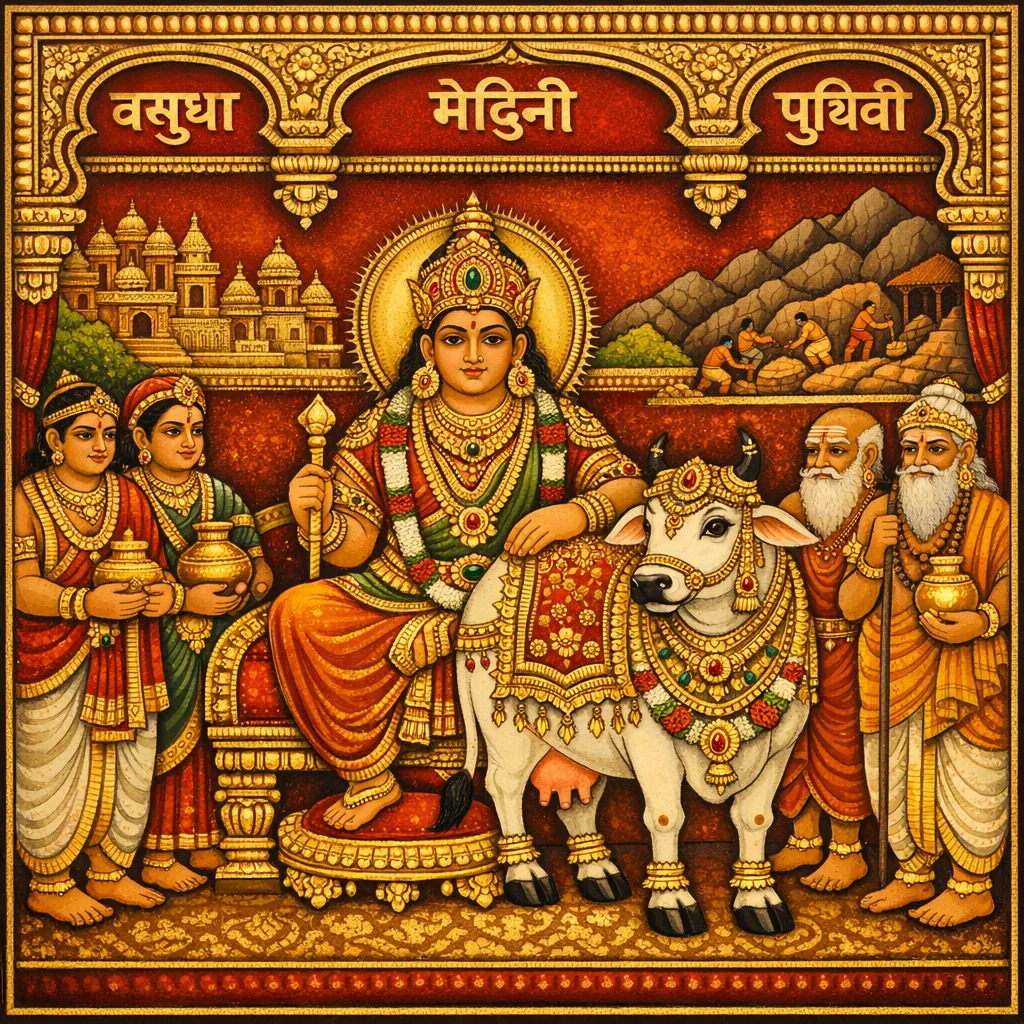
Adhyaya 37
Pṛthivī-dohaṇa (The Milking of the Earth) and the Praise of King Pṛthu
Delivered by Sūta, this adhyāya explains the Earth (Pṛthivī) through sacred etymologies and mythic memory. It derives her names—Vasudhā, “bearer of wealth”; Medinī, tied to medas “fat/substance,” recalling a primordial flood before Madhu and Kaiṭabha were slain; and Pṛthivī, as the earth claimed and ordered by King Pṛthu Vainya, thus linked to him as “daughter/affiliate.” Pṛthu is then praised as ādi-rāja, the archetypal king who partitions and organizes the land into settlements and resource-sites (pattana/ākara), protects society in its four varṇas, and merits homage from all beings and from Veda-knowing brāhmaṇas. The chapter turns on “the milking of the Earth” (pṛthivī-dohaṇa): the earth is a yield-bearing matrix, with calves (vatsa), milkers (dogdhṛ), and vessels (pātra) specified across manvantara contexts, showing prosperity to be epochally regulated and ritually intelligible, not accidental. In pañcalakṣaṇa terms it links Manvantara with Sṛṣṭi-as-ordering, explaining how the world becomes agriculturally and politically structured.
Shlokas
Verse 1
इति श्रीब्रह्माण्डे महापुराणे वायुप्रोक्ते पूर्वभागे द्वितीये ऽनुषङ्ग पादे शेषमन्वन्तराश्यानं पृथिवीदोहनं च नाम षट्त्रिंशत्तमो ऽध्यायः सूत उवाच आसीदिह समुद्रान्ता वसुधेति यथा श्रुतम् / वसु धत्ते यतस्तस्माद्वसुधा सेति गीयते
Thus, in the Śrī Brahmāṇḍa Mahāpurāṇa, in the former section spoken by Vāyu, in the second Anuṣaṅga-pāda, is the thirty-sixth chapter called “The Account of the Remaining Manvantaras and the Milking of the Earth.” Sūta said: as has been heard, this Vasudhā extended to the ocean’s bounds; because she bears the vasus—treasures and wealth—she is sung of as “Vasudhā.”
Verse 2
मधुकैटभयोः पूर्वं मेदसा संपरिप्लुता / तेनेयं मेदिनीत्युक्ता निरुक्त्या ब्रह्मवादिभिः
Before the time of Madhu and Kaiṭabha, this earth was wholly flooded with medas—fatness; therefore the brahmavādins, by nirukti (sacred etymology), spoke of her as “Medinī.”
Verse 3
ततो ऽभ्युपगमाद्राज्ञः पृथोर्वैन्यस्य धीमतः / दुहितृत्वमनुप्राप्ता पृथिवी पठ्यते ततः
Then, because the wise king Pṛthu Vainya accepted her, the Earth attained the status of a daughter; therefore from that time she is recited as “Pṛthivī.”
Verse 4
पृथुना प्रविभागश्चधरायाः साधितः पुरा / तस्याकरवती राज्ञः पत्तनाकरमालिनी
In ancient times Pṛthu accomplished the proper ordering and division of the earth; thus she became rich in mines for the king, like a garland strung with cities and mineral treasuries.
Verse 5
चातुर्वर्णमयसमाकीर्णा रक्षिता तेन धीमता / एवंप्रभावोराजासीद्वैन्यः सद्विजसत्तमाः
She (the Earth) was filled with the four varṇas and was protected by that wise one (Pṛthu); O best of the twice-born, such indeed was the might and splendor of King Vainya.
Verse 6
नमस्यश्चैव पूच्यश्च भूतग्रामेण सर्वशः / ब्राह्मणैश्च महाभागैर्वेदवेदाङ्गपारगैः
He is to be bowed to and worshipped in every way by the entire host of beings; and likewise by the most fortunate Brahmins, perfected in the Vedas and the Vedāṅgas.
Verse 7
पृथुरेव नमस्कार्यो ब्रह्मयोनिः सनातनः / पार्थिवैश्च महाभागैः प्रार्थयद्भिर्महद्यशः
Prithu alone is worthy of reverent salutation—eternal, born of Brahman; of mighty renown, he is entreated by the noble kings of the earth.
Verse 8
आदिराजो नमस्कार्यः पृथुर्वैन्यः प्रतापवान् / योधैरपि च संग्रामे प्राप्तुकामैर्जयं युधि
The primal king, Prithu Vainya, radiant in might, is worthy of homage; even warriors in battle who seek victory revere him.
Verse 9
आदिकर्त्तारणानां वै नमस्यः पृथुरेव हि / यो हि योद्धा रणं याति कीर्त्तयित्वा पृथुं नृपम्
Prithu indeed is to be revered as the first author of battles; for whatever warrior goes to war does so after proclaiming King Prithu’s fame.
Verse 10
स घोररूपात्संग्रामात्क्षेमी तरति कीर्त्तिमान् / वैश्यैरपि च राजर्षिर्वेश्यवृत्तिमिहास्थितैः
The renowned one crosses that dreadful battle in safety; and the royal sage (Prithu) is revered even by the Vaiśyas who abide here in their own rightful vocation.
Verse 11
पृथुरेव नमस्कार्यो वृत्तिदानान्महायशाः / एते वत्सविशेषाश्च दोग्धारः क्षीरमेव च
Because he bestowed livelihood, the greatly renowned Pṛthu alone is worthy of reverence; these are the special calves, these the milkers, and this indeed is the milk.
Verse 12
पात्राणि च मयोक्तानि सर्वाण्येव यथाक्रमम् / ब्रह्मणा प्रथमं दुग्धा पुरा पृथ्वी महात्मना
I have spoken of all the vessels in due order; in ancient times the great-souled Brahmā first milked the Earth.
Verse 13
वायुं कृत्वा तथा वत्सं बीजानि वसुधातले / ततः स्वायंभुवे पूर्वं तदा मन्वन्तरे पुनः
Making Vāyu the calf, the seeds appeared upon the earth’s surface; first in the Svāyambhuva Manvantara, and again thereafter in other Manvantaras.
Verse 14
वत्सं स्वायंभुवं कृत्वा सर्वसस्यानि चैव हि / ततः स्वारोचिषे वापि प्राप्ते मन्वन्तरे ऽधुना
Making Svāyambhuva the calf, indeed all grains and crops were milked forth; and then likewise in the present Manvantara of Svārociṣa.
Verse 15
वत्सं स्वारोचिषं कृत्वा दुग्धा सस्यानि मेदिनी / उत्तमेन तु तेनापि दुग्धा देवानु जेन तु
Making Svārociṣa the calf, the Earth was milked of her crops; likewise she was milked in the time of Uttama Manu, and also in the time of Devānuja Manu.
Verse 16
मनुं कृत्वोत्तमं वत्सं सर्वसस्यानि धीमता / पुनश्च पञ्चमे पृथ्वी तामसस्यान्तरे मनोः
The wise one made Manu the finest calf and milked forth all grains; again, in the fifth Manvantara, in the interval of Manu Tāmāsa, the Earth too was milked.
Verse 17
दुग्धेयं तामसं वत्सं कृत्वा वै बलबन्धुना / चारिष्टवस्य वै षष्ठे संप्राप्ते चान्तरे मनोः
Balabandhu made Tāmāsa the calf and milked it; and when the sixth Manvantara of Manu Cāriṣṭava arrived, in that interval of Manu as well.
Verse 18
दुग्धा मही पुराणेन वत्सं चारिष्टवं प्रति / चाक्षुषे चापि संप्राप्ते तदा मन्वन्तरे पुनः
Purāṇa milked the Earth, taking Cāriṣṭava as the calf; and when the Manvantara of Cākṣuṣa arrived, then again it happened in that Manvantara.
Verse 19
दुग्धा मही पुराणेन वत्सं कृत्वा तु चाक्षुषम् / चाक्षुषस्यान्तरे ऽतीते प्राप्ते वैवस्वते पुनः
Purāṇa milked the Earth, making Cākṣuṣa the calf; and when the interval of Cākṣuṣa had passed, the Manvantara of Vaivasvata arrived again.
Verse 20
वैन्येनेयं पुरा दुग्धा यथा ते कथितं मया / एतैर्दुग्धा पुरा पृथ्वी व्यतीतेष्वन्तरेषु वै
As I have told you, in ancient times Vainya (Pṛthu) milked this Earth; and by these as well, in the intervals of the Manvantaras that have passed, the Earth was milked of old.
Verse 21
देवादिभिर्मनुष्यैश्च ततो भूतादिभिश्च ह / एवं सर्वेषु विज्ञेया अतीतानागतेष्विह
By the gods, by humankind, and then by beings such as the bhūtas—thus, here among all, in times past and yet to come, this is to be understood.
Verse 22
देवा मन्वन्तरे स्वस्थाः पृथोस्तु शृणुत प्रजाः / पृथोस्तु पुत्रौ विक्रान्तौ जज्ञाते ऽन्तर्द्धिपाषनौ
In that manvantara the gods dwelt in well-being. O people, hear of Pṛthu: to him were born two sons of great valor, Antarddhi and Pāṣaṇa.
Verse 23
शिखण्डिनी हविर्धानमन्तर्द्धानाव्द्यजायत / हविर्धानात्षडाग्नेयी धिषणाजनयत्सुतान्
Śikhaṇḍinī bore Havirdhāna by Antarddhāna. And from Havirdhāna, Dhiṣaṇā of Agni’s lineage brought forth six sons.
Verse 24
प्राचीनबर्हिषं शुक्लं गयं कृष्णं प्रजाचिनौ / प्राचीनबर्हिर्भगवान्महानासीत्प्रजापतिः
The sons of Prācīnabarhiṣ were Śukla, Gaya, Kṛṣṇa, and Prajācina. Bhagavān Prācīnabarhi himself was a great Prajāpati.
Verse 25
बलश्रुततपोवीर्यैः पृथिव्यामेकराडसौ / प्राचीनाग्राः कुशास्तस्य तस्मात्प्राचीनबर्ह्यसौ
By strength, sacred learning of śruti, austerity, and valor, he was the sole sovereign upon the earth. The tips of his kuśa grass faced east; therefore he was called Prācīnabarhi.
Verse 26
समुद्रतनयायां तु कृतदारः स वै प्रभुः / महतस्तपसः पारे सवर्णायां प्रजापतिः
That Lord took the ocean’s daughter as his wife; beyond the bounds of mighty austerity, from Savarṇā he manifested as Prajāpati.
Verse 27
सवर्णाधत्त सामुद्री दश प्राचीनबर्हिषः / सर्वान्प्रचेतसो नाम धनुर्वेदस्य पारगान्
From Savarṇā and Sāmudrī were born ten sons of Prācīnabarhiṣ; all were called the Pracetas, masters of the Dhanurveda.
Verse 28
अपृथग्धर्मचरणास्ते ऽतप्यन्त महात्तपः / दशवर्ष सहस्राणि समुद्रसलिलेशयाः
United in the practice of dharma, they performed mighty austerity for ten thousand years, lying within the ocean’s waters.
Verse 29
तपश्चतेषु पृथिवीं तप्यत्स्वथ महीरुहाः / अरक्ष्यमाणामावब्रुर्बभूवाथ प्रजाक्षयः
As they pursued their austerity, the earth grew scorched; unguarded, trees and creepers spread and overran it, and then the creatures began to perish.
Verse 30
प्रत्याहृते तदा तस्मिञ्चाक्षुषस्यान्तरे मनोः / नाशकन्मारुतो वातुं वृत्तं खमभवद्द्रुमैः
Then, in the interval of Cākṣuṣa Manu, when that was drawn back, even the wind could not blow; the sky became hemmed in by trees.
Verse 31
दशवर्षसहस्राणि न शेकुश्चेष्टितुं प्रजाः / तदुपश्रुत्य तपसा सर्वे युक्ताः प्रचेतसः
For ten thousand years the beings could not bestir themselves in action. Hearing of this, all the Pracetas became united in tapas (austere penance).
Verse 32
मुखेभ्यो वायुमग्निं च ससृजुर्जातमन्यवः / उन्मूलानथ वृक्षांस्तान्कृत्वा वायुरशोषयत्
Roused to wrath, from their mouths they sent forth wind and fire. Then the wind tore those trees up by the roots and dried them away.
Verse 33
तानग्निरदहद्धोर एवमासीद्दुमक्षयः / द्रुमक्षयमथो बुद्ध्वा किञ्चिच्छिष्टेषु शाखिषु
A dreadful fire burned them; thus came the destruction of the trees. Realizing this ruin of the forest, when only a few branching trees remained…
Verse 34
उपगम्याब्रवी देतान्राजा सोमः प्रचेतसः / दृष्ट्वा प्रयोजनं सत्यं लोकसंतानकारणात्
Then King Soma approached the Pracetas and spoke, having perceived the true purpose for the cause of the world’s continuance in progeny.
Verse 35
कोपं त्यजत राजानः सर्वे प्राचीनबर्हिषः / वृक्षाः क्षित्यां जनिष्यन्ति शाम्यतामग्निमारुतौ
O kings, sons of Prācīnabarhis, cast away your wrath. Upon the earth the trees shall be born again; let fire and wind be calmed.
Verse 36
रत्नभूता च कन्येयं वृक्षाणां वरवर्णिनीः / भविष्यज्जनता ह्येषा धृता गर्भेण वै मया
This maiden is jewel-born, of the finest hue among the trees. She is the people of the future, truly borne by me within the womb.
Verse 37
मारिषा नाम नाम्नैषा वृक्षैरेव विनिर्मिता / भार्या भवतु वो ह्येषा सोमगर्भा विवर्द्धिता
Her name is Māriṣā, fashioned by the trees themselves. May she, nurtured in Soma’s womb, become your lawful wife in dharma.
Verse 38
युष्माकं तेजसार्द्धेन मम चार्धेन तेजसा / अस्यामुत्पत्स्यते विद्वान्दक्षो नाम प्रजापतिः
From half of your radiance and half of mine, from her will be born the wise Prajāpati named Dakṣa.
Verse 39
स इमां दग्धभूयिष्ठां युष्मत्तेजोमयेन वै / अग्निनाग्निसमो भूयः प्रजाः संवर्द्धयिष्यति
He will, becoming fire equal to fire, make this earth—mostly scorched and truly formed of your radiance—flourish again with living beings.
Verse 40
ततः सोमस्य वचनाज्जगृहुस्ते प्रचेतसः / संत्दृत्य कोपं वृक्षेभ्यः पत्नीं धर्मेण मारिषाम्
Then, at Soma’s word, the Pracetas restrained their wrath toward the trees and accepted Māriṣā as their wife in accordance with dharma.
Verse 41
मारिषायां ततस्ते वै मनसा गर्भमादधुः / दशभ्यस्तु प्रचेतोभ्यो मारिषायां प्रजापतिः
Then, in Māriṣā, they placed the seed of the womb by the power of mind; from the ten Pracetas, in Māriṣā, Prajāpati was born.
Verse 42
दक्षो जज्ञे महातेजाः सोमस्यांशेन वीर्यवान् / असृजन्मनसा त्वादौ प्रजा दक्षो ऽथ मैथुनात्
Dakṣa was born, mighty in splendor and vigor, from a portion of Soma; at first he created beings by mind alone, and afterward through union.
Verse 43
अचरांश्च चरांश्चैव द्विपदो ऽथ चतुष्पदः / विसृज्य मनसा दक्षः पश्चादसृजत स्त्रियः
Having first brought forth by mind the unmoving and the moving, the two-footed and the four-footed, Dakṣa afterward created women.
Verse 44
ददौ स दश धर्माय कश्यपाय त्रयां दश / कालस्य नयने युक्ताः सप्तविंशतिमिन्दवे
He gave ten daughters to Dharma and thirteen to Kaśyapa; and to Indu (the Moon) he offered twenty-seven, joined as the very eyes of Time.
Verse 45
एभ्यो दत्त्वा ततो ऽन्या वै चतस्रो ऽरिष्टनेमिने / द्वे चैव बहुपुत्राय द्वे चैवाङ्गिरसे तथा
Having given these, he then bestowed four others upon Ariṣṭanemi; two upon Bahuputra, and likewise two upon Aṅgiras.
Verse 46
कन्यामेकां कृशाश्वाय तेभ्यो ऽपत्यं बभूव ह / अन्तरं चाक्षुषस्याथ मनोः षष्ठं तु गीयते
One maiden was given to Kṛśāśva, and from them offspring arose. After the Cākṣuṣa Manvantara, the sixth Manvantara of Manu is sung of.
Verse 47
मनोर्वैवस्वतस्यापि सप्तमस्य प्रजापतेः / वसुदेवाः खगा गावो नागा दितिजदानवाः
In the age of Vaivasvata Manu, the seventh Prajāpati, there arose the Vasudevas, the birds, the cattle, the Nāgas, and the sons of Diti—the Dānavas.
Verse 48
गन्धर्वाप्सरसश्चैव जज्ञिरे ऽन्याश्च जातयः / ततः प्रभृति लोके ऽस्मिन्प्रजा मैथुनसंभवाः / संकल्पाद्दर्शनात्स्पर्शात्पूर्वासां सृष्टिरुच्यते
Gandharvas and Apsarases were born, and other kinds as well. From that time onward in this world, beings arise from sexual union; but the earlier creation is said to have come from intention, from sight, and from touch.
Verse 49
ऋषिरुवाच देवानां दानवानां च देवर्षिणां च ते शुभः / संभवः कथितः पूर्वं दक्षस्य च महात्मनः
The Ṛṣi said: The auspicious origin of the gods, the Dānavas, and the divine seers has already been told before—so too that of the great-souled Dakṣa.
Verse 50
प्राणात्प्रजापतेर्जन्म दक्षस्य कथितं त्वया / कथं प्राचे तस्त्वं च पुनर्लेभे महातपाः
You have said that Dakṣa was born from the very life-breath of Prajāpati. O great ascetic, how then was Prācetasa (Dakṣa) obtained once again?
Verse 51
एतं नः संशयं सूत व्याख्यातुं त्वमिहार्हसि / दौहित्रश्चैव सोमस्य कथं श्र्वशुरतां गतः
O Sūta, you are fit to explain this doubt of ours: how did Soma’s grandson come to attain the status of a father-in-law?
Verse 52
सूत उवाच उत्पत्तिश्च निरोधश्च नित्यं भूतेषु सत्तमाः / ऋषयो ऽत्र न सुह्यन्ति विद्यावन्तश्च ये जनाः
Sūta said: O best of men, among beings creation and cessation ever occur; in this matter the ṛṣis and the learned are not deluded.
Verse 53
युगे युगे भवन्त्येते सर्वे दक्षादयो द्विजाः / पुनश्चैव निरुध्यन्ते विद्वांस्तत्र न मुह्यति
From age to age all these twice-born, beginning with Dakṣa, arise and again are withdrawn; the wise are not bewildered by this.
Verse 54
ज्यैष्ठ्यकानिष्ठ्यमप्येषां पूर्वमासीद्द्विजोत्तमाः / तप एव गरीयो ऽभूत्प्रभावश्चैव कारणम्
O best of the twice-born, in former times there was even a distinction of elder and younger among them; yet tapas alone was weightier, and its potency was the cause.
Verse 55
इमां विसृष्टिं यो वेद चाक्षुषस्य चराचरम् / प्रजावानायुषस्तीर्णः स्वर्गलोके महीयते
Whoever knows this manifestation of creation in Cākṣuṣa’s time—both the moving and the unmoving—becomes blessed with progeny, completes a full span of life, and is honored in the heavenly world.
Verse 56
एवं सर्गः समाख्यातश्चाक्षुषस्य समासतः / इत्येते षट् निसर्गाश्च क्रान्ता मन्वन्तरात्मकाः
Thus, in brief, the sarga of the Cākṣuṣa Manvantara has been declared. In this manner, these six nisarga—each of the nature of a Manvantara—have passed.
Verse 57
स्वायंभुवाद्याः संक्षेपाच्चाशुषान्ता यथाक्रमम् / एते सर्गा यथा प्राज्ञैः प्रोक्ता ये द्विजसत्तमाः
From Svāyaṃbhuva onward, up to the end of Cākṣuṣa, these sarga have been set forth in brief, in due order. O best of the twice-born, they are as the wise have declared.
Verse 58
वैवस्वतनिसर्गेण तेषां ज्ञेयस्तु विस्तरः / अन्यूनानतिरिक्तास्ते सर्वे सर्गा विवस्वतः
Their full extent is to be understood through the Vaivasvata nisarga. All these sarga of Vivasvān are neither deficient nor excessive.
Verse 59
आरोग्यायुः प्रमाणेभ्यो धर्मतः कामतोर्ऽथतः / एतानेव गुणानेति यः पठन्ननसूयकः
Whoever recites this without envy attains health, long life, renown, and the fruits of dharma, kāma, and artha—these very virtues.
Verse 60
वैवस्वतस्य वक्ष्यामि सांप्रतस्य महात्मनः / समासव्यासतः सर्गं ब्रुवतो मे निबोधत
Now I shall speak of the sarga of the present Mahātmā Vaivasvata, both in summary and in detail; attend carefully to my words.
Frequently Asked Questions
The chapter foregrounds King Pṛthu Vainya as the ādi-rāja (archetypal sovereign). Rather than a long dynastic catalogue, it encodes kingship as a cosmological function: partitioning, protecting, and making the earth productive for the varṇa-ordered society.
They function as compressed cosmological memory: Vasudhā highlights the earth as the bearer of ‘vasu’ (wealth/substance); Medinī recalls an early state of material inundation (medas) associated with the Madhu-Kaiṭabha prelude; Pṛthivī links the earth to Pṛthu’s ordering claim, portraying geography as politically and ritually constituted.
The earth’s ‘milking’ is presented as epoch-sensitive: different manvantaras are associated with specific calves (vatsa), milkers (dogdhṛ), and vessels (pātra), implying that prosperity and resource-availability are governed by cyclical cosmic administration rather than a single, timeless event.