Adhyaya 26
Nīlakaṇṭha-nāmotpatti-kathana (Origin of the Epithet “Nīlakaṇṭha”)
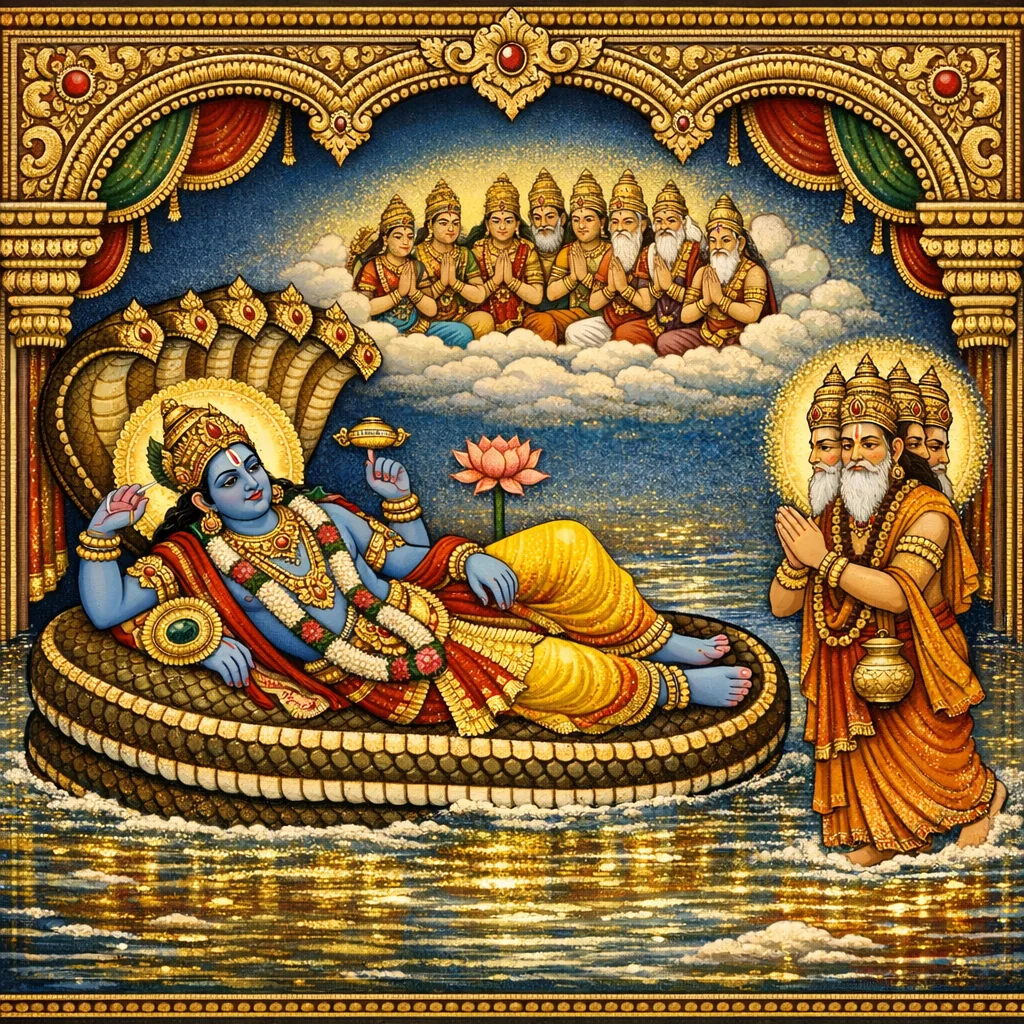
This chapter unfolds as a question-and-answer: the ṛṣis ask for a clear account of Mahādeva’s greatness and sovereignty, seeking a fuller exposition of divine aiśvarya (lordly attributes). Sūta replies by placing the teaching after a major cosmic stabilization—Viṣṇu’s victory over the daityas and the binding of Bali, restoring order in the three worlds. In gratitude and wonder, devas, siddhas, brahmarṣis, and other beings gather at the transcendent locus associated with Viṣṇu (imagery aligned with Kṣīroda, the primordial waters) and hymn him as creator, sustainer, and regulator of the cosmos. Viṣṇu then explains causality in cosmological terms: kāla as the sovereign principle, the arising of worlds through māyā together with Brahmā, and the universe’s condition when wrapped in undifferentiated darkness. The narrative shifts into a theophanic recollection: Viṣṇu, in vast form, beholds a radiant four-faced ascetic—Brahmā—who swiftly approaches and questions Viṣṇu’s identity and station. Through layered speakers and “cosmic memory,” the chapter links devotional praise with creation-theory, preparing for the origin of the epithet “Nīlakaṇṭha” and Śaiva glorification while remaining grounded in Purāṇic cosmological causality.
Shlokas
Verse 1
इति श्रीब्रह्माण्डे महापुराणे वायुप्रोक्ते पूर्व भागे द्वितीये ऽनुषङ्गपादे नीलकण्ठनामोत्पत्तिकथनं नाम पञ्चविंशतितमो ऽध्यायः ऋषय ऊचुः महादेवस्य महात्म्यं प्रभुत्वं च महात्मनः / श्रोतुमिच्छामहे सम्यगैश्वर्यगुणविस्तरम्
Thus, in the Śrī Brahmāṇḍa Mahāpurāṇa, proclaimed by Vāyu, in the first part, in the second Anuṣaṅga section, is the twenty-fifth chapter called “The Account of the Arising of the Name Nīlakaṇṭha.” The sages said: We wish to hear in full the greatness and sovereignty of the great-souled Mahādeva, and the wide expanse of his divine attributes.
Verse 2
सूत उवाच पूर्वं त्रैलोक्यविजये विष्णुना समुदात्दृ तम् / बलिं बद्ध्वा महावीर्यं त्रैलोक्याधिपतिं पुरा
Sūta said: Formerly, at the time of the conquest of the three worlds, Viṣṇu performed a noble deed; in ancient days he bound Bali, the mighty hero and lord of the three worlds.
Verse 3
प्रनष्टेषु तु दैत्येषु प्रहृष्टे तु शचीपतौ / अथाजग्मुः प्रभुं द्रष्टुं सर्वे देवाः सनातनम्
When the Daityas had perished and Śacī’s lord Indra rejoiced, then all the Devas went to behold the Eternal Lord.
Verse 4
यत्रास्ते विश्वरूपात्मा क्षीरोदस्य मसीपतः / सिद्धा ब्रह्मर्षयो यक्षा गन्धर्वाप्सरसां गणाः
Where the Universal-Souled One abides by the shore of the Ocean of Milk, there are Siddhas, Brahmarishis, Yakshas, and hosts of Gandharvas and Apsaras.
Verse 5
नागा देवर्षयश्चैव नद्यः सर्वे च पर्वताः / अभिगम्य महात्मानं स्तुवन्ति पुरुषं हरिम्
Nagas and Devarishis, all rivers and mountains, draw near to the great-souled Purusha Hari and sing His praise.
Verse 6
त्वं धाता त्वं च कर्तासि त्वं लोकान्सृजसि प्रभो / त्वत्प्रसादाच्च कल्याणं प्राप्तं त्रैलोक्यमव्ययम्
O Lord, You are the Sustainer and the Doer; You create the worlds. By Your grace, the imperishable three worlds have attained auspicious well-being.
Verse 7
असुराश्च जिताः सर्वे बलिर्बद्धश्च वै त्वया / एवमुक्तः सुरैर्विष्णः सिद्धैश्च परमर्षिभिः
You have conquered all the Asuras, and you have bound Bali as well; thus was Vishnu addressed by the Devas, the Siddhas, and the supreme Rishis.
Verse 8
प्रत्युवाच तदा देवान् सर्वांस्तान्पुरुषोत्तमः / श्रूयतामभिधास्यामि कारणं सुरसत्तमाः
Then the Supreme Person replied to all the gods: “O best of the Suras, listen; I shall declare the cause.”
Verse 9
यः स्रष्टा सर्वभूतानां कालः कालकरः प्रभुः / येनाहं ब्रह्मणा सार्द्धं सृष्टा लोकाश्च मायया
He who is the Creator of all beings is the Lord—Time itself, the maker of Time; by Him I, together with Brahmā, created the worlds through Māyā.
Verse 10
तस्यैव च प्रसादेन आदौ सिद्धत्वमागतः / पुरा तमसि चाव्यक्ते त्रैलोक्ये ग्रसिते मया
By His grace alone I attained perfection at the beginning; long ago, when in unmanifest darkness the three worlds were swallowed up by me.
Verse 11
उदरस्थेषु भूतेषु त्वेको ऽहं शयित स्तदा / सहस्रशीर्षा भूत्वा च सहस्राक्षः सहस्रपात्
Then, amid the beings held within, I alone lay in repose—becoming thousand-headed, thousand-eyed, and thousand-footed.
Verse 12
शङ्खचक्रगदापाणिः शयितो विमलेंऽभसि / एतस्मिन्नन्तरे दूरात्पश्यामि ह्यमितप्रभम्
Bearing conch, discus, and mace in my hands, I lay upon the spotless waters; in that moment, from afar, I beheld One of immeasurable radiance.
Verse 13
शतसूर्यप्रतीकाशं ज्वलन्तं स्वेन तेजसा / चतुर्वक्त्रं महायोगं पुरुषं काञ्चनप्रभम्
He blazed with his own radiance, shining like a hundred suns—four-faced, a great yogin, the Purusha of golden splendor.
Verse 14
कृष्णाजिनधरं देवं कमण्डलुविभूषितम् / निमेषान्तरमात्रेण प्राप्तो ऽसौ पुरुषोत्तमः
That god, clad in black antelope-skin and adorned with a kamandalu, was reached by the Purushottama in but the space of a blink.
Verse 15
ततो मामब्रवीद्ब्रह्मा सर्वलोकनमस्कृतः / कस्त्वं कुतो वा कि चेह तिष्ठसे वद मे विभो
Then Brahmā, revered by all the worlds, said to me: “O Vibhu, who are you, whence have you come, and why do you stand here? Tell me.”
Verse 16
अहं कर्तास्मि लोकानां स्वयंभूर्विश्वतोमुखः / एवमुक्तस्तदा तेन ब्रह्मणाहमुवाच तम्
He said: “I am the maker of the worlds—Svayambhū, facing all directions.” When Brahmā spoke thus, I then replied to him.
Verse 17
अहं कर्त्ता हि लोकानां संहर्ता च पुनः पुनः / एवं संभाषमाणौ तु परस्परजयैषिणौ
“I am indeed the maker of the worlds, and again and again their destroyer as well.” Thus the two conversed, each seeking victory over the other.
Verse 18
उत्तरां दिशमास्थाय ज्वालामद्राक्ष्व विष्ठिताम् / ज्वालां ततस्तामालोक्य विस्मितौ च तदानघाः
Turning toward the northern quarter, they beheld a flame standing firm. Gazing upon that flame, the two blameless ones were filled with wonder.
Verse 19
तेजसा च बलेनाथ शार्वं ज्योतिः कृताञ्जली / वर्द्धमानां तदा ज्वालामत्यन्तपरमाद्भुताम्
With radiance and might, hands joined in reverence, they bowed to the Śārva Light. Then that flame kept swelling—utterly, supremely wondrous.
Verse 20
अभिदुद्राव तां ज्वालां ब्रह्मा चाहं च सत्वरौ / दिवं भूमिं च निर्भिद्य तिष्ठन्तं जवालमण्डलम्
Brahmā and I both rushed swiftly toward that flame. That circle of fire stood, piercing heaven and earth alike.
Verse 21
तस्या ज्वालस्य मध्ये तु पश्यावो विपुलप्रभम् / प्रादेशमात्रमव्यक्तं लिङ्गं परमदीप्तिमत्
Within that flame’s very midst we beheld a vast radiance: an unmanifest Liṅga, only a handspan in measure, yet blazing with supreme brilliance.
Verse 22
न च तत्काञ्चनं मध्ये नशैलं न च राजतम् / अनिर्देश्यमचिन्त्यं च लक्ष्यालक्ष्यं पुनः पुनः
Within it there was neither gold, nor stone, nor silver. It was beyond description and beyond thought—again and again, both seen and yet unseen.
Verse 23
ज्वालामालासहस्राढ्यं विस्मयं परमद्भुतम् / महता तेजसायुक्तं वर्दभमानंभृशन्तथा
Abounding in thousands of garlands of flame, that vision was supremely wondrous and filled with awe; joined with mighty radiance, it was growing exceedingly.
Verse 24
ज्वालामालाततं न्यस्तं सर्वभूतभयङ्करम् / घोररूपिणमत्यर्थं भिन्दं तमिव रोदसी
Spread over with garlands of flame, that form was terrifying to all beings; in a most dreadful aspect, it seemed to cleave the darkness and split even heaven and earth.
Verse 25
ततो मामब्रवीद्ब्रह्मा अधो गच्छ त्वमाशु वै / अन्तमस्य विजानीवो लिङ्गस्य तु महात्मनः
Then Brahmā said to me, “Go swiftly downward and ascertain the end of that Liṅga of the Great Soul.”
Verse 26
अहमूर्ध्वं गमिष्यामि यावदन्तो ऽस्य दृश्यते / तदा तु समयं कृत्वा गत उर्द्ध्वमधश्च हि
“I shall go upward until its end is seen.” Having thus made an agreement, we set forth—one going above and the other below.
Verse 27
ततो वर्षसहस्रं तु ह्यहं पुनरधो गतः / न पश्यामि च तस्यान्तं भीतश्चाहं ततो ऽभवम्
Then for a thousand years I went downward again; yet I did not behold its end, and fear arose within me.
Verse 28
तथैव ब्रह्मा ह्यूध्व च न चान्तं तस्य लब्धवान् / समागतो मया सार्द्ध तत्रैव च महाभसि
So too Brahmā went upward, yet he did not find its end. He met with me there itself, within that great radiance.
Verse 29
ततो विस्मयमापन्नौ भीतौ तस्य महात्मनः / मायया मोहितौ तेन नष्टसंज्ञै व्यवस्थितौ
Then, awed and afraid before that great-souled One, we both fell into wonder. Deluded by his māyā, we stood as though bereft of awareness.
Verse 30
ततो ध्यानरतौ तत्र चेश्वरं सर्वतोमुखम् / प्रभवं निधनं चैव लौकानां प्रभुमव्ययम्
Then, absorbed in meditation there, we beheld the Lord who faces all directions—source and dissolution of the worlds, the imperishable Master.
Verse 31
प्रह्वाञ्जलिपुटौ भूत्वा तस्मै शर्वाय शूलिने / महाभैरवनादाय भीमरूपाय दंष्ट्रिणे / अव्यक्तायाथ महते नमस्कारं प्रकुर्वहे
Bowing with hands joined in reverence, we offered homage to Śarva, the trident-bearer—whose roar is Mahābhairava, whose form is dreadful and fanged—to the Unmanifest and the Great.
Verse 32
नमो ऽस्तु ते लोकसुरेश देव नमो ऽस्तु ते भूतपते महात्मन् / नमो ऽस्तु ते शाश्वतसिद्धयोगिने नमोस्तु ते सर्वजगत्प्रतिष्ठित
Homage to you, O Deva, Lord of the gods of the worlds. Homage to you, O great-souled Bhūtapati. Homage to you, the eternal perfected Yogin. Homage to you, the foundation of all the universe.
Verse 33
परमेष्ठी परं ब्रह्म त्वक्षरं परमं पदम् / ज्येष्ठस्त्वं वामदेवश्च रुद्रः स्कन्दः शिवः प्रभुः
O Parameṣṭhī, You are the Supreme Brahman, the Imperishable, the highest abode. You are Jyeṣṭha and Vāmadeva; You are Rudra, Skanda, Śiva, the Lord.
Verse 34
त्वं य५स्त्वं वषट्कारस्त्वमोङ्कारः परन्तपः / स्वाहाकारो नमस्कारः संस्कारः सर्वकर्मणाम्
You are the yajña, You are the vaṣaṭ-cry; O subduer of foes, You are the Oṃkāra. You are the svāhā-invocation, the namaskāra, and the sanctifying rite of all actions.
Verse 35
स्वधाकारश्च यज्ञश्च व्रतानि नियमास्तथा / वेदा लोकाश्च देवाश्च भगवानेव सर्वशः
You are the svadhā-utterance and the yajña; You are the vows and the sacred disciplines. The Vedas, the worlds, and the gods—everywhere and in every way, You alone are Bhagavān.
Verse 36
आकाशस्य च शब्दस्त्वंभूतानां प्रभवाप्ययः / भूमौ गन्धो रसश्चाप्सु तेजोरूपं महेश्वरः
You are the sound within ākāśa, and the arising and dissolution of all beings. In earth You are fragrance, in waters You are taste; as radiant fire You are form, O Maheśvara.
Verse 37
वायोः स्पर्शश्च देवेश वपुश्चन्द्रमसस्तथा
O Deveśa, You are the touch of the wind; likewise You are the radiant form of Candra, the Moon.
Verse 38
बुद्धौ ज्ञानं च देवेश प्रकृतेर्बीजमेव च
O Lord of the gods, within buddhi abides knowledge, and that indeed is the very seed of Prakṛti.
Verse 39
संहर्त्ता सर्वलोकानां कालो मृत्युमयोंऽतकः / त्वं धारयसि लोकांस्त्रींस्त्वमेव सृजसि प्रभो
O Lord, You are the destroyer of all worlds—Time embodied as death, Antaka; You uphold the three worlds, and You alone create them.
Verse 40
पूर्वेण वदनेन त्वमिन्द्रत्वं प्रकरोषि वै / दक्षिणेन तु वक्त्रेण लोकान्संक्षिपसे पुनः
With Your eastern face You truly manifest the state of Indra; with Your southern face You again draw the worlds into dissolution.
Verse 41
पश्चिमेन तु वक्त्रेण वरुणस्थो न संशयः / उत्तरेण तु वक्त्रेण सोमस्त्वं देवसत्तमः
With Your western face You abide in Varuṇa’s station, without doubt; with Your northern face, O best of gods, You are Soma.
Verse 42
एकधा बहुधा देव लोकानां प्रभवाप्ययः / आदित्या वसवो रुद्रा मरुतश्च सहाश्विनः
O Deva, though One, You appear as many; from You arise and into You dissolve the worlds. Ādityas, Vasus, Rudras, Maruts, and the Aśvins—all are You.
Verse 43
साध्या विद्याधरा नागाश्चारणाश्च तपोधनाः / वालखिल्या महात्मानस्तपः सिद्धाश्च सुव्रताः
There are the Sādhyas, Vidyādharas, Nāgas, and Cāraṇas, rich in the treasure of tapas; and also the Vālakhilya great souls, the ascetic siddhas, and those of pure vows.
Verse 44
त्वत्तः प्रसूता देवेश ये चान्ये नियतव्रताः / उमा सीता सिनीवाली कुहूर्गायत्र्य एव च
O Lord of the Devas, from you were born also other powers of steadfast vows—Umā, Sītā, Sinīvālī, Kuhū, and Gāyatrī as well.
Verse 45
लक्ष्मीः कीर्त्तिर्धृतिर्मेधा लज्जा कान्तिर्वपुः स्वधा / तुष्टिः पुष्टिः क्रिया चैव वाचां देवी सरस्वती / त्वत्तः प्रसूता देवेश संध्या रात्रिस्तथैव च
O Lord of the Devas, from you were born Lakṣmī, Fame, Steadfastness, Wisdom, Modesty, Splendor, Form, and Svadhā; Contentment, Nourishment, Sacred Action, and Sarasvatī the Goddess of Speech; and from you also came Twilight (Sandhyā) and Night (Rātri).
Verse 46
सूर्यायुतानामयुतप्रभाव नमो ऽस्तु ते चन्द्रसहस्रगौर / नमो ऽस्तु ते वज्रपिनाकधारिणे नमोस्तु ते देव हिरण्यवाससे
Homage to you, whose might is as that of myriads of suns, radiant as a thousand moons. Homage to you who bear the Vajra and the Pināka; homage to you, O Deva, clad in golden splendor.
Verse 47
नमोस्तु ते भस्मविभूषिताङ्ग नमो ऽस्तु ते कामशरीरनाशन / नमो ऽस्तु ते देव हिरण्यरेतसे नमो ऽस्तु ते देव हिरण्यवाससे
Homage to you whose limbs are adorned with sacred ash; homage to you who destroyed the body of Kāma. Homage to you, O Deva, Hiraṇyaretas—of golden seed; homage to you, O Deva, clad in golden splendor.
Verse 48
नमो ऽस्तु ते देव हिरण्ययोने नमो ऽस्तु ते देव हिरण्यनाभ / नमो ऽस्तु ते देव हिरण्यरेतसे नमो ऽस्तु ते नेत्रसहस्रचित्र
Salutations to You, O Deva, Hiraṇyayoni; salutations to You, O Deva, Hiraṇyanābha. Salutations to You, O Deva, Hiraṇyaretas; salutations to You, wondrous One adorned with a thousand eyes.
Verse 49
नमो ऽस्तु ते देव हिरण्यवर्ण नमो ऽस्तु ते देव हिरण्यकेश / नमो ऽस्तु ते देव हिरण्यवीर नमो ऽस्तु ते देव हिरण्यदायिने
Salutations to You, O Deva of golden hue, Hiraṇyavarṇa; salutations to You, O Deva with golden hair, Hiraṇyakeśa. Salutations to You, O Deva, golden hero, Hiraṇyavīra; salutations to You, O Deva, bestower of gold, Hiraṇyadāyin.
Verse 50
नमो ऽस्तु ते देव हिरण्यनाथ नमो ऽश्तुते देव हिरण्यनाद / नमो ऽस्तु ते देव पिनाकपाणे नमो ऽश्तुते ते शङ्कर नीलकण्ठ
Salutations to You, O Deva, Hiraṇyanātha; salutations to You, O Deva, Hiraṇyanāda. Salutations to You, O Deva, Pinākapāṇi who bears the bow Pināka; salutations to You, O Śaṅkara, Nīlakaṇṭha, the Blue-throated One.
Verse 51
एवं संस्तूयमानस्तु व्यक्तो भूत्वा महामतिः / देवदेवो जगद्योनिः सूर्य कोटिसमप्रभः
Thus, as he was hymned, the great-minded Deva of devas became manifest—the womb of the worlds, radiant as ten million suns.
Verse 52
आबभाषे कृपाविष्टो महादेवो महाद्युतिः / वक्त्रकोटिसहस्रेण ग्रसमान इवांबरम्
Then Mahādeva, of vast splendor and filled with compassion, spoke—as though with thousands of millions of mouths he were swallowing the sky.
Verse 53
कंबुग्रीवः सुज ठरो नानाभूषणभूषितः / नानारत्नविचित्राङ्गो नानामाल्यानुलेपनः
With a neck like a sacred conch, well-formed and adorned with many ornaments; his limbs were wondrous with varied jewels, and he wore many garlands and fragrant unguents.
Verse 54
पिनाकपाणिर्भगवान्सुरपूज्यस्त्रिशूलधृक् / व्यालय ज्ञोपवीती च सुराणामभयङ्करः
Bhagavan, holding the Pinaka bow, worshiped by the gods and bearing the trident; wearing a serpent as the sacred thread, he grants the devas fearlessness.
Verse 55
दुन्दुभिस्वरनिर्घोषः पर्जन्यनिनदोपमः / मुक्तो हासस्तदा तेन सर्वमापूरयञ्जगत्
His roar resounded like a dundubhi drum, like the rumble of rain clouds; then his unleashed laughter filled the entire world.
Verse 56
तेन शब्देन महता चावां भीतौ महात्मनः / अथोवाच महादेवः प्रीतो ऽहं सुरसत्तमौ
By that mighty sound, O great-souled one, we both were afraid. Then Mahadeva said, “O best of the devas, I am pleased.”
Verse 57
पश्यतां च महायोगं भयं सर्व प्रमुच्यताम् / युवां प्रसूतौ गात्रेभ्यो मम पूर्वं सनातनौ
Behold my great yoga, and let all fear be cast away. You two were born from my limbs long ago; you are sanātana, eternal.
Verse 58
यं मे दक्षिणो बाहुर्ब्रह्मा लोकपितामहः / वामो बाहुश्च मे विष्णुर्नित्यं युद्धेष्वनिर्जितः
My right arm is Brahmā, the grandsire of the worlds; my left arm is Viṣṇu, ever unconquered in battles.
Verse 59
प्रीतो ऽहं युवयोः सम्यग्वरं दद्यां यथैप्सितम् / ततः प्रहृष्टमनसौ प्रणतौ पादयोः प्रभोः
I am truly pleased with you both; I shall grant the boon you desire. Then, their hearts rejoicing, they bowed at the Lord’s feet.
Verse 60
अब्रूतां च महादेवं प्रसादाभिमुखं स्थितम् / यदि प्रीतिः समुत्पन्ना यदि देयो वरश्च ते / भक्तिर्भवतु नौ नित्यं त्वयि देव सुरेश्वर
They spoke to Mahādeva, who stood facing them with gracious favor: “If your delight has arisen, and if you would grant a boon, O God, Lord of the suras, may our devotion to you be eternal.”
Verse 61
देवदेव उवाच एवमस्तु महाभागौ सृजतां विपुलाः प्रजाः / एवमुक्त्वा स भगवांस्तत्रैवातरधाद्विभुः
The God of gods said: “So be it, O fortunate ones; bring forth abundant progeny.” Having spoken thus, the all-powerful Lord vanished there itself.
Verse 62
एष एव मयोक्तो वः प्रभावस्तस्य धीमतः / एतद्धि परमं ज्ञानमव्यक्तं शिवसंज्ञितम्
This is the very glory of that wise one which I have declared to you; this indeed is the supreme knowledge—the Unmanifest, known as “Śiva”.
Verse 63
एतत्सूक्ष्ममचिन्त्यं च पश्यन्ति ज्ञ३नचक्षुषः / तस्मै देवाधिदेवाय नमस्कारं प्रकुर्महे / महादेव नमस्ते ऽस्तु महेश्वर नमो ऽस्तु ते
This truth is subtle and unthinkable, seen by those whose eyes are wisdom. To that God above all gods we offer reverent salutations. O Mahādeva, homage to You; O Maheśvara, homage to You.
Verse 64
सूत उवाच एतच्छ्रुत्वा गताः सर्वे सुराः स्वं स्वं निवेशनम् / नमस्कारं प्रकुर्वाणाः शङ्कराय महात्मने
Sūta said: Hearing this, all the gods departed to their own abodes, offering salutations to Śaṅkara, the great-souled one.
Verse 65
इमं स्तवं पठिद्यस्तु चेश्वरस्य महात्मनः / कामांश्च लभते सर्वान् पापेभ्यश्च प्रमुच्यते
Whoever recites this hymn to Īśvara, the great-souled Lord, gains all desired boons and is freed from sins.
Verse 66
एतत्सर्वं तदा तेन न विष्णुना प्रभविष्णुना / महादेवप्रसादेन ह्युक्तं ब्रह्म सनातनम् / एतद्वः सर्वमाख्यातं मया माहेश्वरं बलम्
All this was not spoken then by mighty Viṣṇu; by Mahādeva’s grace it was uttered by the eternal Brahman. Thus have I told you in full the power of Maheśvara.
Frequently Asked Questions
No formal vaṃśa catalog is foregrounded in the sampled passage; the chapter’s emphasis is theological-cosmological (aiśvarya, kāla, māyā) and narrative framing for Śiva’s epithet rather than dynasty enumeration.
The chapter is not primarily metrological; it uses cosmographic setting markers (e.g., Kṣīroda/primordial waters and three-world order) to situate the discourse, but does not present explicit distances or planetary measures in the provided excerpt.
It establishes a causality-first frame—restored cosmic order, devas’ hymns, and kāla/māyā creation logic—so Śiva’s later glorification (including the Nīlakaṇṭha name-origin) is read as part of a unified cosmic governance narrative rather than an isolated miracle-story.