Adhyaya 10
Rudra-prasava-varṇana (The Manifestation and Naming of Rudra / Nīlalohita)
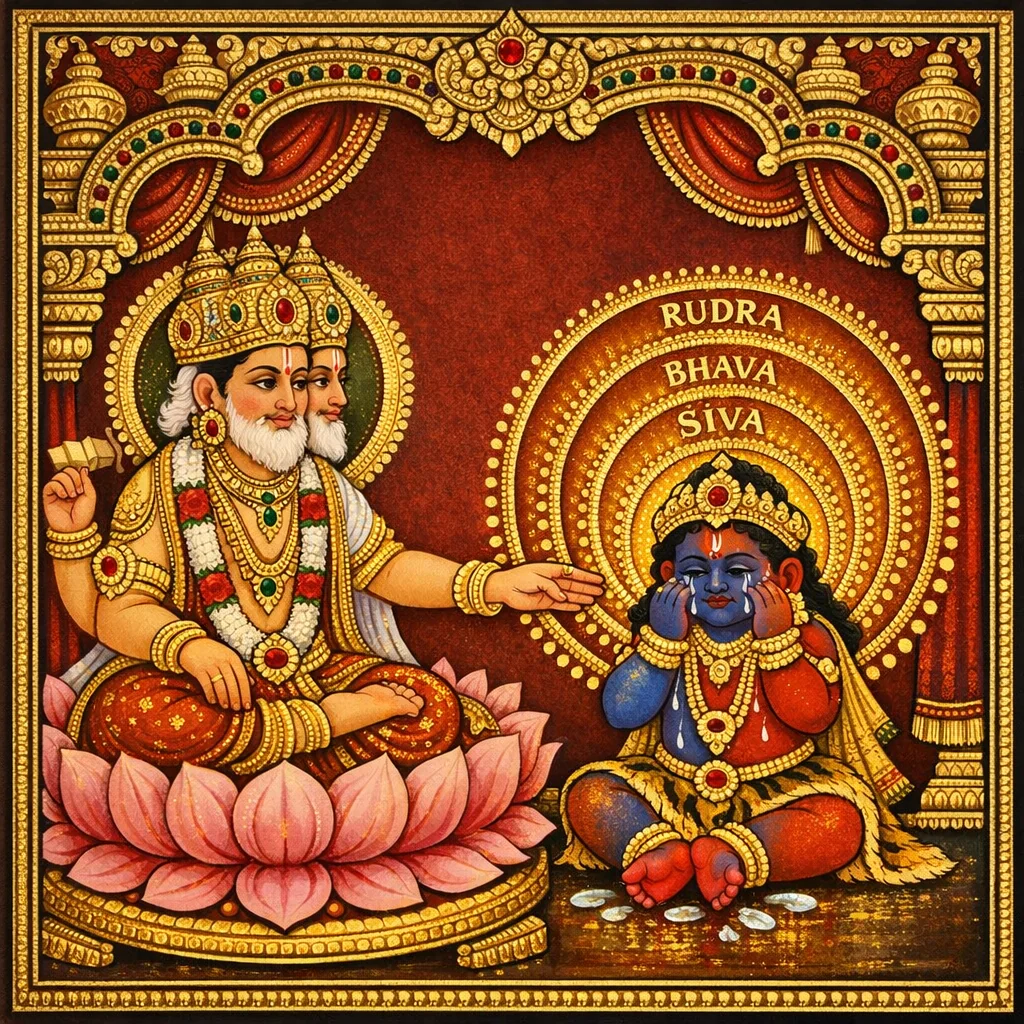
The chapter unfolds as a dialogue: a Ṛṣi asks about the manifestation (prādurbhāva) of Mahādeva-Rudra in the present Kalpa, since the earlier account of creation was only brief. Sūta replies that he has already outlined the origin of the first creation (ādi-sarga) and will now explain in detail the names and corresponding forms (tanū) connected with Rudra’s emergence. At the beginning of the Kalpa, the Lord contemplates a son equal to himself, and the child Nīlalohita appears. The child’s intense crying prompts Brahmā to bestow names formally; each time he is asked, “Why do you cry?”, the child requests another name, and Brahmā grants a sequence of Rudra-epithets—Rudra, Bhava, Śarva, Īśāna, Paśupati, Bhīma, and others—establishing a template for Rudra’s many identities and functions. Thus naming becomes a cosmological classification, placing Rudra within the Sarga/Pratisarga narrative and preparing for later expansions on emanations, attendants, and genealogical-cosmic links.
Shlokas
Verse 1
इति श्री ब्रह्माण्डे महापुराणे वायुप्रोक्ते पूर्वभागे द्वितीये ऽनुषङ्गपादे रुद्रप्रसववर्णनं नाम नवमो ऽध्यायः ऋषिरुवाच अस्मिन्कल्पे त्वया नोक्तः प्रादुर्भावो महात्मनः / महादेवस्य रुद्रस्य साधकैरृषिभिः सह
Thus, in the Śrī Brahmāṇḍa Mahāpurāṇa, in the former section spoken by Vāyu, in the second anuṣaṅga-pāda, is the ninth chapter called “The Description of Rudra’s Birth.” The Ṛṣi said: “O great-souled one, in this kalpa you have not yet told of the manifestation of Mahādeva Rudra together with the ascetic ṛṣis.”
Verse 2
सूत उवाच उत्पत्तिरादिसर्गस्य मया प्रोक्ता समासतः / विस्तरेण प्रवक्ष्यामि नामानि तनुभिः सह
Sūta said: “I have briefly spoken of the origin of the primal creation (ādi-sarga). Now I shall declare in detail the names, together with their embodied forms (tanu).”
Verse 3
पत्नीषु जनयामास महादेवः सुतान्बहून / कल्पेष्वन्येष्वतीतेषु ह्यस्मिन्कल्पे तु ताञ्शृणु
Mahādeva begot many sons among his consorts. So it was in other kalpas that have passed; but now, hear of those in this kalpa.
Verse 4
कल्पादावात्मनस्तुल्यं सुतमध्यायत प्रभुः / प्रादुरा सीत्ततोङ्के ऽस्य कुमारो नीललोहितः
At the beginning of the kalpa, the Lord contemplated a son equal to himself. Then, upon his lap, there appeared a youth named Nīlalohita.
Verse 5
रुरोद सुस्वरं घोरं निर्दहन्निव तेजसा / दृष्ट्वा रुदन्तं सहसा कुमारं नीललोहितम्
He wept in a clear yet dreadful voice, as though scorching all with his radiance. Seeing the youth Nīlalohita suddenly in tears, (all were struck with awe).
Verse 6
किं रोदिषि कुमारेति ब्रह्मा तं प्रत्यभाषत / सो ऽब्रवीद्देहि मे नाम प्रथमं त्वं पितामह
Brahmā said to him, “Why do you weep, O child?” He replied, “O Pitāmaha, first grant me a name.”
Verse 7
रुद्रस्त्वं देव नामासि स इत्युक्तो ऽरुदत्पुनः / किं रोदिषि कुमारेति ब्रह्मा तं प्रत्यभाषत
Brahmā said, “O deva, your name is Rudra.” When so addressed, he wept again. Brahmā then asked, “Why do you weep, O child?”
Verse 8
नाम देहि द्वितीयं मे इत्युवाच स्वयंभुवम् / भवस्त्वं देवनाम्नासि इत्युक्तः सो ऽरुदत्पुनः
He said to Brahmā the Self-born, “Grant me a second name.” Brahmā replied, “By the divine name, you are Bhava.” Thus addressed, he wept again.
Verse 9
किं रोदिषीति तं ब्रह्मा रुदन्तं प्रत्युवाच ह / तृतीयं देहि मे नाम इत्युक्तः सो ऽब्रवीत्पुनः
Brahmā spoke to him as he wept, “Why do you weep?” He replied again, “Grant me a third name.”
Verse 10
शर्वस्त्वं देव नाम्नासि इत्युक्तः सो ऽरुदत्पुनः / किं रोदिषीति तं ब्रह्मा रुदन्तं प्रत्युवाच ह
Brahmā said, “O deva, your name is Śarva.” When so addressed, he wept again. Brahmā then spoke to him as he wept, “Why do you weep?”
Verse 11
चतुर्थ देहि मे नाम इत्युक्तः सो ऽब्रवीत्पुनः / ईशानो देवनाम्नासि इत्युक्तः सो ऽरुदत्पुनः
“Grant me the fourth name,” he said again. When told, “Among the gods you are named Īśāna,” he wept once more.
Verse 12
किं रोदिषीति तं ब्रह्मा रुदन्तं पुनरब्रवीत् / पञ्चमं नाम देहीति प्रत्युवाच स्वयंभुवम्
Brahmā spoke again to him as he wept, “Why do you cry?” He replied to the Self-born, “Grant me the fifth name.”
Verse 13
पशूनां त्वं पतिर्देव इत्युक्तः सो ऽरुदत्पुनः / किं रोदिषीति तं ब्रह्मा रुदन्तं पुनरब्रवीत्
When told, “O deva, you are the lord of beings (paśu),” he wept again. Brahmā spoke once more to him as he cried, “Why do you weep?”
Verse 14
षष्ठं वै देहि मे नाम इत्युक्तः प्रत्युवाच तम् / भीमस्त्वं देव नाम्नासि इत्युक्तः सो ऽरुदत्पुनः
“Grant me the sixth name,” he said, and replied. When told, “Among the gods you are named Bhīma,” he wept once more.
Verse 15
किं रोदिषीति तं ब्रह्मा रुदन्तं पुनरब्रवीत् / सप्तमं देहि मे नाम इत्युक्तः प्रत्युवाच ह
Brahmā spoke again to him as he wept, “Why do you cry?” He replied, “Grant me the seventh name,” thus he answered.
Verse 16
उग्रस्त्वं देव नाम्नासि इत्युक्तः सो ऽरुदत्पुनः / तं रुदन्तं कुमारं तु मारोदीरिति सो ऽब्रवीत्
When he was told, “Your name is Ugra, O deva,” he wept again. To that crying boy he said, “Mā rodīḥ—do not weep.”
Verse 17
सो ऽब्रवीदष्टमं नाम देहि मे त्वं विभो पुनः / त्वं महादेवनामासि इत्युक्तो विरराम ह
He said, “O Vibhu, grant me the eighth name as well.” When told, “You are named Mahādeva,” he became still.
Verse 18
लब्ध्वा नामानि चैतानि ब्रह्माणं नीललोहितः / प्रोवाच नाम्नामेतेषां स्थानानि प्रदिशेति ह
Having obtained these names, Nīlalohita said to Brahmā, “Declare to me the abodes assigned to these names.”
Verse 19
ततो विसृष्टास्तनव एषां नाम्ना स्वयंभुवा / सूर्यो जलं मही वायुर्व ह्निराकाशमेव च
Then Svayambhū Brahmā, in accord with those names, brought forth their embodied forms: the Sun, Water, Earth, Wind, Fire, and also Ākāśa (space).
Verse 20
दीक्षिता ब्राह्मणश्चन्द्र इत्येवं ते ऽष्टधा तनुः / तेषु पूज्यश्च वन्द्यश्च नमस्कार्यश्च यत्नतः
Dīkṣita, Brāhmaṇa, and Candra—thus your body is eightfold. Among these, each is to be worshiped, revered, and carefully saluted with devotion.
Verse 21
प्रोवाच तं पुनर्ब्रह्मा कुमारं नीललोहितम् / यदुक्तं ते मया पूर्वं नाम रुद्रेति वै विभो
Then Brahmā spoke again to the youth Nīlalohita: “O mighty one, as I told you before, your name indeed is Rudra.”
Verse 22
तस्यादित्यतनुर्नाम्नः प्रथमा प्रथमस्य ते / इत्युक्ते तस्य यत्तेजश्चक्षुस्त्वासीत्प्रकाशकम्
Of your earliest names, the first is Ādityatanu; when this was spoken, his radiance became like an eye that gives light.
Verse 23
विवेश तत्तदादित्यं तस्माद्रुद्रो ह्यसौ स्मृतः / उद्यतमस्तं यन्तं च वर्जयेद्दर्शनेरविम्
That radiance entered into that very Āditya; therefore he is remembered as Rudra. One should avoid gazing directly at the Sun at its rising, setting, and when it stands overhead.
Verse 24
शश्वच्च जायते यस्माच्छश्वत्संतिष्ठते तु यत् / तस्मात्मूर्यं न वीक्षेत आयुष्कामः शुचिः सदा
For from Him there is ceaseless arising, and in Him there is ceaseless abiding; therefore the ever-pure seeker of long life should not gaze at the Sun when it stands above the head.
Verse 25
अतीतानागतं रुद्रं विप्रा ह्याप्याययन्ति यत् / उभे संध्ये ह्युपासीना गृणन्तः सामऋग्यजुः
The vipras, seated in worship at both twilights, chant the Sāma, Ṛg, and Yajus hymns, thereby satisfying Rudra who spans the past and the yet-to-come.
Verse 26
उद्यन्स तिष्ठते ऋक्षु मध्याह्ने च यजुःष्वथ / सामस्वथापराह्णे तु रुद्रः संविशति क्रमात्
At sunrise He abides in the Ṛgveda, at midday in the Yajurveda; and in the afternoon Rudra enters the Sāmaveda in due order.
Verse 27
तस्माद्भवेन्नाभ्युदितो बाह्यस्तमित एव च / न रुद्रम्प्रति मेहेत सर्वावस्थं कथं चन
Therefore He neither truly rises, nor goes forth outside, nor sets; in no condition should one ever commit impurity against Rudra.
Verse 28
एवं युक्तान् द्विजान् देवो रुद्रस्तान्न हिनस्ति वै / ततो ऽप्रवीत्पुनर्ब्रह्मा तं देवं नीललोहितम्
Thus the god Rudra truly does not harm the disciplined twice-born; then Brahmā spoke again to that deity, Nīlalohita.
Verse 29
द्वितीयं नामधेयं ते मया प्रोक्तं भवेति यत् / एतस्यापो द्वितीया ते तनुर्नाम्ना भवत्विति
I have declared your second name to be ‘Bhava’; and for this, let your second form be known by the name ‘Āpaḥ’—the Waters.
Verse 30
इत्युक्ते त्वथ तस्यासीच्छरीरस्थं रसात्मकम् / विवेश तत्तदा यस्तु तस्मादापो भवः स्मृतः
When this was spoken, the essence of rasa abiding within his body entered into it; and because that rasa entered then, Āpaḥ is remembered as Bhava.
Verse 31
यस्माद्भवन्ति भूतानि ताभ्यस्ता भावयन्ति च / भवनाद्रावनाच्चैव भूतानामुच्यते भवः
From Him all beings arise, and by Him they are sustained; because He brings forth and sets in flow, He is called Bhava.
Verse 32
तस्मान्मूत्रं पुरीषं च नाप्सु कुर्वीत कर्हिचित् / न निष्ठीवेन्नावगाहेन्नैव गच्छेच्च मैथुनम्
Therefore one should never urinate or defecate in water; one should not spit into it, not bathe by submerging, and not engage in sexual union near it.
Verse 33
न चैताः परिचक्षीत वहन्त्यो वा स्थिता अपि / मैध्यामेध्यास्त्वपामेतास्तनवो मुनिभिः स्मृताः
And do not regard these waters—whether flowing or still—with a fault-finding gaze; for the sages have taught that the forms of water are held to be both pure and, at times, impure.
Verse 34
विवर्णरसगन्धाश्च वर्ज्या अल्पाश्च सर्वशः / अपां योनिः समुद्रस्तु तस्मात्तं कामयन्ति ताः
Waters whose color, taste, and fragrance are corrupted, and waters that are scant, should be wholly avoided; the ocean is the womb of waters, therefore they yearn for it.
Verse 35
मध्याश्चैवामृता ह्यापो भवन्ति प्राप्य सागरम् / तस्मादपो न रुन्धीत समुद्रं कामयन्ति ताः
When waters reach the ocean, they become sweet and like amṛta; therefore one should not obstruct water, for it longs for the sea.
Verse 36
न हिनस्ति भवो देवो य एवं ह्यप्सु वर्तते / ततो ऽब्रवीत्पुनर्ब्रह्मा कुमारं नीललोहितम्
The god Bhava, who abides in the waters, harms no one. Then Brahmā again spoke to the youth Nīlalohita.
Verse 37
शर्वेति यत्तृतीयं ते नाम प्रोक्तं मया विभो / तस्य भूमिस्तृतीयस्य तनुर्नाम्ना भवत्त्वियम्
O mighty one, the third name I have declared for you is “Śarva”; let this Earth become the very body (tanu) that bears that third name.
Verse 38
इत्युक्ते यत्स्थिरं तस्य शरीरे ह्यस्थिसंज्ञितम् / विवेश तत्तदा भूमिं यस्मात्सा शर्व उच्यते
When this was spoken, the firm part in his body, known as asthi (bone), entered the Earth at that time; therefore she is called “Śarva”.
Verse 39
तस्मात्कृष्टेन कुर्वीत पुरीषं मूत्रमेव च / न च्छायायां तथा मार्गे स्वच्छायायां न मेहयेत्
Therefore one should relieve oneself—stool and urine—only in a proper prepared place; one should not urinate in the shade, on the road, nor upon one’s own shadow.
Verse 40
शिरः प्रावृत्य कुर्वीत अन्तर्धाय तृणैर्महीम् / एवं यो वर्तते भूमौ शर्वस्तं न हिनस्ति वै
Covering the head and concealing the ground with grass, one should do so discreetly. Whoever behaves thus upon the Earth, Śarva indeed does not harm that person.
Verse 41
ततो ऽब्रवीत्पुनर्ब्रह्मा कुमारं नीललोहितम् / ईशानेति चतुर्थ ते नाम प्रोक्तं मयेह यत्
Then Brahmā spoke again to the youth Nīlalohita: “Īśāna”—this is the fourth name of yours that I have proclaimed here.
Verse 42
चतुर्थस्य चतुर्थी तु वायुर्नाम्ना तनुस्तव / इत्युक्ते यच्छरीरस्थं पञ्चधा प्राणसंज्ञितम्
The fourth aspect of the fourth was named “Vāyu” for you; when this was spoken, the prāṇa abiding within his body became divided fivefold.
Verse 43
विवेश तस्य तद्वायुमीशानस्तन मारुतः / तस्मान्नैनं परिवदेत्प्रवान्तं वायुमीश्वरम्
Then the Maruta, taking the form of Īśāna, entered that Vāyu; therefore let none revile the Lord of the wind as it blows.
Verse 44
यज्ञैर्व्यवहरन्त्येनं ये वै परिचरन्ति च / एवं युक्तं महेशानो नैव देवो हिनस्ति तम्
Those who approach him through yajñas and attend upon him in service—one thus united, by Maheśāna’s grace, is harmed by no deity.
Verse 45
ततो ऽब्रवीत्पुनर्ब्रह्मा तं देवं ध५म्लमीश्वरम् / नाम यद्वै पशुपतिरित्युक्तं पञ्चमं मया
Then Brahmā spoke again to that deity, the smoke-hued Īśvara: “Paśupati”—this is the fifth name that I have declared.
Verse 46
पञ्चमी पञ्चम स्यैषा तनुर्नाम्नाग्निरस्तु ते / इत्युक्ते यच्छरीरस्थं तेजस्तस्योष्णसंज्ञितम्
“O Pañcamī, let this fifth body of yours be named ‘Agni’.” When this was spoken, the radiance abiding within his body was called ‘Uṣṇa’, the sacred heat.
Verse 47
विवेश तत्तदा ह्यग्निं तस्मात्पशुपतिस्तु सः / यस्मादग्निः पशुश्चासीद्यस्मात्पाति पशूंश्च सः
Then that radiance entered into Agni; therefore he became renowned as Paśupati. For he became both Agni and paśu, and because he protects all paśu.
Verse 48
तस्मात्पशुपतेस्तस्य तनुरग्निर्निरुच्यते / तस्मादमेद्यं न दहेन्न च पादौ प्रतापयेत्
Therefore the body of Paśupati is declared to be ‘Agni’. Hence he does not burn what is impure, nor does he scorch the feet.
Verse 49
अधस्तान्नोपदध्याच्च न चैनमतिलङ्घयेत् / नैनं पशुपतिर्देव एवं युक्तं हिनस्ति वै
Place nothing beneath it, and do not step over it. One who is thus properly observant is not harmed by the god Paśupati.
Verse 50
ततो ऽब्रवीत्पुनर्ब्रह्मा तं देवं श्वेतपिङ्गलम् / षष्टं नाम मया प्रोक्तं तव भीमेति यत्प्रभो
Then Brahmā spoke again to that white-and-tawny deity: “O Lord, the sixth name I have proclaimed for you is ‘Bhīma’.”
Verse 51
आकाशं तस्य नाम्नस्तु तनुः षष्ठी भवत्विति / इत्युक्ते सुषिरं तस्य शरीरस्थमभूच्च यत्
When it was declared, “Let Ākāśa be the sixth body of his Name,” the hollow space that lay within his frame became manifest as Space itself.
Verse 52
विवेश तत्तदाकाशं तस्माद्भीमस्य सा तनुः / यदाकाशे स्मृतो देवस्तस्मान्ना संवृतः क्वचित्
He entered into that very Ākāśa; therefore Bhīma’s form became made of Space. The deity remembered in Ākāśa is never veiled anywhere.
Verse 53
कुर्यान्मूत्रं पुरीषं वा न भुञ्जीत पिबेन्न वा / मैथुनं वापि न चरेदुच्छिष्टानि च नोत्क्षिपेत्
He should neither pass urine nor stool; he should neither eat nor drink; he should not engage in sexual union; and he should not cast away impure remnants (ucchiṣṭa).
Verse 54
न हिनस्ति च तं देवो यो भीमे ह्येवमाचरेत् / ततो ऽब्रवीत्पुनर्ब्रह्मा तं देवं सबलं प्रभुम्
The deity does not harm one who acts in this manner toward Bhīma. Then Brahmā again addressed that mighty Lord among the gods.
Verse 55
सप्तमं यन्मया प्रोक्तं नामोग्रेति तव प्रभो / तस्य नाम्नस्तनुस्तुभ्यं द्विजो भवति दीक्षितः
O Lord, the seventh Name I have declared is “Ogra”; through the body of that Name, the twice-born who has received dīkṣā becomes consecrated unto You.
Verse 56
एवमुक्ते तु यत्तस्य चैतन्यं वै शरीरगम् / विवेश दीक्षितं तद्वै ब्राह्मणं सोमयाजिनम्
When this was spoken, the consciousness abiding in his body truly entered that consecrated brāhmaṇa, the Somayājin.
Verse 57
तावत्कालं स्मृतो विप्र उग्रो देवस्तु दीक्षितः / तस्मान्नेमं परिवदेन्नाश्लीलं चास्य कीर्त्तयेत्
For that duration the vipra is to be remembered as Ugra Deva, consecrated; therefore do not revile him, nor utter anything obscene about him.
Verse 58
ते हरन्त्यस्य पाप्मानं ये वै परिवदन्ति तम् / एवं युक्तान् द्विजानुग्रो देवस्तान्न हिनस्ति वै
Those who revile him carry away his sin; thus Ugra Deva does not harm the dvijas who are rightly restrained.
Verse 59
ततोब्रवीत्पुनर्ब्रह्मा तं देवं भास्करद्युतिम् / अष्टमं नाम यत् प्रोक्तं महादेवेति ते मया
Then Brahmā spoke again to that deity radiant as the sun: “The eighth name I have declared to you is ‘Mahādeva’.”
Verse 60
तस्य नाम्नो ऽष्टमस्यास्तु तनुस्तुभ्यं तु चन्द्रमाः / इत्युक्ते यन्मन स्तस्य संकल्पकमभूत्प्रभोः
“Let the embodiment of that eighth name for you be Candramā, the Moon.” When this was said, the Lord’s mind became fixed in sacred resolve.
Verse 61
विवेश तच्चन्द्रमसं महादेवस्ततः शशी / तस्माद्विभाव्यते ह्येष महादेवस्तु चन्द्रमाः
Mahādeva entered that orb of the Moon; then it became Śaśī. Therefore this Moon is understood to be Mahādeva himself.
Verse 62
अमावास्यां न वै छिन्द्याद्वृक्षगुल्मौषधीर्द्विजः / महादेवः स्मृतः सोमस्तस्यात्मा ह्यौषधीगणः
On Amāvāsyā, a dvija should not cut trees, shrubs, or medicinal herbs. Soma is remembered as Mahādeva, and the host of herbs is truly his very Self.
Verse 63
एवं यो वर्त्तते चैह सदा पर्वणि पर्वणि / न हन्ति तं महादेवो य एवं वेद तं प्रभुम्
Whoever in this world always lives thus, at every sacred parva, and knows the Lord in this way—Mahādeva does not destroy him.
Verse 64
गोपायति दिवादित्यः प्रजा नक्तं तु चन्द्रमाः / एकरात्रौ समेयातां सूर्या चन्द्रमसावुभौ
By day Āditya guards the creatures, and by night the Moon. In a single night—Amāvāsyā—Sun and Moon come together.
Verse 65
अमावास्यानिशायां तु तस्यां युक्तः सादा भवेत् / रुद्राविष्टं सर्वमिदं तनुभिर्न्नामभिश्च ह
On that night of Amāvāsyā one should ever remain disciplined and composed. All this is pervaded by Rudra—by his forms and by his names.
Verse 66
एकाकी चश्चरत्येष सूर्यो ऽसौ रुद्र उच्यते / सूर्यस्य यत्प्रकाशेन वीक्षन्ते चक्षुषा प्रजाः
This Sun moves on alone; therefore it is called Rudra. By the Sun’s radiance, beings behold with their eyes.
Verse 67
मुक्तात्मा संस्थितो रुद्रः पिबत्यंभो गभस्तिभिः / अद्यते पीयते चैव ह्यन्नपानादिकाम्यया
Rudra, established in liberated Self, drinks the waters with his rays. Through the desire for food and drink, there is eating and drinking.
Verse 68
तनुरंबूद्भवा सा वै देहेष्वेवोपचीयते / यया धत्ते प्रजाः सर्वाः स्थिरीभूतेन तेजसा
That body born of water increases within embodied beings. By its steadied radiance, it upholds all creatures.
Verse 69
पार्थिवी सा तनुस्तस्य साध्वी धारयते प्रजाः / या च स्थिता शरीरेषु भूतानां प्राणवृत्तिभिः
His earthly, holy body sustains all beings, abiding in their bodies along with the functions of prāṇa.
Verse 70
वातात्मिका तु चैशानी सा प्राणः प्राणिनामिह / पीताशितानि पचति भूतानां जठरेष्विह
Īśānī, whose nature is wind, is the prāṇa of living beings here. In the bellies of creatures, she digests what is drunk and eaten.
Verse 71
तनुः पाशुपती तस्य पाचकः सो ऽग्निरुच्यते / यानीह शुषिराणि स्युर्देहेष्वन्तर्गतानि वै
His body is called Pāśupatī; the fire that cooks and digests within is said to be Agni. And whatever cavities lie hidden inside bodies—those indeed are meant here.
Verse 72
वायोः संचरणार्थानि भीमा सा प्रोच्यते तनुः / वैतान्यादीक्षितानां तु या स्थितिर्ब्रह्मवादिनाम्
The form meant for the movement of Vāyu is proclaimed as Bhīmā. And such too is the station of the brahmavādins, initiated through vaitānya and other consecrations.
Verse 73
तनुरुग्रात्मिका सा तु तेनोग्रो दीक्षितः स्मृतः / यत्तु संकल्पकं तस्य प्रजास्विह समास्थितम्
That form is of Ugra nature; therefore he is remembered as one initiated as Ugra. And his power of saṅkalpa—his sacred resolve—abides here among the creatures.
Verse 74
सा तनुर्मानसी तस्य चन्द्रमाः प्राणिषु स्थितः / नवोनवो यो भवति जायमानः पुनःपुनः
That is his mental form; Candra, the Moon, is established within living beings. Again and again he is born, ever renewing himself, ever new.
Verse 75
पीयते ऽसौ यथाकालं विबुधैः पितृभिः सह / महादेवो ऽमृतात्मा स चन्द्रमा अम्मयः स्मृतः
In due season that Candra is drunk by the gods together with the Pitṛs. Mahādeva, whose very essence is amṛta, is that Moon—remembered as filled with nectar.
Verse 76
तस्य या प्रथमा नाम्ना तनू रौद्री प्रकीर्त्तिता / पत्नी सुवर्च्चला तस्याः पुत्रश्चास्य शनैश्चरः
His first manifestation is renowned by the name Raudrī. Her consort is Suvarccalā, and his son is Śanaiścara.
Verse 77
भवस्य या द्वितीया तु आपो नाम्ना तनुः स्मृता / तस्या धात्री स्मृता पत्नी पुत्रश्च उशना स्मृतः
Bhava’s second manifestation is remembered as Āpaḥ, the Waters. Her consort is Dhātrī, and his son is recalled as Uśanā.
Verse 78
शर्वस्य या तृतीयस्य नाम्नो भूमिस्तनुः स्मृता / तस्याः पत्नी विकेशी तु पुत्रो ऽस्याङ्गारकः स्मृतः
Śarva’s third manifestation is remembered as Bhūmi, the Earth. Her consort is Vikeśī, and his son is recalled as Aṅgāraka.
Verse 79
ईशानस्य चतुर्थस्य नाम्ना वातस्तनुस्तु या / तस्याः पत्नी शिवा नाम पुत्रश्चास्या मनोजवः
Īśāna’s fourth manifestation is remembered as Vāta, the Wind. Her consort is named Śivā, and his son is Manojava.
Verse 80
अविज्ञातगतिश्चैव द्वौ पुत्रौ चानिलस्य तु / नाम्ना पशुपतेर्या तु तनुरग्निर्द्विजैः स्मृता
Anila also has two sons whose course is unknown. And the manifestation of Paśupati named Agni, the Fire, is remembered by the twice-born sages.
Verse 81
तस्याः पत्नी स्मृता स्वाहा स्कन्दस्तस्याः सुतः स्मृतः / नाम्ना षष्ठस्य या भीमा तनुराकाशमुच्यते
His consort is remembered as Svāhā, and her son is known as Skanda. The formidable one named “Ṣaṣṭha” is Bhīmā; her body is called Ākāśa, the sky.
Verse 82
दिशः पत्न्यः स्मृतास्तस्य स्वर्गश्चापि सुतः स्मृतः / अग्रा तनुः सप्तमी या दीक्षितो ब्राह्मणः स्मृतः
His wives are remembered as the Directions, and his son is also known as Svarga, Heaven. The seventh form, called Agrā, is said to be a brāhmaṇa consecrated by dīkṣā.
Verse 83
दीक्षा पत्नी स्मृता तस्याः संतानः पुत्र उच्यते / नाम्नाष्टमस्य महस्तनुर्या चन्द्रमाः स्मृतः
His consort is remembered as Dīkṣā, and Saṃtāna is spoken of as his son. The eighth is named Mahaḥ; his form is remembered as Candramā, the Moon.
Verse 84
तस्य वै रोहिणी पत्नी पुत्रस्तस्य बुधः स्मृतः / इत्येतास्तनवस्तस्य नामभिः सह कीर्तिताः
His consort is Rohiṇī, and his son is remembered as Budha. Thus have all his forms been proclaimed together with their names.
Verse 85
तासु वन्द्यो नमस्यश्च प्रतिनामतनूषु वै / सूर्येप्सूर्व्यां तथा वायावग्नौ व्योम्न्यथ दीक्षिते
In each form bearing its own name, he is to be revered and saluted: in the Sun, in the Earth, in the Wind, in Fire, in the Sky, and also in the Initiated (dīkṣita).
Verse 86
भक्तैस्तथा चन्द्रमसि भत्तया वन्द्यस्तु नामभिः / एवं यो वेत्ति तं देवं तनुभिर्नामभिश्च ह
Let the devotees worship Him even in the lunar sphere, with devotion and by His sacred names. He who thus knows that Deva, together with His forms and names.
Verse 87
प्रजावानेति सायुज्यमीश्वरस्य भवस्य सः / इत्येतद्वो मया प्रोक्तं गुह्यं भीमास्य यद्यशः
By the name “Prajāvān,” he attains sāyujya with Bhava, the Lord Īśvara. Thus have I declared to you this secret, connected with the fame of Bhīmāsya.
Verse 88
शन्नो ऽस्तु द्विपदे विप्राः शन्नो ऽस्तु च चतुष्पदे / एतत्प्रोक्तमिदानीं च तनूनां नामभि सह / महादेवस्य देवस्य भृगोस्तु शृणुत प्रजाः
O vipras, may there be welfare for the two-footed, and welfare also for the four-footed. This has now been declared together with the names of the tanu-forms; O people, hear through Bhṛgu the glory of Mahādeva, Deva of devas.
Frequently Asked Questions
This Adhyāya is not a royal or sage vaṃśa catalogue; it functions as a theogonic classification sequence, organizing Rudra’s identities through successive epithets rather than enumerating Solar/Lunar dynasties.
None in the sampled passage and chapter theme: the focus is Kalpa-beginning manifestation and name-taxonomy, not bhuvana-kośa distances, dvīpa measurements, or planetary intervals.
This chapter is not part of the Lalitopākhyāna segment; it belongs to a creation/emanation discourse centered on Rudra’s manifestation and naming, rather than Śākta vidyā/yantra exegesis or the Bhaṇḍāsura cycle.