Adhyaya 24
Rāma’s Inquiry into the Hidden Identity of the Radiant Stranger (Dialogue Frame)
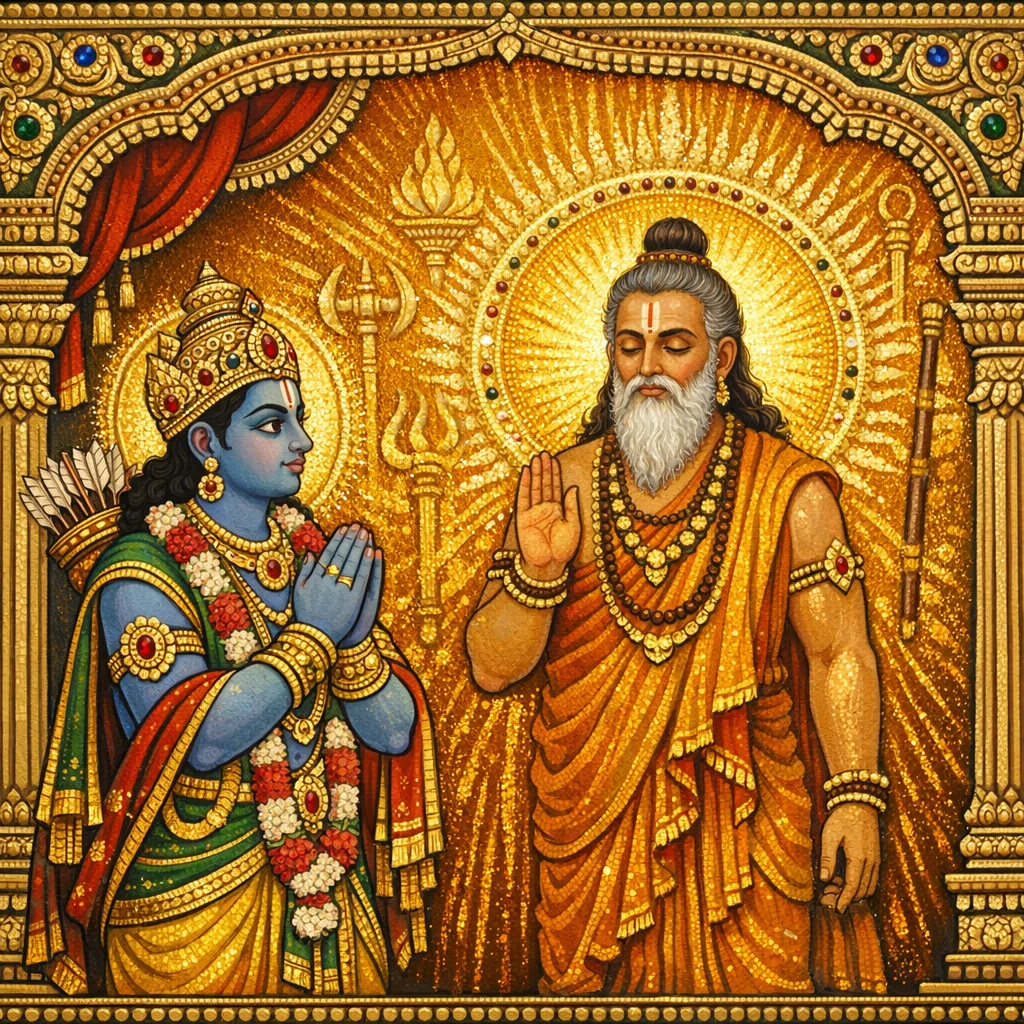
This adhyāya is framed as a dialogue in which the royal Rāma confronts a radiant stranger whose presence and speech surpass human limits. Rāma probes to know who he is, inferring divinity from the stranger’s extraordinary brilliance and from words that are deep, composed, and seemingly all-knowing. He then surveys possible identities in a comparative order: cosmic officials among the devas (Indra, Agni, Yama, Dhātā, Varuṇa, Kubera), higher principles (Brahmā, Vāyu, Soma), and supreme deities (Viṣṇu as the māyāvī Puruṣottama, or Śiva as the all-pervading one). The chapter models Purāṇic recognition by signs (lakṣaṇa) and presents devotion (bhakti) as a means to resolve doubt. It culminates in Rāma’s request for self-revelation (svarūpa-darśana) to end mental uncertainty, followed by concentrated contemplation (dhyāna), marking a shift from questioning to direct realization.
Shlokas
Verse 1
इति श्रीब्रह्माण्डे महापुराणे वायुप्रोक्ते मध्यभागे तृतीय उपोद्धातपादे त्रयोविंशतितमो ऽध्यायः वसिष्ठ उवाच इत्युक्तस्तेन भूपाल रामो मतिमतां वरः / निरूप्य मनसा भूयस्तमुवाचाभिविस्मितम्
Thus, in the Śrī Brahmāṇḍa Mahāpurāṇa, spoken by Vāyu, in the middle section, in the third Upoddhāta-pāda, is the twenty-third chapter. Vasiṣṭha said: when he had spoken thus, King Rāma—foremost among the wise—pondered again in his mind and, astonished, addressed him.
Verse 2
राम उवाच कस्त्वं ब्रूहि महाभाग न वै प्राकृतपूरुषः / इन्द्रस्येवानुभावेन वपुरालक्ष्यते तव
Rāma said: “O blessed one, tell me—who are you? You are no ordinary man; your very form is marked by a majesty like that of Indra.”
Verse 3
विचित्रार्थपदौदार्यगुणगांभीर्यजातिभिः / सर्वज्ञस्यैव ते वाणी श्रूयते ऽतिमनोहरा
With wondrous meanings, noble words, virtue, and depth, your speech is heard as supremely enchanting—like the utterance of one who is all-knowing.
Verse 4
इन्द्रो वह्निर्यमो धाता वरुणो वा धनाधिपः / ईशानस्तपनो ब्रह्मा वायुः सोमो गुरुर्गुहः
Are you Indra, Agni, Yama, Dhātā, Varuṇa, or Kubera the lord of wealth? Or are you Īśāna, the Sun, Brahmā, Vāyu, Soma, Guru (Bṛhaspati), or Guha?
Verse 5
एषामन्यतमः प्रायो भवान्भवितुमर्हति / अनुभावेन जातिस्ते हृदिशङ्कां तनोति मे
Among these, you seem fit to be one indeed; by your manifest power, your very nature spreads doubt within my heart.
Verse 6
मायावी भगवान्विष्णुः श्रूयते पुरुषोत्तमः / को वा त्वं वपुषानेन ब्रूहि मां समुपागतः
It is heard that the Lord Vishnu, wielder of māyā, is the Supreme Person; who then are you, come to me in this form—tell me.
Verse 7
अथ वा जगतां नाथः सर्वज्ञः परमेश्वरः / परमात्मात्मसंभूतिरात्मारामः सनातनः
Or else you are the Lord of all worlds, the all-knowing Supreme God; born of the Paramātman, rejoicing in the Self, the Eternal.
Verse 8
स्वच्छन्दचारी भगवाञ्छिवः सर्वजगन्मयः / वपुषानेन संयुक्ते भवान्भवितुमर्हति
The Lord Shiva, who roams in perfect freedom and pervades all worlds—joined with this form, you are truly fit to be He.
Verse 9
नान्यस्येदृग्भवेल्लोके प्रभावानुगतं वपुः / जात्यर्थसौष्ठवोपेता वाणी चौदार्यशालिनी
In this world none other could bear a form attended by such majesty; nor a speech so refined in birth and meaning, and so filled with noble generosity.
Verse 10
मन्ये ऽहं भक्तवात्सल्याद्वानेन वपुषाहरः / प्रत्यक्षतामुपगतो संदेहो ऽस्मत्परीक्षया
I deem that, out of love for His devotees, Hari has assumed a forest-dweller’s form and become manifest before us; by my testing, doubt too has been dispelled.
Verse 11
न केवलं भवान् व्याधस्तेषां नेदृग्विधाकृतिः / तस्मात्तुभ्यं नमस्तस्मै सुरुपं संप्रदर्शय
You are not merely a hunter; such a form is not theirs. Therefore I bow to you, and I bow to that Supreme as well—reveal your auspicious, beautiful form.
Verse 12
आविष्कुर्वन्प्रसीदात्ममहिमानुगुणं वपुः / ममानेकविधा शङ्कामुच्येत येन मानसी
Be gracious, revealing a form befitting Your own inner glory, so that the many doubts within my mind may be released.
Verse 13
प्रसीद सर्वभावेन बुद्धिमोहौ ममाधुना / प्रणाशय स्वरूपस्य ग्रहणादेव केवलम्
Be gracious in every way; now destroy my delusion of intellect and my bewilderment, solely by granting me the grasp of Your true form.
Verse 14
प्रार्थयेत्वां महाभाग प्रणम्य शिरसासकृत् / कस्त्वं मे दर्शयात्मानं बद्धो ऽयं ते मयाञ्जलिः
O greatly blessed one, bowing my head once in reverence I beseech you—who are you? Show me your very Self; this is my joined palms, offered to you.
Verse 15
इत्युक्त्वा तं महाभाग ज्ञातुमिच्छन्भृगूद्वहः / उपविश्य ततो भूमौ ध्यानमास्ते समाहितः
Having spoken thus, the greatly blessed scion of Bhrigu, wishing to know, sat down upon the ground and, fully composed, entered meditation.
Verse 16
बद्धपद्मासनो मौनी यतवाक्कायमानसः / निरुद्धप्राणसंचारो दध्यौ चिरमुदारधीः
Seated in a firm lotus posture, silent and self-restrained in speech, body, and mind, he checked the movement of prāṇa and meditated long with lofty understanding.
Verse 17
सन्नियम्येन्द्रियग्रामं मनो हृदि निरुध्य च / चिन्तयामास देवेशं ध्यानदृष्ट्या जगद्गुरुम्
Having firmly restrained the host of senses and held the mind within the heart, he contemplated, with meditative vision, the Lord of the gods—the Guru of the world.
Verse 18
अपश्यच्च जगन्नाथमात्मसंधानचक्षुषा / स्वभक्तानुग्रहकरं मृगव्याधस्वरूपिणम्
With the eye of inward concentration he beheld Jagannātha, the Lord of the world—gracious to His own devotees—appearing in the form of a hunter of deer.
Verse 19
तत उन्मील्य नयने शीघ्रमुत्थाय भार्गवः / ददर्श देवं तेनैव वपुषा पुरतः स्थितम्
Then Bhārgava opened his eyes, rose swiftly, and beheld the Deity standing before him in that very same form.
Verse 20
आत्मनो ऽनुग्रहार्थाय शरण्यं भक्तवत्सलम् / आविर्भूतं महाराज दृष्ट्वा रामः ससंभ्रमम्
O great king, seeing the Refuge of all, the Lover of devotees, manifested to bestow His grace, Rama was filled with reverent awe.
Verse 21
रोमाञ्छोद्भिन्नसर्वाङ्गो हर्षाश्रुप्लुतलोचनः / पपात पादयोर्भूमौ भक्त्या तस्य महामतिः
His whole body thrilled with rapture, his eyes flooded with tears of joy; that great-souled one fell upon the earth at His feet in devotion.
Verse 22
स गद्गदमुवाचैनं संभ्रमाकुलया गिरा / शरणं भव शर्वेति शङ्करेत्यसकृन्नृप
O king, with a voice choked by emotion and words shaken with reverence, he cried again and again: “Be my refuge, O Śarva, O Śaṅkara!”
Verse 23
ततः स्वरुपधृक् शंभुस्तद्भक्तिपरितोषितः / राममुत्थापयामास प्रणा मावनतं भुवि
Then Śambhu, assuming His own true form and pleased by that devotion, raised up Rama who was bowed in prostration upon the earth.
Verse 24
उत्थापितो जगद्धात्रा स्वहस्ताभ्यां भृगूद्वहः / तुष्टाव देवदेवेशं पुरः स्थित्वा कृताजलिः
Raised up by the Sustainer of the worlds with His own hands, that foremost of Bhṛgu’s line stood before Him with folded palms and hymned the Lord of the gods.
Verse 25
राम उवाच नमस्ते देवदेवाय शङ्करायादिमूर्त्तये / नमः शर्वाय शान्ताय शाश्वताय नमोनमः
Rama said— Salutations to the God of gods, to Śaṅkara, the Primordial Form. Salutations to Śarva, the Peaceful, the Eternal; again and again, my reverence.
Verse 26
नमस्ते नीलकण्ठाय नीललोहितमूर्त्तये / नमस्ते भूतनाथाय भूतवासाय ते नमः
Salutations to Nīlakaṇṭha, whose form is blue and ruddy. Salutations to Bhūtanātha, Lord of the bhūtas, to Bhūtavāsa who dwells among them; to You, my reverence.
Verse 27
व्यक्ताव्यक्तस्वरूपाय महादेवाय मीढुषे / शिवाय बहुरूपाय त्रिनेत्राय नमोनमः
Salutations to Him whose nature is both manifest and unmanifest, to Mahādeva, the gracious giver. Salutations to Śiva of many forms, the Three-Eyed; again and again, my reverence.
Verse 28
शरणं भव मे शर्व त्वद्भक्तस्य जगत्पते / भूयो ऽनन्याश्रयाणां तु त्वमेव हि परायणम्
O Śarva, Lord of the world! I am Your devotee—be my refuge. For those who have no other shelter, You alone are the highest reliance.
Verse 29
यन्मयापकृतं देव दुरुक्तं वापि शङ्कर / अजानता त्वां भगवन्मम तत्क्षन्तुमर्हसि
O Deva, O Śaṅkara! Whatever wrong I have done, or harsh words I have spoken, through not knowing You—O Bhagavān—be pleased to forgive it.
Verse 30
अनन्यवेद्यरुपस्य सद्भावमिहकः पुमान् / त्वामृते तव सर्वेश सम्यक् शक्रोति वेदितुम्
O Sarveśa, Lord of all, whose form is not knowable by any other means—without You, who in this world can truly know Your real nature?
Verse 31
तस्मात्त्वं सर्वभावेन प्रसीद मम शङ्कर / नान्यास्ति मे गतिस्तुभ्यं नमो भूयो नमो नमः
Therefore, O my Śaṅkara, be gracious to me with Your whole being. I have no other refuge but You; homage—again homage—homage upon homage.
Verse 32
वसिष्ठ उवाच इति संस्तूयमानस्तु कृताञ्जलिपुटं पुरः / तिष्ठन्तमाह भगवान्प्रसन्नात्मा जगन्मयः
Vasiṣṭha said: Thus praised, he stood before Him with palms joined; then the Blessed Lord—serene of heart, pervading the worlds—spoke to him.
Verse 33
भगवानुवाच प्रीतो ऽस्मि भवते तात तपसानेन सांप्रतम् / भक्त्या चैवानपायिन्या ह्यपि भार्गवसत्तम
The Lord said: My child, I am pleased at this time by your austerity; and also, O best of the Bhārgavas, by your unwavering devotion.
Verse 34
दास्ये चाभि मतं सवे भवते ऽहं त्वया वृतम् / भक्तो हि मे त्वमत्यर्थं नात्र कार्या विचारणा
Even in the spirit of devoted service, O All-pervading One, you have chosen Me. You are My most ardent devotee; there is no need for doubt or deliberation here.
Verse 35
मयैवावगतं सर्वं त्दृदि वत्ते ऽद्यवर्त्तते / तस्माद्ब्रवीमि यत्त्वाहं तत्कुरुष्वाविशङ्कितम्
I have fully known all that abides in your heart today. Therefore do, without doubt, what I tell you.
Verse 36
नास्त्राणां धारणे वत्स विद्यते शक्तिरद्य ते / रौद्राणां तेन भूयो ऽपि तपो घोरं समाचर
Child, today you do not have the strength to bear the divine weapons. Therefore, for the Raudra astras, practice still more dreadful austerity.
Verse 37
परीत्य पृथिवीं सर्वां सर्वतीर्थेषु च क्रमात् / स्रात्वा पवित्रदेहस्त्तवं सर्वाण्यस्त्राण्यवाप्स्यसि
Having circled the whole earth and, in due order, bathed at every sacred ford, your body purified, you shall obtain all the astras.
Verse 38
इत्युक्त्वान्तर्दधे देवस्तेनैव वपुषा विभुः / रामस्य पश्यतो राजन्क्षणेन भवभागकृत्
So saying, the mighty Deva vanished in that very form. O king, before Rama’s eyes he disappeared in an instant.
Verse 39
अन्तर्हिते जगन्नाथे रामो नत्वा तु शङ्करम् / परीत्यवसुधां सर्वां तीर्थस्नाने ऽकरोन्मनः
When the Lord of the world had vanished, Rama bowed to Śaṅkara and set his mind on bathing at the sacred fords, after circling the whole earth.
Verse 40
ततः स पृथिवीं सर्वां परिक्रम्य यथाक्रमम् / चकार सर्वतीर्थेषु स्नानं विधिवदात्मवान्
Then, self-possessed, he circumambulated the whole earth in due order and performed ritual bathing at all sacred tīrthas.
Verse 41
तीर्थेषु क्षेत्रमुख्येषु तथा देवालयेषु च / पितॄन्देवांश्च विधिवदतर्पयदतन्द्रितः
At the tīrthas, the foremost sacred sites, and in temples, he tirelessly offered due tarpaṇa to the Pitṛs and the Devas according to rite.
Verse 42
उपवासतपोहोमजपस्नानादिसुक्रियाः / तीर्थेषु विधिवत्कुर्वन्परिचक्राम मेदिनीम्
Performing at the tīrthas, in due form, holy acts—fasting, austerity, homa, japa, sacred bathing, and the like—he journeyed around the earth.
Verse 43
एवं क्रमेण तीर्थेषु स्नात्वा चैव वसुंधराम् / प्रदक्षिणीकृत्य शनैः शुद्धदेहो ऽभवन्नृप
O king, thus, bathing in the tīrthas in proper sequence and making pradakṣiṇā of the earth, he gradually became purified in body.
Verse 44
परीत्यैवं वसुमतीं भार्गवः शंभुशासनात् / जगाम् भूयस्तं देशं यत्र पूर्वमुवास सः
Thus, having traversed the earth, Bhārgava, by Śambhu’s command, returned again to the land where he had formerly dwelt.
Verse 45
गत्वा राजन्सतत्रैव स्थित्वा देवमुमापतिम् / भक्त्या संपूजयामास तपोभिर्न्नियमैरपि
O King, he went there and, staying in that very place, worshiped the god Umāpati with devotion; with austerities and sacred observances as well, he adored Him.
Verse 46
एतस्मिन्नेव काले तु देवानामसुरैः सह / बभूव सुचिरं राजन्संग्रामो रोमहर्षणः
O King, at that very time there arose a long and hair-raising war between the gods and the asuras.
Verse 47
ततो देवान्पराजित्य युद्धे ऽतिबलिनो ऽसुराः / अवापुरमरैश्वर्यमशेषमकुतोभयाः
Then the exceedingly mighty asuras defeated the gods in battle and, fearless, seized the entire divine sovereignty and splendor.
Verse 48
युद्धे पराजिता देवाः सकला वासवादयः / शङ्करं शरणं चग्मुर्हतैश्वर्या ह्यरातिभिः
Defeated in war, all the gods—Indra and the rest—bereft of their sovereignty by their foes, sought refuge in Śaṅkara.
Verse 49
तोषयित्वा जगन्नाथं प्रणामजय संस्तवैः / प्रार्थयामासुरसुरान्हन्तुं देवाः पिनाकिनम्
Having pleased Jagannātha with prostrations, cries of victory, and hymns of praise, the gods entreated the Pināka-bearing Lord to slay the asuras.
Verse 50
ततस्तेषां प्रतिश्रुत्य दानवानां वधं नृप / देवानां वरदः शंभुर्महो दरमुवाच ह
Then, O king, having pledged the slaying of the Dānavas, Śambhu—the boon-giver to the Devas—spoke to Mahodara.
Verse 51
हिमद्रेर्दक्षिणे भागे रामो नाम महातपाः / मुनिपुत्रो ऽतितेजस्वी मामुद्दिश्य तपस्यति
On the southern side of Himadri there is a great ascetic named Rāma, a sage’s son, radiant with splendor, performing austerities with his mind fixed on me.
Verse 52
तत्र गत्वात्वमद्यैव निवेद्य मम शासनम् / महोदर तपस्यन्तं तमिहानय माचिरम्
Go there this very day and deliver my command; O Mahodara, bring here without delay that Rāma who is engaged in austerities.
Verse 53
इत्याज्ञप्रस्तथेत्युक्त्वा प्रणभ्येशं महोदरः / जगाम वायुवेगेन यत्र रामो व्यवस्थितः
Saying, “So be it,” Mahodara bowed to the Lord and sped like the wind to the place where Rāma was staying.
Verse 54
समासाद्य स तं देशं दृष्ट्वा रामं महामुनिम् / तपस्यन्तमिदं वाक्यमुवाच विनयान्वितः
Reaching that place and seeing the great sage Rāma engaged in austerities, he spoke these words with reverent humility.
Verse 55
द्रष्टुमिच्छति शम्भुस्त्वां भृगुवर्यं तदाज्ञया / आगतो ऽहं तदागच्छ तत्पादांबुजसन्निधिम्
Śambhu desires to see you, O foremost of the Bhṛgus; by his command I have come. Therefore come—draw near to the lotus of his feet.
Verse 56
तच्छ्रुत्वा वचनं तस्य शीघ्रमुत्थाय भार्गवः / तदाज्ञां शिरसानन्द्य तथेति प्रत्यभाषत
Hearing his words, the Bhārgava rose at once; honoring that command upon his head with joy, he replied, “So be it.”
Verse 57
ततो रामं त्वरोपेतः शंभुपार्श्वं महोदरः / प्रापयामास सहसा कैलासे नागसत्तमे
Then Mahodara, hastening, swiftly brought Rāma to Śambhu’s side, and at once conveyed him to Kailāsa, abode of the noblest of nāgas.
Verse 58
सहितं सकलैर्भूतैरिन्द्राद्यैश्च सहामरैः / ददर्श भार्गवश्रेष्ठः शङ्करं भक्तवत्सलम्
Then the foremost of the Bhārgavas beheld Śaṅkara, tender to his devotees—surrounded by all the bhūtas, and accompanied by Indra and the other gods.
Verse 59
संस्तूयमानं मुनिभिर्नारदाद्यैस्तपोधनैः / गन्धर्वैरुपगायद्भिर्नृत्यद्भिश्चाप्सरोगणैः
He was being hymned by ascetic sages such as Nārada; the gandharvas sang in chorus, and the hosts of apsarases danced.
Verse 60
उपास्यमानं देवेशं गजचर्मधृताम्बरम् / भस्मोद्धूलितसर्वाङ्गं त्रिनेत्रं चन्द्रशेखरम्
The Lord of the gods, worshipped in devotion, clad in elephant-hide; his whole body dusted with sacred ash—three-eyed, Chandrashekhara, crowned with the moon.
Verse 61
धृतपिङ्गजटाभारं नागाभरमभूषितम् / प्रलम्बोष्ठभुजं सौम्यं प्रसन्नमुखपङ्कजम्
He bore the weight of tawny matted locks, adorned with serpent-ornaments; long-lipped and long-armed, gentle, with a serene lotus-face.
Verse 62
आस्थितं काञ्चने पट्टे गीर्वाणसमितौ नृप / उपासर्पत्तु देवेशं भृगुवर्यः कृताञ्जलिः
O king, in the assembly of the gods, as the Lord of the gods sat upon a golden seat, the foremost Bhṛgu approached with hands joined in reverence.
Verse 63
श्रीकण्ठदर्शनोद्वत्तरोमाञ्चाञ्चितविग्रहः / बाष्पत्तु सिक्तकायेन स तु गत्वा हरान्तिकम्
At the sight of Śrīkaṇṭha his body thrilled with rapture; drenched in tears, he went and drew near to Hara.
Verse 64
भक्त्या ससंभ्रमं वाचा हर्षगद्गदयासकृत् / नमस्ते देवदेवेति व्यालपन्नाकुलाक्षरम्
In devotion and trembling awe, his voice choked again and again with joy; he cried, in broken syllables, “Homage to you, O God of gods!”
Verse 65
पपात संस्पृशन्मूर्ध्ना चरणौ पुरविद्विषः / पश्यतां देववृन्दानां मध्ये भृगुकुलोद्वहम्
The foremost of Bhṛgu’s line fell down, touching with his head the feet of the foe of the city, while the hosts of gods looked on.
Verse 66
तमुत्थाप्य शिवः प्रीतः प्रसन्नमुखपङ्कजम् / रामं मधुरया वाचा प्रहसन्नाह सादरम्
Śiva, pleased, raised him up and, smiling, spoke with sweet and reverent words to Rāma, whose face was serene like a lotus.
Verse 67
इमे दैत्यगणैः क्रान्ताः स्वाधिष्ठानात्परिच्युताः / अशक्रुवन्तस्तान्हन्तुं गीर्वाणा मामुपागताः
These gods have been overrun by the hosts of Daityas and driven from their own seats; unable to slay them, the celestials have come to me.
Verse 68
तस्मान्ममाज्ञया राम देवानां च प्रियेप्सया / जहि दैत्यगणान्सर्वान्समर्थस्त्वं हि मे मतः
Therefore, O Rāma, by my command and for the beloved welfare of the gods, slay all the hosts of Daityas; for I deem you fully able.
Verse 69
ततो रामो ऽब्रवीच्छर्वं प्रणिपत्य कृताञ्जलिः / शृण्वतां सर्वदेवानां सप्रश्रयमिदं वचः
Then Rāma, bowing to Śarva with hands joined, spoke these humble words as all the gods listened.
Verse 70
स्वामिन्न विदितं किं ते सर्वज्ञस्याखिलात्मनः / तथापि विज्ञापयतो वचनं मे ऽवधारय
O Lord, to You—omniscient, the Self of all—what can be unknown? Yet, as I make my petition, please heed my words.
Verse 71
यदि शक्रादिभिर्देवैरखिलैरमरारयः / न शक्या हन्तुमेकस्य शक्याः स्यस्ते कथं मम
If Indra and all the gods cannot slay even one of those foes of the immortals, how could I possibly slay them?
Verse 72
अनस्त्रज्ञो ऽस्मि देवेश युद्धानामप्यकोविदः / कथं हनिष्ये सकलान्सुरशत्रूननायुधः
O Lord of the gods, I know no lore of weapons and am unskilled in war; without arms, how shall I slay all the enemies of the devas?
Verse 73
इत्युक्तस्तेन देवेशः सितं कालाग्निसप्रभम् / शैवमस्त्रमयं तेजो ददौ तस्मै महात्मने
Thus addressed, the Lord of the gods bestowed upon that great-souled one a white radiance, blazing like the fire of Time—power embodied as a Śaiva weapon.
Verse 74
आत्मीयं परशुं दत्वा सर्वशस्त्राभिभावकम् / रामपाह प्रसन्नात्मा गीर्वाणानां तु शृण्वतम्
Giving his own axe, which overmasters every weapon, he spoke with a gladdened heart as the gods listened: “Rama, protect!”
Verse 75
मत्प्रसादेन सकलान्सुरशत्रून्विनिघ्नतः / शक्तिर्भवतु ते सौम्य समस्तारिदुरासदा
By my grace, slay all the enemies of the gods; O gentle one, may invincible power be yours, unassailable to every foe.
Verse 76
अनेनैवायुधेन त्वं गच्छ युध्यस्व शत्रुभिः / स्वयमेव च वेत्सि त्वं यथावद्युद्धकौशलम्
Take this very weapon, go forth and fight the foes; then you yourself will learn, in due measure, the true skill of battle.
Verse 77
वसिष्ठ उवाच एवमुक्तस्ततो रामः शंभुना तं प्रणम्य च / जग्राह परशुं शैव विबुधारिवधोद्यतः
Vasiṣṭha said: Thus addressed by Śambhu, Rāma bowed to him, and—eager to slay the foes of the gods—took up the Śaiva axe.
Verse 78
ततः स शुशुभे रामो विष्णुतेर्ञ्जो ऽशसंभवः / रुद्रभक्त्या समायुक्तो द्युत्येव सवितुर्महः
Then Rāma shone forth—born of Viṣṇu’s radiance and filled with devotion to Rudra—blazing like the mighty splendor of the sun.
Verse 79
सो ऽनुज्ञातस्त्रिनेत्रेण देवैः सर्वैः समन्वितः / जगाम हन्तुमसुरान्युद्धाय कृतनिश्चयः
Granted leave by the Three-Eyed Lord and accompanied by all the gods, he set out—firm in resolve for war—to slay the asuras.
Verse 80
ततो ऽभवत्पुनर्युद्धं देवानामसुरैः सह / त्रैलोक्यविजयोद्युक्तै राजन्नतिभयङ्करम्
Then war arose again between the Devas and the Asuras. O king, that battle—waged for the conquest of the three worlds—was exceedingly dreadful.
Verse 81
अथ रामो महाबाहुस्तस्मिन्युद्धे सुदारुणे / कुद्धः परशुना तेन निजघान महासुरान्
Then, in that most dreadful battle, mighty-armed Rama grew wrathful and with that axe he struck down the great Asuras.
Verse 82
प्रहारैरशनिप्रख्यैर्निघ्नन्दैत्यान्सहस्रशः / चचार समरे रामः क्रुद्धः काल इवापरः
With blows like thunderbolts he slew the Daityas by the thousand; wrathful Rama ranged through the battle like another Kala, Death itself.
Verse 83
हत्वा तु सकलान्दैत्यान्देवान्सर्वानहर्षयत् / क्षणेन नाशयामास रामः प्रहरतां वरः
Having slain all the Daityas, he gladdened all the Devas. Rama, the foremost of strikers, destroyed them in a single moment.
Verse 84
रामेण हन्यमा नास्तु समस्ता दैत्यदानवाः / ददृशुः सर्वतो रामं हतशेषा भयान्विताः
As Rama slew all the Daityas and Danavas, the few who remained—stricken with fear—beheld Rama on every side.
Verse 85
हतेष्वसुरसंघेषु विद्रुतेषु च कृत्स्नशः / राममामन्त्र्य विबुधाः प्रययुस्त्रिदिवं पुनः
When the hosts of asuras had been slain and the rest had fled entirely, the gods took leave of Rama and returned again to Tridiva, the heavenly realm.
Verse 86
रामो ऽपि हत्वा दितिजानभ्यनुज्ञाप्य चामरान् / स्वमाश्रमं समापेदे तपस्यासक्तमानसः
Rama too, having slain the sons of Diti and dismissed the gods, returned to his own hermitage, his mind absorbed in austerity.
Verse 87
मृगव्याधप्रतिकृतिं कृत्वा शम्भोर्महामतिः / भक्त्या संपूजयामास स तस्मिन्नाश्रमेवशी
The great-minded one (Rama), fashioning an image of the deer-hunter, dwelt in that hermitage in self-control and worshiped Śambhu (Śiva) with devotion.
Verse 88
गन्धैः पुष्पैस्तथा हृद्यैर्नैवेद्यैरभिवन्दनैः / स्तोत्रैश्च विधिवद्भक्त्या परां प्रीतिमुपानयत्
With fragrances, flowers, pleasing offerings, salutations, and hymns—worshiping with devotion according to rite—he attained supreme delight.
Frequently Asked Questions
It serves as a dialogic ‘identity-resolution’ node: Rāma uses observable signs (radiance, speech qualities) to classify possible divine identities, then requests direct revelation to remove doubt—an archetypal Purāṇic method of authentication.
The chapter names major cosmic regulators (Indra, Agni, Yama, Dhātā, Varuṇa, Kubera), plus higher principles/figures (Brahmā, Vāyu, Soma, Guru/Bṛhaspati, Guha) and culminates in Viṣṇu and Śiva. The list functions as a hierarchy/map of divine possibilities, useful for entity-graphing and for understanding how Purāṇas encode cosmic administration.
In the sampled portion, it is primarily theological and epistemic rather than genealogical or cosmographic: it catalogs divine identities and titles, models recognition through lakṣaṇas, and frames a movement toward revelation and meditation rather than listing lineages or measurements.