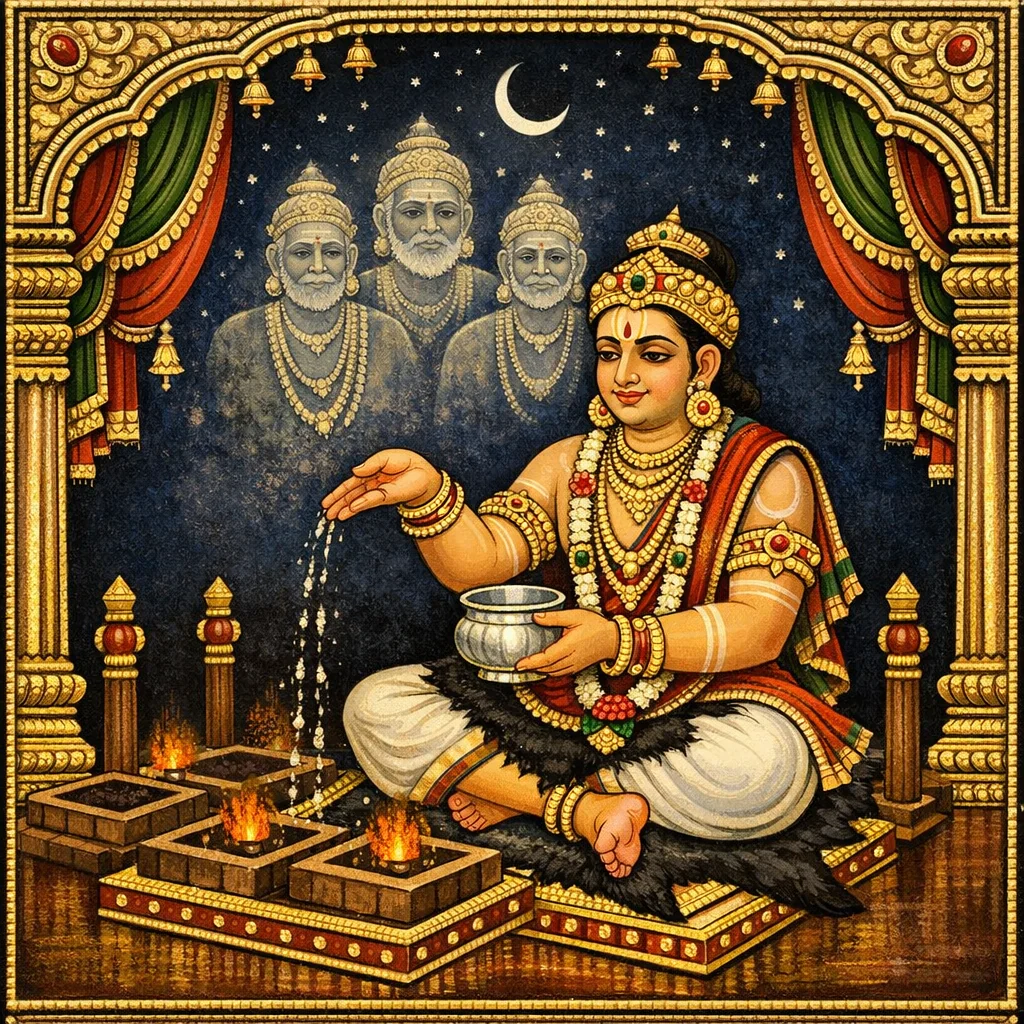
Adhyaya 11
Pitṛ-Śrāddha Vidhi: Rājata-dāna, Kṛṣṇājina, and Vedi/Garta Construction (Ancestral Rite Protocols)
This adhyāya gives a technical exposition of Pitṛ-Śrāddha within a sage-dialogue, with Bṛhaspati speaking in the cited verses. It extols the akṣaya-phala of śrāddha adjuncts—especially silver (rājata) vessels and silver-related dāna—as granting inexhaustible heavenly reward and enabling descendants to “deliver” the Pitṛs. It further lists auspicious purifiers such as gold (kanaka), silver, sesame (tilā), kutupa, and the presence or gifting of kṛṣṇājina (black antelope skin), described as rakṣoghna and as increasing brahma-varchas, cattle, sons, and prosperity. The procedure prescribes placing the vedi/altar to the south-east, forming a proper square measure, and preparing three pits (garta) and three khadira-wood posts with stated measurements and orientation, along with purification by water and pavitra and cleansing with goat/cow milk. The rite is linked to continual tarpaṇa and to sacrificial merit likened to aśvamedha when performed with mantra and discipline, especially at amāvāsyā. Promised results include nourishment, sovereignty and wealth, longevity, growth of lineage, splendor in heaven, and gradual attainment of mokṣa.
Shlokas
Verse 1
इति श्रीब्रह्माण्डे महापुराणे वायुप्रोक्ते मध्यभागे तृतीये उपोद्धातपादे पितृराज्य कल्पो नाम दशमो ऽध्यायः // १०// बृहस्पतिरुवाच राजतं राजताक्तं वा पितॄणां पात्रमुच्यते / राजतस्य कथावापि दर्शनं दान मेव वा
Thus, in the Śrī Brahmāṇḍa Mahāpurāṇa, proclaimed by Vāyu, in the middle section, the third Upoddhāta-pāda, begins the tenth chapter called “Pitṛrājya-kalpa.” Bṛhaspati said: a vessel for the Pitṛs is declared to be of silver, or silver-plated; even hearing of silver, beholding it, or gifting it in charity (is meritorious).
Verse 2
अनन्तमक्षयं स्वर्गे राजते दानमुच्यते / पितॄनेतेन दानेन सत्पुत्रास्तारयन्त्युत
The gift of silver is said to yield in heaven an endless, imperishable reward; by this offering, virtuous sons also deliver their Pitṛs (ancestors).
Verse 3
राजते हि स्वधा दुग्धा पात्रे तैः पृथिवी पुरा / स्वधां वा पार्थिभिस्तात तस्मिन् दत्तं तदक्षयम्
In ancient times upon the earth, they (the Pitṛs) drew forth svadhā into a vessel of silver; dear child, whatever svadhā kings offer into that vessel becomes imperishable (akṣaya).
Verse 4
कृष्णाजिनस्य सांनिध्यं दर्शनं दानमेव च / रक्षोघ्नं ब्रह्म वर्चस्यं पशून्पुत्रांश्च तारयेत्
To keep the black antelope-skin near, to behold it, and to give it in charity—these destroy evil forces, increase brahmanic radiance, and bring deliverance even to cattle and sons.
Verse 5
कनकं राजतं पात्रं दौहित्रं कुतुपस्तिलाः / वस्तूनि पावनीयानि त्रिदण्डीयोग एव वा
Gold, silver, a vessel, a gift to the daughter’s son, the kutupa time, and sesame—these are purifying offerings; or else the discipline of Tridaṇḍī-yoga as well.
Verse 6
श्राद्धकर्मण्ययं श्रेष्ठो विधिर्ब्राह्मः सनातनः / आयुःकीर्तिप्रजैश्वर्यप्रज्ञासंततिवर्द्धनः
In the śrāddha rite, this is the supreme, eternal brahmanic ordinance; it increases longevity, fame, progeny, prosperity, wisdom, and the continuance of one’s lineage.
Verse 7
दिशिदक्षिणपूर्वस्यां वेदिस्थानं निवेदयेत् / सर्वतो ऽरत्निमात्रं च चतुरस्रं सुसंस्थितम्
In the southeast direction one should designate the place for the vedi; let it be a well-set square, one aratni in measure on every side.
Verse 8
वक्ष्यामि विधिवत्स्थानं पितॄणामनुशासितम् / धन्यमायुष्यमारोग्यं बलवर्णविवर्द्धनमा
I shall declare, in due rite, the place enjoined by the Pitṛs; it is auspicious, bestows longevity and health, and increases strength and radiant complexion.
Verse 9
तत्र गर्तास्त्रयः कायार्स्त्रयो दण्डाश्च खादिराः / अरत्निमात्रास्ते कार्या रजतैः प्रविभूषिताः
There, three pits should be made, and three staffs of khadira wood as well. Let those staffs be one aratni in length and richly adorned with silver.
Verse 10
ते वितस्त्यायता गर्त्ताः सर्वतश्चतुरङ्गुलाः / प्राग्दक्षिणमुखान्कुर्यात्स्थिरानशुषिरांस्तथा
Let those pits be one vitasti in length and four fingers in measure on every side. Make them face toward the east–south, firm and without hollowness.
Verse 11
अद्भिः पवित्रयुक्ताभिः पावयेत्सततं शुचिः / पयसा ह्याज गव्येन शोधनं चाद्भिरेव च
With water joined to the pavitra, the pure one should continually sanctify himself. Purification is to be done with goat’s milk and cow’s milk, and also with water alone.
Verse 12
सततं तर्पणं ह्येतत्तृप्तिर्भवति शास्वती / इह वामुत्र य वशी सर्वकामसमन्वितः
This indeed is continual tarpaṇa, and from it arises everlasting satisfaction. One who is thus self-controlled is endowed with every worthy desire, here and hereafter.
Verse 13
एवं त्रिषवणस्नातो योर्ऽचयेत्प्रयतः पितॄन् / मन्त्रेण विधिवत्सम्यगश्वमेधफलं लभेत्
One who, having thus bathed at the three savanas, reverently worships the Pitṛs with the mantra in due rite, attains the fruit of the Aśvamedha sacrifice.
Verse 14
तान्स्थापयेदमावास्यां गर्त्तान्वै चतुरङ्गुलान् / त्रिःसप्तसंस्थास्ते यज्ञास्त्रैलोक्यं धार्यते तु यः
On the Amāvasyā day, let those pits of four finger-breadths be set in place. These are the sacrifices arranged as thrice seven, by which the three worlds are upheld.
Verse 15
तस्य पुष्टिस्तथैश्वर्यमायुः संततिरेव च / दिवि च भ्राजतेलक्ष्म्या मोक्षं च लभते क्रमात्
For him arise nourishment and prosperity, sovereignty, long life, and offspring. In heaven he shines with Lakṣmī’s splendor, and in due course attains liberation.
Verse 16
पाप्मापहं पावनीयं ह्यश्वमेधफलं लभेत् / अश्वमेधफलं ह्येत्तद्द्विजैः संस्कृत्य पूजितम्
He gains the purifying fruit of the Aśvamedha, which removes sin. This very Aśvamedha-fruit is that which the dvijas, after due consecration, have revered in worship.
Verse 17
मन्त्रं वक्ष्याम्यहं तस्मादमृतं ब्रह्मनिर्मितम् / देंवतेभ्यः पितृभ्यश्च महायोगिभ्य एव च
Therefore I shall declare a mantra—nectar-like and fashioned by Brahman—meant for the Devas, for the Pitṛs, and for the great Yogins as well.
Verse 18
नमः स्वाहयै स्वधायै नित्यमेव भवत्युत / आद्धे ऽवसाने श्राद्धस्य त्रिरावृत्तं जपेत्सदा
Ever be reverence to Svāhā and to Svadhā. At the beginning and at the end of the Śrāddha, one should always recite it three times.
Verse 19
पिण्डनिर्वपणे वापि जपेदेतं समाहितः / क्षिप्रमायान्ति पितरो रक्षांसि प्रद्रवन्ति च
Even at the offering of the piṇḍa, one who recites this with a collected mind—swiftly the Pitṛs arrive, and the rākṣasas flee away.
Verse 20
पित्र्यं तु त्रिषु कालेषु मन्त्रो ऽयं तारयत्युत / पठ्यमानः सदा श्राद्धे नियतैर्ब्रह्मवादिभिः
This ancestral mantra, recited at the three times, truly grants deliverance; and in śrāddha rites it is ever chanted by disciplined brahmavādins.
Verse 21
राज्यकामो जपेदेतं सदा मन्त्रमतन्द्रितः / वीर्यशौर्यार्थसत्त्वाशीरायुर्बुद्धिविवर्द्धनम्
One who longs for sovereignty should ever recite this mantra without sloth; it increases vigor, valor, prosperity, sattva, blessings, lifespan, and wisdom.
Verse 22
प्रीयन्ते पितरो येन जपेन नियमेन च / सप्तर्चिषं प्रवक्ष्यामि सर्वकामप्रदं शुभम्
That japa and discipline by which the Pitṛs are pleased—I shall proclaim the auspicious Saptarciṣ, bestower of every desire.
Verse 23
अमूर्त्तीनां समूर्त्तिनां पितॄणां दीप्ततेजसाम् / नमस्यामि सदा तेषां ध्यानिनां योगचक्षुषाम्
I ever bow to the Pitṛs—formless and embodied—radiant with blazing splendor, meditators endowed with the yogic eye.
Verse 24
इन्द्रादीनां च नेतारो दशमारीचयोस्तथा / सप्तर्षीणां पितॄणां च तान्नमस्यामि कामदान्
I bow to the leaders such as Indra, to the ten Maricis, and to the Pitṛs of the Seven Ṛṣis—those who bestow the fulfillment of desires.
Verse 25
मन्वादिनां च नेतारः सूर्याचन्द्रमसोस्तथा / तान्नमस्कृत्य सर्वान्वै पितृमत्सु विधिष्वपि
Having paid homage to the leaders of the Manus and likewise to the leaders of the Sun and the Moon, I bow to them all and also observe the rites pertaining to the Pitṛs.
Verse 26
नक्षत्राणां ग्रहाणां च वाय्वग्न्योश्च पितॄनथ / द्यावापृथिव्योश्च सदा नामस्यामि कृताञ्जलिः
With palms joined, I ever bow to the Pitṛs of the constellations and planets, of Vāyu and Agni, and of Heaven and Earth (Dyāvā–Pṛthivī).
Verse 27
देवर्षीणां च नेतारः सर्वलोकनमस्कृताः / त्रातारः सर्वभूतानां नमस्यामि पितामहान्
I bow to the Pitāmahas—the leaders of the Devarṣis, revered by all worlds, protectors of every being.
Verse 28
प्रजापतेर्गवां वह्नेः सोमाय च यमाय च / योगेश्वरेभ्यश्च सदा नमस्यामि कृताञ्जलिः
With palms joined, I ever bow to Prajāpati, to the sacred cows, to Agni, to Soma, to Yama, and to the Yogēśvaras.
Verse 29
पितृगणेभ्यः सप्तभ्यो नमो लोकेषु सप्तसु / स्वयंभुवे नमश्चैव ब्रह्मणे योगचक्षुषे
Homage to the seven hosts of the Pitṛs in the seven worlds; homage also to Svayambhū, to Brahmā whose sight is yogic.
Verse 30
एतदुक्तं च सप्तार्चिर्ब्रह्मर्षिगणसेवितम् / पवित्रं परमं ह्येतच्छ्रीमद्रोगविनाशनम्
This is proclaimed as the Saptārci, revered by the hosts of brahmarṣis; it is supremely purifying, auspicious, and a destroyer of disease.
Verse 31
एतेन विधिना युक्तस्त्रीन्वरांल्लभते नरः / अन्नमायुः सुताश्चैव ददते पितरो भुवि
One who follows this rite gains three boons: on earth the Pitṛs bestow food, longevity, and sons.
Verse 32
भक्त्या परमया युक्तः श्रद्धधानो जितेन्द्रियः / सप्तार्चि षं जपेद्यस्तु नित्यमेव समाहितः
Whoever, endowed with supreme devotion, faith, and mastery of the senses, daily recites the Saptārci with collected mind,
Verse 33
सप्तद्वीपसमुद्रायां पृथिव्यामेकराड् भवेत् / यत्किञ्चित्पच्यते गेहे भक्ष्यं वा भोज्यमेव वा
On the earth of seven continents and seas, he becomes a sole sovereign; whatever is cooked in his house, be it snack or meal,
Verse 34
अनिवेद्य न भोक्तव्यं तस्मिन्नयतने सदा / क्रमशः कीर्तयिष्यामि बलिपात्राण्यतः परम्
In that unfit place one should never eat without first offering; henceforth I shall recount, in order, the vessels for the bali-offering.
Verse 35
येषु यच्च फलं प्रोक्तं तन्मे निगदतः श्रुणु / पलाशे ब्रह्मवर्चस्त्वमश्वत्थे वसुभावना
Hear from me the fruits declared for each: in the palāśa is brahmanic radiance, and in the aśvattha is the fostering of wealth.
Verse 36
सर्वभूताधिपत्यं च प्लक्षे नित्यभुदात्दृतम् / पुष्टिः प्रजाश्च न्यग्रोधे बुद्धिः प्रज्ञा धृतिः स्मृतिः
In the plakṣa is ever declared lordship over all beings; in the nyagrodha are nourishment and progeny, and also intellect, wisdom, steadfastness, and sacred memory.
Verse 37
रशोध्नं च यशस्यं च काश्मरीपात्रमुच्यते / सौभाग्यमुत्तमं लोके माधूके समुदात्दृतम्
The kāśmarī vessel is said to quell disease and bestow renown; in the mādhūka is declared the highest good fortune in the world.
Verse 38
फलगुपात्रेषु कुर्वाणः सर्वान्कामानवाप्नुयात् / परां द्युतिमथार्केतु प्राकाश्यं च विशेषतः
One who performs the rite in phalagu vessels attains all desires; and in the arka is gained the highest radiance, a brilliance most especially manifest.
Verse 39
बैल्वे लक्ष्मीन्तथा मेधां नित्यमायुस्तथैव च / क्षेत्रारामतडागेषु सर्वसस्येषु चैव ह
Near the bilva tree, Lakṣmī, sacred intelligence, and unbroken longevity ever increase; in fields, gardens, ponds, and in all crops as well, auspiciousness abides.
Verse 40
वर्षत्य जस्रं पर्जन्यो वेणुपात्रेषु कुर्वतः / एतेष्वेव सुपात्रेषु भोजनाग्रमशेषतः
For one who prepares the food-offering in bamboo vessels, Parjanya pours rain unceasingly; in these very worthy vessels, the first portion of the meal should be offered in full.
Verse 41
सदा दद्यात्स यज्ञानां सर्वेषां फलमाप्नुयात् / पितृभ्यः पुष्पमाल्यानि सुगन्धानि च तत्परः
One who gives continually attains the fruit of all sacrifices; devoted to the Pitṛs, he offers them garlands of flowers and fragrant gifts.
Verse 42
सदा दद्यात्क्रियायुक्तः श विभाति दिवाकरः / गुग्गुलादींस्तथा धूपान्पितृभ्यो यः प्रयच्छति
One who gives always, joined with proper rite, shines like the sun; he is the one who offers the Pitṛs incense—guggulu and other sacred fumes.
Verse 43
संयुक्तान्मधुसर्पिर्भ्यं सो ऽग्निष्टोमफलं लभेत् / धूपं गन्धगुणोपेतं कृत्वा पितृपरायणः
He who offers honey joined with ghee gains the fruit of the Agniṣṭoma; preparing incense rich in fragrance, he remains wholly devoted to the Pitṛs.
Verse 44
लभते च सुशर्माणि इह चामुत्र चोभयोः / दद्यादेवं पितृभ्यास्तु नित्यमेव ह्यतन्द्रितः
He who, without sloth, ever gives in this manner to the Pitṛs attains благополучие in both worlds—here and hereafter.
Verse 45
दीपं पितृभ्यः प्रयतः सदा यस्तु प्रयच्छति / गतिं चाप्रतिमं चक्षुस्तस्मात्सलभते शुभम्
Whoever, in purity, ever offers a lamp to the Pitṛs gains an incomparable state and divine sight; therefore he attains auspicious good.
Verse 46
तेजसा यशसा चैव कान्त्या चापि बलेन च / भुवि प्रकाशो भवति ब्राजते च त्रिविष्टपे
With radiance, fame, splendor, and strength, he becomes a light upon the earth and shines forth in Triviṣṭapa (heaven) as well.
Verse 47
अप्सरोभिः परिवृतो विमानाग्रे च मोदते / गन्धपुष्पैश्च धूपैश्व जपाहुतिभिरेव च
Surrounded by Apsarases, he rejoices at the fore of the vimāna; and he is delighted by fragrances, flowers, incense, and by japa and offerings of āhuti.
Verse 48
फलमूलनमस्कारैः पितॄणां प्रयतः शुचिः / पूजां कृत्वा द्विजान्पश्चात्पूजयेदन्नसंपदा
Pure and self-restrained, one should worship the Pitṛs with fruits, roots, and reverent salutations; then, having honored the dvijas, one should serve them with abundance of food.
Verse 49
श्राद्धकालेषु नियतं वायुभूताः पितामहाः / आविशन्ति द्विजाञ्छ्रेष्ठांस्तस्मादेतद्ब्रवीमि ते
At the time of śrāddha, the grandfathers (pitāmahas), become as the wind, surely enter the most excellent of the twice-born; therefore I tell you this.
Verse 50
वस्त्रै रत्नप्रदानैश्च भक्ष्यैः पेयैस्तथैव च / गोभिरश्वैस्तथा ग्रामैः पूजयेद्द्विजसत्तमान्
With garments, gifts of jewels, foods and drinks, and also with cows, horses, and even villages, one should honor the most excellent of the twice-born.
Verse 51
भवन्ति पितरः प्रीताः पूजितेषु द्विजातिषु / तस्माद्यत्नेन विधिवत्पूजयेत द्विजान्सदा
When the twice-born are worshiped, the Fathers (pitṛs) are pleased; therefore, with care and according to rite, one should always honor the twice-born.
Verse 52
सव्योत्तराभ्यां पाणिभ्यां कुर्यादुल्लेखनं द्विजाः / प्रोक्षणं च ततः कुर्याच्छ्राद्धकर्मण्यतन्द्रितः
With both hands, left and right, the dvija should perform the rite of ullekhana; then, diligent in the śrāddha act, he should also perform the prokṣaṇa (sprinkling).
Verse 53
दर्भान्पिण्डांस्तथा भक्ष्यान्पुष्पाणि विविधानि च / गन्धदानमलङ्कारमेकैकं निर्वपेद् बुधः
Darbha grass, piṇḍas, foods, many kinds of flowers, offerings of fragrance, and ornaments—the wise should place each, one by one, as an offering.
Verse 54
पेषयित्वाञ्जनं सम्यग्विश्वेषामुत्तरोत्तरम् / अभ्यङ्गं दर्भविञ्जूलैस्त्रिभिः कुर्याद्यथाविधि
Having well ground the añjana (sacred collyrium), one should, in due order, perform the rites for the Viśvedevas according to rule. Then, with three bundles of darbha grass, one should do the prescribed anointing (abhyaṅga).
Verse 55
अपसव्यं वितृभयश्च दद्यादञ्जनमुत्तमम् / निपात्य जानु सर्वेषां वस्त्रार्थं सूत्रमेव वा
In the apasavya manner, and with the act that dispels fear, one should give the finest añjana. Then, kneeling before all, one should offer thread for a garment—or even a single thread alone.
Verse 56
खण्डनं प्रोक्षणं चैव तथैवोल्लेखनं द्विजः / सकृद्देवपितॄणां स्यात्पितॄणां त्रिभिरुच्यते
A dvija should perform the khaṇḍana, the prokṣaṇa, and likewise the ullekhaṇa. For the deva-pitṛs it is done once; for the pitṛs it is prescribed as three times.
Verse 57
एकं पवित्रं हस्तेन पितॄनसर्वान्सकृत्सकृत् / चैलमन्त्रेण पिण्डेभ्यो दत्त्वादर्शाञ्जिने हि तम्
Wearing a single pavitra (kuśa ring) on the hand, one should touch all the pitṛs again and again. Then, with the caila-mantra, having offered it to the piṇḍas, one should place it in the darśāñjali.
Verse 58
सदा सर्पिस्तिलैर्युक्तांस्त्रीन्पिण्डान्निर्वपेद्भुवि / जानु कृत्वा तथा सव्यं भूमौ पितृपरायणः
Devoted to the pitṛs, one should always place upon the ground three piṇḍas mixed with ghee and sesame. Then, kneeling and in the savya manner, one should perform the rite upon the earth.
Verse 59
पितॄन्पितामहांश्चैव तथैव प्रपितामहान् / आहूय च पितॄन्प्राञ्चः पितृतीर्थेन यत्नतः
Facing east, one should carefully invoke the Pitṛs—father, grandfather, and great-grandfather—by means of the pitṛtīrtha.
Verse 60
पिण्डान्परिक्षिपेत्सम्यगपसव्यमतन्द्रितः / अन्नाद्यैरेव मुख्यैश्चभक्ष्यैश्चैव पृथग्विधैः
Without negligence, one should properly arrange the piṇḍas in the apasavya manner, offering staple foods and various kinds of edibles separately.
Verse 61
पृथङ्मातामहानां तु केचिदिच्छन्ति मानवाः / त्रीन्पिण्डानानुपूर्व्येण सांगुष्ठान्पुष्टिवर्द्धनान्
Some people desire separate piṇḍas for the maternal ancestors; in due order they offer three piṇḍas, thumb-sized, that increase nourishment and well-being.
Verse 62
जान्वन्तराभ्यां यत्नेन पिण्डान्दद्याद्यथाक्रमम् / सव्योत्तराभ्यां पाणिभ्यां धारार्थं मन्त्रमुच्चरन्
With care, one should give the piṇḍas in due order between the knees, supporting them with both hands in the savyottara manner while reciting the mantra.
Verse 63
नमो वः पितरः शोषायेति सर्वमतन्द्रितः / दक्षिणस्यां तु पाणिभ्यां प्रथमं पिण्डमुत्सृजेत्
Without negligence, reciting “Namo vaḥ pitaraḥ śoṣāya,” one should offer the first piṇḍa with the right hand.
Verse 64
नमो वः पितरः सौम्यः पठन्नेवमतन्द्रितः / सव्योत्तराभ्यां पाणिभ्यां धर्मेर्ऽधं समतन्द्रितः
Homage to you, O Pitṛs. Let the gentle one recite thus without negligence; with the left hand and with both hands raised, let him offer the arghya in the rite of dharma.
Verse 65
उलूखलस्य लेखायामुदपात्रावसेचनम् / क्षौमं सूत्रं नवं दद्याच्छाणं कार्पासकं तथा
Upon the marked line of the ulūkhal, sprinkle water from the vessel. Then give new kṣauma thread, and likewise thread of flax (śaṇa) and of cotton (kārpāsa).
Verse 66
पत्रोर्णं पट्टसूत्रं च कौशेयं परिवर्जयेत् / वर्जयेद्यक्षणं यज्ञे यद्यप्यहतवस्त्रजाम्
Let him avoid patrorṇa, paṭṭa thread, and kauśeya (silk). In the yajña he should refrain from them, even if they are new and unwashed cloth.
Verse 67
न प्रीणन्ति तथैतानि दातु श्चाप्यहितं भवेत् / श्रेष्ठमाहुस्त्रिककुदमञ्जनं नित्यमेव च
Such things do not please in that manner, and may even be harmful to the giver. The best, it is said, is trikakuda anjana, and that offered always.
Verse 68
कृष्णेभ्यश्च तेलैस्तैलं यत्नात्सुपरिरक्षितम् / चन्दनागुरुणी चोभे तमालोशीरपद्मकम्
For the Kṛṣṇas (the dark-hued deities/ancestors), among oils offer that oil which has been carefully well preserved. Offer also sandalwood and aguru, both, and tamāla, uśīra, and padmaka.
Verse 69
धूपश्च गुग्गलः श्रेष्टस्तुरुष्कः श्वेत एव च / शुक्लाः सुमनसः श्रेष्ठास्तथा पद्मोत्पलानि च
Among incenses, guggulu is the finest, and so too is the white turuṣka. White sumanā blossoms are best, and likewise the padma and utpala lotuses.
Verse 70
गन्धरूपोपपन्नानि चारण्यानि च कृत्स्नशः / तथा हि सुमना नाडीरूपिकास्मकुरण्डिका
So too are all forest flowers endowed with fragrance and beauty—of every kind; likewise sumanā, nāḍī-rūpikā, and asmakuraṇḍikā.
Verse 71
पुष्पाणि वर्जनीयानि श्राद्धकर्मणि नित्यशः / यथा गन्धादपेतानि चोग्रगन्धानि यानि च
In the śrāddha rite, certain flowers should always be avoided—those devoid of fragrance, and those whose scent is excessively pungent.
Verse 72
वर्जनीयानि पुष्पाणि पुष्टिमन्विच्चता सदा / द्विजातयो यथोद्दिष्टा नियताः स्युरुदङ्मुखाः
One who seeks well-being (puṣṭi) should always avoid the flowers that are to be shunned. And the twice-born, as prescribed, should sit in due order facing north.
Verse 73
पूजयेद्यजमानस्तु विधिवद्यक्षिणामुखः / तेषामभिमुखो दद्याद्दर्भत्पिण्डांश्च यत्नतः
The yajamāna should worship according to rule, facing south. And facing them, he should carefully offer the piṇḍa-balls together with darbha grass.
Verse 74
अनेन विधिना साक्षादर्चिताः स्युः पितामहाः / हरिता वै स पिञ्जालाः पुष्टाः स्निग्धाः समाहिताः
By this rite the Pitāmahas (forefathers) are, as it were, worshiped in person. They become greenish-golden in hue, well-nourished, gentle, and steady in collected mind.
Verse 75
रत्निमात्राः प्रमाणेन वितृतीर्थेन संस्मृताः / उपमूले तथा नीला विष्टरार्थं कुशोत्तमाः
By the measure of a ratni (a hand’s breadth) it is remembered as the Vitṛtīrtha. Near the root it should be bluish; for spreading out, the finest kuśa grass is to be used.
Verse 76
तथा श्यामाकनीवारा दूर्वा च समुदाहृता / पूर्वं कीर्त्तिमतां श्रेष्ठो बभूवाश्वः प्रजापतिः
So too are śyāmāka, nīvāra, and dūrvā grass spoken of. In ancient times, among the renowned, the Prajāpati named Aśva was the foremost.
Verse 77
तस्य बाला निपतिता भूमौ काशत्वामागताः / तस्माद्देयाः सदा काशाः श्राद्धकर्मसु पूजिताः
His hairs fell upon the earth and became kāśa grass. Therefore, in śrāddha rites, the revered kāśa should always be offered.
Verse 78
पिण्डनिर्वपणं तेषु कर्त्तव्यं भूतिमिच्छता / प्रजाः पुष्टिद्युतिप्रज्ञाकीर्त्तिकान्तिसमन्विताः
He who seeks bhūti (well-being) should perform piṇḍa-nirvapaṇa there—the offering of sacred piṇḍas. Then the people are endowed with nourishment, radiance, wisdom, fame, and beauty.
Verse 79
भवन्ति रुचिरा नित्यं विपाप्मानो ऽघवर्जिताः / सकृदेवास्तरेद्यर्भान्पिण्डार्थे दक्षिणामुखः
They become ever radiant, free from sin and untouched by evil. For the piṇḍa offering, facing south, let him spread the kuśa once.
Verse 80
प्राग्दक्षिणाग्रान्नियतो विधि चाप्यत्र वक्ष्यति / न दीनो नापि वा क्रुद्धो न चैवान्यमना नरः / एकत्र चाधाय मनः श्राद्धं कुर्यात्समाहितः
This is the rite: let the tips of the kuśa be set toward the east and the south. Let a man be neither dejected nor angry nor distracted; with mind gathered to one point, let him perform the śrāddha.
Verse 81
निहन्मि सर्वं यदमेध्यवद्भवेद्धतश्च सर्वे सुरदानवा मया / रक्षांसि यक्षाः सपिशाचसंघा हता मया यातुधानाश्च सर्वे
All that is like impurity I destroy; by me the dānava, foes of the Devas, have been slain. Rākṣasas, yakṣas, hosts of piśācas, and all yātudhānas have been struck down by me.
Verse 82
एतेन मन्त्रेण तु संयतात्मा तां वै वेदिं सकृदुल्लिख्य धीरः / शिवां हि बुद्धिं ध्रुवमिच्छमानः क्षिपेद्द्विचातिर्दिशमुत्तरां गतः
With this mantra, the self-restrained and steadfast one, having once marked out the vedi, desiring a surely auspicious and steady mind, should go toward the north and sprinkle twice.
Verse 83
एवं पित्र्यं दृष्टमन्त्रं हि यस्यतस्यासुरा वर्जयन्तीह सर्वे / यस्मिन्देशे पठ्यते मन्त्र एष तं वै देशं राक्षसा वर्जयन्ति
Whoever possesses this proven pitṛya mantra, all asuras here avoid him. And the land where this mantra is recited—that land the rākṣasas too forsake.
Verse 84
अन्नप्रकारानशुचीनसाधून्संवीक्षते नो स्पृशंश्वापि दद्यात् / पवित्रपाणिश्च भवेन्न वा हि यः पुमान्न कार्यस्य फलं समश्नुते
Let him neither look upon nor touch impure and unworthy kinds of food, nor give them even to a dog. Let his hands be pure; otherwise a man does not partake of the fruit of his rite.
Verse 85
अनेन विधिना नित्यं श्राद्धं कुर्याद्धि यः सदा / मनसा काङ्क्षते यद्यत्तत्तद्यद्युः पितमहाः
Whoever, following this rule, performs śrāddha daily and without fail—whatever he longs for in his heart, the Pitāmahas bestow that upon him.
Verse 86
पितरो हृष्टमनसो रक्षांसि विमनांसि च / भवन्त्येवं कृते श्राद्धे नित्यमेव प्रयत्नतः
When śrāddha is performed thus, daily and with earnest effort, the Pitṛs rejoice in heart, and the rākṣasas grow dispirited.
Verse 87
शूद्राः श्राद्धेष्वविक्षीरं बल्वजा उपलास्तथा / विरणाश्चोतुवालाश्च लड्वा वर्ज्याश्च नित्यशः
In śrāddha rites one should always avoid: a śūdra, unstrained milk, balvajā, upalā, viraṇa, otuvālā, and laddu.
Verse 88
एवमादीन्ययज्ञानि तृणानि परिवर्जयेत् / अञ्जनाभ्यजनं गन्धान्सूत्रप्रणयनं तथा
Thus one should shun grasses and the like that are unfit for yajña; and (at that time) refrain from anjana, oil-unction, fragrances, and the donning of the yajñopavīta (sacred thread).
Verse 89
काशेः पुनर्भवैः कार्यमश्वमेधफलं लभेत् / काशाः पुनर्भवा ये च बर्हिणो ह्युपबर्हिणः
By being reborn in Kāśī, one attains the fruit of the Aśvamedha sacrifice. Those who are reborn in Kāśī are called barhiṇa and upabarhiṇa.
Verse 90
इत्येते पितरो देवा देवाश्च पितरः पुनः / पुष्पगन्धविभूषाणामेष मन्त्र उदाहृतः
Thus the Pitṛs are the Devas, and the Devas again are the Pitṛs. This is the mantra declared for offering flowers, fragrance, and adornments.
Verse 91
आहृत्य दक्षिणाग्निं तु होमार्थं वै प्रयत्नतः / अन्यार्थे लौकिकं वापि जुहुयात्कर्मसिद्धये
For the homa, one should diligently bring forth the Dakṣiṇāgni. For other purposes too, for the accomplishment of the rite, one may offer oblations into an ordinary (laukika) fire.
Verse 92
अन्तर्विधाय समिधस्ततो दीप्तो विधीयते / समाहितेन मनसा प्रणीयाग्निं समन्ततः
Having placed the kindling (samidh) within, the fire is then kindled to blaze. With a composed mind, one should conduct the fire ritually all around.
Verse 93
अग्नये कव्यवाहाय स्वधा अङ्गिरसे नमः / सोमाय वै पितृमते स्वधा अङ्गिरसे पुनः
Homage to Agni, the kavyavāha who bears offerings to the ancestors, with the utterance svadhā—salutation to Aṅgirasa. Homage to Soma, aligned with the Pitṛs, with svadhā—again, salutation to Aṅgirasa.
Verse 94
यमाय वैवस्वतये स्वधानम इति ध्रुवम् / इत्येते होममन्त्रास्तु त्रयाणामनुपूर्वशः
For Yama, the Vaivasvata, one surely says: “svadhānam.” These are the Homa mantras for the three, in due sequence.
Verse 95
दक्षिणेनाग्नये नित्यं सोमायोत्तरतस्तथा / एतयोरन्तरे नित्यं जुहुयाद्वै विवस्वते
To the south, offer always to Agni; to the north, likewise to Soma; and between these two, one should daily pour the oblation for Vivasvat.
Verse 96
उपहारः स्वधाकारस्तथैवोल्लेखनं च यत् / होमजप्ये नमस्कारः प्रोक्षणं च विशेषतः
There are the offering (upahāra), the utterance of “svadhā,” and the prescribed marking and mention; in Homa and in japa there is reverent salutation (namaskāra), and especially the sprinkling rite (prokṣaṇa).
Verse 97
बहुहव्येन्धने चाग्नौ सुसमिद्धे तथैव च / अञ्जनाब्यञ्जनं चैव पिण्डनिर्वपणं तथा
In the well-kindled fire, with many offerings and much fuel, one should also perform the rites of anointing and unction (añjana-abhyañjana), and the placing of the pinda offerings (piṇḍa-nirvapaṇa).
Verse 98
अश्वमेधफलं चैतत्समिद्धे यत्कृतं द्विजैः / क्रिया सर्वा यथोद्दिष्टाः प्रयत्नेन समाचरेत्
This rite, performed by the twice-born in the well-kindled fire, bestows the fruit of the Aśvamedha; therefore, all actions as prescribed should be carried out with diligent effort.
Verse 99
बहुहव्येन्धने चाग्नौ सुसमिद्धे विशेषतः / विधूमे लेलिहाने च होतव्यं कर्मसिद्धये
For the rite to succeed, one should offer into a fire well fed with many sacrificial fuels—especially when it is brightly kindled, smokeless, and its flames lick upward.
Verse 100
अप्रबुद्धे समिद्धे वा जुहुयाद्यो हुताशने / यजमानो भवे दन्धः सो ऽमुत्रेति हि नः श्रुतम्
Whoever pours oblations into the Hutāśana when it is not fully awakened, or only smoldering, the sacrificer becomes wretched and dull; and we have heard that he perishes in the world beyond.
Verse 101
अल्पेन्धनो वा रूक्षो ऽग्निर्वस्फुलिङ्गश्च सर्वशः / ज्वालाधूमापसव्यश्च स तु वह्निरसिद्धये
A fire with scant fuel, harsh and dry, throwing sparks on every side, with flame and smoke turning to the left—such a fire is for non-attainment, not success.
Verse 102
दुर्गन्धश्चैव नीलश्च कृष्णश्चैव विशेषतः / भूमिं वगाहते यत्र तत्र विद्यात्पराभवत्
If the fire is foul-smelling, blue, or especially black, and where it seems to sink into the earth—know that there is defeat there, an inauspicious sign.
Verse 103
अर्चिष्मान् पिण्डितशिखः सर्प्पिकाञ्जनसन्निभः / स्निग्धः प्रदक्षिणश्चैव वह्निः स्यात्कार्यसिद्धये
A fire that is radiant, with a compact crest of flame, shining like anjana mixed with ghee, smooth and moving in the rightward (pradakṣiṇa) course—such a fire brings success to the undertaking.
Verse 104
नरनारीगणेभ्यश्च पूजां प्राप्नोति शाश्वतीम् / अक्षयं पूजितास्तेन भवन्ति पितरो ऽग्नयः
He attains everlasting worship from the assembly of men and women; the Pitṛs (ancestors) and Lord Agni, honored by him, become bestowers of imperishable fruit.
Verse 105
बिल्वोदुंबरपत्राणि फलानि समिधस्तथा / श्राद्धे महापवित्राणि मेध्यानि च विशेषतः
Bilva and udumbara leaves, fruits, and also the sacred kindling-sticks (samidh)—in the śrāddha rite are deemed greatly holy and especially purifying.
Verse 106
पवित्रं च द्विजश्रेष्ठाः शुद्धये जन्मकर्मणाम् / पात्रेषु फलमुद्दिष्टं यन्मया श्राद्धकर्मणि
O best of the twice-born! For the purification of birth and deeds, in the śrāddha rite I have prescribed the sacred pavitra and the fruits to be placed in the vessels.
Verse 107
तदेव कृत्स्नं विज्ञेयं समित्सु च यथाक्रमम् / कृत्वा समाहितं चित्तमाग्नेयं वै करोम्यहम्
That same teaching should be understood in full, also regarding the samidh, in due order; having steadied the mind, I indeed perform the agneya rite pertaining to Agni.
Verse 108
अनुज्ञातः कुरुष्वेति तथैव द्विजसत्तमैः / घृतमादाय पात्रे च जुहुयाद्धव्यवाहने
When the foremost dvijas grant permission, saying “Do it,” one should take ghee in a vessel and offer the oblation into Havyavāhana—the sacred Fire that bears the offerings.
Verse 109
पलाशप्लक्षन्यग्रोधप्लक्षाश्वत्थविकङ्कताः / उदुंबरस्तथाबिल्वश्चन्दनो यज्ञियाश्च ये
Palāśa, plakṣa, nyagrodha (banyan), plakṣa, aśvattha, vikaṅkata, uduṃbara, bilva, sandalwood, and all trees deemed fit for yajña.
Verse 110
सरलो देवदारुश्च शालश्च कदिरस्तथा / समिदर्थे प्रशस्ताः स्युरेते वृक्षा विशेषतः
Sarala, devadāru, śāla, and khadira—these trees are especially praised as samidh, sacred fuel for the rite.
Verse 111
ग्राम्याः कण्टकिनश्चैव याज्ञिया ये च केचन / पूजिताः समिदर्थं ते पितॄणां वचनं यथा
Whether common village trees, thorny ones, or any that are yajñic—when revered as samidh, they are honored in accord with the word of the Pitṛs.
Verse 112
समिद्भिः षट्फलेयाभिर्जुहुयाद्यो हुताशनम् / फलं यत्कर्मणस्तस्य तन्मे निगदतः शृणु
Whoever offers oblations into Hutāśana with ṣaṭphaleyā samidh—hear from me the fruit that arises from that rite.
Verse 113
अक्षयं सर्वकामीयमश्वमेधफलं हि तत् / श्लेष्मान्तको नक्तमालः कपित्थः शाल्मलिस्तथा
That reward is imperishable and grants all desires; truly it equals the fruit of the Aśvamedha. (Samidh trees include) śleṣmāntaka, naktamāla, kapittha, and śālmali as well.
Verse 114
नीपो विभीतकश्चैव श्राद्धकर्मणि गर्हिताः / चिरबिल्वस्तथा कोलस्तिदुकः श्राद्धकर्मणि
In the śrāddha rite, the nīpa and vibhītaka trees are deemed blameworthy; likewise cirabilva, kola, and tiduka are also forbidden for śrāddha.
Verse 115
बल्वजः कोविदारश्च वर्जनीयाः समन्ततः / शकुनानां निवासांश्च वर्जयेत महीरुहान्
Balvaja and kovidāra are to be avoided on all sides; and one should also shun great trees that are the dwelling places of birds.
Verse 116
अन्यांश्चैवंविधान्सर्वान्नयज्ञीयांश्च वर्जयेत् / स्वधेति चैव मन्त्राणां पितॄणां वचनं यथा / स्वाहेति चैव देवानां यज्ञकर्मण्युदाहृतम्
In this way, all other things of such kind, unfit for yajña, should be avoided. In the mantras for the Pitṛs the utterance is ‘svadhā’, while in sacrificial acts for the Devas it is declared as ‘svāhā’.
Frequently Asked Questions
A prescriptive Pitṛ-Śrāddha/Tarpaṇa protocol: the chapter praises rājata (silver) vessels and dāna, lists sanctifying adjuncts (tilā, kutupa, kṛṣṇājina), and gives spatial/measurement rules for vedi and three gartas, alongside purification steps.
Rājata (silver)—as vessel, sight, or gift—is explicitly described as producing anantam-akṣayam merit; the discourse also elevates kṛṣṇājina proximity/darśana/dāna and other pāvanīya items (e.g., tilā, kanaka) as highly efficacious for śrāddha.
Neither as a primary catalog: it is predominantly ritual-technical (śrāddha-vidhi). Its link to vaṃśa is functional—ancestral satisfaction is presented as enabling progeny/lineage increase and prosperity rather than listing dynasties.