Adhyaya 6
Parīkṣit’s Final Absorption, Takṣaka’s Bite, Janamejaya’s Snake Sacrifice, and the Vedic Sound-Lineage
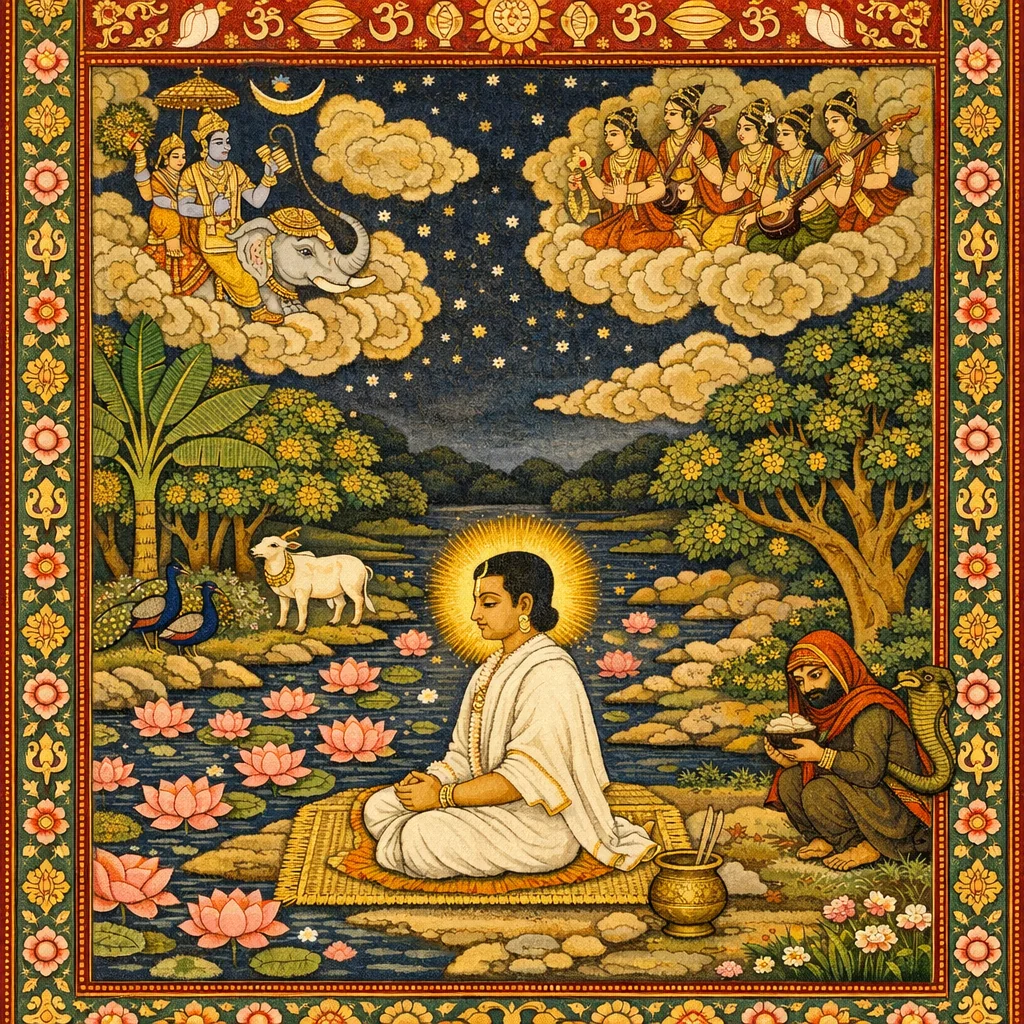
After Śukadeva Gosvāmī finishes his narration, Mahārāja Parīkṣit offers final gratitude, declares fearlessness of Takṣaka and even repeated death through absorption in Hari, and asks leave to withdraw speech and senses into Lord Adhokṣaja. Śukadeva grants permission and departs; Parīkṣit sits in yogic steadiness on the Gaṅgā’s bank facing north, fixing his mind on the Absolute Truth until prāṇa becomes still. Takṣaka, having bribed Kaśyapa away from countering him, approaches in disguise and bites; Parīkṣit’s body burns to ashes as celestial beings lament and praise. The aftermath follows: Janamejaya’s wrathful sarpa-satra (snake sacrifice), Takṣaka’s flight to Indra, and Bṛhaspati’s intervention teaching karma-siddhānta—that life and death come to each by his own deeds—leading the king to stop the rite. The chapter then turns to śabda-brahman: the subtle transcendental sound, the rise of oṁkāra with its A-U-M triad, Brahmā’s generation of the Vedas, Vyāsa’s fourfold division, and the branching disciplic lineages (including Yājñavalkya receiving new Yajur mantras from Sūrya), bridging Parīkṣit’s era to Vedic preservation in Kali-yuga.
Shlokas
Verse 1
सूत उवाच एतन्निशम्य मुनिनाभिहितं परीक्षिद् व्यासात्मजेन निखिलात्मदृशा समेन । तत्पादमूलमुपसृत्य नतेन मूर्ध्ना बद्धाञ्जलिस्तमिदमाह स विष्णुरात: ॥ १ ॥
Sūta said: Having heard all that was spoken by Śukadeva, Vyāsa’s son—the self-realized sage, equal in vision—Parīkṣit humbly approached the root of his lotus feet. Bowing his head at the muni’s feet and folding his hands, the king protected by Viṣṇu spoke as follows.
Verse 2
राजोवाच सिद्धोऽस्म्यनुगृहीतोऽस्मि भवता करुणात्मना । श्रावितो यच्च मे साक्षादनादिनिधनो हरि: ॥ २ ॥
The King said: O compassionate great soul, by your mercy I have attained fulfillment. You have personally spoken to me this narration of Lord Hari, who is without beginning and without end.
Verse 3
नात्यद्भुतमहं मन्ये महतामच्युतात्मनाम् । अज्ञेषु तापतप्तेषु भूतेषु यदनुग्रह: ॥ ३ ॥
I do not find it at all astonishing that great souls like you, whose minds are ever absorbed in Acyuta, show mercy to ignorant beings like us, scorched by the miseries of material life.
Verse 4
पुराणसंहितामेतामश्रौष्म भवतो वयम् । यस्यां खलूत्तम:श्लोको भगवाननुवर्ण्यते ॥ ४ ॥
My lord, we have heard from you this Śrīmad-Bhāgavatam, the perfect compendium of all the Purāṇas, wherein the Supreme Lord, Uttamaḥśloka, is fully described.
Verse 5
भगवंस्तक्षकादिभ्यो मृत्युभ्यो न बिभेम्यहम् । प्रविष्टो ब्रह्म निर्वाणमभयं दर्शितं त्वया ॥ ५ ॥
My lord Bhagavān, I no longer fear Takṣaka or any other being, nor even repeated deaths, for I have entered the fearless Brahman-nirvāṇa you have revealed.
Verse 6
अनुजानीहि मां ब्रह्मन् वाचं यच्छाम्यधोक्षजे । मुक्तकामाशयं चेत: प्रवेश्य विसृजाम्यसून् ॥ ६ ॥
O brāhmaṇa, please grant me leave to offer my speech and the functions of all my senses unto Lord Adhokṣaja. Let my mind, freed from desire, enter into Him, and thus may I give up my life.
Verse 7
अज्ञानं च निरस्तं मे ज्ञानविज्ञाननिष्ठया । भवता दर्शितं क्षेमं परं भगवत: पदम् ॥ ७ ॥
You have revealed to me what is most auspicious—the supreme personal abode of the Lord. Now I am fixed in knowledge and realized understanding, and my ignorance has been dispelled.
Verse 8
सूत उवाच इत्युक्तस्तमनुज्ञाप्य भगवान् बादरायणि: । जगाम भिक्षुभि: साकं नरदेवेन पूजित: ॥ ८ ॥
Sūta Gosvāmī said: Thus requested, Bhagavān Bādarāyaṇi (Śukadeva) granted permission to King Parīkṣit. Then, worshiped by the King and the sages present, he departed that place with the mendicants.
Verse 9
परीक्षिदपि राजर्षिरात्मन्यात्मानमात्मना । समाधाय परं दध्यावस्पन्दासुर्यथा तरु: ॥ ९ ॥ प्राक्कूले बर्हिष्यासीनो गङ्गाकूल उदङ्मुख: । ब्रह्मभूतो महायोगी नि:सङ्गश्छिन्नसंशय: ॥ १० ॥
Then Mahārāja Parīkṣit, by pure intelligence, settled his mind within the spiritual self and meditated upon the Supreme Absolute Truth; the movement of his life air ceased, and he became motionless like a tree.
Verse 10
परीक्षिदपि राजर्षिरात्मन्यात्मानमात्मना । समाधाय परं दध्यावस्पन्दासुर्यथा तरु: ॥ ९ ॥ प्राक्कूले बर्हिष्यासीनो गङ्गाकूल उदङ्मुख: । ब्रह्मभूतो महायोगी नि:सङ्गश्छिन्नसंशय: ॥ १० ॥
Mahārāja Parīkṣit sat on the bank of the Gaṅgā upon a darbha-grass seat with its tips facing east and turned toward the north; perfected in yoga, he attained Brahman realization, free from attachment and doubt.
Verse 11
तक्षक: प्रहितो विप्रा: क्रुद्धेन द्विजसूनुना । हन्तुकामो नृपं गच्छन् ददर्श पथि कश्यपम् ॥ ११ ॥
O learned brāhmaṇas, Takṣaka, the snake-bird sent by the angry son of a brāhmaṇa, was going to kill the King when he saw Kaśyapa Muni on the road.
Verse 12
तं तर्पयित्वा द्रविणैर्निवर्त्य विषहारिणम् । द्विजरूपप्रतिच्छन्न: कामरूपोऽदशन्नृपम् ॥ १२ ॥
Takṣaka satisfied Kaśyapa with valuable gifts and turned back the sage who could counteract poison; then, able to assume any form, he disguised himself as a brāhmaṇa, approached the King, and bit him.
Verse 13
ब्रह्मभूतस्य राजर्षेर्देहोऽहिगरलाग्निना । बभूव भस्मसात् सद्य: पश्यतां सर्वदेहिनाम् ॥ १३ ॥
As all beings looked on, the body of that king-sage, established in Brahman realization, was at once burned to ashes by the fire of the serpent’s poison.
Verse 14
हाहाकारो महानासीद् भुवि खे दिक्षु सर्वत: । विस्मिता ह्यभवन् सर्वे देवासुरनरादय: ॥ १४ ॥
On earth, in the sky, and in every direction there arose a mighty cry of lamentation, and all—demigods, demons, humans, and other beings—were struck with astonishment.
Verse 15
देवदुन्दुभयो नेदुर्गन्धर्वाप्सरसो जगु: । ववृषु: पुष्पवर्षाणि विबुधा: साधुवादिन: ॥ १५ ॥
In the realms of the demigods the celestial kettledrums resounded; the Gandharvas and Apsarās sang, and the praising devas showered down rains of flowers.
Verse 16
जन्मेजय: स्वपितरं श्रुत्वा तक्षकभक्षितम् । यथा जुहाव सङ्क्रुद्धो नागान् सत्रे सह द्विजै: ॥ १६ ॥
Hearing that his father had been fatally bitten by Takṣaka, Mahārāja Janamejaya blazed with anger and, with the brāhmaṇas, performed the mighty Sarpasatra sacrifice, offering all the world’s serpents into the sacrificial fire.
Verse 17
सर्पसत्रे समिद्धाग्नौ दह्यमानान् महोरगान् । दृष्ट्वेन्द्रं भयसंविग्नस्तक्षक: शरणं ययौ ॥ १७ ॥
When Takṣaka saw even the mighty serpents being burned in the blazing fire of that snake sacrifice, he was seized by fear and went to Lord Indra for shelter.
Verse 18
अपश्यंस्तक्षकं तत्र राजा पारीक्षितो द्विजान् । उवाच तक्षक: कस्मान्न दह्येतोरगाधम: ॥ १८ ॥
When King Janamejaya did not see Takṣaka there, he said to the brāhmaṇas: “Why is Takṣaka—the lowest of serpents—not burning in this fire?”
Verse 19
तं गोपायति राजेन्द्र शक्र: शरणमागतम् । तेन संस्तम्भित: सर्पस्तस्मान्नाग्नौ पतत्यसौ ॥ १९ ॥
The brāhmaṇas said: O best of kings, Takṣaka has not fallen into the fire, for Indra (Śakra), whom he has approached for refuge, is protecting him; Indra is holding him back from the flames.
Verse 20
पारीक्षित इति श्रुत्वा प्राहर्त्विज उदारधी: । सहेन्द्रस्तक्षको विप्रा नाग्नौ किमिति पात्यते ॥ २० ॥
Hearing this, the intelligent King Janamejaya said to the priests: Then, dear brāhmaṇas, why not make Takṣaka fall into the fire together with his protector, Indra?
Verse 21
तच्छ्रुत्वाजुहुवुर्विप्रा: सहेन्द्रं तक्षकं मखे । तक्षकाशु पतस्वेह सहेन्द्रेण मरुत्वता ॥ २१ ॥
Hearing this, the priests chanted in the sacrifice to offer Takṣaka together with Indra: “O Takṣaka, fall at once into this fire, along with Indra and all his Marut hosts!”
Verse 22
इति ब्रह्मोदिताक्षेपै: स्थानादिन्द्र: प्रचालित: । बभूव सम्भ्रान्तमति: सविमान: सतक्षक: ॥ २२ ॥
Struck by the brahmanically uttered, cutting words of the brāhmaṇas, Indra was jolted from his position; with his vimāna and with Takṣaka, he became greatly disturbed.
Verse 23
तं पतन्तं विमानेन सहतक्षकमम्बरात् । विलोक्याङ्गिरस: प्राह राजानं तं बृहस्पति: ॥ २३ ॥
Seeing Indra falling from the sky in his vimāna along with Takṣaka, Bṛhaspati, the son of Aṅgirā Muni, approached King Janamejaya and spoke to him as follows.
Verse 24
नैष त्वया मनुष्येन्द्र वधमर्हति सर्पराट् । अनेन पीतममृतमथ वा अजरामर: ॥ २४ ॥
O king among men, it is not fitting that this king of snakes be slain by your hand, for he has drunk the devas’ nectar of immortality; therefore he is not subject to the ordinary signs of old age and death.
Verse 25
जीवितं मरणं जन्तोर्गति: स्वेनैव कर्मणा । राजंस्ततोऽन्यो नास्त्यस्य प्रदाता सुखदु:खयो: ॥ २५ ॥
The embodied soul’s life and death, and his destination in the next world, arise from his own karma; therefore, O King, no other being is truly the giver of his happiness and distress.
Verse 26
सर्पचौराग्निविद्युद्भ्य: क्षुत्तृड्व्याध्यादिभिर्नृप । पञ्चत्वमृच्छते जन्तुर्भुङ्क्त आरब्धकर्म तत् ॥ २६ ॥
O King, when a conditioned soul is slain by snakes, thieves, fire, lightning, hunger, disease, or anything else, he is simply tasting the reaction of his own past karma already set in motion.
Verse 27
तस्मात् सत्रमिदं राजन् संस्थीयेताभिचारिकम् । सर्पा अनागसो दग्धा जनैर्दिष्टं हि भुज्यते ॥ २७ ॥
Therefore, my dear King, stop this satra sacrifice begun with the intent to harm others. Many innocent snakes have already been burned to death; indeed, people must endure the destined consequences of their past deeds.
Verse 28
सूत उवाच इत्युक्त: स तथेत्याह महर्षेर्मानयन् वच: । सर्पसत्रादुपरत: पूजयामास वाक्पतिम् ॥ २८ ॥
Sūta Gosvāmī said: Thus advised, Mahārāja Janamejaya replied, “So be it.” Honoring the great sage’s words, he stopped the snake sacrifice and worshiped Bṛhaspati, lord of eloquence among sages.
Verse 29
सैषा विष्णोर्महामायाबाध्ययालक्षणा यया । मुह्यन्त्यस्यैवात्मभूता भूतेषु गुणवृत्तिभि: ॥ २९ ॥
This is indeed Lord Viṣṇu’s Mahā-māyā—irresistible and hard to discern. Though the jīvas are His own parts, by her influence they are bewildered by the workings of the guṇas and identify with material bodies.
Verse 30
न यत्र दम्भीत्यभया विराजिता मायात्मवादेऽसकृदात्मवादिभि: । न यद्विवादो विविधस्तदाश्रयो मनश्च सङ्कल्पविकल्पवृत्ति यत् ॥ ३० ॥ न यत्र सृज्यं सृजतोभयो: परं श्रेयश्च जीवस्त्रिभिरन्वितस्त्वहम् । तदेतदुत्सादितबाध्यबाधकं निषिध्य चोर्मीन् विरमेत तन्मुनि: ॥ ३१ ॥
Yet there is a supreme Reality where māyā cannot rule with impunity, thinking, “He is deceitful; I can control him.” There, no illusory, quarrelsome doctrines prevail; rather, true students of spiritual science continually inquire on the strength of authorized pramāṇas. There, the material mind—moving between resolve and doubt—does not manifest; nor do created products, their subtle causes, or the aims of enjoyment. Nor is there the conditioned jīva, covered by false ego and the three guṇas. That Reality rejects all that is limited or limiting; therefore the wise should still the waves of worldly life and rest within that Supreme Truth.
Verse 31
न यत्र दम्भीत्यभया विराजिता मायात्मवादेऽसकृदात्मवादिभि: । न यद्विवादो विविधस्तदाश्रयो मनश्च सङ्कल्पविकल्पवृत्ति यत् ॥ ३० ॥ न यत्र सृज्यं सृजतोभयो: परं श्रेयश्च जीवस्त्रिभिरन्वितस्त्वहम् । तदेतदुत्सादितबाध्यबाधकं निषिध्य चोर्मीन् विरमेत तन्मुनि: ॥ ३१ ॥
Yet there is a supreme Reality where māyā cannot rule with impunity, thinking, “He is deceitful; I can control him.” There, no illusory, quarrelsome doctrines prevail; rather, true students of spiritual science continually inquire on the strength of authorized pramāṇas. There, the material mind—moving between resolve and doubt—does not manifest; nor do created products, their subtle causes, or the aims of enjoyment. Nor is there the conditioned jīva, covered by false ego and the three guṇas. That Reality rejects all that is limited or limiting; therefore the wise should still the waves of worldly life and rest within that Supreme Truth.
Verse 32
परं पदं वैष्णवमामनन्ति तद् यन्नेति नेतीत्यतदुत्सिसृक्षव: । विसृज्य दौरात्म्यमनन्यसौहृदा हृदोपगुह्यावसितं समाहितै: ॥ ३२ ॥
Those who long to abandon all that is not essentially real proceed step by step through the negating discernment “neti, neti” (“not this, not that”) to the supreme Vaiṣṇava abode—the highest position of Lord Viṣṇu. Casting off petty materialism, they offer exclusive love to the Absolute Truth within the heart and embrace Him in steady meditation.
Verse 33
त एतदधिगच्छन्ति विष्णोर्यत् परमं पदम् । अहं ममेति दौर्जन्यं न येषां देहगेहजम् ॥ ३३ ॥
Such devotees come to understand Lord Viṣṇu’s supreme transcendental position, because they are no longer tainted by the notions of “I” and “mine” arising from body and home.
Verse 34
अतिवादांस्तितिक्षेत नावमन्येत कञ्चन । न चेमं देहमाश्रित्य वैरं कुर्वीत केनचित् ॥ ३४ ॥
One should tolerate all insults and never disrespect anyone. Giving up identification with the material body, one should not create enmity with anyone.
Verse 35
नमो भगवते तस्मै कृष्णायाकुण्ठमेधसे । यत्पादाम्बुरुहध्यानात् संहितामध्यगामिमाम् ॥ ३५ ॥
I offer my obeisances to Bhagavān Śrī Kṛṣṇa, the invincible Lord of unimpeded intelligence. By meditating on His lotus feet, I have been able to comprehend this saṁhitā.
Verse 36
श्रीशौनक उवाच पैलादिभिर्व्यासशिष्यैर्वेदाचार्यैर्महात्मभि: । वेदाश्च कथिता व्यस्ता एतत् सौम्याभिधेहि न: ॥ ३६ ॥
Śaunaka Ṛṣi said: O gentle Sūta, please tell us how Paila and the other great disciples of Vyāsadeva, the authoritative teachers of Vedic wisdom, recited and arranged the Vedas.
Verse 37
सूत उवाच समाहितात्मनो ब्रह्मन् ब्रह्मण: परमेष्ठिन: । हृद्याकाशादभून्नादो वृत्तिरोधाद् विभाव्यते ॥ ३७ ॥
Sūta said: O brāhmaṇa, from the sky of the heart of Brahmā, the Paramesthin whose mind was fixed in samādhi, the subtle vibration of transcendental sound (nāda) arose; it is perceived when external hearing is restrained.
Verse 38
यदुपासनया ब्रह्मन् योगिनो मलमात्मन: । द्रव्यक्रियाकारकाख्यं धूत्वा यान्त्यपुनर्भवम् ॥ ३८ ॥
O brāhmaṇa, by worship of this subtle form of the Vedas, yogīs cleanse the heart of the impurity called substance, action, and doer, and thus attain apunarbhava—freedom from repeated birth and death.
Verse 39
ततोऽभूत्त्रिवृदोंकारो योऽव्यक्तप्रभव: स्वराट् । यत्तल्लिङ्गं भगवतो ब्रह्मण: परमात्मन: ॥ ३९ ॥
Then, from that subtle transcendental vibration arose the threefold oṁkāra, born of the unmanifest and self-effulgent. That oṁkāra is the sacred emblem of the Absolute Truth in His three phases—Bhagavān, Paramātmā, and the impersonal Brahman.
Verse 40
शृणोति य इमं स्फोटं सुप्तश्रोत्रे च शून्यदृक् । येन वाग् व्यज्यते यस्य व्यक्तिराकाश आत्मन: ॥ ४० ॥ स्वधाम्नो ब्राह्मण: साक्षाद् वाचक: परमात्मन: । स सर्वमन्त्रोपनिषद्वेदबीजं सनातनम् ॥ ४१ ॥
This oṁkāra, as sphoṭa, is ultimately nonmaterial and beyond the senses; Paramātmā “hears” it without material ears, as a hearer independent of all sense organs. From it speech is unfolded, and it manifests within the sky of the soul’s heart.
Verse 41
शृणोति य इमं स्फोटं सुप्तश्रोत्रे च शून्यदृक् । येन वाग् व्यज्यते यस्य व्यक्तिराकाश आत्मन: ॥ ४० ॥ स्वधाम्नो ब्राह्मण: साक्षाद् वाचक: परमात्मन: । स सर्वमन्त्रोपनिषद्वेदबीजं सनातनम् ॥ ४१ ॥
This oṁkāra is the direct designation of Paramātmā in His own abode. It is the hidden essence and the eternal seed of all mantras, the Upaniṣads, and the Vedas.
Verse 42
तस्य ह्यासंस्त्रयो वर्णा अकाराद्या भृगूद्वह । धार्यन्ते यैस्त्रयो भावा गुणनामार्थवृत्तय: ॥ ४२ ॥
O most eminent descendant of Bhṛgu, oṁkāra revealed the three original sounds—A, U, and M. By these three are sustained all threefold aspects: the guṇas, names, meanings, and the various functions and states of existence.
Verse 43
ततोऽक्षरसमाम्नायमसृजद् भगवानज: । अन्तस्थोष्मस्वरस्पर्शह्रस्वदीर्घादिलक्षणम् ॥ ४३ ॥
From that oṁkāra, Bhagavān Brahmā, the Unborn, created the complete array of alphabetic sounds—vowels, consonants, semivowels, sibilants, and others—distinguished by features such as short and long measure.
Verse 44
तेनासौ चतुरो वेदांश्चतुर्भिर्वदनैर्विभु: । सव्याहृतिकान् सोंकारांश्चातुर्होत्रविवक्षया ॥ ४४ ॥
With that collection of sounds, the all-powerful Brahmā manifested from his four mouths the four Vedas, together with the sacred oṁkāra and the seven vyāhṛti invocations, intending to spread the Vedic sacrificial process according to the duties of the priests of each Veda.
Verse 45
पुत्रानध्यापयत्तांस्तु ब्रह्मर्षीन् ब्रह्मकोविदान् । ते तु धर्मोपदेष्टार: स्वपुत्रेभ्य: समादिशन् ॥ ४५ ॥
Brahmā taught those Vedas to his sons, great brāhmaṇa-sages skilled in Vedic recitation. They, acting as ācāryas, in turn instructed their own sons, thus passing the Vedas onward.
Verse 46
ते परम्परया प्राप्तास्तत्तच्छिष्यैर्धृतव्रतै: । चतुर्युगेष्वथ व्यस्ता द्वापरादौ महर्षिभि: ॥ ४६ ॥
Thus, through disciplic succession, steadfast disciples received the Vedas generation after generation throughout the cycles of the four ages. At the end of each Dvāpara-yuga, eminent sages edit and divide the Vedas into distinct sections.
Verse 47
क्षीणायुष: क्षीणसत्त्वान् दुर्मेधान् वीक्ष्य कालत: । वेदान्ब्रह्मर्षयो व्यस्यन् हृदिस्थाच्युतचोदिता: ॥ ४७ ॥
Seeing that, under the influence of time, people had become reduced in lifespan, strength, and intelligence, the great sages—impelled by Acyuta dwelling within their hearts—systematically divided the Vedas.
Verse 48
अस्मिन्नप्यन्तरे ब्रह्मन् भगवान्लोकभावन: । ब्रह्मेशाद्यैर्लोकपालैर्याचितो धर्मगुप्तये ॥ ४८ ॥ पराशरात् सत्यवत्यामंशांशकलया विभु: । अवतीर्णो महाभाग वेदं चक्रे चतुर्विधम् ॥ ४९ ॥
O brāhmaṇa, in this present age of Vaivasvata Manu, the universe’s rulers, led by Brahmā and Śiva, prayed to Bhagavān, the sustainer of the worlds, to protect dharma. O fortunate Śaunaka, the almighty Lord, manifesting as a divine spark of a portion of His plenary portion, descended into Satyavatī’s womb as the son of Parāśara and divided the one Veda into four.
Verse 49
अस्मिन्नप्यन्तरे ब्रह्मन् भगवान्लोकभावन: । ब्रह्मेशाद्यैर्लोकपालैर्याचितो धर्मगुप्तये ॥ ४८ ॥ पराशरात् सत्यवत्यामंशांशकलया विभु: । अवतीर्णो महाभाग वेदं चक्रे चतुर्विधम् ॥ ४९ ॥
O brāhmaṇa, in this age of Vaivasvata Manu, the rulers of the universe—headed by Brahmā and Śiva—entreated Bhagavān, the sustainer of all worlds, to protect the principles of dharma. O most fortunate Śaunaka, that almighty Lord, manifesting a divine spark of a portion of His plenary portion, appeared in the womb of Satyavatī as the son of Parāśara and, as Kṛṣṇa Dvaipāyana Vyāsa, divided the one Veda into four.
Verse 50
ऋगथर्वयजु:साम्नां राशीरुद्धृत्य वर्गश: । चतस्र: संहिताश्चक्रे मन्त्रैर्मणिगणा इव ॥ ५० ॥
Śrīla Vyāsadeva drew out the masses of mantras from the Ṛg, Atharva, Yajur and Sāma Vedas and arranged them by divisions; like sorting a mixed heap of jewels into separate piles, he thus composed four distinct saṁhitās.
Verse 51
तासां स चतुर: शिष्यानुपाहूय महामति: । एकैकां संहितां ब्रह्मन्नेकैकस्मै ददौ विभु: ॥ ५१ ॥
O brāhmaṇa, the mighty and supremely intelligent Vyāsadeva summoned four of his disciples and entrusted to each of them one of those four saṁhitās.
Verse 52
पैलाय संहितामाद्यां बह्वृचाख्यां उवाच ह । वैशम्पायनसंज्ञाय निगदाख्यं यजुर्गणम् ॥ ५२ ॥ साम्नां जैमिनये प्राह तथा छन्दोगसंहिताम् । अथर्वाङ्गिरसीं नाम स्वशिष्याय सुमन्तवे ॥ ५३ ॥
Vyāsadeva taught the first saṁhitā, the Ṛg Veda, to Paila and named it Bahvṛca. To the sage Vaiśampāyana he gave the collection of Yajur mantras called Nigada. He taught Jaimini the Sāma Veda mantras known as the Chandoga-saṁhitā, and he entrusted to his dear disciple Sumantu the Atharva Veda, called Atharvāṅgirasa.
Verse 53
पैलाय संहितामाद्यां बह्वृचाख्यां उवाच ह । वैशम्पायनसंज्ञाय निगदाख्यं यजुर्गणम् ॥ ५२ ॥ साम्नां जैमिनये प्राह तथा छन्दोगसंहिताम् । अथर्वाङ्गिरसीं नाम स्वशिष्याय सुमन्तवे ॥ ५३ ॥
Vyāsadeva taught the first saṁhitā, the Ṛg Veda, to Paila and named it Bahvṛca. To the sage Vaiśampāyana he gave the collection of Yajur mantras called Nigada. He taught Jaimini the Sāma Veda mantras known as the Chandoga-saṁhitā, and he entrusted to his dear disciple Sumantu the Atharva Veda, called Atharvāṅgirasa.
Verse 54
पैल: स्वसंहितामूचे इन्द्रप्रमितये मुनि: । बाष्कलाय च सोऽप्याह शिष्येभ्य: संहितां स्वकाम् ॥ ५४ ॥ चतुर्धा व्यस्य बोध्याय याज्ञवल्क्याय भार्गव । पराशरायाग्निमित्र इन्द्रप्रमितिरात्मवान् ॥ ५५ ॥ अध्यापयत् संहितां स्वां माण्डूकेयमृषिं कविम् । तस्य शिष्यो देवमित्र: सौभर्यादिभ्य ऊचिवान् ॥ ५६ ॥
The sage Paila divided his saṁhitā into two and taught it to Indrapramiti and to Bāṣkala.
Verse 55
पैल: स्वसंहितामूचे इन्द्रप्रमितये मुनि: । बाष्कलाय च सोऽप्याह शिष्येभ्य: संहितां स्वकाम् ॥ ५४ ॥ चतुर्धा व्यस्य बोध्याय याज्ञवल्क्याय भार्गव । पराशरायाग्निमित्र इन्द्रप्रमितिरात्मवान् ॥ ५५ ॥ अध्यापयत् संहितां स्वां माण्डूकेयमृषिं कविम् । तस्य शिष्यो देवमित्र: सौभर्यादिभ्य ऊचिवान् ॥ ५६ ॥
Bāṣkala further divided his recension into four and instructed Bodhya, Yājñavalkya, Parāśara, and Agnimitra.
Verse 56
पैल: स्वसंहितामूचे इन्द्रप्रमितये मुनि: । बाष्कलाय च सोऽप्याह शिष्येभ्य: संहितां स्वकाम् ॥ ५४ ॥ चतुर्धा व्यस्य बोध्याय याज्ञवल्क्याय भार्गव । पराशरायाग्निमित्र इन्द्रप्रमितिरात्मवान् ॥ ५५ ॥ अध्यापयत् संहितां स्वां माण्डूकेयमृषिं कविम् । तस्य शिष्यो देवमित्र: सौभर्यादिभ्य ऊचिवान् ॥ ५६ ॥
Self-controlled Indrapramiti taught his saṁhitā to the learned seer-poet Māṇḍūkeya, and Māṇḍūkeya’s disciple Devamitra passed it on to Saubhari and others.
Verse 57
शाकल्यस्तत्सुत: स्वां तु पञ्चधा व्यस्य संहिताम् । वात्स्यमुद्गलशालीयगोखल्यशिशिरेष्वधात् ॥ ५७ ॥
Śākalya, the son of Māṇḍūkeya, divided his saṁhitā into five and entrusted them to Vātsya, Mudgala, Śālīya, Gokhalya, and Śiśira.
Verse 58
जातूकर्ण्यश्च तच्छिष्य: सनिरुक्तां स्वसंहिताम् । बलाकपैलजाबालविरजेभ्यो ददौ मुनि: ॥ ५८ ॥
Jātūkarṇya, a disciple of Śākalya, divided the saṁhitā he received into three, added a fourth section of nirukta, and taught these to Balāka, the second Paila, Jābāla, and Viraja.
Verse 59
बाष्कलि: प्रतिशाखाभ्यो वालखिल्याख्यसंहिताम् । चक्रे वालायनिर्भज्य: काशारश्चैव तां दधु: ॥ ५९ ॥
Bāṣkali compiled the Vālakhilya-saṁhitā by gathering it from all the branches of the Ṛg Veda. This sacred collection was received and preserved in succession by Vālāyani, Bhajya, and Kāśāra.
Verse 60
बह्वृचा: संहिता ह्येता एभिर्ब्रह्मर्षिभिर्धृता: । श्रुत्वैतच्छन्दसां व्यासं सर्वपापै: प्रमुच्यते ॥ ६० ॥
Thus these various saṁhitās of the Ṛg Veda were preserved in disciplic succession by those saintly brāhmaṇas, like brahmarṣis. Simply by hearing of this distribution of the Vedic meters and hymns, one is freed from all sins.
Verse 61
वैशम्पायनशिष्या वै चरकाध्वर्यवोऽभवन् । यच्चेरुर्ब्रह्महत्यांह: क्षपणं स्वगुरोर्व्रतम् ॥ ६१ ॥
The disciples of Vaiśampāyana became authorities known as Caraka-adhvaryus. They were called Carakas because they undertook strict vows and wandered in austerity to relieve their guru of the sin of brahma-hatyā, the killing of a brāhmaṇa.
Verse 62
याज्ञवल्क्यश्च तच्छिष्य आहाहो भगवन् कियत् । चरितेनाल्पसाराणां चरिष्येऽहं सुदुश्चरम् ॥ ६२ ॥
Once Yājñavalkya, his disciple, said: “O Bhagavān, revered master, what great result can come from the feeble endeavors of these weak disciples? I myself shall perform an exceptional and most difficult penance.”
Verse 63
इत्युक्तो गुरुरप्याह कुपितो याह्यलं त्वया । विप्रावमन्त्रा शिष्येण मदधीतं त्यजाश्विति ॥ ६३ ॥
Thus addressed, the spiritual master Vaiśampāyana became angry and said: “Go away from here! I have had enough of you. O disciple who insults the brāhmaṇas, immediately return everything I have taught you.”
Verse 64
देवरातसुत: सोऽपि छर्दित्वा यजुषां गणम् । ततो गतोऽथ मुनयो ददृशुस्तान् यजुर्गणान् ॥ ६४ ॥ यजूंषि तित्तिरा भूत्वा तल्लोलुपतयाददु: । तैत्तिरीया इति यजु:शाखा आसन् सुपेशला: ॥ ६५ ॥
Yājñavalkya, the son of Devarāta, vomited forth the collection of Yajur mantras and departed. Then the disciples, gazing upon those hymns with greedy longing, assumed the form of partridges (tittirāḥ) and gathered them all; thus that most graceful Yajur branch became known as the Taittirīya-saṁhitā.
Verse 65
देवरातसुत: सोऽपि छर्दित्वा यजुषां गणम् । ततो गतोऽथ मुनयो ददृशुस्तान् यजुर्गणान् ॥ ६४ ॥ यजूंषि तित्तिरा भूत्वा तल्लोलुपतयाददु: । तैत्तिरीया इति यजु:शाखा आसन् सुपेशला: ॥ ६५ ॥
Out of greed the disciples became partridges and gathered up the Yajur hymns; therefore that exquisitely beautiful branch came to be called “Taittirīya.”
Verse 66
याज्ञवल्क्यस्ततो ब्रह्मंश्छन्दांस्यधिगवेषयन् । गुरोरविद्यमानानि सूपतस्थेऽर्कमीश्वरम् ॥ ६६ ॥
O brāhmaṇa Śaunaka, Yājñavalkya then longed to obtain new Yajur mantras unknown even to his guru. With that resolve he worshiped, with steady attention, the powerful Lord manifest as the sun.
Verse 67
श्रीयाज्ञवल्क्य उवाच ॐ नमो भगवते आदित्यायाखिलजगतामात्मस्वरूपेण कालस्वरूपेण चतुर्विधभूतनिकायानां ब्रह्मादिस्तम्बपर्यन्तानामन्तर्हृदयेषु बहिरपि चाकाश इवोपाधिनाव्यवधीयमानो भवानेक एव क्षणलवनिमेषावयवोपचितसंवत्सरगणेनापामादान विसर्गाभ्यामिमां लोकयात्रामनुवहति ॥ ६७ ॥
Śrī Yājñavalkya said: Om, I bow to Bhagavān Āditya, the Supreme Lord appearing as the sun. You alone are the Self of all worlds and also the very form of Time; from Brahmā down to a blade of grass, within the hearts of all beings and also without, You pervade like the sky, never covered by any false designation. Through the stream of years, woven of the subtle moments called kṣaṇa, lava, and nimeṣa, You alone dry up the waters and return them as rain, sustaining the journey of this world.
Verse 68
यदु ह वाव विबुधर्षभ सवितरदस्तपत्यनुसवनमहर अहराम्नायविधिनोपतिष्ठमानानामखिलदुरितवृजिन बीजावभर्जन भगवत: समभिधीमहि तपन मण्डलम् ॥ ६८ ॥
O Savitṛ, foremost among the devas, O radiant Tapana: for those who worship You three times daily according to the Vedic method handed down in disciplic succession, You burn away all sin, all ensuing misery, and even the very seed of desire. Therefore we meditate with care upon Your blazing orb.
Verse 69
य इह वाव स्थिरचरनिकराणां निजनिकेतनानां मनइन्द्रियासु गणाननात्मन: स्वयमात्मान्तर्यामी प्रचोदयति ॥ ६९ ॥
You are personally present as the indwelling Lord within the hearts of all moving and nonmoving beings who wholly depend on Your shelter. Indeed, You Yourself impel their minds, senses, and vital airs to act.
Verse 70
य एवेमं लोकमतिकरालवदनान्धकारसंज्ञाजगरग्रह गिलितं मृतकमिव विचेतनमवलोक्यानुकम्पया परमकारुणिक ईक्षयैवोत्थाप्याहरहरनुसवनं श्रेयसि स्वधर्माख्यात्मावस्थाने प्रवर्तयति ॥ ७० ॥
The world has been seized and swallowed by the python of darkness, with its dreadful mouth, and has become unconscious as if dead. Yet You, supremely compassionate, cast Your merciful glance upon the sleeping people and raise them by the gift of true sight; thus, at the three sacred junctures of each day, You engage the pious on the path of ultimate good, urging them to perform their dharma and abide in their spiritual position.
Verse 71
अवनिपतिरिवासाधूनां भयमुदीरयन्नटति परित आशापालैस्तत्र तत्र कमलकोशाञ्जलिभिरुपहृतार्हण: ॥ ७१ ॥
Like an earthly king, You travel everywhere, spreading fear among the unholy, as the mighty guardians of the directions offer You lotus flowers and other respectful presentations in their folded palms.
Verse 72
अथ ह भगवंस्तव चरणनलिनयुगलं त्रिभुवनगुरुभिरभिवन्दितमहमयातयामयजुष्काम उपसरामीति ॥ ७२ ॥
Therefore, my Lord, I prayerfully approach Your lotus feet, honored by the spiritual masters of the three worlds, for I long to receive from You yajur-mantras unknown to anyone else.
Verse 73
सूत उवाच एवं स्तुत: स भगवान् वाजिरूपधरो रवि: । यजूंष्ययातयामानि मुनयेऽदात् प्रसादित: ॥ ७३ ॥
Sūta Gosvāmī said: Pleased by such praise, the powerful sun-god assumed the form of a horse and bestowed upon the sage Yājñavalkya yajur-mantras previously unknown in human society.
Verse 74
यजुर्भिरकरोच्छाखा दशपञ्च शतैर्विभु: । जगृहुर्वाजसन्यस्ता: काण्वमाध्यन्दिनादय: ॥ ७४ ॥
From the countless hundreds of mantras of the Yajur Veda, that mighty sage compiled fifteen branches. Because they were said to arise from the hairs of the horse’s mane, they became known as the Vājasaneyī-saṁhitā, and were received in disciplic succession by the lineages of Kāṇva, Mādhyandina, and other ṛṣis.
Verse 75
जैमिने: सामगस्यासीत् सुमन्तुस्तनयो मुनि: । सुत्वांस्तु तत्सुतस्ताभ्यामेकैकां प्राह संहिताम् ॥ ७५ ॥
Jaimini Ṛṣi, the authority on the Sāma Veda, had a son named Sumantu, and Sumantu’s son was Sutvān. The sage Jaimini taught each of them a different portion of the Sāma-veda-saṁhitā.
Verse 76
सुकर्मा चापि तच्छिष्य: सामवेदतरोर्महान् । सहस्रसंहिताभेदं चक्रे साम्नां ततो द्विज ॥ ७६ ॥ हिरण्यनाभ: कौशल्य: पौष्यञ्जिश्च सुकर्मण: । शिष्यौ जगृहतुश्चान्य आवन्त्यो ब्रह्मवित्तम: ॥ ७७ ॥
Sukarmā, another disciple of Jaimini, was a great scholar. O brāhmaṇa, he divided the mighty tree of the Sāma Veda into one thousand saṁhitās. Then Sukarmā’s three disciples—Hiraṇyanābha, son of Kuśala; Pauṣyañji; and Āvantya, highly advanced in realization of Brahman—took charge of the sāma mantras.
Verse 77
सुकर्मा चापि तच्छिष्य: सामवेदतरोर्महान् । सहस्रसंहिताभेदं चक्रे साम्नां ततो द्विज ॥ ७६ ॥ हिरण्यनाभ: कौशल्य: पौष्यञ्जिश्च सुकर्मण: । शिष्यौ जगृहतुश्चान्य आवन्त्यो ब्रह्मवित्तम: ॥ ७७ ॥
Sukarmā, another disciple of Jaimini, was a great scholar. O brāhmaṇa, he divided the mighty tree of the Sāma Veda into one thousand saṁhitās. Then Sukarmā’s three disciples—Hiraṇyanābha, son of Kuśala; Pauṣyañji; and Āvantya, highly advanced in realization of Brahman—took charge of the sāma mantras.
Verse 78
उदीच्या: सामगा: शिष्या आसन् पञ्चशतानि वै । पौष्यञ्ज्यावन्त्ययोश्चापि तांश्च प्राच्यान् प्रचक्षते ॥ ७८ ॥
The five hundred disciples of Pauṣyañji and Āvantya became known as the northern singers of the Sāma Veda, and in later times some of them were also called the eastern singers.
Verse 79
लौगाक्षिर्माङ्गलि: कुल्य: कुशीद: कुक्षिरेव च । पौष्यञ्जिशिष्या जगृहु: संहितास्ते शतं शतम् ॥ ७९ ॥
Five other disciples of Pauṣyañji—Laugākṣi, Māṅgali, Kulya, Kuśīda and Kukṣi—each received one hundred saṁhitās.
Verse 80
कृतो हिरण्यनाभस्य चतुर्विंशतिसंहिता: । शिष्य ऊचे स्वशिष्येभ्य: शेषा आवन्त्य आत्मवान् ॥ ८० ॥
Kṛta, the disciple of Hiraṇyanābha, taught twenty-four saṁhitās to his own disciples, and the remaining collections were carried on in succession by the self-realized sage Āvantya.
Frequently Asked Questions
Parīkṣit’s request formalizes nirodha in a bhakti-centered way: rather than mere yogic shutdown, he offers vāk and indriyas into Adhokṣaja (the Lord beyond material perception). In Bhāgavata theology, this indicates that the culmination of hearing (śravaṇa) is internal surrender—mind and senses reposed in the Lord—producing fearlessness (abhaya) even before death arrives.
Bṛhaspati stops the sacrifice by teaching karma-siddhānta: happiness, distress, life, death, and next destination arise from one’s own past and present actions, not from an external scapegoat. Therefore vengeance against snakes becomes adharmic harm to innocents and ignores the deeper causal chain of karma overseen by the Lord’s order.
The chapter presents oṁkāra as śabda-brahman’s primordial articulation—triune (A-U-M) and representative of the Absolute in personal, localized (Paramātmā), and impersonal aspects. From this subtle vibration Brahmā expands phonemes and reveals the four Vedas, establishing that Vedic authority is rooted in transcendental sound rather than human authorship.
Though outwardly violent, Parīkṣit’s end is framed as siddhi: he is already fixed in self-realization, free of doubt and attachment, and absorbed in the Absolute Truth. The bite becomes the final external trigger, while the inner cause is perfected remembrance of Hari—demonstrating that death cannot terrify one established in āśraya.