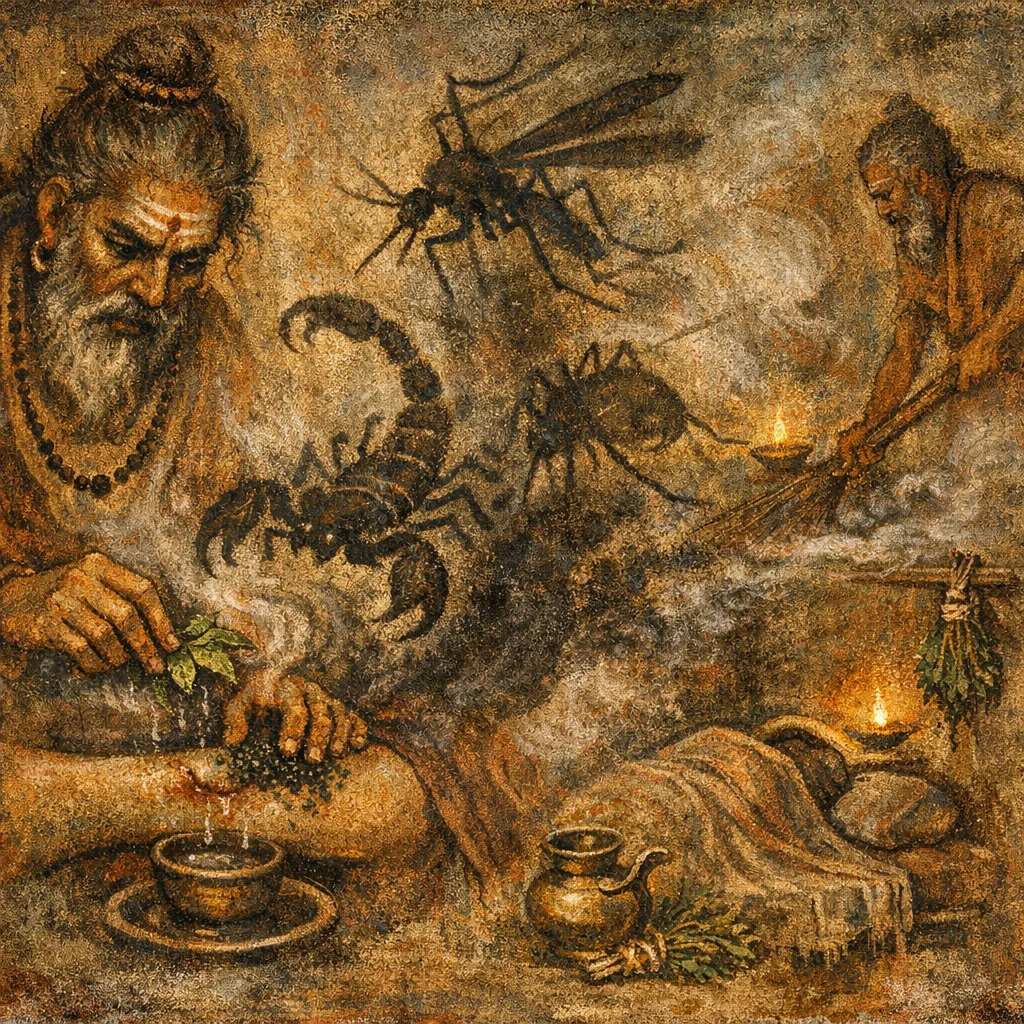
Sukta 56
Rishi: Atharvanic tradition (specific r̥ṣi not stated in the provided excerpt; commonly anonymous/Angirasic for such charms)
Devata: Viṣa-nāśana (poison-destroying power) directed against the śarkota; the mantra itself functions as the agent
Chandas: Anuṣṭubh (probable; typical for short apotropaic verses)
Mantras
Mantra 1
विषभैषज्यम्। तिरश्चिराजेरसितात् पृदाकोः परि संभृतम्। तत् कङ्कपर्वणो विषमियं वीरुदनीनशत्
Poison gathered round about—(poison) of the striped one, of the black one, of the spotted one, of the knot-jointed—this herb hath driven it away.
Mantra 2
इयं वीरुन्मधुजाता मधुश्चुन्मधुला मधूः । सा विह्रुतस्य भेषज्यथो मशकजम्भनी
This herb is honey-born, honey-dropping, honey-rich, honey-sweet: she is a remedy for the disordered; and moreover a crusher of the mosquito.
Mantra 3
यतो दष्टं यतो धीतं ततस्ते निर्ह्वयामसि । अर्भस्य तृप्रदंशिनो मशकस्यारसं विषम्
Whencesoever it was bitten, whencesoever it was lodged—thence we call it forth: the sapless poison of the tiny, sharp-biting mosquito.
Mantra 4
अयं यो वक्रो विपरुर्व्यऽङ्गो मुखानि वक्रा वृजिना कृणोषि । तानि त्वं ब्रह्मणस्पत इषीकामिव सं नमः
This crooked, twisted-jointed, disjointed thing, that with crooked mouths works injury—those (mouths) do thou, O Lord of sacred speech, bend wholly down, as one (bends) a reed: (to thee) be reverence.
Mantra 5
अरसस्य शर्कोटस्य नीचीनस्योपसर्पतः । विषं ह्य१स्यादिष्यथो एनमजीजभम्
Of the sapless Śarkota, the low-creeping thing that steals upon one—its venom verily, when I have marked it out, then have I crushed and made it powerless.
Mantra 6
न ते बाह्वोर्बलमस्ति न शीर्षे नोत मध्यतः । अथ किं पापयामुया पुच्छे बिभर्ष्यर्भकम्
No strength is thine in arms, none in the head, nor yet within the middle: then what, with that evil thing, dost thou bear in thy tail—a paltry trifle?
Mantra 7
अदन्ति त्वा पिपीलिका वि वृश्चन्ति मयूर्यः । सर्वे भल ब्रवाथ शार्कोटमरसं विषम्
The ants devour thee; the peahens cut thee piecemeal. Cry all ‘Well done!’—the Śārkoṭa, sapless, mere poison.
Mantra 8
य उभाभ्यां प्रहरसि पुच्छेन चास्येऽन च । आस्ये३ न ते विषं किमु ते पुच्छधावसत्
Thou that strikest with both, with tail and also with mouth—within thy mouth is no venom: what venom then is thine, O tail-rushing one?
Frequently Asked Questions
Śarkota is a low-creeping venomous being in the hymn’s imagery—often understood as a stinging/biting creature (such as a scorpion-like or similar ground-crawling threat). The hymn targets its venom and its ability to injure.
Both. The sukta presents vīrúd (a medicinal herb/creeper) as the antidotal carrier while mantra provides the binding and poison-destroying force that ‘marks out’ and crushes the venom.
Brahmaṇaspati represents the mastery of sacred speech. In 7.56.4 he is asked to bend down the creature’s injuring mouths like a reed—ritually disabling the source of envenomation and reinforcing protection.