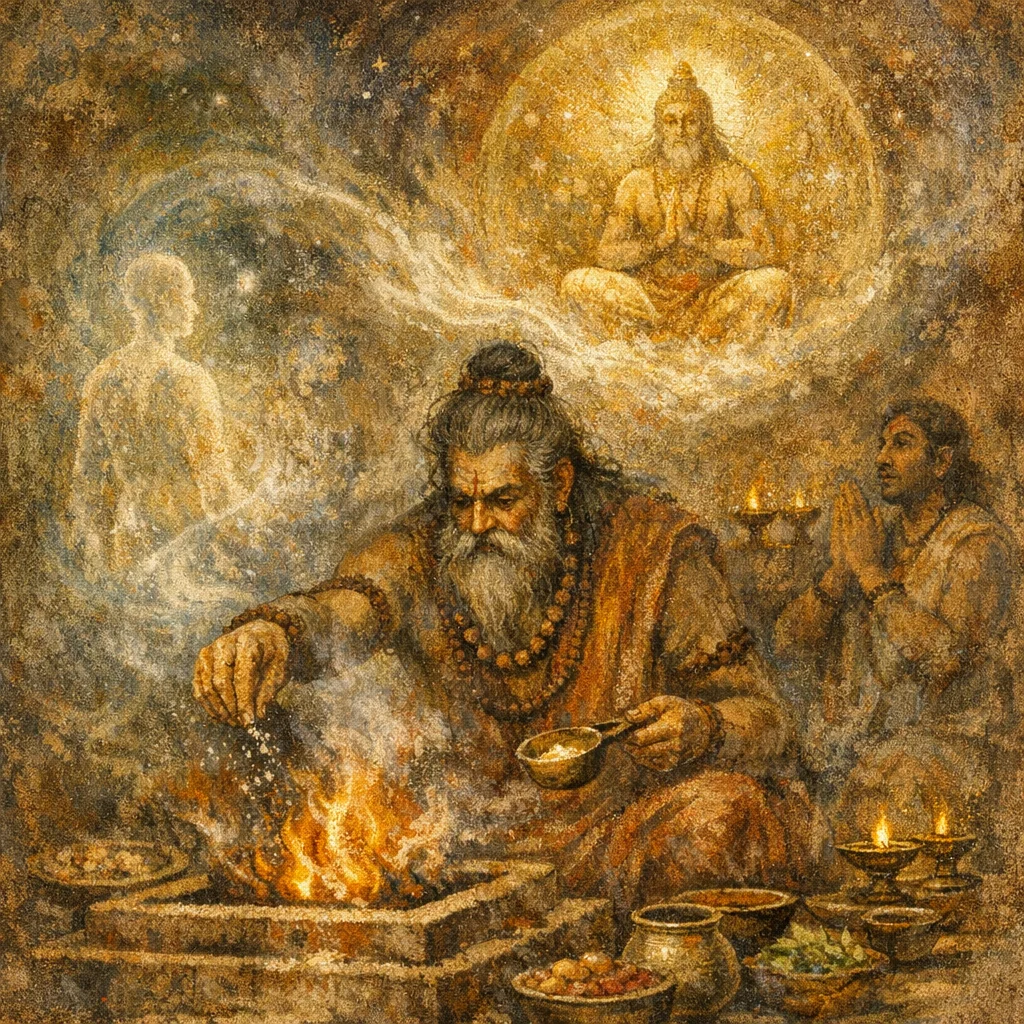
Sukta 2
Rishi: Traditionally associated with Prajāpati/Hiraṇyagarbha-type hymnic voice (exact r̥ṣi attribution varies in ancillary lists).
Devata: Prajāpati / Hiraṇyagarbha (the ‘Ka’ deity of the refrain).
Chandas: Triṣṭubh-like cadence (as in the well-known ‘kásmai devā́ya’ hymn-type).
Mantras
Mantra 1
आत्मविद्या। य आत्मदा बलदा यस्य विश्व उपासते प्रशिषं यस्य देवाः । यो३स्येशे द्विपदो यश्चतुष्पदः कस्मै देवाय हविषा विधेम
Self-knowledge: He who is giver of the self, giver of strength; whose ordinance all revere, whose command the Gods obey; who is lord of this—of the two-footed and the four-footed—to what God shall we pay worship with oblation?
Mantra 2
यः प्राणतो निमिषतो महित्वैको राजा जगतो बभूव । यस्य छायामृतं यस्य मृत्युः कस्मै देवाय हविषा विधेम
He who, by majesty, became the one King of the breathing and the blinking world; whose shadow is immortality, whose (ordinance) is Death—to what God shall we pay worship with oblation?
Mantra 3
यं क्रन्दसी अवतश्चस्कभाने भियसाने रोदसी अह्वयेथाम्। यस्यासौ पन्था रजसो विमानः कस्मै देवाय हविषा विधेम
Whom the two Worlds, trembling, upheld and, fearful, the two Firmaments invoked; whose is that measured pathway of the mid-air—unto what God shall we pay worship with oblation?
Mantra 4
यस्य द्यौरुर्वी पृथिवी च मही यस्याद उर्व१न्तरिक्षम्। यस्यासौ सूरो विततो महित्वा कस्मै देवाय हविषा विधेम
Whose are the Sky, and Earth the broad, the great; from whom the wide Mid-air (is set); whose yonder Sun is spread abroad by majesty—to what God shall we pay worship with oblation?
Mantra 5
यस्य विश्वे हिमवन्तो महित्वा समुद्रे यस्य रसामिदाहुः । इमाश्च प्रदिशो यस्य बाहू कस्मै देवाय हविषा विधेम
Whose, by his majesty, are all the snowy mountains; whose are the vital juices, so men indeed declare, in the ocean: whose arms are these quarters of space—unto what God shall we with oblation do worship?
Mantra 6
आपो अग्रे विश्वमावन् गर्भं दधाना अमृता ऋतज्ञाः । यासु देवीष्वधि देव आसीत् कस्मै देवाय हविषा विधेम
The Waters, in the beginning, guarded all, bearing the germ—immortal, knowing Order; in which goddesses the God had his being: unto what God shall we with oblation do worship?
Mantra 7
हिरण्यगर्भः समवर्तताग्रे भूतस्य जातः पतिरेक आसीत्। स दाधार पृथिवीमुत द्यां कस्मै देवाय हविषा विधेम
Hiraṇyagarbha at first came into being; born as the sole lord of what hath become. He upheld the earth and also the heaven: unto what God shall we with oblation do worship?
Mantra 8
आपो वत्सं जनयन्तीर्गर्भमग्रे समैरयन्। तस्योत जायमानस्योल्ब आसीद्धिरण्ययः कस्मै देवाय हविषा विधेम
The Waters, bringing forth the calf, at first set the germ in motion. And of him, even as he was being born, the envelope was golden: unto what God shall we with oblation do worship?
Frequently Asked Questions
The question points to ‘Ka’ (“Who?”) as a deliberate name for the Supreme—Prajāpati/Hiraṇyagarbha—beyond limited identifications, so the offering is directed to the highest cosmic Lord.
It is mainly paustika: prosperity, strength, vitality, protection of household and cattle, and overall stability—because it invokes the deity who upholds the worlds and life-sustaining ‘rasa’.
No. The hymn is structured around havis (a simple oblation like ghee/food) and contemplative alignment with cosmic order; optional water and kuśa/darbha may be used for ritual cleanliness and calm.