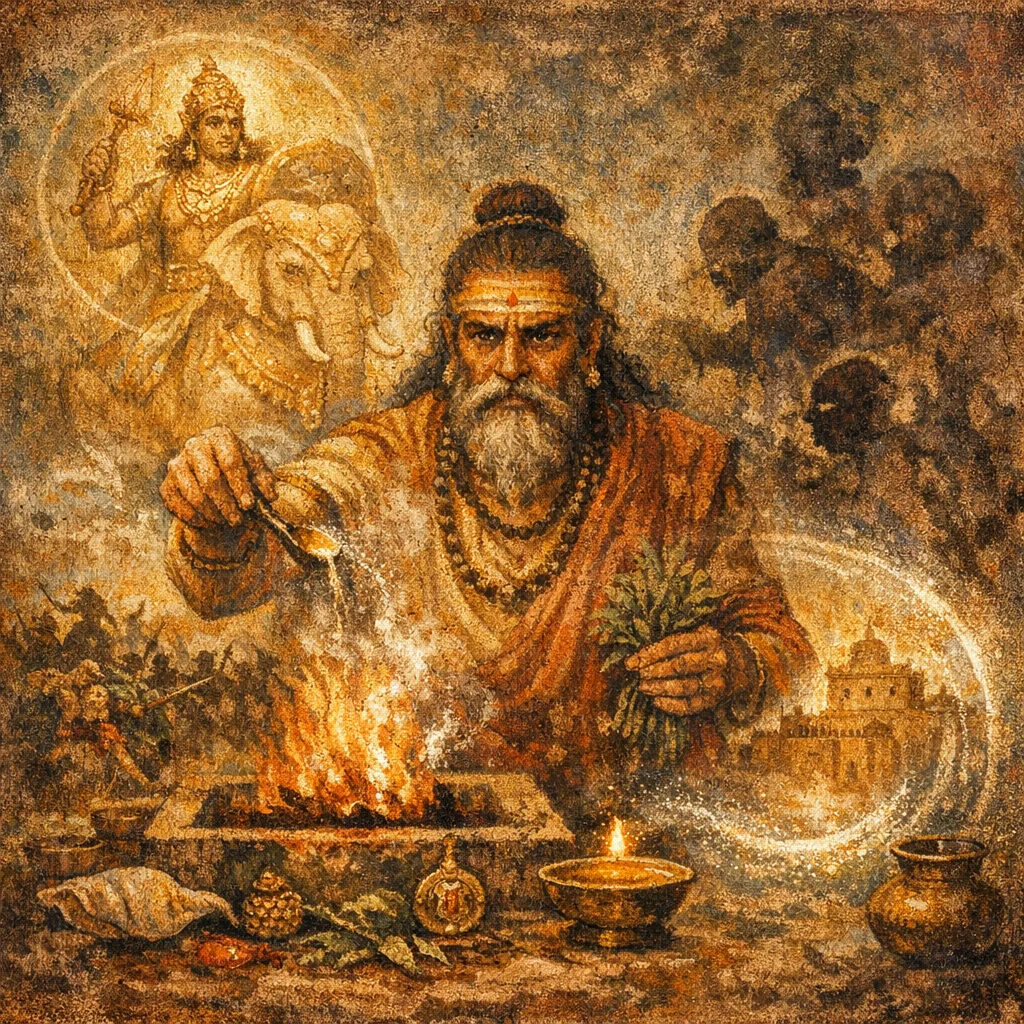
Sukta 34
Rishi: Traditionally Indra-stuti material in AV 20 is largely Rigvedic in origin; r̥ṣi aligns with the RV source-hymn’s seer (to be specified by RV concordance).
Devata: Indra
Chandas: Triṣṭubh/Jagatī-type cadence typical of RV Indra-stutis (exact meter to be confirmed by RV concordance).
Mantras
Mantra 1
यो जात एव प्रथमो मनस्वान् देवो देवान् क्रतुना पर्यभूषत्। यस्य शुष्माद् रोदसी अभ्यसेतां नृम्णस्य मह्ना स जनास इन्द्रः
He who, born even at the first, the wise-hearted God, by force of counsel outshone the Gods; from whose impetuous might the two Worlds drew back in awe—by the greatness of heroic power, he, O men, is Indra.
Mantra 2
यः पृथिवीं व्यथमानामदृंहद् यः पर्वतान् प्रकुपिताँ अरम्णात्। यो अन्तरिक्षं विममे वरीयो यो द्यामस्तभ्नात् स जनास इन्द्रः
He who made firm the Earth when she was quaking; who set the mountains fast when they were shaken; who measured out the mid-air, wider and more spacious; who propped up Heaven—he, O men, is Indra.
Mantra 3
यो हत्वा हिमरिणात् सप्त सिन्धून् यो गा उदाजदपधा वलस्य । यो अश्मनोरन्तरग्निं जजान संवृक् समत्सु स जनास इन्द्रः
He who, having slain, set free the Seven Rivers; who drave the cows forth from the hiding-place of Vala; who generated Fire from between the stones, a comrade in battles—he, O men, is Indra.
Mantra 4
येनेमा विश्वा च्यवना कृतानि यो दासं वर्णमधरं गुहाकः । श्वघ्नीव यो जिगीवां लक्षमाददर्यः पुष्टानि स जनास इन्द्रः
By whom all these overthrowings have been wrought; who made the Dāsa’s order lower, the cave-lurker; who, like a slayer of dogs, seized the victor’s prize—(and) the Arya’s prosperities: he, O men, is Indra.
Mantra 5
यं स्मा पृच्छन्ति कुह सेति घोरमुतेमाहुर्नैषो अस्तीत्येनम्। सो अर्यः पुष्टीर्विज इवा मिनाति श्रदस्मै धत्त स जनास इन्द्रः
Whom men, in sooth, ask of—‘Where is he?’—the dreadful one; and of this very one they say, ‘He is not,’—of him: that noble Lord abateth prosperities, as ’twere, of the folk. Set ye your faith in him: he, O peoples, is Indra.
Mantra 6
यो रध्रस्य चोदिता यः कृशस्य यो ब्रह्मणो नाधमानस्य कीरेः । युक्तग्राव्णो योऽविता सुशिप्रः सुतसोमस्य स जनास इन्द्रः
He who is prompter of the needy, who of the feeble; who of the prayer of the singer in distress; who, with pressing-stones made ready, is helper—fair-lipped—of the Soma when pressed: he, O peoples, is Indra.
Mantra 7
यस्याश्वासः प्रदिशि यस्य गावो यस्य ग्रामा यस्य विश्वे रथासः । यः सूर्यं य उषसं जजान यो अपां नेता स जनास इन्द्रः
Whose horses are abroad in every quarter, whose cows, whose villages, whose chariots are all; who generated the Sun, who Dawn; who is leader of the Waters: he, O peoples, is Indra.
Mantra 8
यं क्रन्दसी संयती विह्वयेते परेऽवरे उभया अमित्राः । समानं चिद् रथमातस्थिवांसा नाना हवेते स जनास इन्द्रः
Whom the two roaring hosts, when joined in onset, invoke—both parties, foes, the farther and the nearer; though mounted on the self-same chariot, they call on him diversely: he, O peoples, is Indra.
Mantra 9
यस्मान्न ऋते विजयन्ते जनासो यं युध्यमाना अवसे हवन्ते । यो विश्वस्य प्रतिमानं बभूव यो अच्युतच्युत् स जनास इन्द्रः
Without whom men win not victory—whom, when they fight, they call upon for aid; who hath become the measure of the whole; who is the Unshaken, yea Unshaken: he, O peoples, is Indra.
Mantra 10
यः शश्वतो मह्येनो दधानानमन्यमानांछर्वा जघान । यः शर्धते नानुददाति शृध्यां यो दस्योर्हन्ता स जनास इन्द्रः
He who smote down the ever-during bearer of mighty guilt, the self-deeming; he who yieldeth not to the hostile band, nor granteth to the assailant; he who is the Dasyu-slayer—he, O peoples, is Indra.
Mantra 11
यः शम्बरं पर्वतेषु क्षियन्तं चत्वारिंश्यां शरद्यन्वविन्दत्। ओजायमानं यो अहिं जघान दानुं शयानं स जनास इन्द्रः
He who tracked out Śambara dwelling in the mountains, in the fortieth year, in autumn; he who slew the Serpent as it waxed in strength, and Dānu lying prone—he, O peoples, is Indra.
Mantra 12
यः शम्बरं पर्यतरत् कसीभिर्योऽचारुकास्नापिबत् सुतस्य । अन्तर्गिरौ यजमानं बहुं जनं यस्मिन्नामूर्छत् स जनास इन्द्रः
He who with his means surmounted Śambara; who, fair-mouthed, drank of the pressed Soma; within the mountain, the sacrificer and the many folk in whom sank not in swoon—he, O peoples, is Indra.
Mantra 13
यः सप्तरश्मिर्वृषभस्तुविष्मानवासृजत् सर्तवे सप्त सिन्धून्। यो रौहिणमस्फुरद् वज्रबाहुर्द्यामारोहन्तं स जनास इन्द्रः
He, seven-reined, the Bull, the vehement, who loosed the Seven Rivers to run; who, thunderbolt-armed, smote Rohiṇa as he would mount to heaven—he, O peoples, is Indra.
Mantra 14
द्यावा चिदस्मै पृथिवी नमेते शुष्माच्चिदस्य पर्वता भयन्ते । यः सोमपा निचितो वज्रबाहुर्यो वज्रहस्तः स जनास इन्द्रः
Even heaven and earth bow down to him; even from his impetuous might the mountains tremble. He who is Soma-drinker, firmly set, thunderbolt-armed; he who is thunderbolt-handed—he, O peoples, is Indra.
Mantra 15
यः सुन्वन्तमवति यः पचन्तं यः शंसन्तं यः शशमानमूती। यस्य ब्रह्म वर्धनं यस्य सोमो यस्येदं राधः स जनास इन्द्रः
He who befriendeth him that presseth Soma, he who aideth him that cooketh, he who aideth the singer of praise, he who with saving succour helpeth the zealous worshipper; whose is the prayer that maketh increase, whose is the Soma, whose is this bounty—he, O men, is Indra.
Mantra 16
जातो व्यख्यत् पित्रोरुपस्थे भुवो न वेद जनितुः परस्य । स्तविष्यमाणो नो यो अस्मद् व्रता देवानां स जनास इन्द्रः
Born, he made himself manifest in the lap of his two parents; he knew not the worlds, nor the highest begetter. Yet, while he is to be praised, he who (guardeth) us from our ordinance—(and from) the gods’—he, O men, is Indra.
Mantra 17
यः सोमकामो हर्यश्वः सूरिर्यस्माद् रेजन्ते भुवनानि विश्वा । यो जघान शम्बरं यश्च शुष्णं य एकवीरः स जनास इन्द्रः
He who is Soma-loving, tawny-steeded, a lordly patron, from whom all worlds do tremble; who slew Śambara, and who (slew) Śuṣṇa; who is the single champion—he, O men, is Indra.
Mantra 18
यः सुन्वते पचते दुध्र आ चिद् वाजं दर्दर्षि स किलासि सत्यः । वयं त इन्द्र विश्वह प्रियासः सुवीरासो विदथमा वदेम
Thou who, even through the stubborn (hindrance), makest the prize appear for him that presseth and for him that cooketh—thou surely art true. We, O Indra, are ever thy dear ones; rich in good heroes, may we address the assembly-rite.
Frequently Asked Questions
It is used as an Indra-praise charm to secure victory, strengthen resolve, and repel hostile forces—especially when facing opposition, conflict, or competitive trials.
Because the hymn presents Indra as the steadfast support that does not slip under pressure; invoking ‘acyuta’ ritually transfers that stability to the patron’s cause.
No specific substances are required by the text. It can be recited as a stand-alone stuti; optional simple offerings (like ghee in fire or water libation) may be added as customary supports.