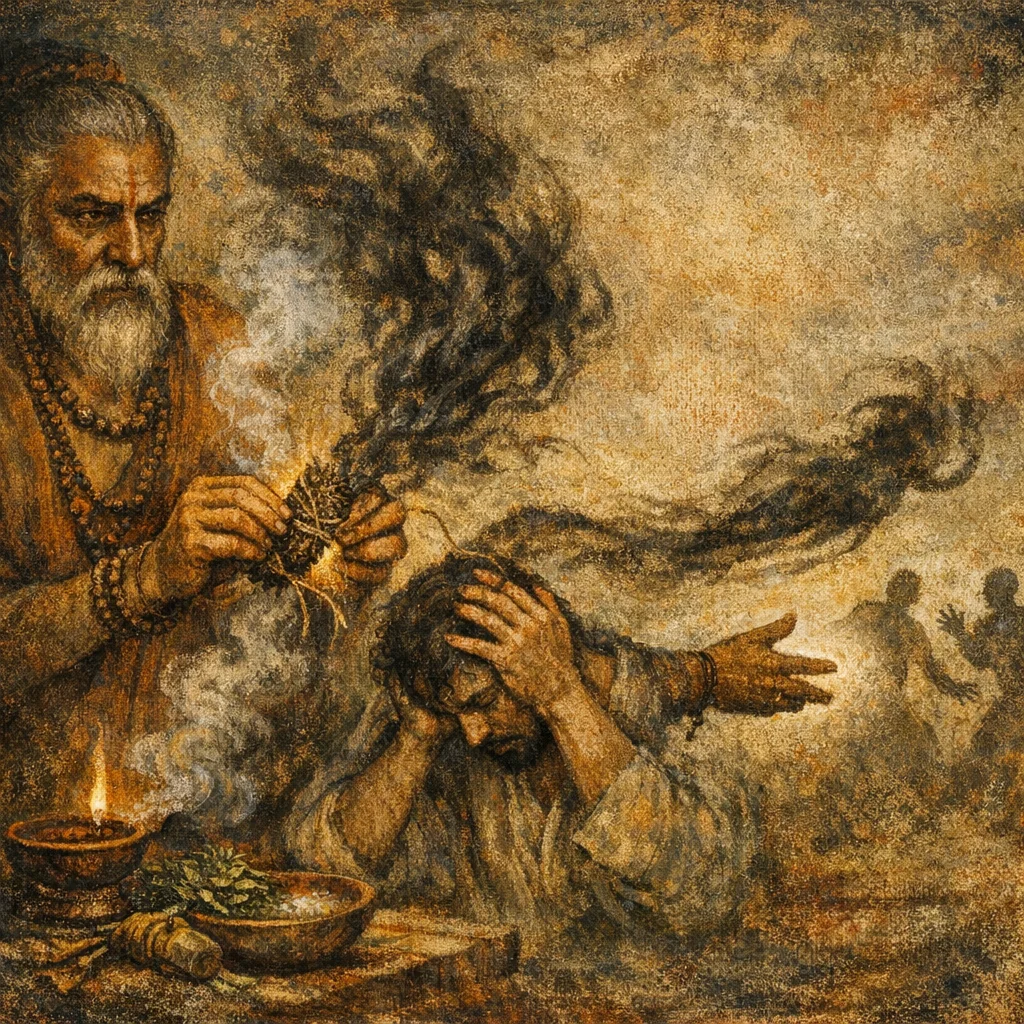
Sukta 57
Rishi: Atharvanic tradition (Anukramaṇī attribution for this late book is often generalized; consult Śaunakīya anukramaṇī for precise assignment).
Devata: Duṣvapnya (ill-dream) as the target; implicit protective power of the Atharvanic mantra.
Chandas: Mixed/late Atharvanic; approximates Anuṣṭubh cadence but not strictly regular.
Mantras
Mantra 1
दुःष्वप्ननाशनम्। यथा कलां यथा शफं यथर्णं संनयन्ति । एवा दुष्वप्न्यं सर्वमप्रिये सं नयामसि
As men gather up a portion, as they gather up the hoof, as they gather up the wave’s mass—so do we gather up and convey, in its entirety, the evil of ill-dream unto the Unloved (the foe).
Mantra 2
सं राजानो अगुः समृणाम्यगुः सं कुष्ठा अगुः सं कला अगुः । समस्मासु यद् दुष्वप्न्यं निर्द्विषते दुष्वप्न्यं सुवाम
Together have the Kings come; together have the debts come; together have Kuṣṭha come; together have the portions come. What ill-dream evil is upon us—this ill-dream evil let us drive forth unto the hater.
Mantra 3
देवानां पत्नीनां गर्भ यमस्य कर यो भद्रः स्वप्न । स मम यः पापस्तद् द्विषते प्र हिण्मः । मा तृष्टानामसि कृष्णशकुनेर्मुखम्
The dream that is auspicious—offspring of the Gods and their Consorts, wrought by Yama’s hand—that be mine. But whatsoever dream is evil, that do we drive forth unto the hater. Be not the mouth of the black omen-bird, nor of the parched and tormented.
Mantra 4
तं त्वा स्वप्न तथा सं विद्म स त्वं स्वप्नाश्व इव कायमश्व इव नीनाहम्। अनास्माकं देवपीयुं पियारुं वप यदस्मासु दुष्वप्न्यं यद् गोषु यच्च नो गृहे
Thee, O Dream, thus do we wholly know: thou art, as it were, a dream-horse; like a horse thou bearest upon the body—yet I lead thee down and away. Strew forth the god-drinking Piyāru, not ours, to cast out whatever ill-dream evil is in us, whatever is among our kine, and whatever is within our house.
Mantra 5
अनास्माकस्तद् देवपीयुः पियारुर्निष्कमिव प्रति मुञ्चताम्। नवारत्नीनपमया अस्माकं ततः परि । दुष्वप्न्यं सर्वं द्विषते निर्दयामसि
Not ours be that: let the god-drinking Piyāru release it back, as one unfastens a niṣka-amulet. With the nine-knotted (cord) remove it away from us, wholly from our sphere. All ill-dream evil do we cast forth unto the hater.
Frequently Asked Questions
It treats nightmares as a removable harm: the mantra gathers the bad dream-force, loosens it like an amulet, and sends it away from the person and home, while keeping good dreams as favorable signs.
This is a common Atharvanic transfer-logic: harm is not merely dissolved but relocated outside one’s kin-sphere, to a hostile or symbolically external recipient, so it cannot return to the household.
The text highlights these as ritual models—knots for ‘binding/removing’ and niṣka for ‘unfastening.’ Traditions often substitute a simple cord and any small ornament, focusing on the gesture and the mantra’s intent.