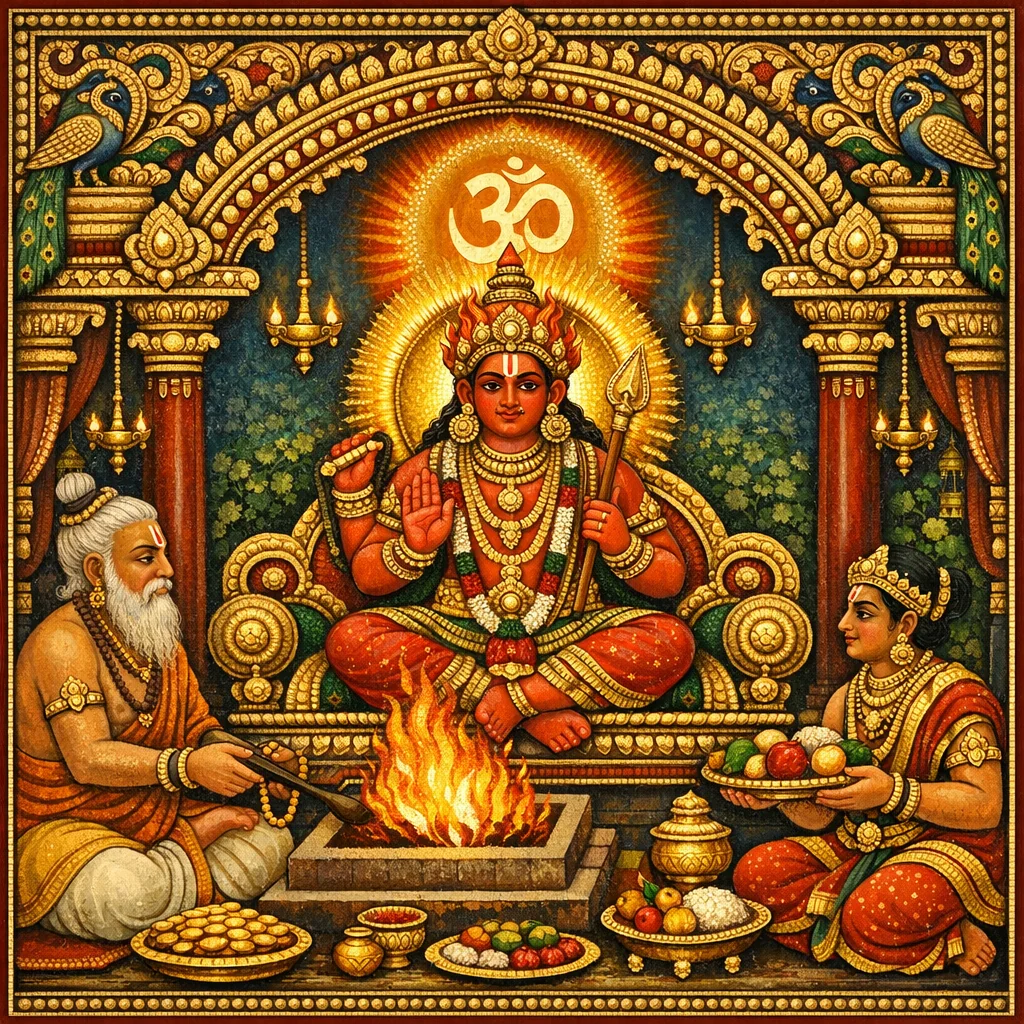
Adhyaya 258
Ṛग्विधानम् (Ṛgvidhāna) — Applications of Ṛgvedic Mantras through Japa and Homa
This chapter shifts from the prior legal-ethical discussion to a practical liturgical manual. Agni presents Puṣkara’s Vedic procedures (Ṛg, Yajus, Sāma, Atharva) as granting both bhukti and mukti, to be performed chiefly through japa and homa. Puṣkara then teaches Ṛgvidhāna: Gāyatrī-japa (in water and in homa) with prāṇāyāma, graded observances of 10,000 and 100,000 recitations, and Oṁ-japa as the supreme Brahman that destroys sin. The chapter lists specific mantra-prayogas for purification, longevity, intelligence, victory, travel-safety, restraining enemies, calming dreams, healing, aiding childbirth, rainmaking, success in debate, and agricultural prosperity—often tied to time (sunrise/midday/sunset), place (water, crossroads, cowshed, field), and discipline (fasting, alms, bathing). It concludes with procedural dharma: giving dakṣiṇā after homa, gifting food and gold, relying on brāhmaṇa blessings, and using prescribed materials, showing ritual technology embedded within ethical order and purification.
Shlokas
Verse 1
इत्य् आग्नेये महापुराणे वाक्पारुष्यादिप्रकरणं नाम सप्तपञ्चाशदधिकद्विशतत्मो ऽध्यायः अथाष्टपञ्चाशदधिकद्विशततमो ऽध्यायः ऋग्विधानं अग्निर् उवाच ऋग्यजुःसामाथर्वविधानं पुष्करोदितम् भुक्तिमुक्तिकरं जप्याद्धोमाद्रामाय तद्वदे
Thus, in the Agni Mahāpurāṇa, the chapter called “On verbal harshness and related matters” is the 257th chapter. Now begins the 258th chapter, “Ṛgvidhāna.” Agni said: “The procedures concerning the Ṛg-, Yajus-, Sāma-, and Atharva- Vedas, as taught by Puṣkara, bestow both worldly enjoyment and liberation. One should practice them by japa and by homa for Rāma, and likewise for the others as prescribed.”
Verse 2
पुष्कर उवाच प्रतिवेदन्तु कर्माणि कार्याणि प्रवदामि ते प्रथमं ऋग्विधानं वै शृणु त्वं भुक्तिमुक्तिदम्
Puṣkara said: “I shall explain to you the rites and duties to be performed in accordance with each Veda. First, listen to the procedure of the Ṛgveda—indeed, it bestows both worldly enjoyment and liberation.”
Verse 3
अन्तर्जले तथा होमे जपती मनसेप्सितम् कामं करोति गायत्री प्राणायामाद्विशेषतः
When the Gāyatrī is recited—whether while standing in water during ritual bathing or in the course of a fire-offering—she brings about the desired aim conceived in the mind, especially when combined with prāṇāyāma.
Verse 4
गायत्र्या दशसाहस्रो जपो नक्ताशनो द्विज बहुस्नातस्य तत्रैव सर्वकल्मषनाशनः
O twice-born one, the japa of the Gāyatrī ten thousand times—while keeping the vow of eating only at night and after repeated ritual baths—becomes, in that very observance, the destroyer of all defilements (sins).
Verse 5
दशायुतानि जप्त्वाथ हविष्याशी स मुक्तिभाक् प्रणवो हि परं ब्रह्म तज्जपः सर्वपापहा
Then, having recited it a hundred thousand times and living on havis (oblational, ritual food), he becomes a recipient of liberation. For the Praṇava (Oṁ) is indeed the Supreme Brahman; its repetition destroys all sins.
Verse 6
ओंकारशतजप्तन्तु नाभिमात्रोदके स्थितः जलं पिवेत् स सर्वैस्तु पापैर् वै विप्रमुच्यते
Having performed a hundred repetitions of the syllable Oṁ, and standing in water up to the navel, one should drink water; by that act one is indeed completely released from all sins.
Verse 7
मात्रात्रयं त्रयो वेदास्त्रयो देवास्त्रयो ऽग्नयः महाव्याहृतयः सप्त लोका होमो ऽखिलाघहा
The three sacred syllabic measures (mātrās) of the Gāyatrī, the three Vedas, the three gods, and the three fires; the seven great Vyāhṛtis and the seven worlds—thus the Homa (fire-offering) is the destroyer of all sins.
Verse 8
गायत्री परमा जाप्या महाव्याहृतयस् तथा अन्तर्जले तथा राम प्रोक्तश् चैवाघमर्षणः
The Gāyatrī is the supreme mantra to be repeated in japa; likewise the great Vyāhṛtis. Japa is also to be performed within water; and the Aghamarṣaṇa (sin-dispelling hymn), as taught by Rāma, is indeed for the removal of sins.
Verse 9
अग्निमीले पुरोहितं सूत्को ऽयं वह्निदैवतः पापैर् हि विप्रमुच्यत इति ग , घ , ञ च शिरसा धारयन् वह्निं यो जपेत्परिवत्सरम्
He who, bearing the Fire (Agni) upon his head in meditation, repeats for a full year this Agni-formula—“Agnim īḷe, the household priest; this mantra is called Sūtka, with Vahni (Agni) as its presiding deity; by it one is indeed released from sins”—together with the syllables ga, gha, and ña, is freed from sinful taints.
Verse 10
होमं त्रिषवणं भैक्ष्यमनग्निज्वलनञ्चरेत् अतः परमृचः सप्त वाय्वाद्या याः प्रकीर्तिताः
He should perform the homa (fire-offering) at the three daily services, live on alms, and practice the kindling of fire without a (visible) fire. After this, the seven Ṛk-verses beginning with (the deity) Vāyu, as taught, are to be recited.
Verse 11
ता जपन् प्रयतो नित्यमिष्टान् कामान् समश्नुते मेधाकामो जपेन्नित्यं सदसन्यमिति त्यचम्
Repeating that mantra daily with self-discipline, one attains the desired aims. One who seeks intellect (medhā) should always repeat the Tyaca-mantra, namely: “sadasanyam”.
Verse 12
अन्वयो यन्निमाः प्रोक्ताः नवर्चो मृत्युनाशनाः शुनःशेफमृषिं बद्धः सन्निरुद्धो ऽथ वा जपेत्
According to the proper anvaya (syntactic connection), these nine taught Ṛk-verses are destroyers of death. One who is bound or imprisoned should then recite them, taking as the model the sage Śunaḥśepha, who was bound and restrained.
Verse 13
मुच्यते सर्वपापेभ्यो गदी वाप्यगदो भवेत् य इच्छेच्छाश्वतं कामं मित्रं प्राज्ञं पुरन्दरं
One is released from all sins; and one becomes either a mace-bearer (a powerful warrior) or free from disease. Whoever desires an enduring fulfillment of wishes should seek Purandara (Indra) as a wise and friendly ally.
Verse 14
ऋग्भिः षोड्शभिः कुर्यादिन्द्रियस्येति दिने दिने हिरण्यस्तूपमित्येतज्जपन् शत्रून् प्रबाधते
One should perform the rite/recitation with sixteen Ṛg-verses—using the formula “of Indriya”—day after day; by repeatedly muttering the mantra beginning “hiraṇyastūpam…,” one overpowers enemies.
Verse 15
क्षेमी भवति चाध्वानो ये ते पन्था जपन् नरः रौद्रीभिःषड्भिरीशानं स्तूयाद्यो वै दिने दिने
The roads of one’s journey become safe and free from danger for the man who repeats these mantras while travelling. Indeed, whoever praises Īśāna day after day with the six Raudrī formulas attains security and well-being.
Verse 16
चरुं वा कल्पयेद्रौद्रं तस्य शान्तिः परा भवेत् उदित्युदन्तमादित्यमुपतिष्ठन् दिने दिने
Or one should prepare a raudra-caru (a pacificatory caru-oblation prescribed for fierce afflictions); by that, supreme appeasement is obtained. And day after day, at sunrise, one should worship Āditya, the Sun, facing the direction of his rising.
Verse 17
क्षिपेज्जलाञ्जलीन् सप्त मनोदुःखविनाशनं द्विषन्तमित्यथार्धर्चं यद्विप्रान्तं जपन् स्मरेत्
He should cast seven handful-offerings of water; this destroys mental sorrow. Then, while repeating the half-verse beginning with “dviṣantam…,” he should remember the mantra and its purport as taught by the learned Brahmins.
Verse 18
आगस्कृत् सप्तरात्रेण विद्वेषमधिगच्छति आरोग्यकामी रोगी वा प्रस्कन्नस्योत्तमं जपेत्
One who has committed an offence incurs enmity within seven nights. A seeker of health—or even a sick person—should recite the excellent mantra for one who is afflicted and overcome by the disorder.
Verse 19
उत्तमस्तस्य चार्धर्चो जपेद्वै विविधासने उदयत्यायुरक्ष्यय्यं तेजो मध्यन्दिने जपेत्
Among these, the highest practitioner should recite that (mantra/hymn) together with the half-ṛc, seated in various postures. Recited at sunrise, it grants imperishable longevity; recited at midday, it bestows radiance (tejas) and vigor.
Verse 20
सन्निबद्धो ऽथेति क , ख , ज च अस्तं प्रतिगते सूर्ये द्विषन्तं प्रतिबाधते न वयश्चेति सूक्तानि जपन् शत्रून्नियच्छति
When the sun has set, being duly prepared, one should recite the mantric syllables “ka, kha, and ja”; thereby one checks and obstructs a hostile person. By repeating the hymnic formulas beginning with “na vayaḥ …”, one restrains enemies.
Verse 21
एकादश सुपर्णस्य सर्वकामान्विनिर्दिशेत् आध्यात्मिकीः क इत्य् एता जपन्मोक्षमवाप्नुयात्
One should employ the elevenfold mantric formula of Suparṇa for the attainment of all desired aims. By repeating these—‘ka’ and the rest—of an inward, spiritual (ādhyātmika) nature, one attains liberation (mokṣa).
Verse 22
आ नो भद्रा इत्य् अनेन दीर्घमायुरवाप्नुयात् त्वं सोमेति च सूक्तेन नवं पश्येन्निशाकरं
By reciting the mantra beginning with “ā no bhadrāḥ…”, one obtains long life; and by the hymn beginning with “tvaṃ soma…”, one beholds the newly arisen moon, the maker of night.
Verse 23
उपतिष्ठेत् समित्पाणिर्वासांस्याप्नोत्यसंशयं आयुरीप्सन्निममिति कौत्स सूक्तं सदा जपेत्
Let him attend (the sacred rite/teacher) with fuel-sticks (samit) in hand; without doubt he obtains garments. Desiring long life, he should always recite the Kautsa hymn beginning with the words “imam iti”.
Verse 24
आपनः शोशुचदिति स्तुत्वा मध्ये दिवाकरं यथा मुञ्चति चेषोकां तथा पापं प्रमुञ्चति
Having praised (the deity) with the words “āpanaḥ śośucad…”, just as the sun at midday releases its rays, so too one casts off sin.
Verse 25
जातवेदस इत्य् एतज्जपेत् स्वस्त्ययनं पथि भयैर् विमुच्यते सर्वैः स्वस्तिमानाप्नुयात् गृहान्
Reciting this (mantra beginning with) “jātavedasa…” as a svastyayana (rite/mantra for auspicious well-being) while on the road, one is freed from all fears and reaches one’s home in safety and auspiciousness.
Verse 26
व्युष्टायाञ्च तथा रात्र्यामेतद्दुःस्वप्ननाशनं प्रमन्दिनेति सूयन्त्या जपेद्गर्भविमोचनं
At daybreak as well as at night, this (mantra/japa) destroys evil dreams. And while in labour, the woman should repeat (the mantra) beginning with “pramandine”, for the release of the fetus, that delivery may be eased.
Verse 27
जपन्निन्द्रमिति स्नातो वैश्यदेवन्तु सप्तकं मुञ्चत्याज्यं तथा जुह्वत् सकलं किल्विषं नरः
Having bathed while reciting the mantra beginning with “indram,” and then performing the sevenfold Vaiśvadeva, a man—by offering and pouring ghee into the fire—casts off all sin.
Verse 28
इमामिति जपन् शश्वत् कामानाप्नोत्यभीप्सितान् मानस्तोक इति द्वाभ्यां त्रिरात्रोपोषितः शुचिः
By continually reciting (the mantra beginning with) “imām”, one obtains the desired objects of one’s wishes. And, having fasted for three nights and remaining pure, one should recite the two (verses/mantras) beginning with “māna” and “stoka”.
Verse 29
औडुम्बरीश् च जुहुयात्समिधश्चाज्यसंस्कृताः छित्त्वा सर्वान्मृत्युपाशान् जीवेद्रोगविवर्जितः
One should offer into the sacred fire auḍumbarī (udumbara/cluster-fig) kindling-sticks anointed with ghee. Thus cutting asunder all the nooses of Death, one lives free from disease.
Verse 30
ऊर्ध्वबाहुरनेनैव स्तुत्वा सम्भुं तथैव च मानस्तोकेति च ऋचा शिखाबन्धे कृते नरः
Raising his arms, a man should thereby praise Śambhu (Śiva). Likewise, while tying the topknot (śikhā-bandha), he should recite the Ṛk beginning with “mā naḥ stoke….”
Verse 31
अघृष्यः सर्वभूतानां जायते संशयं विना चित्रमित्युपतिष्ठेत त्रिसन्ध्यं भास्करं तथा
He becomes unassailable by all beings—without any doubt. Likewise, he should worship Bhāskara (the Sun) at the three junctions of the day, with the invocation “Citram”.
Verse 32
समित्पाणिर्नरो नित्यमीप्सितं धनमाप्नुयात् अथ स्वप्नेति च जपन् प्रातर्मध्यन्दिने दिने
A man who continually holds ritual firewood (samidh) in his hand attains the wealth he desires. Then, repeating as japa the words “atha svapne,” he should do so daily—at dawn and at midday.
Verse 33
दुःस्वप्नञ्चार्हते कृत्स्नं भोजनञ्चाप्नुयाच्छुभम् उभे पुमानिति तथा रक्षोघ्नः परिकीर्तितः
He wards off all evil dreams and obtains auspicious nourishment (food). Likewise, the expression “ubhe pumān” is proclaimed as a slayer of rākṣasas (malevolent beings).
Verse 34
उभे वासा इति ऋचो जपन् कामानवाप्नुयात् न सागन्निति च जपन् मुच्यते चाततायिनः
By reciting the Ṛk that begins with “ubhe vāsā,” one obtains the desired enjoyments; and by reciting the Ṛk that begins with “na sāgann,” one is freed even from the sin of being an ātatāyin (a violent aggressor).
Verse 35
कया शुभेति च जपन् जातिश्रैष्ठमवाप्नुयात् इमन्नृसोममित्येतत् सर्वान् कामानवाप्नुयात्
By repeating in japa the formula “kayā śubheti,” one attains excellence and distinction of birth (social and spiritual pre-eminence). By repeating the formula “imannṛsomam,” one obtains the fulfillment of all desired aims.
Verse 36
पितरित्युपतिष्ठेत नित्यमर्थमुपस्थितं अग्ने नयेति सूक्तेन घृतहोमश् च मार्गगः
One should regularly stand in reverent attendance, invoking “O Fathers (Pitṛs)!”—remaining constantly intent upon the rite—and, by the hymn beginning “Agne naya…,” one should offer an oblation of ghee (ghṛta) into the fire; thus the departed is guided as a traveller upon the proper path.
Verse 37
वीरान्नयमवाप्नोति सुश्लोकं यो जपेत् सदा कङ्कतो नेति सूक्तेन विषान् सर्वान् व्यपोहति
Whoever constantly recites this excellent verse attains the state (or path) of the heroic; and by the hymn beginning “kaṅkato neti” he wards off all poisons.
Verse 38
यो जात इति सूक्तेन सर्वान् कामानवाप्नुयात् गणानामिति सूक्तेन श्निग्धमाप्नोत्यनुत्तमं
By reciting the hymn beginning “yo jātaḥ…,” one may obtain all desired aims. By reciting the hymn beginning “gaṇānām…,” one attains unsurpassed prosperity and divine favor.
Verse 39
यो मे राजन्नितीमान्तु दुःस्वप्नशमनीमृचं अध्वनि प्रस्थितो यस्तु पश्येच्छत्रूं समुत्थितं
O King, whoever sets out on a journey and recites this ṛc-verse of mine that pacifies evil dreams—if he should see enemies rising up (against him), let him recite it as protection.
Verse 40
अप्रशस्तं प्रशस्तं वा कुविदङ्ग इमं जपेत् द्वाविंशकं जपन् सूक्तमाध्यात्मिकमनुत्तमं
Whether the circumstance is deemed inauspicious or auspicious, even one unskilled in the auxiliaries of sacred recitation should repeat this; by reciting the unsurpassed spiritual hymn consisting of twenty-two verses, one attains the intended benefit.
Verse 41
पर्वसु प्रयतो नित्यमिष्टान् कामान् समश्नुते कृणुष्वेति जपन् सूक्तं जुह्वदाज्यं समाहितः
On the sacred junction-days (parvas), one who is constantly disciplined attains the desired objects. With focused mind, he should recite the hymn while repeating the formula “kṛṇuṣva (do/bring it about),” and offer ghee as an oblation.
Verse 42
भोजनञ्चाप्नुयाच्छतमिति ख , ग , घ , ज च नित्यमन्नमुपस्थितमिति क , छ च आरातीनां हरेत् प्राणान् रक्षांस्यपि विनाशयेत् उपतिष्ठेत् स्वयं वह्निं परित्यृचा दिने दिने
“One obtains a hundredfold supply of food” (so read the kha, ga, gha, and ja recensions); and “food is ever at hand” (so read the ka and cha recensions). By such daily attendance one would take away the life-breath (prāṇa) of enemies and also destroy malevolent spirits (rākṣasas). Therefore, one should personally attend upon the sacred fire every day, without omission.
Verse 43
तं रक्षति स्वयं वह्निर्विश्वतो विश्वतोमुखः हंसः शुचिः सदित्येतच्छुचिरीक्षेद्दिवाकरं
Fire himself protects that person—the all-pervading one with faces turned in every direction. Meditating thus: ‘The Haṃsa is pure; the Sun is ever pure’—having become purified, one should gaze upon the Sun.
Verse 44
कृषिं प्रपद्यमानस्तु स्थालीपाकं यथाविधि जुहुयात् क्षेत्रमध्ये तु स्वनीस्वाहास्तु पञ्चभिः
When one is about to undertake agriculture, one should, according to rule, offer the sthālīpāka oblation; and in the middle of the field one should make five offerings, uttering “svanī svāhā.”
Verse 45
इन्द्राय च मरुद्भ्यस्तु पर्जन्याय भगाय च यथालिङ्गन्तु विहरेल्लाङ्गलन्तु कृषीबलः
Let the cultivator make offerings to Indra, to the Maruts, to Parjanya, and to Bhaga; and then, according to the prescribed tokens (liṅgas), let him proceed with the rites—indeed, the strength of agriculture is the plough.
Verse 46
युक्तो धान्याय सीतायै सुनासीरमथोत्तरं गन्धमाल्यैर् नमस्कारैर् यजेदेताश् च देवताः
Having made the proper preparations, one should worship Dhānya (Grain), Sītā (the Furrow), and thereafter Sunāsīra, with fragrances, garlands, and reverent salutations—thus worshipping these deities.
Verse 47
प्रवापने प्रलवने खलसीतापहारयोः अमोघङ्कर्म भवति वर्धते सर्वदा कृषिः
In sowing, in weeding/clearing, in threshing, in ploughing, and in removing pests, the work becomes unfailing in result; agriculture always prospers.
Verse 48
समुद्रादिति सूक्तेन कामानाप्नोति पावकात् विश्वानर इति द्वाभ्यां य ऋग्भ्यां वह्निमर्हति
By reciting the sūkta that begins with “samudrāt…”, one obtains desired enjoyments from Pāvaka (Agni). And by the two Ṛgvedic verses beginning with “viśvānara…”, one becomes worthy to receive the rite of Fire—fit for Agni worship and fire-sacrifice.
Verse 49
स तरत्यापदः सर्वा यशः प्राप्नोति चाक्षयं विपुलां श्रियमाप्नोति जयं प्राप्नोत्यनुत्तमं
He crosses beyond all calamities; he attains imperishable fame, gains abundant prosperity, and obtains unsurpassed victory.
Verse 50
अग्ने त्वमिति च स्तुत्वा धनमाप्नोति वाञ्छितं प्रजाकामो जपेन्नित्यं वरुणदैवतत्रयं
Having praised (Agni) with the formula beginning “Agne, tvam…”, one obtains the desired wealth. One who desires offspring should daily repeat the triad (of mantras/verses) whose presiding deity is Varuṇa.
Verse 51
स्वस्त्या त्रयं जपेत् प्रातः सदा स्वस्त्ययनं महत् स्वस्ति पन्था इति प्रोच्य स्वस्तिमान् व्रजते ऽध्वनि
At dawn one should always recite the three “Svastyā” formulas—the great Svastyayana (rite for well-being). Having uttered, “May the path be auspicious,” one proceeds on one’s journey endowed with auspiciousness.
Verse 52
विजिगीषुर्वनस्पते शत्रूणां व्याधितं भवेत् स्त्रिया गर्भप्रमूढाया गर्भमोक्षणमुत्तमं
O lord of plants (Vanaspati), for one who seeks conquest, it causes the enemies to become afflicted with disease; and for a woman distressed by an obstructed pregnancy, it is an excellent means for the release/expulsion of the fetus.
Verse 53
व्याधिकम्भवदिति ट अच्छावदेति सूक्तञ्च वृष्टिकामः प्रयिओजयेत् निराहारः क्लिन्नवासा न चिरेण प्रवर्षति
One who desires rain should perform the prescribed application of the (mantra beginning) “vyādhikambhavad …” and also the sūkta beginning “acchā vad …”. Remaining without food and wearing wet garments, rain is produced before long.
Verse 54
मनसः काम इत्य् एतां पशुकामो नरो जपेत् कर्दमेन इति स्नायात्प्रजाकामः शुचिव्रतः
A man who desires cattle should recite this mantra beginning with “manasaḥ kāma…”. One who desires offspring, observing a pure vow, should bathe while reciting the mantra beginning with “kardamena…”.
Verse 55
अश्वपूर्वा इति स्नायाद्राज्यकामस्तु मानवः राहिते चर्मणि स्नायात् ब्राह्मणस्तु यथाविधि
A man who desires sovereignty should bathe while reciting the formula/mantra “aśvapūrvā”. A brāhmaṇa, however, should bathe according to rule, seated or standing upon a “rāhita” hide—properly prepared and ritually fit.
Verse 56
राजा चर्मणि वैयाघ्रे छागे वैश्यस्तथैव च दशसाहस्रिको होमः प्रत्येकं परिकीर्तितः
The king should perform the rite seated upon a tiger-skin; likewise the Vaiśya upon a goat-skin. For each of them, a fire-offering (homa) consisting of ten thousand oblations is prescribed.
Verse 57
आगार इति सूक्तेन गोष्ठे गां लोकमातरं उपतिष्ठेद्व्रजेच्चैव यदिच्छेत्ताः सदाक्षयाः
With the hymn beginning “Āgāra…”, one should worship the cow—the “Mother of the world”—in the cowshed; and one should also go to the cattle-pen. If one desires boons such as prosperity, they become ever-unfailing and enduring.
Verse 58
उपेतितिसृभीराज्ञो दुन्दुभिमभिमन्त्रयेत् तेजो बकञ्च प्राप्नोति शत्रुञ्चैव नियच्छति
When the king is about to set forth, he should consecrate the war-drum with mantra; thereby he obtains brilliance and vigor, and he also restrains the enemy.
Verse 59
तृणपाणिर्जपेत्सूक्तुं रक्षोघ्नं दस्युन्भिर्वृतः ये के च उमेत्यृचं जप्त्वा दीर्घमायुराप्नुयात्
Holding a blade of grass in his hand, even if surrounded by bandits, one should recite the demon-slaying hymn; and, having recited the Ṛg-vedic verse beginning with “ye ke ca…”, one attains long life.
Verse 60
जीमूतसूक्तेन तथा सेनाङ्गान्यभिमन्त्रयेत् यधा लिङ्गं ततो राजा विनिहन्ति रणे रिपून्
Likewise, with the Jīmūta-sūkta he should consecrate, by mantra-recitation, the various divisions of the army; and, according to the omen-sign (liṅga) obtained thereby, the king destroys his enemies in battle.
Verse 61
आग्नेयेति त्रिभिःसूक्तैर् धनमाप्नोति चाक्षयं अमीवहेति सूक्तेन भूतानि स्थापयेन्निशि
By reciting the three hymns beginning with “āgneyī…”, one obtains wealth that is imperishable; and by the hymn beginning with “amīvahe…”, one can immobilize or restrain spirits (bhūtas) at night.
Verse 62
सबाधे विषमे दुर्गे बन्धा वा निर्गतः क्वचित् पलायन् वा गृहीतो वा सूक्तमेतत्तथा जपेत्
When afflicted, in uneven or perilous terrain, in a difficult crisis—whether bound or somehow released, whether fleeing or seized—one should then recite this hymn accordingly.
Verse 63
त्रिरात्रं नियतोपोष्य श्रापयेत् पायसञ्चरुं तेनाहुतिशतं पूर्णं जुहुयात् त्र्यम्बकेत्यृचा
Having observed a regulated fast for three nights, one should have a milk-and-rice oblation (pāyasa caru) duly consecrated; with that, one should offer a complete set of one hundred oblations into the fire, reciting the Ṛg-vedic verse beginning with “tryambaka—” (the Mahāmṛtyuñjaya mantra).
Verse 64
अवाप्तवानिति ट समुद्दिश्य महादेवं जीवेदब्दशतं सुखं तच्चक्षुरित्यृचा स्नात उपतिष्ठेद्दिवाकरं
By reciting the mantra that begins “avāptavān …” and addressing Mahādeva, one lives happily for a hundred years. After bathing, one should then stand and worship the Sun (Divākara) with the Ṛk hymn beginning “tac cakṣur …”.
Verse 65
उद्यन्तं मध्यगञ्चैव दीर्घमायुर्जिजीविषुः इन्द्रा सोमेति सूक्तन्तु कथितं शत्रुनाशनं
For one who desires long life, the hymns to the Rising Sun and to the Midday Sun should be employed; and the Sūkta beginning “Indrā Somā …” is taught as a destroyer of enemies.
Verse 66
यस्य लुप्तं व्रतं मोहाद्व्रात्यैर् वा संसृजेत्सह उपोष्याज्यं स जुहुयात्त्वमग्ने व्रतपा इति
If a person’s vow (vrata) has lapsed through delusion, or if he has associated with vrātyas (those outside proper observance), then—having fasted—he should offer ghee as an oblation, reciting: “O Agni, you are the protector of vows (vratapā).”
Verse 67
आदित्येत्यृक् च सम्राजं जप्त्वा वादे जयी भवेत् महीति च चतुष्केण मुच्यते महतो भयात्
Having recited as japa the Ṛk beginning “Āditya …”, together with the mantra “Samrāj”, one becomes victorious in debate. And by the fourfold recitation of “Mahī …”, one is freed from great fear.
Verse 68
ऋचं महीति जप्त्वा यदि ह्य् एतत् सर्वकामानवाप्नुयात् द्वाचत्वारिंशतिं चैन्द्रं जप्त्वा नाशयते रिपून्
If one recites the Ṛc beginning “mahī”, then indeed one obtains all desired aims. And by reciting the Indra-mantra forty-two times, one destroys enemies.
Verse 69
वाचं महीति जप्त्वा च प्राप्नोत्यारोग्यमेव च शन्नो भवेति द्वाभ्यान्तु भुक्त्वान्नं प्रयतः शुचिः
Having recited the mantra “vācaṃ mahī,” one indeed attains health. And after eating, a disciplined and pure person should recite the two verses beginning with “śaṃ no bhava,” for well-being.
Verse 70
हृदयं पाणिना स्पृष्ट्वा व्याधिभिर् नाभिभूयते उत्तमेदमिति स्नातो हुत्त्वा शत्रुं प्रमापयेत्
Having touched the heart with the hand, one is not overcome by diseases. Having bathed while reciting “This is the best (formula),” and then having offered oblations, one should cause the enemy to be destroyed.
Verse 71
शन्नोग्न इति सूक्तेन हुतेनान्नमवाप्नुयात् कन्या वारर्षिसूक्तेन दिग्दोषाद्विप्रमुच्यते
By offering oblations accompanied by the hymn beginning “śam no agne…,” one obtains food and sustenance. And a maiden, by (oblations with) the Vārarṣi-sūkta, is completely freed from the directional defect (dig-doṣa).
Verse 72
यदत्य कव्येत्युदिते जप्ते ऽवश्यं जगद्भवेत् यद्वागिति च जप्तेन वाणी भवति संस्कृता
If, at sunrise, one repeats the formula beginning with “yad-atyakāvya…,” one surely becomes capable of poetic composition. And by repeating the formula beginning with “yad-vāk…,” one’s speech becomes refined and well cultivated.
Verse 73
वाचो विदितमिति त्वेतां जपन् वाचं समश्नुते पवित्राणां पवित्रन्तु पावमान्येत्यृचो मताः
Reciting the mantra beginning with “vāco viditam,” one attains mastery and excellence of speech. The Ṛk-verses known as the Pāvamānīs are regarded as the “purifier among purifiers.”
Verse 74
वैखानसा ऋचस्त्रिंशत्पवित्राः परमा मताः आदित्येति प्रसंम्राजमिति ग , घ , ञ संस्थितेति क , छ , च ऋचो द्विषष्टिः प्रोक्ताश् च परस्वेत्यृषिसत्तम
The Vaikhānasa Ṛg-verses—thirty pavitras—are regarded as supreme. (In some recensions) the reading is “ādityeti” and “prasaṃmrājam iti” (ga, gha, ña); (in others) it is “saṃsthiteti” (ka, cha, ca). The Ṛk-verses are also stated to be sixty-two, O best of sages, with the reading “parasveti”.
Verse 75
सर्वकल्मषनाशाय पावनाय शिवाय च स्वादिष्टयेतिसूक्तानां सप्तषष्टिरुदाहृता
For the destruction of all impurity, for purification, and for auspiciousness, the sūktas beginning with “svādiṣṭa …” are declared to number sixty-seven.
Verse 76
दशोत्तराण्यृचाञ्चैताः पावमान्यः शतानि षट् एतज्जपंश् च जुह्वच्च घोरं मृत्युभयं जयेत्
These are the Pavamāna verses—six hundred and ten ṛks in total. By reciting them and also offering oblations into the fire, one conquers dreadful fear of death.
Verse 77
आपोहिष्टेति वारिस्थो जपेत्पापभयार्दने प्रदेवन्नेति नियतो जपेच्च मरुधन्वसु
Standing in water, one should recite the mantra beginning with “Āpohiṣṭhā…” for the removal of sin and fear. Disciplined and self-controlled, one should also recite the mantra beginning with “Pradevann…”, and likewise recite in the region of Marudhanvan.
Verse 78
प्राणान्तिके भये प्राप्ते क्षिप्रमायुस्तु विन्दति प्रावेयामित्यृचमेकां जपेच्च मनसा निशि
When a life-threatening fear has arisen, one quickly obtains renewed lifespan; at night one should mentally repeat a single Ṛgvedic verse beginning with “prāveyām…”.
Verse 79
व्युष्टायामुदिते सूर्ये द्यूते जयमवाप्नुयात् मा प्रगामेति मूढश् च पन्थानं पथि विन्दति
When dawn has fully broken and the sun has risen, one attains victory in gambling. And the fool who says, “Do not set out,” nevertheless finds the road while on the road—thus the journey succeeds despite discouraging words.
Verse 80
क्षीणायुरिति मन्येत यङ्कञ्चित् सुहृदं प्रियं यत्तेयमिति तु स्नातस्तस्य मूर्धानमालभेत्
If one thinks, “My lifespan is dwindling,” then—having bathed—one should lay the hand upon the head of any dear and friendly person, saying, “This is yours.”
Verse 81
सहस्रकृत्वः पञ्चाहं तेनायुर्विन्दते महत् इदं मेध्येति जुहुयात् घृतं प्राज्ञः सहस्रशः
For five days, performing it a thousand times, by that one attains great longevity. The wise should offer ghee (ghṛta) into the fire a thousand times, reciting, “This is purifying (medhya).”
Verse 82
पशुकामो गवां गोष्ठे अर्थकामश् चतुष्पथे वयः सुपर्ण इत्य् एतां जपन् वै विन्दते श्रियं
One who desires livestock should recite it in a cattle-shed; one who desires wealth should recite it at a crossroads. Reciting this mantra beginning with “vayaḥ suparṇa …”, one indeed obtains Śrī—prosperity and good fortune.
Verse 83
हविष्यन्तीयमभ्यस्य सर्वपापैः प्रमुच्यते तस्य रोगा विनश्यन्ति कायाग्निर्वर्धते तथा
By practising this Haviṣyantī observance, one is freed from all sins; that person’s diseases are destroyed, and the bodily digestive fire (kāyāgni) likewise increases.
Verse 84
या ओषधयः स्वस्त्ययनं सर्वव्याधिविनाशनं वृहस्पते अतीत्येतद्वृष्टिकामः प्रयोजयेत्
“Those medicinal herbs that are a means to well-being and an auspicious safeguard, and that destroy all diseases—O Bṛhaspati—having duly uttered this, one who desires rainfall should apply this rite/remedy.”
Verse 85
सर्वत्रेति परा शान्तिर्ज्ञेया प्रतिरथस् तथा सूत सांकाश्यपन्नित्यं प्रजाकामस्य कीर्तितं
“‘Sarvatrā’ (‘Everywhere’) is to be understood as the supreme pacification (bestowing the highest peace). Likewise, ‘Pratiratha’ is known thus. And, O Sūta, ‘Sāṃkāśyapa’ is declared to be ever efficacious for one who desires progeny.”
Verse 86
अहं रुद्रेति एतद्वाग्मी भवति मानवः न योनौ जायते विद्वान् जपन्रात्रीति रात्रिषु
“A man who recites the formula ‘I am Rudra’ becomes eloquent. The learned one, reciting the mantra ‘rātrī’ during the nights, is not born again from a womb.”
Verse 87
रात्रिसूक्तं जपन्न्रात्री रात्रिं क्षेमी जयेन्नरः कल्पयन्तीति च जपन्नित्यं कृत्त्वारिनाशनं
“A man who recites the Rātri-sūkta at night, night after night, becomes secure and victorious. And by daily reciting the mantra beginning with ‘kalpayantī…’, he accomplishes the destruction of enemies.”
Verse 88
आयुष्यञ्चैव वर्चस्यं सूक्तं दाक्षायणं महत् उत देवा इति जपेदामयघ्नं धृतव्रतः
“For longevity and vital splendour, one should recite the great Dākṣāyaṇa Sūkta; and the disciplined observer of vows should also repeat the mantra beginning ‘uta devā…’, which destroys disease.”
Verse 89
अयमग्ने जनित्येतज्जपेदग्निभये सति अरण्यानीत्यरण्येषु जपेत्तद्भयनाशनं
When there is danger from fire, one should recite in japa this mantra beginning “ayam agne janitā”. In forests, one should recite the mantra beginning “araṇyānī”, for it destroys that fear.
Verse 90
ब्राह्म्नीमासाद्य सूक्ते द्वे ऋचं ब्राह्मीं शतावरीं पृथगद्भिर्घृतैर् वाथ मेधां लक्ष्मीञ्च विन्दति
Approaching (and employing) Brāhmī, and reciting two sūkta-hymns and the Brāhmī-ṛc, one should take Brāhmī and Śatāvarī separately with water and with ghee (ghṛta); thereby one obtains medhā (intellect) and lakṣmī (prosperity) as well.
Verse 91
मास इत्य् असपत्नघ्नं संग्रामं विजिगीषतः ब्रह्मणो ऽग्निः संविदानं गर्भमृत्युनिवारणं
The mantra beginning “māsa” is the “slayer of rivals”, to be employed by one who seeks victory in battle. “Agni of Brahman” is the mantra for securing saṃvidāna (agreement/settlement). The mantra of “warding off death in the womb” is for preventing fetal demise (miscarriage/stillbirth).
Verse 92
अपहीति जपेत्सूक्तं शुचिर्दुस्वप्ननाशनं येनेदमिति वैजप्त्वा समाधिं विन्दते परं
Being purified, one should recite in japa the “Apahīti” hymn, which destroys evil dreams. And indeed, having repeated the mantra beginning “yenedam”, one attains the supreme samādhi.
Verse 93
मयो भूर्वात इत्य् एतत् गवां स्वस्त्ययनं परं शाम्बरीमिन्द्रजालं वा मायामेतेन वारयेत्
“Mayo bhūr vāta …”—this formula is the supreme svastyayana (auspicious protective rite) for cattle. By means of it one should ward off Śāmbarī-sorcery, Indrajāla (conjuring/illusion), or any māyā (deceptive magic).
Verse 94
महीत्रीणामवरोस्त्विति पथि स्वस्त्ययनं जपेत् अग्नये विद्विषन्नेवं जपेच्च रिपुनाशनं
While on a journey, one should recite the auspicious ‘svastyayana’ japa for safe passage, beginning with “mahītrīṇām avaros tv…”. Likewise, for Agni one should recite in the same manner the enemy-subduing formula, thereby bringing about the destruction of foes.
Verse 95
वास्तोष्पतेन मन्त्रेण यजेत गृहदेवताः जपस्यैष विधिः प्रोक्तो हुते ज्ञेयो विशेषतः
With the Vāstoṣpati mantra one should worship—by ritual offering—the deities of the household. This procedure is taught for japa, and it is to be understood as especially applicable when an oblation in homa has been offered.
Verse 96
होमान्ते दक्षिणा देया पापशान्तिर्हुतेन तु हुतं शाम्यति चान्नेन अन्नहेमप्रदानतः
At the conclusion of the homa, the dakṣiṇā (sacrificial fee) should be given. Sin is pacified by the offerings cast into the fire, and the rite’s remaining effects are brought to completion through food—by gifting food and gold.
Verse 97
विप्राशिषस्त्वमोघाः स्युर्बहिःस्नानन्तु सर्वतः सिद्धार्थका यवा धान्यं पयो घृतं तथा
The blessings uttered by Brahmins are indeed unfailing. One should perform external bathing in every prescribed manner, and also use/offer white mustard seeds (siddhārthaka), barley, grain, milk, and ghee.
Verse 98
क्षीरवृक्षास्तथेध्मन्तु होमा वै सर्वकामदाः समिधः कण्ठकिन्यश् च राजिका रुधिरं विषं
Likewise, trees that exude milky latex are to be used as samidh fuel-sticks for the homa; such homas are said to bestow the fulfillment of all desires. (Among the offering/fuel materials are) kaṇṭhakinī, rājikā (mustard), blood, and poison.
Verse 99
अभिचारे तथा शैलं अशनं शक्तवः पयः दधि भैक्ष्यं फलं मूलमृग्विधानमुदाहृतं
In rites of abhichāra (ritual operations for subduing or afflicting), the prescribed regimen is declared as follows: rock-salt, food (grains), saktu (parched grain-flour), milk, curd, alms-food, fruits, roots, and also the procedure involving meat (game).
Frequently Asked Questions
That Ṛgvedic mantra procedures—performed as japa and homa with purity and restraint—grant practical results (health, safety, prosperity, victory) while also functioning as a path of purification leading toward mokṣa.
Disciplined Gāyatrī-japa (often in water and with prāṇāyāma), Praṇava (Oṁ) repetition, use of Mahāvyāhṛtis, and svastyayana-style recitations integrated with bathing, homa, and dāna.