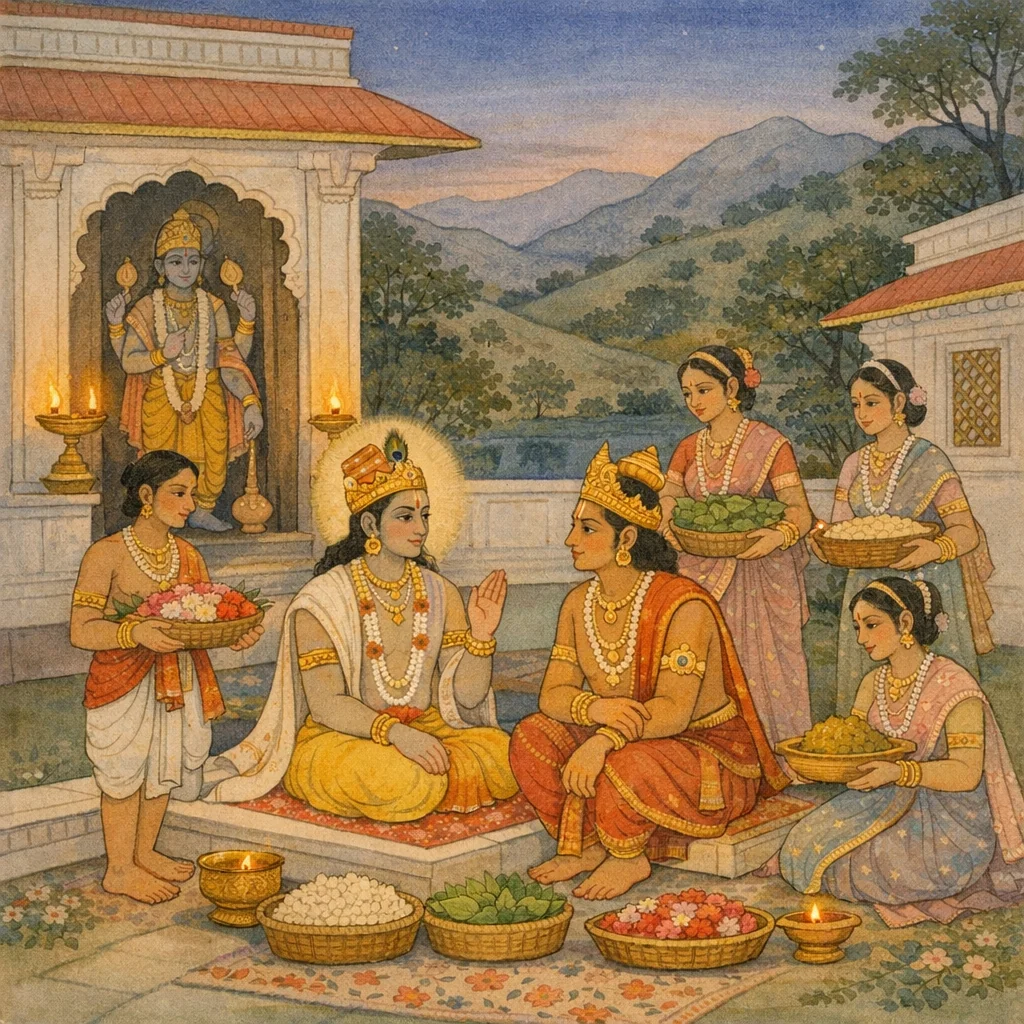
Adhyaya 68: Prahlada’s Instructions to Bali on Vishnu Worship, Monthly Gifts, and Building Hari’s Temple
विष्णुपूजाविधान-दानमाहात्म्य-हरिमन्दिरनिर्माण (Viṣṇupūjāvidhāna–Dānamāhātmya–Harimandiranirmāṇa)
Vishnu Worship and Temple Building
Within the Purāṇic frame narrated by Pulastya, this adhyāya presents a didactic exchange in which Bali questions Prahlāda about the concrete means of pleasing Janārdana—arcana, upavāsa, auspicious tithis, and especially dāna. Prahlāda’s response articulates an asura-dharma reoriented toward bhakti: honoring learned brāhmaṇas is treated as direct worship of Viṣṇu, since the brāhmaṇa is declared a ‘divine body’ of the Lord. The chapter then supplies an iconographic-ritual catalogue—approved flowers, leaves, fragrances, dhūpas, and havis-grains—followed by a calendrical scheme of month-wise donations (from Māgha through Pauṣa) keyed to Viṣṇu’s epithets (Mādhava, Govinda, Trivikrama, etc.). The narrative culminates in temple-building as a salvific act: constructing, painting, lighting, and maintaining a Viṣṇu-ālaya liberates even grave sinners and elevates ancestors. Bali models this piety through constructing and servicing Keśava’s shrine, while the closing verses generalize the ethical thesis: obedience to elders’ counsel functions as a practical ‘medicine’ in संकट (āpatti), yielding siddhi like that attained by Bali.
Divine Beings
Sacred Geography
Mortal & Asura Figures
Key Content Points
- Bali’s inquiry to Prahlada on the most effective modes of pleasing Janardana: arcana, upavāsa, auspicious tithis, and meritorious acts (puṇya) that grant Viṣṇu’s satisfaction.
- Ritual-ethical synthesis: worship of brāhmaṇas as worship of Viṣṇu; prohibition against disparaging brāhmaṇas; approved offerings (flowers, leaves, sandal, kuṅkuma, dhūpa, grains prepared as haviṣ).
- Dana-calendar and temple-mahātmya: month-wise prescribed gifts dedicated to Viṣṇu’s names; extraordinary merit of building, painting, cleaning, and lighting a Viṣṇu temple; ancestral uplift and expiation even for mahāpātakas; Bali’s enactment and the concluding praise of heeding elders’ counsel.
Shlokas in Adhyaya 68
Verse 1
इति श्रीवामनपुराणे सप्तषष्टितमो ऽध्यायः बलिरुवाच भवता कथितं सर्वं समाराध्य जनार्दनम् या गतिः प्राप्यते लोके तां मे वक्तुमिहार्हसि
Thus, in the Śrī Vāmana Purāṇa, the sixty-eighth chapter begins. Bali said: “You have explained everything about propitiating Janārdana. Now you should tell me here what ‘state’ (gati)—what ultimate destination—is attained in this world by such worship.”
Verse 2
केनार्चनेन देवस्य प्रीतिः समुपजायते कानि दानानि शस्तानि प्रीणनाय जगद्गुरोः
“By what form of worship does the Lord’s satisfaction arise? And which gifts (dānas) are praised as best for pleasing the Guru of the world?”
Verse 3
उपवासादिकं कार्यं कस्यां तिथ्यां महोदयम् कानि पुण्यानि शस्तानि विष्णोस्तुष्टिप्रदानि वै
“On which lunar day (tithi) should fasting and related observances be performed so that they yield great spiritual ‘rise’ (mahā-udaya)? And which meritorious acts are praised as those that truly bestow Viṣṇu’s satisfaction?”
Verse 4
यच्चान्यदपि कर्त्तव्यं हृष्टरूपैरनालसैः तदप्यशेषं दैत्येन्द्र ममाख्यातुमिहार्हसि
“And whatever else is to be done—by those who are cheerful in disposition and not indolent—do you, O lord of the Daityas, also relate all of that to me here, without omission.”
Verse 5
प्रह्लाद उवाच श्रद्दधानैर्भक्तिपरैर्यान्युद्दिश्य जनार्दनम् बले दानानि दीयन्ते तानूचुर्मुनयो ऽक्षयान्
Prahlāda said: “O Bali, the gifts that are given by people who are full of faith and devoted—dedicating them to Janārdana—those the sages have declared to be imperishable (yielding inexhaustible fruit).”
Verse 6
ता एव तिथयः शस्ता यास्वभ्यर्च्य जगत्पतिम् तच्चित्तस्तन्मयो भूत्वा उपवासी नरो भवेत्
“Those very lunar days (tithis) are commendable on which, having worshiped the Lord of the world, a man—his mind fixed on Him, becoming absorbed in Him—should observe a fast.”
Verse 7
पूजितेषु द्विजेन्द्रेषु पूजितः स्याज्जनार्दनः एतान् द्विषन्ति ये मूढास्ते यान्ति नरकं ध्रुवम्
When the foremost of the twice-born (brāhmaṇas) are honored, Janārdana (Viṣṇu) is thereby honored. Those deluded persons who hate them certainly go to hell.
Verse 8
तानर्चयेन्नरो भक्त्या ब्राह्मणान् विष्णुतत्परः एवमाह हरिः पूर्वं ब्राह्मणा मामकी तनुः
A man devoted to Viṣṇu should worship those brāhmaṇas with devotion. Thus Hari declared formerly: ‘Brāhmaṇas are my own body.’
Verse 9
ब्राह्मणो नावमन्तव्यो बुधो वाप्यबुधो ऽपि वा सो ऽपि दिव्या तनुर्विष्णोस्तस्मात् तामर्चयेन्नरः
A brāhmaṇa should not be despised—whether he is learned or even unlearned. Even he is a divine body of Viṣṇu; therefore a man should honor him.
Verse 10
तान्येव च प्रशस्तानि कुसुमानि महासुर यानि स्युर्वर्णयुक्तानि रसगन्धयुतानि च
“Those very flowers are indeed commendable, O great Asura—those which are endowed with good colour, and which possess (pleasing) sap/nectar and fragrance as well.”
Verse 12
विशेषतः प्रवक्ष्यामि पुष्पाणि तिथयस्तथा दानानि च प्रशस्तानि माधवप्रीणनाय तु / 68.11 जाती शताह्वा सुमनाः कुन्दं बहुपुटं तथा बाणञ्च चम्पकाशोकं करवीरं च यूथिका
“I shall now declare in particular the flowers, the lunar dates (tithis), and the commendable gifts (dānas) for the purpose of pleasing Mādhava. (The flowers are:) jasmine (jātī), śatāhvā, sumanā, kunda, the many-petalled (bahu-puṭa), bāṇa, campaka, aśoka, karavīra, and yūthikā.”
Verse 13
पारिभद्रं पाटला च बकुलं गिरिशालिनी तिलकं च जपाकुसुमं पीतकं नागरं त्वपि
“(Also commendable are) pārijāta/pāribhadra, pāṭalā, bakula, giriśālinī, tilaka, the hibiscus flower (japā-kusuma), pītaka, and nāgara as well.”
Verse 14
एतानि हि प्रशस्तानि कुसुमान्यच्युतार्चने सुरभीणि तथान्यानि वर्जयित्वा तु केतकीम्
These indeed are the approved flowers for the worship of Acyuta (Viṣṇu). Likewise, other fragrant blossoms may be used—however, one should avoid the ketakī flower.
Verse 15
बिल्वपत्रं शमीपत्रं पत्रं भृङ्गमृगाङ्कयोः तमालामलकीपत्रं शस्तं केशवपूजने
Bilva leaves, śamī leaves, the leaves of bhṛṅga and mṛgāṅka, and the leaves of tamāla and āmalakī are commended for the worship of Keśava (Viṣṇu).
Verse 17
येषामपि हिच पुष्पाणि प्रशस्तान्यच्युतार्चने पल्लवान्यपि तेषां स्तुः पत्राण्यर्चाविधौ हरेः 68.16 वीरुधां च प्रवालेन बर्हिषा चार्चयेत्तथा नानारूपैश्चाम्बुभवैः कमलेन्दीवरादिभिः
For those plants whose flowers are approved for the worship of Acyuta, their tender shoots (pallavas) and leaves too are to be used in the procedure of worship of Hari. One may likewise worship with the sprouts of creepers and with sacred grass (barhis), and also with various water-born offerings such as lotus, blue-lotus, and the like.
Verse 18
प्रवालैः शुचिभिः श्लक्ष्णैर्जलप्रक्षालितैर्बले वनस्पतीनामर्च्येत तथा दूर्वाग्रपल्लवैः
“O Bali, one should worship (the deity) with clean, smooth coral pieces that have been washed with water, and likewise with the tender shoots at the tips of dūrvā grass.”
Verse 19
चन्दनेनानुलिम्पेत कुङ्कुमेन प्रयत्ननतः उशीरपद्मकाभ्यां च तथा कालीयकादिना
“One should carefully anoint (the deity) with sandalwood paste and with saffron; also with uśīra and lotus (fragrances), and likewise with kālīyaka and other such aromatics.”
Verse 20
महिषाख्यं कणं दारु सिह्लकं सागरुं सिता शङ्खं जातीफलं श्रीशे धूपानि स्युः प्रियाणि वै
“Mahiṣākhya, kaṇa, dāru, sihlaka, sāgaru, white conch (powder), and nutmeg—these incenses are indeed dear to Śrīśa (the Lord of Śrī).”
Verse 21
हविषा संस्कृता ये तु यवगोधूमशालयः तिलमुद्गादयो माषा व्रीहयश्च प्रिया हरेः
Barley, wheat, and śāli-rice that are duly prepared with sacrificial oblation (havis), as well as sesame, mung and other pulses, black gram, and rice—these are dear to Hari (Viṣṇu).
Verse 22
गोदानानि पवित्राणि भूमिदानानि चानघ वस्त्रान्नस्वर्णदानानि प्रीतये मधुघातिनः
O sinless one, gifts of cows are purifying, and so too are gifts of land; likewise gifts of garments, food, and gold are for the delight of the slayer of Madhu (Viṣṇu).
Verse 23
माघमासे तिला देयास्तिलधेनुश्च दानव इन्धनादीनि च तथा माधवप्रीणनाय तु
In the month of Māgha, sesame should be given; and (one should give) a ‘sesame-cow’ (tila-dhenu), O Dānava; likewise fuel and related necessities as well—indeed, for the satisfaction of Mādhava (Viṣṇu).
Verse 24
फाल्गुने व्रीहयो मुद्गा वस्त्रकृष्णाजिनादिकम् गोविन्दप्रीणनार्थाय दातव्यं पुरुषर्षभैः
In the month of Phālguna, rice and green gram (mudga), along with garments, black antelope-skin and the like, should be given by the best of men, for the purpose of pleasing Govinda.
Verse 25
चैत्रे चित्राणि वस्त्राणि शयनान्यासनानि च विष्णोः प्रीत्यर्थमेतानि देयानि ब्राह्मणेष्वथ
In the month of Caitra, variegated garments, as well as beds and seats, should be given—these are to be donated to brāhmaṇas for the sake of Viṣṇu’s satisfaction.
Verse 26
गन्धमाल्यानि देयानि वैशाखे सुरभीणि वै देयानि द्विजमुख्येभ्यो मधुसूदनतुष्टये
In the month of Vaiśākha, fragrant perfumes and garlands should be given; indeed, fragrant offerings are to be donated to the foremost among the twice-born, for the satisfaction of Madhusūdana.
Verse 27
उदकुम्भाम्बुधेनुं च तालवृन्तं सुचन्दनम् त्रिविक्रमस्य प्रीत्यर्थं दातव्यं साधुभिः सदा
A water-pot, a ‘water-cow’ (i.e., a vessel or gift that supplies water), a palm-leaf fan, and fine sandalwood should always be given by the virtuous, for the satisfaction of Trivikrama.
Verse 28
उवानद्युगलं छत्रं लवणामलकादिकम् आषाढे वामनप्रीत्यै दातव्यानि तु भक्तितः
In the month of Āṣāḍha, a pair of footwear, an umbrella, and items such as salt and āmalaka should be given with devotion, for the satisfaction of Vāmana.
Verse 29
घृतं च क्षीरकुम्भाश्च घृतधेनुफलानि च श्रावणे श्रीधरप्रीत्यै दातव्यानि विपश्चिता
In the month of Śrāvaṇa, ghee, pots filled with milk, and fruits—together with a ‘ghee-cow’ (a gift representing abundant ghee)—should be given by the wise, for the satisfaction of Śrīdhara.
Verse 30
मासि भाद्रपदे दद्यात् पायसं मधुसर्पिषी हृषीकेशप्रीणनार्थं लवणं सगुडोदनम्
In the month of Bhādrapada, one should give pāyasa (milk-rice) together with honey and ghee; and, for the purpose of pleasing Hṛṣīkeśa, one should also give salt and cooked rice mixed with jaggery.
Verse 31
तिलास्तुरङ्गं वृषभं दधि ताम्रायसादिकम् प्रीत्यर्थं पद्मनाभस्य देयमाश्वयुजे नरैः
In Āśvayuja, people should give sesame, a horse, a bull, curd, and items of copper and iron and the like, for the pleasure of Padmanābha.
Verse 32
रजतं कनकं दीपान् मणिमुक्ताफलादिकम् दामोदरस्य तुष्ट्यर्थं प्रदद्यात् कार्तिके नरः
In Kārtika, a person should give silver, gold, lamps, and jewels, pearls, and the like, for the satisfaction of Dāmodara.
Verse 33
खरोष्ट्राश्वतरान् नागान् यानयुग्यमजाविकम् दात्वयं केशवप्रीत्यै मासि मार्गशिरे नरैः
In the month of Mārgaśīrṣa, people should give (in charity) donkeys, camels, mules, elephants, conveyances fit for travel, and goats and sheep—this is for the pleasure of Keśava.
Verse 34
प्रासादनगरादीनि गृहप्रावरणादिकम् नारायणस्य तुष्ट्यर्थं पौषे देयानि भक्तितः
In the month of Pauṣa, with devotion one should give (in charity) mansions, towns and the like, as well as coverings and furnishings for a house, for the satisfaction of Nārāyaṇa.
Verse 35
दासीदासमलङ्कारमन्नं षड्रससंयुतम् पुरुषोत्तमस्य तुष्ट्यर्थं प्रदेयं सार्वकालिकम्
Female and male servants, ornaments, and food endowed with the six tastes should be given at all times, for the satisfaction of Puruṣottama.
Verse 36
यद्यदिष्टतमं किञ्चिद्यद्वाप्यस्ति शुचि गृहे तत्तद्वि देयं प्रीत्यर्थं देवदेवाय चक्रिणे
Whatever most cherished thing one has—whatever pure (worthy) possession exists in one’s home—one should indeed give that, as an offering of love, to the God of gods, the discus-bearing Lord (Viṣṇu).
Verse 37
यः कारयेन्मन्दिरं केशवस्य पुण्यांल्लोकान् स जयेच्छाश्वतान् वै दत्त्वारामान् पुष्पफलाभिपन्नान् भोगान् भुङ्क्ते कामातः श्लाघनीयान्
Whoever causes a temple of Keśava to be built conquers (attains) the meritorious worlds—indeed, the everlasting ones. And having donated pleasure-groves rich in flowers and fruits, he enjoys desirable, praiseworthy enjoyments according to his wish.
Verse 38
पितामहस्य पुरतः कुलान्यष्टौ तु यानि च तारयेदात्मना सार्धं विष्णोर्मन्दिरकारकः
In the presence of the Grandfather (Pitāmaha), the builder of Viṣṇu’s temple delivers (carries across) the eight lineages of his family, together with himself.
Verse 39
इमाश् च पितरो दैत्य गाथा गायन्ति योगिनः पुरतो यदुसिंहस्य ज्यामघस्य तपस्विनः
“And these very ancestral Fathers (pitaraḥ), O Daitya, sing sacred verses (gāthāḥ) as yogins do, in the presence of Jyāmagha—the lion among the Yadus—who is an ascetic (tapasvin).”
Verse 40
अपि नः स कुले कश्चिद् विष्णुभक्तो भविष्यति हरिमन्दिरकर्ता यो भविष्यति शिचिव्रतः
“Will there be, in our lineage, someone who becomes a devotee of Viṣṇu—one who will build a temple for Hari—who will be steadfast in vows and conduct (śuci-vrata)?”
Verse 41
अपि नः सन्ततौ जायेद् विष्ण्वालयविलेपनम् सम्मार्जनं च धर्मात्मा करिष्यति च भक्तितः
“Will there be born in our progeny a righteous-souled person who, out of devotion, will perform the plastering/anointing (vilepana) and the sweeping/cleaning (sammārjana) of Viṣṇu’s abode (temple)?”
Verse 42
अपि नः सन्ततौ जातो ध्वजं चकेशवमन्दिरे दास्यते देवदेवाय दीपं पुष्पानुलेपनम्
“May there be born in our lineage someone who will offer a banner in Keśava’s temple, and who will present to the God of gods a lamp, flowers, and unguents (for anointing).”
Verse 43
महापातकयुक्तो वा पातकी चोपपातकी विमुक्तपापो भवति विष्ण्वायतनचित्रकृत्
“Even one burdened with a great sin, or a sinner guilty of (ordinary) sins and subsidiary sins, becomes freed from sin if he makes (or commissions) decorative work for a temple of Viṣṇu.”
Verse 44
इत्थं पितॄणां वचनं श्रुत्वा नृपतिसत्तमः चकारायतनं भूम्यां ख्यं च लिम्पतासुर
“Having thus heard the words of the Pitṛs, the best of kings caused a shrine to be made upon the ground, and (had it) renowned; and the Asura applied plaster/daubed (it) (i.e., carried out the coating/finishing work).”
Verse 45
विभूतिभिः केशवस्य केशवाराधने रतः नानाधातुविकारैश्च पञ्चवर्णैश्च चित्रकैः
Delighting in the worship of Keśava, he (Bali) honored Keśava with sacred substances (vibhūtis), with various mineral preparations, and with multicolored (five-hued) decorative designs.
Verse 46
ददौ दीपानि विधिवद् वासुदेवालये बले सुगन्धितैलपूर्णानि घृतपूर्णानि च स्वयम्
Bali, in the temple of Vāsudeva, duly offered lamps—some filled with fragrant oil and others filled with ghee—personally (with his own hands).
Verse 47
नानावर्णा वैजयन्त्यो महारजनरञ्जिताः मञ्जिष्ठा नवरङ्गीयाः श्वेतपाटलिकाश्रिताः
There were many-colored vaijayantī garlands—deeply dyed with great (strong) pigments—tinted with madder (mañjiṣṭhā), newly multihued, and adorned with white pāṭalikā flowers.
Verse 48
आरामा विविधा हृद्याः पुष्पाढ्याः फलशालिनः लतापल्लवसंछन्ना देवदारुभिरावृताः
There were many kinds of delightful pleasure-groves—rich in flowers and laden with fruits—covered with creepers and fresh shoots, and enclosed by deodar trees.
Verse 49
कारिताश्च महामञ्चाधिष्ठिताः कुशलैर्जनैः पौरोगवविधानज्ञै रत्नसंस्कारिभिर्द्दढै
And there were great platforms/pavilions constructed and set up by skilled people—those who knew the proper ritual arrangements (as officiants) and who were expert in firm, gem-like finishing and ornamentation.
Verse 50
तेषु नित्यं प्रपूज्यन्ते यतयो ब्रह्मचारिणः श्रोत्रिया ज्ञानसम्पन्ना दीनान्धविकलादयः
In those places, ascetics and brahmacārins are honored every day; likewise learned Vedic scholars and those endowed with knowledge, as well as the poor, the blind, the disabled, and others.
Verse 51
इत्थं स नृपतिः कृत्वा श्रद्दधानो जितेन्द्रियः ज्यामघो विष्णुनिलयं गत इत्यनुशुश्रुमः
“Thus, having acted in that manner—faithful and self-controlled—King Jyāmagha is said (as we have heard in tradition) to have gone to the abode of Viṣṇu.”
Verse 52
तमेव चाग्यापि बले मार्गं ज्यामघकारितम् व्रजन्ति नरशार्दूल विष्णुलोकजिगीषवः
“Even today, O tiger among men, those who seek to win (attain) the world of Viṣṇu follow that very path established by Jyāmagha.”
Verse 53
तस्मात् त्वमपि राजेन्द्र कारयस्वालयं हरेः तमर्चयस्व यत्नेन ब्राह्मणांश्च बहुश्रुतान् पौराणिकान् विशेषेण सदाचाररताञ्शुचीन्
“Therefore, you too, O lord of kings, should cause a shrine of Hari to be built. Worship Him with diligence; and (honor) Brāhmaṇas who are much learned—especially those versed in the Purāṇas—who are pure and devoted to right conduct.”
Verse 54
वासोभिर्भूषणै रत्नैर्गौभिर्भूकनकादिभिः विभवे सति देवस्य प्रीणनं कुरु चक्रिणः
“When you have the means, please the Lord who bears the discus by offerings of garments, ornaments, jewels, cows, land, gold, and the like.”
Verse 55
एवं क्रियायोगरतस्य ते ऽद्य नूनं मुरारिः शुभदो भविष्यति नरा न सीदन्ति बले समाश्रिता विभुं जगन्नाथमनन्तमच्युतम्
“Thus, for you—devoted today to disciplined action and worship—Murāri (Viṣṇu) will surely become the giver of auspiciousness. Men do not fall into distress when they take refuge in the Powerful Lord of the world—Ananta, Acyuta.”
Verse 56
पुलस्त्य उवाच इत्येवमुक्त्वा वचनं दितीश्वरो वैरोचनं सत्यमनुत्तमं हि संपूजितस्तेन विमुक्तिमाययौ संपूर्णकामो हरिपादभक्तः
“Pulastya said: Having thus spoken these words—supremely excellent and true—to Vairocana (Bali), the lord of the Daityas, and being honored by him, he departed to liberation; his desires fulfilled, devoted to the feet of Hari.”
Verse 57
गते हि तस्मिन् मुदिते पितामहे बलेर्बभौ मन्दिरमिन्दुवर्णम् महेन्द्रशिल्पिप्रवरो ऽथ केशवं स कारयामास महामहीयान्
When that (Vāmana/Viṣṇu) had departed and the grandsire (Brahmā) was pleased, there appeared for Bali a temple, moon-hued in color. Then Keśava—an excellent craftsman like Mahendra (Indra)—had that greatly glorious (shrine) constructed.
Verse 58
स्वयं स्वभार्यासहितश्चकार देवालये मार्जनलेपनादिकाः क्रिया महात्मा यवशर्कराद्यां बलिं चकाराप्रतिमां मधुद्रुहः
He himself, together with his wife, performed in the temple the acts beginning with sweeping and plastering. That great-souled one—Madhudruha (Viṣṇu)—had an incomparable offering (bali) made, consisting of barley, sugar, and the like.
Verse 59
दीपप्रदानं स्वयमायताक्षी विन्ध्यावली विष्णुगृहे चकार गेयं स धर्म्यश्रवणं च धीमान् पौराणिकैर्विप्रवरैरकारयत्
Vindhyāvalī, the large-eyed one, herself performed the offering of lamps in the house/temple of Viṣṇu. And that wise one arranged for sacred singing and for the hearing of righteous narratives, through eminent brāhmaṇas skilled in Purāṇic lore.
Verse 60
तथाविधस्यासुरपुङ्गवस्य धर्म्ये सुमार्गे प्रतिसंस्थितस्य जगत्पतिर्दिव्यवपुर्जनार्दनस्तस्थौ महात्मा बलिरक्षणाय
When that foremost of Asuras (Bali) had become firmly established on the righteous path, the Lord of the universe—Janārdana, of divine form—stood (present) for the protection of the great-souled Bali.
Verse 61
सूर्यायुताभं मुसलं प्रगृह्य निघ्नन् स दुष्टारियूथापालान् द्वारि स्थितो न प्रददौ प्रवेशं प्राकारगुप्ते बलिनो गृहे तु
Grasping a mace blazing like ten thousand suns, and striking down the wicked leaders of hostile bands, he stood at the gate and did not grant entry—at Bali’s house, guarded by ramparts.
Verse 62
द्वारि स्थिते धातरि रक्षपाले नारायणे सर्वगुणाभिरामे प्रासादमध्ये हरिमीशितारमभ्यर्चयामास सुरर्षिमुख्यम्
While Nārāyaṇa—the protector, the sustainer (Dhātṛ), delightful with all virtues—stood at the gate as the guardian, the foremost of the divine seers worshipped Hari, the supreme Lord, within the palace.
Verse 63
स एवमास्ते ऽसुरराड् बलिस्तु समर्चयन् वै हरिपादपङ्कजौ सस्मार नित्यं हरिभषितानि स तस्य जातो विनयाङ्कुशस्तु
Thus did Bali, the king of the Asuras, remain (in his appointed state), continually worshipping the lotus-feet of Hari. He constantly recalled the words spoken by Hari; and thereby he became one whose conduct was restrained by the goad of humility.
Verse 64
इदं च वृत्तं स पपाठ दैत्यराट् स्मरन् सुवाक्यानि गुरोः शुभानि तथ्यानि पथ्यानि परत्र चेह पितामहस्येन्द्रसमस्य वीरः
And this account the Daitya-king recited/pondered, remembering the auspicious, well-spoken words of his guru—true and wholesome, beneficial both here and in the world beyond—(those words) of the heroic grandsire who was equal to Indra.
Verse 65
ये वृद्धवाक्यानि समाचरन्ति श्रुत्वा दुरुक्तान्यपि पूर्वतस्तु स्निग्धानि पश्चान्नवनीतशुद्धा मोदन्ति ते नात्र विचारमस्ति
Those who put into practice the words of elders—even if, at first hearing, they seem harsh—later find them affectionate and pure, like clarified butter. Such people rejoice; of this there is no doubt.
Verse 66
आपद्भुजङ्गदष्टस्य मन्त्रहीनस्य सर्वदा वृद्धवाक्यैषधा नूनं कुर्वन्ति किल निर्विषम्
For one bitten by the serpent of calamity, and ever lacking protective mantras, the medicine of elders’ words indeed makes the poison (of distress) as though non-existent.
Verse 67
वृद्धवाक्यामृतं पीत्वा तदुक्तमनुमान्य च या तृप्तिर्जायते पुंसा सोमपाने कुतस्तथा
Having ‘drunk’ the nectar of elders’ words and having assented to what they have said, the satisfaction that arises in a person—how could it arise in the same way even from drinking Soma?
Verse 68
आपत्तौ पतितानां येषां वृद्धा न सन्ति शास्तारः ते शोच्या बनधूनां जीवन्तो ऽपीह मृततुल्याः
Those who, having fallen into adversity, have no elders as instructors—such people are to be pitied; like children (bereft of guidance), though living here, they are as good as dead.
Verse 69
आपद्ग्राहगृहीतानां वृद्धाः सन्ति न पण्डिताः येषां मोक्ष्यितारे वै तेषां सान्तिर्न विद्यते
For those seized by the crocodile of calamity, there are elders—yet (they are treated) as though not wise. For those who have no one to deliver them, peace is not found.
Verse 70
आपज्जलनिमग्नानां ह्रियतां व्यसनोर्मिभिः वृद्धवाक्यैर्विना नूनं नैवोत्तारं कथञ्चन
Those who have sunk into the waters of calamity and are being carried away by the waves of misfortune—without the words of elders, surely they find no crossing out, in any way.
Verse 71
तस्माद् यो वृद्धवाक्यानि शृणुयाद् विदधाति च स सद्यः सिद्धिमाप्नोति यथा वैरोचनो बलिः
Therefore, whoever listens to the words of elders and acts upon them, attains success at once—just as Bali, the son of Virocana, (did).
Frequently Asked Questions
This chapter is predominantly Vaiṣṇava in its ritual and theological focus (Janārdana/Keśava worship). Its broader Purāṇic synthesis appears indirectly through the shared dharmic grammar—temple-consecration, purity disciplines, and reverence for brāhmaṇas—rather than explicit Harihara identification or Śaiva tirtha-topography in this adhyāya.
No specific Kurukṣetra, Sarasvatī, forest, or sarovara toponyms are named here. The ‘sacred geography’ is primarily architectural and ritual: the Viṣṇu-ālaya itself becomes a sanctified site through construction, painting, lamps, cleaning, and ongoing service, with merit extending to ancestors and sinners.
Bali shifts from inquiry to enactment: after Prahlāda’s instruction, Bali builds and services Keśava’s temple, with Vindhyāvalī offering lamps and Bali arranging Purāṇic recitation and worship. The moral center is asura-dharma transformed by bhakti—dāna, honoring brāhmaṇas, and temple-service—culminating in the maxim that heeding elders’ counsel in crisis functions as a practical salvific discipline, exemplified by Bali’s attainment of siddhi.