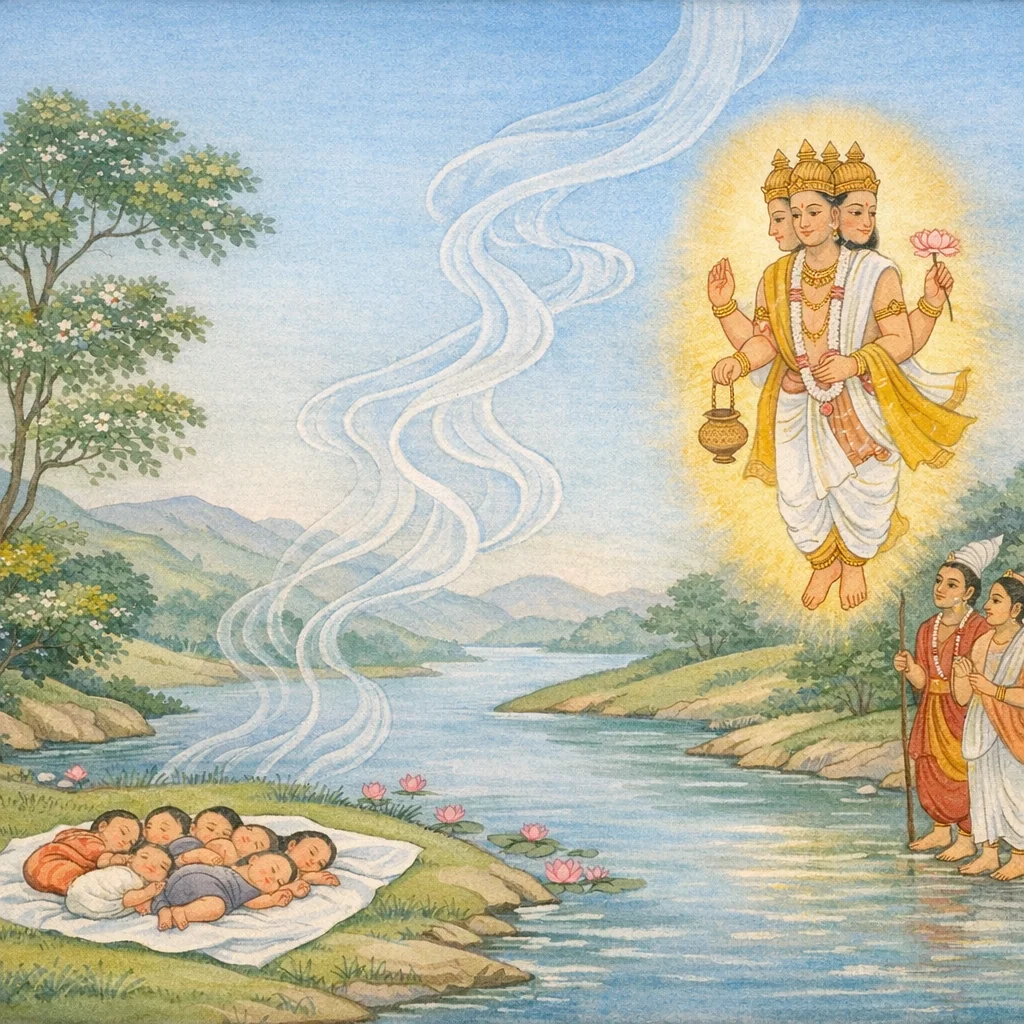
Adhyaya 46: Origins of the Maruts Across the Manvantaras (Pulastya–Narada Dialogue)
मरुत्-उत्पत्ति-वर्णनम् (Marut-Utpatti-Varṇanam)
Across the Manvantaras
Within the Pulastya–Narada narrative framework, this adhyāya systematizes the mythic genealogy of the Maruts by tracing their repeated births across successive manvantaras. Narada’s inquiry—how the Maruts existed previously and by what ‘marunmārga’ (aerial path/office)—elicits Pulastya’s account beginning from Svāyambhuva Manu onward. The chapter presents a recurring etiological pattern: extraordinary conceptions (often via displaced śukra), maternal crisis or abandonment, and Brahmā’s intervention that names and installs the crying infants as ‘Maruts,’ assigning them to the wind-path and divine service. The narrative foregrounds tapas as a cosmic force and also as a site of disruption (Indra’s fear of rivals; apsaras as agents of vighna), thereby explaining why Marut-groups arise through fractured ascetic economies. While this unit is not a Kurukṣetra-tīrtha catalogue, it contributes to Purāṇic syncretic theology by integrating Brahmā’s ordinance, Indra’s political anxiety, and Vāyu’s sphere into a coherent cosmological office for the Maruts.
Divine Beings
Sacred Geography
Mortal & Asura Figures
Key Content Points
- Pulastya answers Narada’s question by narrating the Maruts’ origins across manvantaras, beginning with Svāyambhuva Manu and continuing through Svārociṣa, Uttama, Tāmasa, Raivata, and Cākṣuṣa.
- A repeated birth-pattern is established: anomalous conception (often involving śukra falling into water or fire), subsequent social/ritual rupture (widowhood, abandonment, loss of brahma-tejas), and Brahmā’s arrival to stop the infants’ crying and appoint them as ‘Maruts’ who move in the sky and traverse the vāyu-mārga.
- Indra’s anxiety about ascetics seeking the ‘padam aindram’ motivates interference via the apsaras Pūtanā; the episode explains how tapas can be diverted, producing new Marut-groups and reconfiguring royal/ascetic destinies.
Shlokas in Adhyaya 46
Verse 1
एवं पुरा स्वानपि सोदरान् स गर्भस्थितानुज्जरितुं भयार्तः बिभेद वज्रेण ततः स गोत्रभित् ख्यातो महर्षे भगवान् महेन्द्रः // वम्प्_45.42 इति श्रीवामनपुराणे पञ्चचत्वारिंशो ऽध्यायः नारद उवाच यदमी भवता प्रोक्ता मरुतो दितिजोत्तमाः तत् केन पूर्वमासन् वै मरुन्मार्गेण कथ्यताम्
Thus, long ago, Mahendra—stricken with fear—split with his thunderbolt even those (beings) who were his own brothers, in order to bring forth those who were within the womb. Thereupon that blessed Mahendra became renowned, O great sage, as ‘Gotrabhid’ (the cleaver of the mountain/obstacle). (Here ends the forty-fifth chapter of the Śrī Vāmana Purāṇa.) Nārada said: “Those Maruts whom you have described as the excellent offspring of Diti—what were they previously? Please explain this by the account of the ‘Marut-path’ (marunmārga).”
Verse 2
पूर्वमन्वन्तरेष्वेव समतीतेषु सत्तम् के त्वासन् वायुमार्गस्थास्तन्मे व्याख्यातुमर्हसि
["Brahmā", "Vāyu"]
Verse With well-feathered shafts called Nārācas he covered the enemy forces—together with their chariots
तामन्तरिक्षादशरीरिणी वाक् प्रोवाच मा राजपत्नीह रोदीः यद्यस्ति ते सत्यमनुत्तमं तदा भवत्वयं ते पतिना सहाग्निः
[]
Verse 10
सो ऽथाब्रवीन्मा रुदस्वायताक्षि पुत्रास्त्वत्तो भूमिपालस्य सप्त भविष्यन्ति वह्निमारोह शीघ्रं सत्यं प्रोक्तं श्रद्दधत्स्व त्वमद्य // वम्प्_46.9 इत्येवमुक्ता खचरेण बाला चितौ समारोप्य पितं वरार्हम् हुताशमासाद्य पतिव्रता तं संचिन्तयन्ती ज्वलनं प्रवनन्ना
Then he said: “Do not weep, large-eyed one. From you the king shall have seven sons. Mount the fire quickly; what is spoken is true—believe it today.” Thus addressed by the sky-moving being, the young woman—mindful of her husband—placed that most excellent lord (her husband) upon the funeral pyre; approaching the fire, the devoted wife, meditating upon him, entered the blazing flames.
Verse 11
ततो मुहूर्तान्नृपतिः श्रिया युतः समुत्तस्थौ सहितो भार्ययासौ खमुत्पपाताथ स कामचारी समं महिष्या च सुनाभपुत्र्या
Then, after a short while, the king—endowed with splendor—rose up together with his wife. Thereupon, able to move at will, he leapt into the sky along with the queen, the daughter of Sunābha.
Verse 12
तस्याम्बरे नारद पार्थिवस्य जाता रजोगा महिषी तु गच्छतः स दिव्ययोगात् प्रतिसंस्थितो ऽम्बरे भार्यासहायो दिवसानि पञ्च
O Nārada, while that king was moving through the sky, his chief queen began her menstrual period. By a divine yogic power he remained stationed in the mid-air, together with his wife, for five days.
Verse 13
ततस्तु षष्ठे ऽहनि पार्थिवेन ऋतुर्न वन्ध्यो ऽद्य भवेद् विचिन्त्य रराम तन्व्या सह कामचारी ततो ऽम्बरात् प्राच्यवतास्य शुक्रम्
Then, on the sixth day, the king—reflecting, ‘In this season (fertile time) she should not remain barren today’—sporting at will, enjoyed with the slender lady. Thereupon his semen fell down from the sky.
Verse 15
शुक्रोत्सर्गावसाने तु नृपतिर्भार्यया सह जगाम दिव्यया गत्या ब्रह्मलोकं तपोधन 46.14 तदम्बरात् प्रचलितमभ्रवर्णं शुक्रं समाना नलिनी वपुष्मती चित्रा विशाला हरितालिनी च सप्तर्षिपत्न्यो ददृशुर्यथेच्छया
When the emission of semen was completed, the king, together with his wife, went by a divine mode of travel to Brahmaloka, O treasure of austerity. Then that semen, set in motion from the sky and cloud-colored, was seen—according to their will—by the wives of the Seven Ṛṣis: Samānā, Nalinī, Vapuṣmatī, Citrā, Viśālā, and Haritālinī.
Verse 16
तद् दृष्ट्वा पुष्करे न्यस्तं प्रत्यैच्छन्त तपोधन मन्यमानास्तदमृतं सदा यौवनलिप्सया
O treasure of austerity, seeing that (substance) placed in Puṣkara, they desired to obtain it, thinking it to be nectar, out of a constant longing for youth.
Verse 17
ततः स्नात्वा च विधिवत् संपूज्य तान् निजान् पतीन् पतिभिः समनुज्ञाताः पपुः पुष्करसंस्थितम्
Then, having bathed according to rule and duly honored their own husbands, and having been permitted by those husbands, they drank that which was situated in Puṣkara.
Verse 18
तच्छुक्रं पार्थिवेन्द्रस्य मन्यमानास्तदामृतम् पीतमात्रेण शुक्रेण पार्थिवेन्द्रोद्भवेन ताः
Thinking that semen of the lord of the earth (the king) to be nectar, by merely drinking that semen—originating from the king—they (were affected/changed accordingly).
Verse 19
ब्रह्मतेजोविहीनास्ता जाताः पत्न्यस्तपस्विताम् ततस्तु तत्यजुः सर्वे सदोषास्ताश्च पत्नयः
The wives of the ascetics became bereft of brahma-tejas (sacred spiritual radiance). Therefore, all of them abandoned those wives, for those wives had become ‘fault-bearing’ (tainted).
Verse 20
सुषुवुः सप्त तनयान् रुदतो भैरवं मुने तेषां रुदितशब्देन सर्वमापूरितं जगत्
They gave birth to seven sons, crying in a dreadful manner, O sage. By the sound of their crying, the entire world was filled.
Verse 21
अथाजगाम भगवान् ब्रह्म लोकपितामहः समभ्येत्याब्रवीद् बालान् मा रुदध्वं महाबलाः
Then the Blessed Lord Brahmā, the grandsire of the worlds, arrived. Approaching, he spoke to the children: ‘Do not cry, O mighty ones.’
Verse 22
मरुतो नाम यूयं वै भविष्यध्वं वियच्चराः इत्येवमुक्त्वा देवेशो ब्रह्म लोकपितामहः
“‘You shall indeed be known as the Maruts, moving through the sky.’ Having spoken thus, the Lord of the gods—Brahmā, the grandsire of the world—(so ordained them).”
Verse 23
तानादाय वियच्चारी मारुतानादिदेश ह ते त्वासन् मरुतस्त्वाद्या मनोः स्वायंभुवे ऽन्तरे
“Taking them up, the sky-ranging (Brahmā) appointed those Maruts. And those were indeed the first Maruts, within the Manvantara of Svāyambhuva Manu.”
Verse 24
स्वारेचिषे तु मरुतो वक्ष्यामि शृणु नारद स्वारोचिषस्य पुत्रस्तु श्रीमानासीत् क्रतुध्वजः
“Now I shall tell (you) about the Maruts in the Svārociṣa (Manvantara); listen, O Nārada. Svārociṣa had a son, the illustrious Kratudhvaja.”
Verse 25
तस्य पुत्राभवन् सप्त सप्तार्च्चिःप्रतिमा मुने तपोर्ऽथं ते गताः शैलं महामेरुं नरेश्वराः
O sage, he had seven sons, resembling the Seven Flames (Saptārci). Those royal sons went to the mountain Mahāmeru for the sake of performing austerities.
Verse 26
आराधयन्तो ब्रह्मणं पदमैन्द्रमथेप्सवः ततो विपश्चिन्नामाथ सहस्राक्षो भयातुरः
Seeking the Indra-status, they propitiated Brahmā. Then Sahasrākṣa (Indra), distressed by fear, (took notice)—and (one among them was) named Vipaścit.
Verse 27
पूतनामप्सरोमुख्यां प्राह नारद वाक्यवित् गच्छस्व पूतने शैलं महामेरुं विशालिनम्
O Nārada, the eloquent one said to Pūtanā, foremost among the apsarases: ‘Go, Pūtanā, to the broad mountain Mahāmeru.’
Verse 28
तत्र तप्यन्ति हि तपः क्रतुध्वजसुता महत् यथा हि तपसो विघ्नं तेषां भवति सुन्दरि
“There, O daughter of Kratudhvaja, they are performing great austerities. Therefore, O fair one, become an obstacle to their austerity.”
Verse 29
तथा कुरुष्व मा तेषां सिद्धिर्भवतु सुन्दरि इत्येवमुक्ता शक्रेण पूतना रूपशालिनी
“Do so, O fair one—let their success (siddhi) not come to fruition.” Thus addressed by Śakra, Pūtanā, endowed with a captivating form, (prepared to act).
Verse 30
तत्राजगाम त्वरिता यत्रातप्यन्त ते तपः आश्रमस्याविदूरे तु नदी मन्दोदवाहिनी
“She went there swiftly, to the place where they were practicing austerities. Not far from the hermitage there was a river, flowing with gentle (slow) water.”
Verse 31
तस्यां स्नातुं समायाताः सर्व एव सहोदराः सापि स्नातुं सुचार्वङ्गी त्ववतीर्णा महानदीम्
All the brothers together came there to bathe. She too—beautiful-limbed and fair-bodied—descended into the great river in order to bathe.
Verse 32
ददृशुस्ते नृपाः स्नातां ततश्चुक्षुभिरे मुने तेषां च प्राच्यवच्छुक्रं तत्पपौ जलचारिणी
Those kings saw her bathing; then, O sage, they became agitated. And their semen, as it flowed forth, was drunk by a water-roaming female creature.
Verse 33
शङ्खिना ग्राहमुख्यस्य महाशङ्खस्य वल्लभा ते ऽपि विभ्रष्टतपसो जग्मू राज्यं तु षैतृकम्
She was Śaṅkhinā, the beloved of the foremost of aquatic creatures—Mahāśaṅkha. Those (kings) too, their austerity impaired, went back to their kingdom together with their retinue.
Verse 34
सा चापसराः शक्रमेत्य याथातथ्यं न्यवेदयत् ततो बहुतिथे काले सा ग्राही शङ्खरूपिणी
That apsaras approached Śakra (Indra) and reported the matter exactly as it had occurred. Then, after a long interval of time, she became a crocodile, assuming the form of a conch.
Verse 35
समुद्धृता महाजालौर्मत्स्यबन्धेन मानिनी स तां दृष्ट्वा महाशङ्खी स्थलास्थां मत्स्यजीविकः
The proud one (now in that state) was hauled up by a fisherman using great nets. Seeing her—(appearing as) a great conch and lying upon the ground—the fisherman, whose livelihood was fishing, (took notice).
Verse 36
निवेदयामास तदा क्रतुध्वजसुतेषु वै तथाभ्येत्य महात्मानो योगिनो योगधारिणः
Then he reported it to the sons of Kratudhvaja. Thereupon, great-souled yogins—bearers of yoga—also came there.
Verse 37
नीत्वा स्वमन्दिरं सर्वे पुरवाप्यां समुत्सृजन् ततः प्रमाच्छङ्खिनी सी सुषुवे सप्त वै शिशून्
Having taken (her) to their own dwelling, they all then abandoned (her) in the Puravāpī. Thereupon that woman, Śaṅkhinī, gave birth indeed to seven infants.
Verse 38
जातमात्रेषु पुत्रेषु मोक्षभावमगाच्च सा अमातृपितृका बाला जलमध्यविहारिणः
As soon as the sons were born, she attained the state of liberation. Those children—bereft of mother and father—moved about in the midst of the water.
Verse 39
स्तान्यार्थिनो वै रुरुदुराथाभ्यागात् पितामहः मा रुदध्वमितीत्याह मरुतो नाम पुत्रकाः
Crying for milk, they wept indeed. Then Pitāmaha (Brahmā) came near and said, ‘Do not weep.’ Thus the children came to be called by the name ‘Maruts’.
Verse 40
यूयं देवा भविष्यध्वं वायुस्कन्धविचारिणः इत्येवमुक्त्वाथादाय सर्वास्तान् दैवतान् प्रति
“You shall become gods, moving upon the shoulders (i.e., currents) of the Wind.” Having spoken thus, he then took up (i.e., gathered/led) all those divine beings and proceeded toward the assembly of the gods.
Verse 41
नियोज्य च मरुमार्गे वैराजं भवनं गतः एवमासंश्च मरुतो मनोः स्वारोचिषे ऽन्तरे
And having assigned them to the path/region of the Maruts, he went to the splendid (Vairāja) abode. Thus indeed were the Maruts during the interval (i.e., the Manvantara) of Svārociṣa Manu.
Verse 42
उत्तमे मरुतो ये च ताञ्छृणुष्व तपोधन उत्तमस्यान्ववाये तु राजासीन्निषधाधिपः
Now hear about those Maruts who belonged to (the group called) Uttama, O treasure of austerity. And in the lineage of Uttama there was a king, the lord of Niṣadha.
Verse 43
वपुष्मानिति विख्यातो वपुषा भास्करोपमः तस्य पुत्रो गुणश्रेष्ठो ज्योतिष्मान् धार्मिको ऽभवत्
He was renowned by the name Vapuṣmān, whose bodily splendor was like that of the Sun. His son, pre-eminent in virtues, was Jyotiṣmān, a righteous man.
Verse 44
स पुत्रार्थो तपस्तेपे नदीं मन्दाकिनीमनु तस्य भार्या च सुश्रोणी देवाचार्यासुता शुभा
Desiring a son, he performed austerities along the river Mandākinī. His wife was Suśroṇī, an auspicious woman, the daughter of the preceptor of the gods.
Verse 45
तपश्चारणयुक्तस्य बभूव परिचारिका सा स्वयं फलपुष्पाम्बुसमित्कुशं समाहरत्
For him who was engaged in the practice of austerities, she became an attendant in service; she herself gathered fruits, flowers, water, fuel-sticks, and kuśa grass.
Verse 46
चकार पद्मपत्राक्षी सम्यक् चातिथिपूजनम् पतिं शुश्रूषमाणा सा कृशा धमनिसंतता
The lotus-eyed woman duly performed the honoring of guests. Attending devotedly upon her husband, she became emaciated, her veins standing out in continuous lines.
Verse 47
तेजोयुक्ता सुचार्वङ्गीं दृष्टा सप्तर्षिभिर्वने तां तथा चारुसर्वाङ्गीं दृष्ट्वाथ तपसा कृसाम्
In the forest the Seven Sages beheld her—radiant, of lovely limbs. Seeing that woman, beautiful in all her parts yet made thin by austerity, (they were moved to inquire).
Verse 48
पप्रच्छुस्तपसो हेतुं तस्यास्तद्भर्तुरेव च साब्रवीत् तनयार्थाय आवाभ्यां वै तपःक्रिया
They asked the reason for her austerity, and also (the condition) of her husband. She replied: ‘For the sake of obtaining a son, we two have indeed undertaken the practice of austerity.’
Verse 49
ते चास्यै वरदा ब्रह्मन् जाताः सप्त सहर्षयाः व्रजध्वं तनयाः सप्त भविष्यन्ति न सशं यः
O Brahmin, those seven sages became bestowers of boons to her. “Depart now; seven sons will be born (to you/her)—there is no doubt.”
Verse 50
युवयोर्गुणसंयुक्ता महर्षीणां प्रसादतः इत्येवमुक्त्वा जग्मुस्ते सर्व एव महर्षयः
“Through the favor of the great sages, you two shall be endowed with virtues.” Having spoken thus, all those great sages departed.
Verse 51
स चापि राजर्षिरगात् सभार्यो नगरं निरम् ततो बहुतिथे काले सा राज्ञो महिषी प्रिया
That royal sage too went, together with his wife, to his own city. Then, after a considerable time had passed, that beloved chief queen of the king (…).[The verse is syntactically incomplete here and likely continues in the next śloka with the result—e.g., conception/birth.]
Verse 52
अवाप गर्भं तन्वङ्गी तस्मान्नृपतिसत्तमात् गुर्विण्यामथ भार्यायां ममारासौ नराधिपः
The slender-limbed queen conceived a child from that excellent king. Then, while his wife was pregnant, that ruler (narādhipa) died.
Verse 53
सा चाप्यारोढुमिच्छन्ती भर्तारं वै पतिव्रता निवारिता तदामात्यैर्न तथापि व्यतिष्ठता
She, being devoted to her husband (pativratā), wished to mount (the pyre) with her husband; though restrained then by the ministers, she still did not desist.
Verse 54
समारोप्याथ भर्तारं चितायामारुहच्च सा ततो ऽग्निमध्यात् सलिले मांसपेश्यपतन्मुने
Having placed her husband upon the funeral pyre, she too ascended it. Then, from the midst of the fire, a lump of flesh fell into water, O sage.
Verse 55
साम्भसा सुखशीतेन संसिक्ता सप्तधाभवत् ते ऽजायन्ताथ मरुत उत्तमस्यान्तरे मनोः
Sprinkled with cool, pleasant water, it became sevenfold; and from that were born the Maruts in the Manvantara of the Manu named Uttama.
Verse 56
तामसस्यान्तरे ये च मरुतो ऽप्यभवन् पुरा तानहं कीर्तयिष्यामि गीतनृत्यकलिप्रिय
And the Maruts who existed formerly in the Manvantara of Tāmasa—those I shall now recount, O one fond of song, dance, and sportive play.
Verse 57
तामसस्य मनोः पुत्रो ऋतध्वज इति श्रुतः स पुत्रर्थो जुहावाग्नौ स्वमांसं रुधिरं तथा
The son of the Manu Tāmasa was famed as Ṛtadhvaja. Desiring a son, he offered into the fire his own flesh, and likewise his blood.
Verse 58
अस्थीनि रोमकेशांश्च स्नायुमज्जायकृद्ःअनम् शुक्रं च चित्रगौ राजा सुतार्थो इति नः श्रुतम्
We have heard that King Sutārtha—also known as Citragau—(offered/consigned) bones, body-hair and head-hair, sinews, marrow, and even the substance of the liver, and also semen (as an oblation).
Verse 59
सप्तस्वेवार्चिषु ततः शुक्रपातादनन्तरम् मा मा क्षिपस्वेत्यभवच्छब्दः सो ऽपि मृतो नृपः
Then, among the seven flames, immediately after the falling of the semen, a cry arose: “Do not, do not throw me!” That king too died.
Verse 60
ततस्तस्माद्धुतवहात् सप्त तत्तेजसोपमाः शिशवः समजायन्त ते रुदन्तो ऽभवन् मुने
Then, from that Hutavaha (Agni), seven infants, comparable in radiance to him, were born; and they were crying, O sage.
Verse 61
तेषां तु ध्वनिमाकर्ण्य भगवान् पद्मसंभवः समागम्य निवार्य्याथ स चक्रे मरुतः सुतान्
Hearing their tumult, the Blessed One—Padma-sambhava (Brahmā, ‘born from the lotus’)—came there and restrained them; then he brought into being the Maruts as sons.
Verse 62
ते त्वासन् मरुतो ब्रह्मंस्तमसे देवतागणाः ये ऽभवन् रैवते तांश्च शृणुष्व त्वं तपोधनः
Those indeed were the Maruts, O Brahmin—divine hosts belonging to (the period called) Tāmasa. And those who arose in (the period of) Raivata—listen to them as well, O treasure of austerity.
Verse 63
रैवतस्यान्ववाये तु राजासीद् रिपुजिद् वशी रिपुजिन्नामतः ख्यातो न तस्यासीत् सुतः किल
Now, in the lineage of Raivata there was a king—Ripu-jit, self-controlled—renowned by the name Ripu-jit; and indeed, it is said that he had no son.
Verse 64
स समाराध्य तपसा भास्करं तेजसां निधिम् अवाप कन्यां सुरतिं तां प्रगृह्य गृहं ययौ
Having propitiated Bhāskara (the Sun) through austerity—he who is the treasury of radiance—he obtained the maiden Surati; taking her by the hand, he returned home.
Verse 65
तस्यां पितृगृहे ब्रह्मन् वसन्त्यां स पिता मृतः सापि दुःखपरीताङ्गीं स्वां तनुं त्यक्तुमुद्यता
While she was living in her father’s house, O Brāhmaṇa, her father died; and she too—her body overwhelmed by grief—became intent on abandoning her own body (ending her life).
Verse 66
ततस्तां वारयामासुरृषयः सप्त मानसाः तस्यामासक्तचित्तास्तु सर्व एव तपोधनाः
Then the seven sages, the Mānasas, restrained her; and all of them—rich in ascetic power—had their minds become attached to her.
Verse 67
अपारयन्ती तद्दुःखं प्रज्वाल्याग्निं विवेश ह ते चापश्यन्त ऋषयस्तच्चित्ता भावितास्तथा
Unable to endure that sorrow, she kindled a fire and entered it. The sages too saw this, their minds deeply affected and absorbed in that event.
Verse 68
तां मृतामृषयो दृष्ट्वा कष्टं कष्टेति वादिनः प्रजग्मुर्ज्वलनाच्चापि सप्ताजायन्त दारकाः
Seeing her dead, the sages exclaimed, ‘Alas, alas!’ Then, from the blazing fire as well, seven children were born.
Verse 69
ते च मात्रा विनाभूता रुरुदुस्तान् पितामहः निवारयित्वा कृतवांल्लोकनाथो मरुद्गणान्
And those (children), being without a mother, wept. Then Pitāmaha, having restrained/comforted them, the Lord of the world made them into the host of Maruts.
Verse 70
रैवतस्यान्तरे जाता मरुतो ऽमी तपोधन शृणुष्व कीर्तयिष्यामि चाक्षुषस्यान्तरे मनोः
O treasure of austerity, listen: these Maruts were born in the Manvantara of Raivata. I shall now recount (what occurred) in the Manvantara of Cākṣuṣa Manu.
Verse 71
आसीन्मङ्किरिति ख्यातस्तपस्वी सत्यवाक् शुचिः सप्तसारस्वते तीर्थे सो ऽतप्यत महत् तपः
There was an ascetic renowned as Maṅkiri—truth-speaking and pure. At the tīrtha called Sapta-Sārasvata he practiced great austerity.
Verse 72
विघ्नार्थं तस्य तुषिता देवाः संप्रेषयन् वपुम् सा चाभ्येत्य नदीतीरे क्षोभयामास भामिनी
To create an obstacle for him, the Tuṣita gods dispatched a (female) form. She came to the riverbank and, as a passionate woman, sought to disturb him.
Verse 73
ततो ऽस्य प्राच्यवच्छ्रुक्रं सप्तसारस्वते जले तां चैवाप्यशपन्मूढां मुनिर्मङ्कणको वपुम्
Then, as before, his semen flowed forth into the waters of the Sapta-Sārasvata. Having reached that deluded woman, the sage Maṅkaṇaka cursed her bodily form.
Verse 74
गच्छ लब्धासि मूढे त्वं पापस्यास्य महत् फलम् विध्वंसयिष्यति हयो भवतीं यज्ञसंसदि
‘Go! O deluded one, you have obtained the great fruit of this sin. A horse will destroy you in the assembly of the sacrifice.’
Verse 75
एवं शप्त्वा ऋषिः श्रीमान् जगामाथ स्वमाश्रमम् सरस्वतीभ्यः सप्तभयः सप्त वै मरुतो ऽभवन्
Having thus pronounced the curse, the illustrious sage then went to his own hermitage. From the Sarasvatīs, seven ‘Bhaya’ (fear-causing beings/forces) arose; indeed, they became the seven Maruts (winds).
Verse 76
एतत् तवोक्ता मरुतः पुरा यथा जाता वियद्व्याप्तिकरा महर्षे येषां श्रुते जन्मनि पापहानिर्भवेच्च धर्माभ्युदयो महान् वै
“Thus have you (already) told, O great sage, how the Maruts were formerly born—those who pervade the sky. By hearing the account of their birth, the destruction of sins occurs, and a great increase of dharma indeed arises.”
Frequently Asked Questions
Pulastya explains that Brahmā repeatedly names the crying infants ‘Maruts’ and assigns them to the marunmārga/vāyu-mārga—an aerial, wind-associated divine office—thereby converting anomalous births into a regulated devatā-gaṇa with cosmological duties.
The chapter names Puṣkara (where śukra is seen and consumed), Saptasārasvata Tīrtha and the Sarasvatī waters (where another Marut-group arises), and rivers such as Mandodavāhinī and Mandākinī. These sites function as topographical sanctifiers: waters and fire-altars become generative thresholds where tapas, transgression, and divine ordinance produce new marut-gaṇas.
It focuses elsewhere: Chapter 46 is primarily an etiological and manvantara-structured account of Marut origins within the Pulastya–Narada frame, emphasizing Brahmā’s institutional role and Indra’s anxiety over ascetic competitors rather than the Bali–Vāmana conflict.