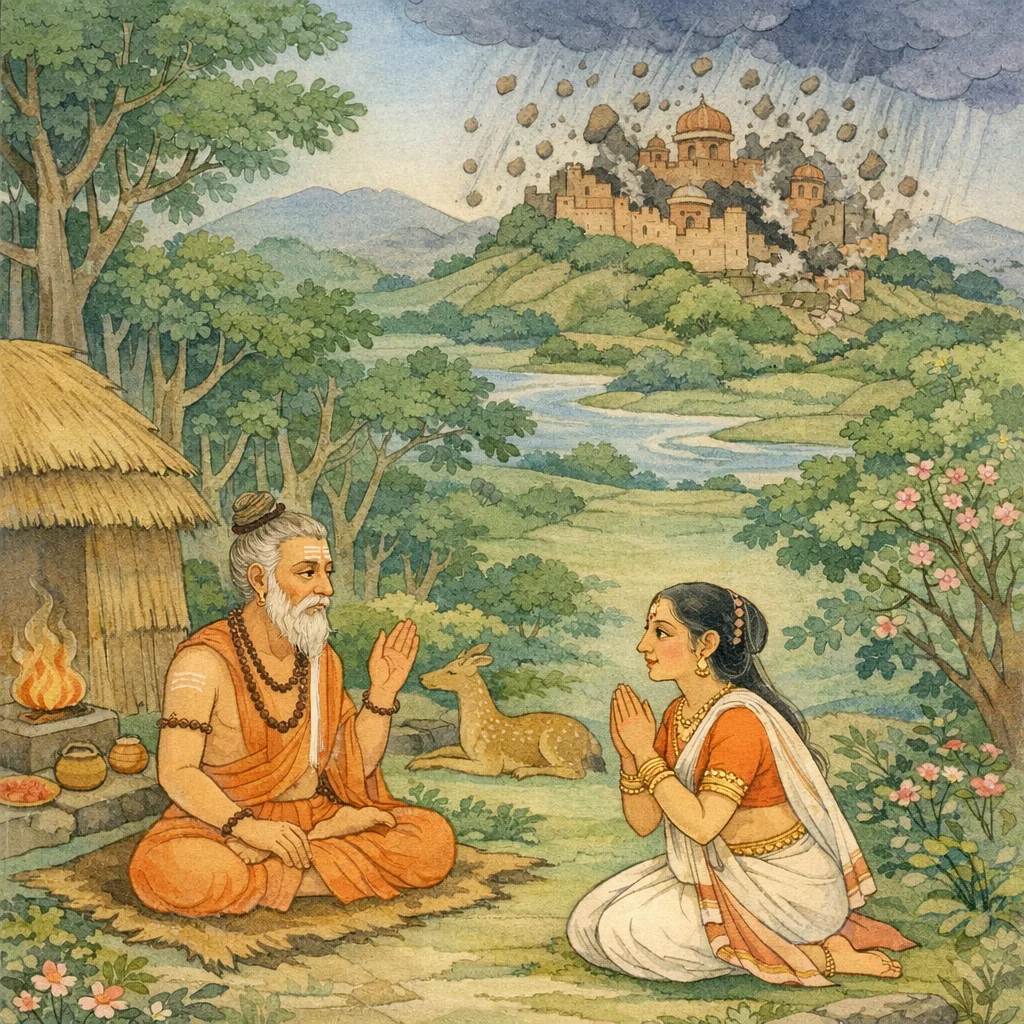
Adhyaya 39: Shukra’s Curse on King Danda and Andhaka’s Challenge to Shiva
शुक्रशापः दण्डविनाशश्च (Śukra-śāpaḥ Daṇḍa-vināśaś ca)
Andhaka Challenges Shiva
Within the Pulastya–Nārada narrative frame, this Adhyāya interweaves asura-dharma instruction with a Shaiva-centered conflict. The episode opens with Araja, daughter of Śukra, violated by King Daṇḍa despite resistance; Śukra returns from Pātāla, interrogates his daughter, and—after ritual purification—utters a decisive curse: Daṇḍa, with his realm, forces, and vehicles, will be reduced to ashes within seven nights by a rain of stones. Araja is enjoined to remain and perform tapas for expiation. The text then pivots to a didactic warning against parastrī-gamana (appropriating another’s wife), presenting ethical exempla and infernal consequences (Raurava and other hells), thereby framing sexual transgression as a cause of political annihilation. Finally, Andhaka rejects Prahlāda’s counsel and provocatively demands Pārvatī from Śiva on Mandara, initiating a martial mobilization against Tryambaka—an implicit assertion of Śiva’s unassailable sovereignty within the Purāṇa’s syncretic theology.
Divine Beings
Sacred Geography
Mortal & Asura Figures
Key Content Points
- Śukra’s return, inquiry, and curse: King Daṇḍa is destroyed (with kingdom and army) by grāva-vṛṣṭi (stone-rain) within seven nights; Araja is directed to undertake tapas for pāpa-mokṣa.
- Dharma discourse within the Pulastya–Nārada frame: Prahlāda warns Andhaka against parastrī-sevana, contrasting dharmic self-restraint with adharmic ruin and describing naraka outcomes (notably Raurava).
- Escalation to Shaiva conflict: Andhaka sends Śambara to Mandara to confront Śiva; Pārvatī proposes a battle-wager (prāmadyūta) and Andhaka’s forces assemble to challenge Tryambaka.
Shlokas in Adhyaya 39
Verse 1
इति श्रीवामनपुराणे अष्टात्रिंशो ऽध्यायः दण्डक उवाच एतस्मिन्नन्तरे बाले यक्षासुरसुते शुभे समागते हरं द्रष्टुं श्रीकण्ठं योगिनां वरम्
Thus ends the thirty-eighth chapter of the Śrī Vāmana Purāṇa. Daṇḍaka said: Meanwhile, when the two auspicious young maidens—daughters of a Yakṣa and an Asura—had arrived, they came to behold Hara, Śrīkaṇṭha, the supreme among yogins.
Verse 2
ददृशाते परिम्लानसंशुष्ककुसुमं विभुम् बहुनिरमालल्यसंयुक्तं गते तस्मिन् ऋतध्वजे
They beheld the Lord, whose flowers were withered and dried, and who was covered with many (old) garlands and floral remnants, after that Ṛtadhvaja had departed.
Verse 3
ततस्तं वीक्ष्य देवेशं ते उभे अपि कन्यके स्नापयेतां विधानेन पूजयेतामहर्निशम्
Then, having seen that Lord of the gods, the two maidens bathed him according to proper rite and worshipped him day and night.
Verse 4
ताभ्यां स्थिताभ्यां तत्रैव ऋषिपभ्यागमद् वनम् द्रष्टुं श्रिकण्ठमव्यक्तं गालवो नाम नामतः
While those two remained standing there, a forest was approached by a sage in order to behold Śrīkaṇṭha, the Unmanifest. The sage was named Gālava.
Verse 5
स दृष्ट्वा कन्यकायुग्मं कस्येदमिति चिन्तयन् प्रविवेश शुचिः स्नात्वा कालिन्द्या विमले जले
Seeing the pair of maidens, and pondering, ‘Whose are these?’, he entered (the sacred precinct). Having bathed and become purified in the spotless waters of the Kālindī, he proceeded.
Verse 6
ततो ऽनुपूजयामास श्रीकण्ठं गालवो मुनिः गायेते सुस्वरं गीतं यक्षासुरसुते ततः
Then the sage Gālava duly worshipped Śrīkaṇṭha. Thereupon, the two—daughters of a Yakṣa and an Asura—sang a song in a beautiful voice.
Verse 7
ततः स्वरं समाकर्ण्य गालवस्ते अजानत गन्धर्वकन्येक चैते संदेहो नात्र विद्यते
Then, on hearing the sound, Galava—though not recognizing (its source at first)—understood: “These are indeed Gandharva maidens; there is no doubt about it.”
Verse 8
संपूज्य देवमीशानं गालवस्तु विधानतः कृतजप्यः समध्यास्ते कन्याभ्यामबिवादितः
Having duly worshipped the god Īśāna, Galava—according to prescribed procedure—performed his recitations and sat in meditation, being respectfully greeted by the two maidens.
Verse 9
ततः पप्रच्छ स मुनिः कन्यके कस्य कथ्यताम् कुलालङ्कारणे भक्तियुक्ते भवस्य हि
Then that sage asked: “O maidens, tell (me)—whose (daughters/attendants) are you? You are adorned as ornaments of a noble lineage, and you are devoted—indeed—unto Bhava (Shiva).”
Verse 10
तमूचतुर्मुनिश्रेष्ठं याथातथ्यं शुभानने जातो विदितवृत्तान्तो गालवस्तपतां वरः
Then those two maidens, of auspicious countenance, spoke to that best of sages, relating the matter exactly as it had occurred. Gālava—foremost among ascetics—having come to know the full account (of events), listened/understood it.
Verse 11
समुष्य तत्र रजनीं ताभ्यां संपूजितो मुनिः प्रातरुत्थाय गौरीसं संपूज्य च विधानतः
Having spent the night there, the sage—duly honored by those two—rose in the morning and, according to proper rite, worshipped Gaurīśa (the Lord of Gaurī).
Verse 12
ते उपेत्याब्रवीद्यास्ये पुष्करारण्यमुत्तमम् आमन्त्रयामि वां कन्ये समनुज्ञातुमर्हथः
Approaching them, he said: ‘I shall go to the excellent forest of Puṣkara. I take leave of you, O maidens; you ought to grant me permission (to depart).’
Verse 13
ततस्ते ऊचतुर्ब्रहन् दुर्लभं दर्शनं तव किमर्थं पुष्करारण्यं भवान् यास्यत्यथादरात्
Then they said: “O Brahman, rare indeed is the sight of you. For what purpose do you, with such earnestness, intend to go to the forest of Puṣkara?”
Verse 14
ते उवाच महातेजा महत्कार्यसमन्वितः कार्तिकी पुण्यदा भाविमासान्ते पुष्करेषु हि
The great-splendored one replied, intent upon an important purpose: “The Kārtikī (observance/season) is about to occur—bestowing merit—at the end of the month, indeed at Puṣkara.”
Verse 15
ते ऊचतुर्वयं यामो भवान् यत्र गमिष्यति न त्वया स्म विना ब्रह्मन्निह चस्थातुं हि शक्नुवः
They said: “We shall go wherever you will go. Without you, O Brahman, we are not able to remain here.”
Verse 16
बाढमाह ऋषिश्रेष्ठस्ततो नत्वा महेश्वरम् गते ते ऋषिणा सार्द्धू पुष्करारण्यमादरात्
Then the foremost of sages replied, “So be it.” Having bowed to Maheśvara (Śiva), they departed together with that sage and, with reverence, went to the Puṣkara forest (Puṣkarāraṇya).
Verse 17
तथान्ये ऋषयस्तत्र समायाताः सहस्रशः पार्थिवा जानपद्याश्च मुक्त्वैकं तमृतध्वजम्
Likewise, many other sages came there by the thousands; and kings and regional rulers (leaders of provinces) also came—leaving aside only that one, Ṛtadhvaja.
Verse 18
ततः स्नाताश्च कार्तिक्यामृषयः पुष्करेष्वथ राजानश्च महाभागा नाभागेक्ष्वाकुसंयुताः
Then, in the month of Kārtika, the sages bathed at the Puṣkaras; and fortunate kings too—together with Nābhāga and Ikṣvāku—(performed the bathing rites there).
Verse 19
गालवो ऽपि समं ताभ्यां कन्यकाभ्यामवातरत् स्नातुं स पुष्करे तीर्थे मध्यमे धनुषाकृतौ
Galava also descended together with those two maidens, in order to bathe at the sacred ford of Puṣkara—at the Middle Puṣkara, shaped like a bow.
Verse 20
निमग्नश् चापि ददृशे महामत्स्यं जलेशयम्ष बह्वीभिर्मत्स्यकन्याभिः प्रीयमाणं पुनः पुनः
And while immersed (in the water), he saw a great fish lying in the water, repeatedly being delighted (attended/pleased) by many fish-maidens.
Verse 21
स ताश्चाह तिमिर्मुग्धाः यूयं धर्मं न जानथ जनापवादं घोरं हि न शक्तः सोढुमुल्बणम्
He said to them: ‘Deluded by darkness, you do not understand dharma. For one is not able to endure the dreadful, overwhelming reproach of people.’
Verse 22
तास्तमूचुर्महामत्स्यं किं न पस्यसि गालवम् तापसं कन्यकाभ्यां वै विचरन्तं यथेच्छया
They said to that great fish: “Do you not see the ascetic Gālava, wandering about at will together with two maidens?”
Verse 23
यद्यसावपि धर्मात्मा न बिभेति तपोधनः जनापवादात् तत्किं त्वं बिभेषु जलमध्यगः
“If that one—righteous-souled and rich in austerity—does not fear public reproach, then why do you, who dwell in the midst of the water, fear?”
Verse 24
ततस्ताश्चाह स तिमिर्नैष वेत्ति तपोधनः रागान्धो नापि च भयं विजानाति सुबालिशः
Then he said to them: “This ascetic, because of darkness, does not understand; blinded by passion, that very foolish one does not even recognize fear.”
Verse 25
तच्छ्रुत्वा मत्स्यवचनं गालवो व्रीडया युतः नोत्तत्तार निमग्नो ऽपि तस्थौ स विजितेन्द्रियः
Hearing the fish’s words, Gālava—filled with shame—did not rise up, though he was submerged; self-controlled, he remained where he was.
Verse 27
स्नात्वा ते अपि रम्भोरु समुत्तीर्य तटे स्थिते प्रतीक्षन्त्यौ मुनिवरं तद्दर्शनसमुत्सुके / 39.26 वृत्ता च पुष्करे यात्रा गता लोका यथागतम् ऋषयः पार्थिवाश्चान्ये नाना जानपदस्तदा
After bathing, those two slender-thighed women also came out and stood upon the bank, eagerly awaiting the best of sages, longing for his sight. And when the pilgrimage at Puṣkara had concluded, the people departed as they had come—sages, kings, and others from many regions at that time.
Verse 28
तत्र स्थितैका सुदती विश्वकर्मतनुरुहा चित्राङ्गदा सुचार्वङ्गी वीक्षन्ती तनुमध्यमे
There stood a certain beautiful woman—said to have arisen from the body of Viśvakarman—named Citrāṅgadā, of lovely limbs and a slender waist, looking on.
Verse 29
ते स्थिते चापि वीक्षन्त्यौ प्रतीक्षन्त्यौ च गालवम् संस्थिते निर्जने तीर्थे गालवो ऽन्तर्जले तथा
While those two remained there—watching and waiting for Gālava—at that solitary sacred ford, Gālava too stayed there, within the water.
Verse 30
ततो ऽभ्यागाद् वेदवती नाम्ना गन्धर्वकन्यका पर्जन्यतनया साध्वी घृताचीर्गर्भसंभवा
Then there arrived a Gandharva maiden named Vedavatī—virtuous—daughter of Parjanya, born from the womb of Ghṛtācī.
Verse 31
सा चाभ्येत्य जले पुण्ये स्नात्वा मध्यमपुष्करे ददर्श कन्यात्रितयमुभयोस्तटयोः स्थितम्
She approached the holy water and, having bathed at Madhyama-Puṣkara, she saw a triad of maidens standing on both banks.
Verse 32
चित्राङ्गदामथाभ्येत्य पर्यपृच्छदनिष्ठुरम् कासि केन च कार्येण निर्जने स्थितवत्यसि
Then Citrāṅgadā approached her and gently questioned her: “Who are you, and for what purpose are you staying here in this lonely place?”
Verse 33
सा तामुवाच पुत्रीं मां विन्दस्व सुरव्रधकेः चित्राङ्गदेति सुश्रेणि विख्यातां विश्वकर्मणः
She said to her: “Know me as your daughter, O fair-hipped one—Citrāṅgadā by name—renowned as (a daughter) of Viśvakarman, the increaser of the gods.”
Verse 34
साहम्भयागाता भद्रे स्नातुं पुण्यां सरस्वतीम् नैमिषे काञ्चनाक्षीं तु विख्यातां धर्ममातरम्
“O auspicious one, I came here out of fear, to bathe in the holy Sarasvatī—at Naimiṣa—(and to seek) Kāñcanākṣī, renowned as the Mother of Dharma.”
Verse 35
तत्रागताथ राज्ञाहं दृष्टा वैदर्भकेण हि सुरथेन स कामार्तो मामेव शरणं गतः
“Then, when I had come there, I was seen by King Suratha of Vidarbha. Afflicted by desire, he came to me alone as his refuge.”
Verse 36
मयात्मा तस्य दत्तश्व सखीभिवार्यमाणया ततः शप्तास्मि तातेन वियुक्तास्मि च भूभुजा
“Though my companions tried to restrain me, I gave myself to him. Thereupon I was cursed by my father, and I was separated from that king.”
Verse 37
मर्तुं कृतमतिर्भद्रे वारिता गुह्यकेन च श्रीकण्ठमगमं द्रष्टुं ततो गोदावरं जलम्
“O noble lady, having resolved to die, I was restrained by a Guhyaka. Then I went to behold Śrīkaṇṭha, and thereafter (I went to) the waters of the Godāvarī.”
Verse 38
तस्मादिमं समायाता तीर्थप्रवरमुत्तम् न चापि दृष्टः सुरथः स मनोह्लादनः पतिः
“Therefore I have come to this most excellent, foremost sacred ford (tīrtha). Yet Suratha—my husband, the delight of my heart—has not been seen (here).”
Verse 39
भवती चात्र का बाले वृत्ते यात्राफले ऽधुना समागता हि तच्छंस मम सत्येन भामिनि
“Who are you here, young woman, now that the ‘fruit of the pilgrimage’ has come to pass? Since you have arrived, tell me that truly, O passionate one.”
Verse 40
साब्रवीच्छ्रुयतां यास्मि मन्दभाग्या कृशोदरी यता यात्राफले वृत्ते समायातास्मि पुष्करम्
She said: “Listen. I am ill-fated, slender-waisted. When the fruit of the pilgrimage came to pass, I arrived at Puṣkara.”
Verse 41
पर्जन्यस्य घृताच्यां तु जाता वेदवतीति हि रममाणा वनेद्देशे दृष्टास्मि कपना सखि
“Born of Parjanya and Ghṛtācī, I am indeed named Vedavatī. While I was roaming about in a forest-region, I was seen, O friend, by a monkey.”
Verse 42
स चाभ्येत्याब्रवीत् का त्वं यासि देववतीति हि आनीतास्यश्रमात् केन भूपृष्ठान्मेरुपर्वतम्
“And he (the monkey), approaching, said: ‘Who are you, going about like a goddess? From whose hermitage have you been brought here, from the surface of the earth, to Mount Meru?’”
Verse 43
ततो मयोक्तो नैवास्मि कपे देववतीत्यहम् नाम्ना वेदवतीत्येवं मेरोरपि कृताश्रया
“Then I said: ‘O monkey, I am not “Devavatī.” By name I am Vedavatī; thus I have taken refuge (made my abode) even upon Meru.’”
Verse 44
ततस्तेनातिदुष्टेन वानरेण ह्यभिद्रुता समारूढास्मि सहसा बन्दुजीवं नगोत्तमम्
Then, being chased by that exceedingly wicked monkey, I suddenly climbed up the excellent mountain called Bandujīva in haste.
Verse 45
तेनापि वृक्षस्तरसा पादाक्रान्तस्त्वभज्यत ततोस्य विपुलां वृक्षं प्राक्षिपत् सागराम्भसि सह तेनैव वृक्षेण पतितास्म्यहमाकुला
By him, that tree—trampled with force underfoot—was broken. Then he hurled that huge tree into the waters of the ocean; and together with that very tree I fell, distressed and confused.
Verse 46
ततः प्लवङ्गमो वक्षं प्राक्षिपत् सागराम्भसि सह तेनैव वृक्षेण पतितास्म्यहमाकुला
Then the monkey hurled the tree-trunk into the waters of the ocean; and with that very tree I fell, distressed and confused.
Verse 47
ततोम्बरतलाद् वृक्षं निपतन्तं यदृच्छया ददृशुः सर्वभूतानि स्तावराणि चराणि च
Then, by chance, all beings—both the immobile and the mobile—beheld a tree falling down from the surface of the sky.
Verse 48
ततो हाहाकृतं लोकैर्मा पतन्तीं निरीक्ष्य हि ऊचुश्च सिद्धगन्धर्वाः कष्टं सेयं महात्मनः
Then the worlds cried out ‘Alas!’ upon seeing her falling—‘Let her not fall!’ And the Siddhas and Gandharvas said: ‘This is a grievous calamity for that great-souled one.’
Verse 49
इन्द्रद्युम्नस्य महिषी गदिता ब्रह्मणा स्वयम् मनोः पुत्रस्य वीरस्य सहस्रक्रतुयाजिनः
She was declared to be the queen of Indradyumna—of that heroic son of Manu—who had performed sacrifices a thousand times, as Brahmā himself stated.
Verse 50
तां वाणीं मधुरां श्रुत्वा मोहमस्म्यागता ततः न च जाने स केनापि वृक्षश्छिन्नः सहस्रधा
Hearing that sweet voice, I then fell into bewilderment. And I do not know by whom that tree was cut into a thousand pieces.
Verse 51
ततो ऽस्मि वेगाद् बलिना हृतानलसखेन हि समानीतास्मयहमिमं त्वं दृष्टा चाद्य सुन्दरि
Then, swiftly, I was carried off by the strong one—indeed, by the friend of Fire. I was brought here, and today I have seen you, O beautiful one.
Verse 52
तदुत्तष्ठस्व गच्छावः पुच्छावः क इमे स्थिते कन्यके अनुपश्ये हि पुण्करस्योत्तरे तटे
Therefore, rise; let us go and ask who these persons are that stand here. O maiden, for I see (them) on the northern bank of Puṣkara.
Verse 53
एवमुक्त्वा वराङ्गी सा तया सुतनुकन्यया जगाम कन्यके द्रष्टुं प्रष्टुं कार्यसमुत्सुका
Having spoken thus, that fair-limbed lady, together with the slender-bodied maiden, went to see the young girl and to question her, eager to learn what was to be done.
Verse 54
ततो गत्वा पर्यपुच्छत् ते ऊचतुरुभे अपि याथातथ्यं तयोस्ताभ्यां स्वमात्मानं निवेदितम्
Then, having gone there, she questioned (them). Both of the two replied truthfully and exactly as it was; and to those two she disclosed her own identity.
Verse 55
ततस्ताश्तुरोपीह सप्तगोदावरं जलम् संप्राप्य तीर्थे पिष्ठन्ति अर्चन्त्यो हाटकेश्वरम्
Then those women, having reached here the waters of the ‘Seven-Godāvarī’ at the tīrtha, performed the prescribed rite (piṣṭhanti) and worshipped Hāṭakeśvara.
Verse 56
ततो बहून् वर्षगणान् बभ्रमुस्ते जनास्त्रयः तासामर्थाय शकुनिर्जाबालिः सऋतध्वजः
Thereafter, for many multitudes of years, those three persons wandered about. For the sake of their livelihood (or to accomplish their purpose), (they went along with/under) Śakuni, Jābāli, and Saṛtadhvaja.
Verse 57
भारवाही ततः खिन्नो दशब्दशतिके गते काले जगाम निर्वेदात् समं पित्रा तु शाकलम्
Then the burden-bearer, exhausted, when a period of one thousand years had passed, went out of dispassion (nirveda) together with his father to Śākala.
Verse 58
तस्मिन्नरपतिः श्रीमानिन्द्रद्युम्नो मनोः सुतः समध्यास्ते स विज्ञाय सार्घपात्रो विनिर्ययौ
There, the illustrious king Indradyumna, son of Manu, was residing. Having learned (of this/that), he—together with his retinue/party—set out.
Verse 59
सम्यक् संपूजितस्तेन सजाबालिरृतध्वजः स चेक्ष्वाकुसुतो धीमान् शकुनिर्भ्रातृजोर्चितः
Having been duly honored by him, Ṛtadhvaja—together with Jābāli—(was present). He was a wise prince, a son of Ikṣvāku, named Śakuni, and was esteemed by his brothers.
Verse 60
ततो वाक्यं मुनिः प्राह इन्द्रद्युम्नं ऋतध्वजः राजन् नष्टऽबलास्माकं नन्दयन्तीति विश्रुता
Then Ṛtadhvaja spoke these words to King Indradyumna: “O King, it is well known that (a certain sacred power/place) called ‘Nandayantī’ restores strength to those whose strength has been lost.”
Verse 61
तस्यार्थे चैव वसुधा स्माभिरटिता नृप तस्मादुत्तिष्ठ मार्गस्व साहाय्यं कर्तुमर्हसि
“For its sake, O King, we have wandered over the earth. Therefore rise up, search (for it), and you ought to render assistance (to us).”
Verse 62
अथोवाच नृपो ब्रह्मन् ममापि ललनोत्तमा नष्टा कृतश्रमस्यापि कस्याहं कथयामि ताम्
Then the king said: “O Brahmin, my own best of women has been lost. Even though I am exhausted, to whom can I tell of her (and my plight)?”
Verse 63
आकाशात् पर्पताकारः पतमानो नजोत्तमः सिद्धानां वाक्यमाकर्ण्य बाणैश्छिन्नः सहस्रधा
From the sky, a best of men came falling, shaped like a winged creature (or bird-like form). Having heard the words of the Siddhas, he was cut into a thousand pieces by arrows.
Verse 64
न चैव सा वरारोहा विभिन्ना लाघावान्मया न च जानामि सा कुत्र तस्माद् गच्छामि मार्गितुम्
“And that fair-hipped lady has not been struck down by me in my haste; nor do I know where she is. Therefore I am going to search for her.”
Verse 65
इत्येमुक्त्वा स नृपः समुत्थाय त्वरान्वितः स्यन्दनानि द्विजाभ्यां स भ्रातृपुत्राय चार्पयत्
Having spoken thus, the king rose up, filled with urgency, and he handed over the chariots to the two Brahmins; and he also entrusted them to his brother’s son.
Verse 66
ते ऽधिरुह्य रथांस्तूर्णं मार्गन्ते वसुधां क्रमात् बदर्याश्रममासाद्य ददृशुस्तपसां निधिम्
Mounting the chariots swiftly, they proceeded along the route across the land; reaching Badaryāśrama, they beheld a treasure-house of austerities (an ascetic of immense tapas).
Verse 67
तपसा कर्शितं दीनं मलपङ्कजटाधरम् निःश्वासायासपरमं प्रथमे वयसि स्थितम्
They saw him—wasted away by austerities, pitiable in appearance, bearing matted locks clotted with grime and mud, greatly afflicted by labored breathing and exertion—yet established in the first stage of life (youth).
Verse 68
तमुपेत्याब्रवीद् राजा इन्द्रद्युम्नो महाभुजः तपस्विन् यौवने घोरमास्थितो ऽसि सुदुश्चरम्
Approaching him, King Indradyumna, the mighty-armed, spoke: “O ascetic, though in youth you have undertaken a fierce austerity, exceedingly difficult to perform.”
Verse 69
तपः किमर्थं तच्छंस किमभिप्रेतमुच्यताम् सो ऽब्रवीत् को भवान् ब्रूहि ममात्मानं सुहृत्तया
“For what purpose is this austerity? Tell me that; let what you intend be stated.” He replied: “Who are you? Tell me your identity, as a friend, with goodwill.”
Verse 70
परिपृच्छसि शोकार्तं परिखिन्नं तपोन्वितम् स प्राह राजास्मि विभो तपस्विन् शाकले पुरे
“You inquire of one afflicted by sorrow, wearied, yet endowed with austerity.” He said: “O venerable ascetic, I am a king, in the city of Śākala.”
Verse 71
मनोः पुत्रः प्रियो भ्राता इक्ष्वाकोः कथितं तव स चास्मै पूर्वचरितं सर्वं कथितवान् नृपः
“The beloved brother of Ikṣvāku—Manu’s son—has been spoken of to you. And that king related to him the entirety of his former deeds.”
Verse 72
श्रुत्वा प्रोवाच राजर्षिर्मा मुञ्चस्व कलेवरम् आगच्छ यामि तन्वङ्गीं विचेतुं भ्रातृजो ऽसि मे
“Having heard (this), the royal sage said: ‘Do not abandon your body. Come—let us go to examine the slender-limbed one; you are my brother’s son.’”
Verse 73
इत्युक्त्वा संपरिष्वज्य नृपं धमनिसंततम् समारोप्य रथं तूर्णं तापसाभ्यां न्यवेदयत्
“Having spoken thus, and embracing the king—whose veins were taut/strained—he quickly lifted him onto a chariot and entrusted (him) to two ascetics.”
Verse 74
ऋतध्वजः सपुत्रस्तु तं दृष्ट्वा पृथिवीपतिम् प्रोवाच राजन्नेह्योहि करिष्यामि तव प्रियम्
Then Ṛtadhvaja, together with his son, on seeing that lord of the earth (the king), addressed him: “O King, come here—come! I shall do what is pleasing to you.”
Verse 75
यासौ चित्राङ्गदा नाम त्वया दृष्टा हि नैमिषे सप्तगोदावरं तीर्थं सा मयैव विसर्जिता
That (maiden) named Citrāṅgadā, whom you indeed saw at Naimiṣa—she herself was released by me at the sacred ford called Saptagodāvara.
Verse 76
तदागच्छथ गच्छमः सौदेवस्यैव कारणात् तत्रास्माकं समेष्यन्ति कन्यास्तिस्रस्तथापराः
Therefore, come—let us go, for the very sake of Saudeva. There, three maidens, and others besides, will come together to meet us.
Verse 77
इत्येवमुक्त्वा स ऋषिः समाश्वास्य सुदेवजम् शकुनिं पुरतझ कृत्वा सेन्द्रद्युम्नः सपुत्रकः
Having spoken thus, that sage consoled Sudevaja; and then Indradyumna, together with his son, placing Śakuni in front (as guide/leader), proceeded onward.
Verse 78
स्यन्दनेनाश्वयुक्तेन गन्तुं समुपचक्रमे सप्तगोदावरं तीर्थं यत्र ताः कन्यका गताः
He set out to go in a chariot yoked with horses, toward the tīrtha called Saptagodāvara, the place to which those maidens had gone.
Verse 79
एतस्मिन्नन्तरे तन्वी घृताची शोकसंयुता विचचारोदयगिरिं विचिन्वन्ती सुतां निजाम्
Meanwhile, the slender Gṛtācī, overcome with sorrow, wandered about Mount Udayagiri, searching for her own daughter.
Verse 80
तमाससाद च कपिं पर्यपृच्छत् तथाप्सराः किं बाला न त्वया दृष्टा कपे सत्यं वदस्व मां
Then the Apsarā approached the monkey and questioned him: “O monkey, have you not seen the young girl? Speak the truth to me.”
Verse 81
तस्यास्तद् वचनं श्रुत्वा सकपिः प्राह बालिकाम् दृष्टा देववती नाम्ना मया न्यस्ता महाश्रमे
Hearing her words, the monkey replied: “I have seen the maiden named Devavatī; I have placed (left) her in a great hermitage.”
Verse 82
कालिन्द्या विमले तीर्थे मृगपक्षिसमन्विते श्रकण्ठायतनस्याग्रे मया सत्यं तवोदितम्
At the pure tīrtha of the Kālindī, frequented by deer and birds, in front of the shrine of Śrakaṇṭha—this is the truth I have told you.
Verse 83
सा प्राह वानरपते नाम्ना वेदवतीति सा न हि देववती ख्याता तदाच्छ व्रजावहे
She said to the lord of monkeys: “My name is Vedavatī; I am not renowned as Devavatī. Therefore, come—let us go at once.”
Verse 84
घृताच्यास्तद्वचः श्रुत्वा वानरस्त्वरितक्रमः पृष्ठतो ऽस्याः समागच्छन्नदीमन्वेव कौशिकीम्
Hearing those words of Ghṛtācī, the monkey, quick in his steps, came along behind her, following the river Kauśikī.
Verse 85
ते चापि कौशिकीं प्राप्ता राजर्षिप्रवरास्त्रयः द्वितये तापसाभ्यां च रथैः परमवेगिभिः
They too reached the Kauśikī—three foremost royal seers—together with two ascetics, in chariots of the greatest speed.
Verse 86
अवतीर्य रथेभ्यस्ते स्नातुमभ्यागमन् नदीम् घृताच्यपि नदीं स्नातं सुपण्यमाजगाम ह
Having descended from their chariots, they approached the river in order to bathe. Ghrtācī too, after bathing in the river, went to (a place called) Supuṇya.
Verse 87
तामन्वेव कपिः प्रायाद् दृष्टो जाबालिना तथा दृष्ट्वैव पितरं पार्थिवं च महाबलम्
That monkey followed her; and he was seen by Jābāli. And upon seeing his father and the mighty king, (he reacted accordingly).
Verse 88
स येव पुनरायाति वानरस्तात वेगवान् पूर्वं जटास्वेव बलाद्योन बद्धो ऽस्मि पादपे
That very monkey returns again, swift, O dear one. Formerly, I was forcibly bound—indeed in the matted locks—upon a tree.
Verse 89
तज्जाबालिवचः श्रुत्वा शकुनिः क्रोधसंयुतः सशरं धनुरादाय इदं वचनमब्रवीत्
Having heard Jābāli’s words, Śakuni—overcome with anger—took up his bow together with an arrow and spoke these words.
Verse 90
ब्रह्मन् प्रदीयतां मह्यमाज्ञा तात वदस्व माम यावदेनं निहन्म्यद्य शरेणैकेन वानरम्
“O Brahman, grant me permission. Dear sir, tell me—so that today I may strike down this monkey with a single arrow.”
Verse 91
इत्येवमुक्ते वचने सर्वभूतहिते रतः महर्षिः शकुनिं प्राह देतुयुक्तं वचो महत्
When these words had thus been spoken, the great sage—devoted to the welfare of all beings—addressed Śakuni with a lofty statement grounded in reason.
Verse 92
न कश्चित्तात केनापि बध्यते हन्यते ऽपि वा वधबन्धौ पूर्वकर्मवश्यौ नृपतिनन्दन
“O dear one, no one is bound or even slain by anyone else. Both ‘killing’ and ‘binding’ are under the control of one’s former deeds (past karma), O son of a king.”
Verse 93
इत्येवमुक्त्वा शकुनिमृषिर्वानरमब्रवीत् एह्येहि वानरास्माकं साहाय्यं कर्तुमर्हसि
Having spoken thus, the sage Śakuni said to the monkey: “Come, come, O monkey; you ought to render assistance to us.”
Verse 94
इत्येवमुक्तो मुनिना बाले स कपिकुञ्जरः कृताञ्जलिपुटो भूत्वा प्रणिपत्येदमब्रवीत्/ ममाज्ञा दीयतां ब्रह्मन् शाधि किं करवाण्यहम्
Thus addressed by the sage, the young lordly monkey, forming his hands into a reverent añjali, bowed down and said: “Let your command be given to me, O Brahman; instruct me—what shall I do?”
Verse 95
इत्यक्ते प्राह स मुनिस्तं वानरपतिं वचः मम पुत्रस्त्वयोद्बद्धो जटासु वटपादपे
When this had been said, that sage addressed the lord of monkeys: “My son has been bound by you in the matted locks (of the tree) upon the banyan.”
Verse 96
न चोन्मोचयितुं वृक्षाच्छक्नुयामो ऽपि यत्नतः तदनेन नरेन्द्रेण त्रिधा कृत्वा तु शाखिनः
“And we are not able to free him from the tree, even with effort. Therefore, by this king of men, having cut the tree’s branch into three parts…”
Verse 97
शाखां वहति मत्सूनुः शिरसा तां विमोचय दशवर्षशतान्यस्य शाखां वै वहतो ऽगमन्
“My son bears the branch upon his head—release him from it. Ten hundreds of years passed while he was indeed carrying that branch.”
Verse 98
न च सो ऽस्ति पुमान् कश्चिद् यचो ह्युन्मोचयितुं क्षमः स ऋषेर्वाक्यमाकर्ण्य कपिर्जाबालिनो जटाः
“There is no man at all who is capable of loosening (them), for they are not to be loosened.” Hearing the sage’s words, the monkey (kapi) set about (attempting) to loosen Jābāli’s matted locks.
Verse 99
शनैरुन्मोचयामास क्षणादुन्मोचिताश्च ताः ततः प्रीतो मुनिश्रेष्ठो वरदोभूदृतध्जः
He began to loosen them gradually, and in an instant they were loosened. Then the best of sages, pleased, became a giver of boons—Ṛtadhvaja.
Verse 100
कपिं प्राह वृणिष्व त्वं वरं यन्मनसोप्सितम् ऋतध्वजवचः श्रुत्वा इमं वरमयाचत
He said to the monkey: “Choose a boon—whatever is desired in your mind.” Having heard Ṛtadhvaja’s words, he requested this boon.
Verse 101
विश्वकर्मा महातेजाः कपित्वे प्रतिसंस्थितः ब्रह्मन् भवान्वरं मह्यं यदि दातुमिहेच्छति
Viśvakarmā, of great splendor, having become established in the state of a monkey, said: “O Brahman, if you wish to grant me a boon here, (then grant it).”
Verse 102
तत्स्वदत्तो महाघोरो मम शापो निवर्त्यताम् चित्राङ्गदायाः पितरं मां त्वष्टारं तपोधन
“Then, by that boon granted (to me), let my exceedingly dreadful curse be turned back. O treasure of austerity, (know) me to be Tvaṣṭṛ, the father of Citrāṅgadā.”
Verse 104
कपिचापल्यदोषेण तानि मे यान्तु संक्ष्यम् ततो ऋथध्वजः प्राह शापस्यान्तो भविष्यति
“Because of the fault of monkey-like fickleness, let those (consequences) of mine come to an end.” Then Ṛtadhvaja said: “The end of the curse will indeed occur.”
Verse 105
यदा घृताच्यां तनयं जनिष्यसि महाबलम् इत्येवमुक्ताः संहृष्टः स तदा कपिकुञ्जरः
When he was thus addressed—“You will beget upon Ghṛtācī a son of great strength”—that elephant-like monkey became delighted at that time.
Verse 106
स्नातुं तूर्णं महानद्यामवतीर्णः कृशोदरि ततस्तु सर्वे क्रमाशः स्नात्वार्ऽच्य पितृदेवताः
Desiring to bathe quickly, O slender-waisted one, he descended into the great river. Then all of them, in due order, bathed and, having performed worship, honored the Pitṛs and the deities.
Verse 107
जग्मुर्हृष्टा रथेभ्यस्ते घृताची दिवमुत्पतत् तामन्वेव महावेगः स कपिः प्लवतां वरः
They departed joyfully from their chariots; Ghṛtācī sprang up to heaven. Following her immediately, that monkey—of great speed, the best among leapers—(went after her).
Verse 109
ज्ञात्वाथत विश्वकर्माणं कामयामास कामिनी ततो ऽनु पर्वतश्रेष्ठे ख्याते कोलाहले कपिः
Then, having come to know Viśvakarmā, the love-stricken woman desired him. Thereafter, on the excellent mountain renowned as Kolāhala, the monkey (kapi) [approached/was present].
Verse 110
रमयामास तां तन्वीं सा च तं वानरोत्तमम् एवं रमन्तौ सुचिरं संप्राप्तौ विन्ध्यपर्वतम्
He sported with that slender woman, and she with that best of monkeys. Thus, sporting together for a long time, they came to the Vindhya mountain.
Verse 111
रथैः पञ्चापि तत्तीर्थं संप्राप्तास्ते नरोत्तमाः मघ्याह्नमये प्रीताः सप्तगोदावरं जलम्
All five of those excellent men, traveling by chariots, reached that tīrtha. Pleased at the time of midday, they [approached/used] the water of Saptagodāvarī.
Verse 112
प्राप्य विश्रामहेत्वर्थमवतेरुस्त्वरान्विताः तेषां सारथयश्चाश्वान् स्नात्वा पीतोदकाप्लुतान्
Having reached (that place) for the purpose of rest, they quickly dismounted. Their charioteers then bathed the horses and let them drink, (so that they were) refreshed and drenched with water.
Verse 113
रमणीये वनोद्देशे प्रचारार्थे समुत्सृजन् शाढ्वलाढ्येषु देशेषु मुहुर्त्तादेव वाजिनः
In a delightful tract of forest, they released the horses to graze and roam; and in those regions rich with fresh grass, the steeds (became content) within a short while.
Verse 114
तृप्ताः समाद्रवन् सर्वे देवायतनमुत्तमम् तुरङ्गखुरनिर्घोषं श्रुत्वा ता योषितां वराः
Satisfied, they all ran toward the most excellent temple. Hearing the resounding clatter of the horses’ hooves, those foremost among women (there) (reacted/turned their attention).
Verse 115
किमेतदिति चोक्त्वैव प्रजग्मुर्हाटकेश्वरम् आरुह्य बलभीं तास्तु समुदैक्षन्त सर्वशः
Saying, “What is this?”, they at once went to Hāṭakeśvara; and having climbed up to Balabhī, those women looked out in every direction over the expanse.
Verse 116
अपश्यंस्तीर्थसलिले स्नायमानान् नरोत्तमान् ततश्चित्राङ्गदा दृष्ट्वा जटामण्डलधारिणम्/ सुरथं हसती प्राह संरोहत्पुलका सखीम्
They saw excellent men bathing in the water of the sacred ford. Then Citrāṅgadā, on seeing Suratha—wearing a circular mass of matted locks—smilingly spoke to her friend, her body thrilled with gooseflesh from excitement.
Verse 117
यो ऽसौ युवा नीलघनप्रकाशः संदृश्यते दीर्घभुजः सूरूपः स एव नूनं नरदेवसूनुर्वृतो मया पूर्वतरं पतिर्यः
That young man who is seen there—dark as a rain-cloud, long-armed, and handsome—he indeed must be the son of the king, the very one whom I formerly chose as my husband.
Verse 118
यश्चैव जाम्बूवनदतुल्यवर्णः श्वेतं जटाभारमधारयिष्यत् स एष नूनं तपतां वरिष्ठो ऋतध्वजो नात्र विचारमस्ति
“And he whose complexion is comparable to the jambu-fruit, who will bear a white mass of matted locks—he indeed is certainly the foremost among ascetics: Ṛtadhvaja. Of this there is no doubt.”
Verse 119
ततो ऽब्रवीदथो हृष्टा नन्दयन्ती सखीजनम् एषो ऽपरो ऽस्यैव सुतो जावालिर्नात्र संशयः
“Then Nandayantī, delighted, spoke to her circle of companions: ‘This other one is indeed his son—Jāvāli; of this there is no doubt.’”
Verse 120
इत्येवमुक्त्वा वचनं बलभ्या अवतीर्य च समासताग्रतः शंभोर्गायन्त्यो गीतिकां शुभाम्
“Having thus spoken these words, Balabhyā descended and sat down in front; and they sang a beautiful song in praise of Śaṃbhu.”
Verse 121
नमो ऽस्तु शर्व शंबो त्रिनेत्र चारुगात्र त्रैलोक्यनाथ उमापते दक्षयज्ञविध्वंसकर कामाह्गनासन घोर पापप्रणाशन महापुरुष महोग्रमूर्ते सर्वसत्त्वक्षयङ्कर शुभङ्कर महेश्वर त्रिशूलधारिन् स्मरारे गुहावासिन् दिग्वासः महाशङ्कशेखर (5) जटाधर कपालमालाविभूषिकशरीर वामचक्षुः बामदेव प्रजाध्यक्ष भगाक्ष्णोः क्षयङ्कर भीमसेन महासेननाथ पशुपते कामाङ्गदहन चत्वरवासिन् शिव महादेव ईशान संकर भीम भव वषभध्वज जटिल प्रौढ महानाट्येश्वर भूरिरत्न (10) अविमुक्तक रुद्रश्वर स्थाणो एकलिङ्ग कालिन्दीप्रिय श्रीकण्ठ नीलकण्ठ अपराजित रिपुभयङ्कर संतोषपते वामदेव अघोर तत्पुरुष महाघोर अघोरमूर्त्त शान्त सरस्वतीकान्त कीनाट सहस्रमूर्त्ते महोद्भव (15) विबो कालाग्निरुद्र हर महीधरप्रिय सर्वतीर्थाधिवास हंस कामेश्वर केदाराधिपते परिपूर्ण मुचुकुन्द मधुनिवासिन् कृपाणपाणे भयङ्कर विद्याराज सोमराज कामराज उञ्जक अञ्जनराजकन्याहृदचलवसते समुद्रशायिन् (20) गजमुख घण्टेश्वर गोकर्ण ब्रह्मयोने सहस्रवक्त्राक्षिचरण हाटकेश्वर नमो ऽस्तु ते एतस्मिन्नन्तरे प्राप्ताः सर्व एवर्षिपार्थिवाः द्रष्टुं त्रैलोक्यकर्तारं त्र्यम्बकं हाटकेश्वरम्
Homage to you, Śarva, Śambhu—three-eyed, of beautiful form; Lord of the three worlds; consort of Umā; destroyer of Dakṣa’s sacrifice; the one who burned Kāma’s body; the eradicator of dreadful sins; the Great Person, of exceedingly fierce manifestation; the one who brings dissolution to all beings and yet the auspicious benefactor; Maheśvara, bearer of the trident; foe of Smara (Kāma); dweller in the cave; sky-clad; great lord crowned with the (crescent) emblem; matted-haired, whose body is adorned with a garland of skulls; Vāmadeva; overseer of creatures; Paśupati; resident of the sacred quadrangle; Śiva, Mahādeva, Īśāna, Śaṅkara, Bhīma, Bhava, whose banner is the bull; the great Lord of Dance; Avimukta; Rudreśvara; Sthāṇu; the One Liṅga; beloved of the Kālindī (Yamunā); Śrīkaṇṭha, Nīlakaṇṭha; unconquered, the one who terrifies enemies; lord of contentment; Aghora, Tatpuruṣa, Mahāghora; the peaceful one; beloved of Sarasvatī; of a thousand forms; the great source; mighty one; Kālāgni-Rudra; Hara; dear to the mountain-bearer; the indweller of all tīrthas; Haṃsa; Kāmeśvara; lord of Kedāra; complete; (protector of) Mucukunda; dwelling in Madhu; with sword in hand; the fearsome; king of knowledge; Soma-king; Kāma-king; resting upon the ocean; elephant-faced; lord of the bell; Gokarṇa; womb/source of Brahmā; having a thousand faces, eyes, feet—Hāṭakeśvara, homage to you. At that very time, all the sages and kings arrived, wishing to behold Tryambaka Hāṭakeśvara, the maker (and ruler) of the three worlds.
Verse 122
समारूढाश्च सुस्नाता ददृशुर्योषितश्च ताः स्थितास्तु पुरतस्तस्य गायन्त्यो गेयमुत्तमम्
Mounted (upon their conveyances) and freshly bathed, those women beheld (him). Standing before him, they sang an excellent song of praise.
Verse 123
ततः सुदेवतनयो विश्वकर्मसुतां प्रियाम् दृष्ट्वा हृषितचित्तस्तु संरोहत्पुलको बभौ
Then Sudeva’s son, seeing his beloved—the daughter of Viśvakarman—became joyful at heart, and from that (joy) his hair stood on end (in rapture).
Verse 124
ऋतध्वजो ऽपि तन्वङ्गीं दृष्ट्वा चित्राङ्गदां स्थिताम् प्रत्यभिज्ञाय योगात्मा बभौ मुदितमानसः
Then Ṛtadhvaja also, seeing the slender-limbed Citrāṅgadā standing there, recognized her; that yogic-souled one shone forth, his mind filled with joy.
Verse 125
ततस्तु सहसाभ्येत्य देवेशं हाटकेश्वरम् संपूजयन्तस्त्र्यक्षं ते स्तुवन्तः संस्थिताः क्रमात्
Then, swiftly approaching the Lord of gods, Hāṭakeśvara, they worshipped the three-eyed one; and, praising him, they stood (there) in due order.
Verse 126
चित्राङ्गदापि तान् दृष्ट्वा ऋतध्वजपुरोगमान् समं ताभिः कृसाङ्गीभिरभ्युत्थायाभ्यवादयत्
Citrāṅgadā too, seeing them with Ṛtadhvaja at their head, rose together with those slender-bodied women and respectfully greeted them.
Verse 127
स च ताः प्रतिनन्द्यैव समं पुत्रेण तापसः समं नृपतिभिर्हृष्टः संविवेश यथासुखम्
And he, having duly welcomed them, the ascetic—together with his son and together with the kings—entered (the place of stay) joyfully and rested as he pleased.
Verse 128
ततः कपिवरः प्राप्तो घृताच्या सह सुन्दरि स्नात्वा गोदावरीतीर्थे दिदृक्षुर्हाटकेश्वरम्
Then the foremost of monkeys arrived there, together with the lovely Ghṛtācī; and, having bathed at the bank of the Godāvarī, he desired to behold Haṭakeśvara.
Verse 129
ततो ऽपश्यत् सुतां तन्वीं घृताची शुभदर्शनाम् सापि तां मातरं दृष्ट्वा हृष्टाभूद्वरवर्णिनी
Then Ghṛtācī saw her slender daughter, of auspicious appearance; and she too, seeing her mother, became delighted—the maiden of excellent complexion.
Verse 130
ततो घृताची स्वां पुत्रीं परिष्वज्य न्यपीडयत् स्नेहात् सवाष्पनयनां मुहुस्तां परिजिघ्रवीत्
Then Ghṛtācī, embracing her own daughter, pressed her close out of affection; with eyes filled with tears, she repeatedly smelled her (as a gesture of maternal love).
Verse 131
ततो ऋतध्वजः श्रीमान् कपिं वचनमब्रवीत् गच्छनेतुं गुह्यकं त्वमञ्जनाद्रौ महाञ्जनम्
Then the illustrious Ṛtadhvaja spoke these words to the monkey: “Go—bring the Guhyaka named Mahāñjana from Mount Añjanādri.”
Verse 132
पातालादपि दैत्येशं वीरं कन्दरमालिनम् स्वर्गाद् गन्धर्वराजानं पर्जन्यं शीघ्रमानय
From Pātāla as well, quickly bring the heroic lord of the Daityas, Kandaramālin; and from Svarga bring Parjanya, the king of the Gandharvas.
Verse 133
इत्येवमुक्ते मुनिना प्राह देववती कपिम् गालवं वानरश्रेष्ठ इहानेतुं त्वमर्हसि
When the sage had thus spoken, Devavatī said to the monkey: “O best of monkeys, you should bring Gālava here.”
Verse 134
इत्येवमुक्ते वचने कपिर्मरुतविक्रमः गत्वाञ्जनं समामन्त्र्य जगामामरपर्वतम्
When these words were spoken, the monkey—swift as the wind—went, summoned Añjanā, and proceeded to the mountain of the gods.
Verse 135
पर्जन्यं तत्र चामन्त्र्य प्रेषयित्वा महाश्रमे सप्तगोदावरे तीर्थे पातालमगमत् कपिः
There he summoned Parjanya and, having dispatched him to the great hermitage, the monkey went to Pātāla at the tīrtha called Sapta-Godāvarī.
Verse 136
तत्रामन्त्र्य महावीर्यं कपिः कन्दरमालिनम् पातालादभिनिष्क्रम्य महीं पर्यचरज्जवी
Having there taken leave of the mighty hero Kandaramālin, the monkey—emerging up from Pātāla—swiftly ranged over the earth.
Verse 137
गालं तपसो योनिं दृष्ट्वा माहिष्मतीमनु समुत्पत्यानयच्छीघ्रं सप्तगोदावरं जलम्
Seeing Gāla, the very source of austerity, he sprang up and quickly brought the water of the sevenfold Godāvarī, following the course toward Māhiṣmatī.
Verse 138
तत्र स्नात्वा विधानेन संप्राप्तो हाटकेश्वरम् ददृशे नन्दयन्ती च स्थितां देववतीमपि
There, having bathed according to rule, he reached Hāṭakeśvara; and he beheld Nandayantī, and also Devavatī standing there.
Verse 139
तं दृष्ट्वा गालवं चैव समुत्थायाभ्यवादयत् स चार्चिष्यन्महादेवं महर्षीनभ्यवादयत् ते चापि नृपतिश्रेष्ठस्तं संपूज्य तपोधनम्
Seeing him—and also Gālava—he rose and respectfully greeted (them). Then, having worshipped Mahādeva, he paid homage to the great ṛṣis. Those sages too, O best of kings, honored that ascetic, rich in austerity.
Verse 140
प्रहर्षमतुलं गत्वा उपविष्टा यथासुखम् तेषूपविष्टेषु तदा वानरोपनिमन्त्रिताः
Having attained incomparable delight, they sat down at ease. When they had taken their seats, then those invited by the Vānara (leader/host) (also arrived/assembled).
Verse 141
समायाता महात्मानो यक्षगन्धर्वदानवाः तानागतान् समीक्ष्यैव पुत्र्यस्ताः पृथुलोचनाः
Great-souled beings—Yakṣas, Gandharvas, and Dānavas—arrived. Seeing them come, those maidens with large eyes (looked on/observed).
Verse 142
स्नेहार्द्रनयनाः सर्वास्तदा सस्वजिरे पितॄन् नन्दयन्त्यादिका दृष्ट्वा सपितृका वरानना
Then all of them, their eyes moist with affection, embraced their fathers. Seeing Nandayantī and the others together with their fathers, the fair-faced lady (also) rejoiced.
Verse 143
सवाष्पनयना जाता विश्वकर्मसुता तदा अथ तामाह स मुनिः सत्यं सत्यध्वजो वचः
Then the daughter of Viśvakarman became tear-eyed. Thereupon that sage addressed her with words that were true—(he who was) a banner of truth.
Verse camels
मा विषादं कृताः पुत्रि पितायं तव वानरः सा तद्वचनमाकर्ण्य व्रीडोपहतचेतना
“Do not grieve, daughter. This monkey is your father.” Hearing those words, she became downcast in mind, struck with shame.
Verse 151
भविष्यति पुतुस्तुभ्यं मत्सकाशान्न संशयः इत्येवमुक्ता संहृष्टा बभौ चित्राङ्गदा तदा
“A son will be born to you from my presence—there is no doubt.” Thus addressed, Citrāṅgadā became delighted and then shone with joy.
Verse 156
सुराणामधिपं शक्रं सहैव सुरकिन्नरैः त्वष्ट्राथ संस्मृतः शक्रो मरुद्गणवृतस्तदा
Then Tvaṣṭṛ remembered (invoked) Śakra, the lord of the gods, together with the divine Kinnaras. At that time Śakra—surrounded by the host of Maruts—[appeared/arrived in response].
Verse 157
सुरैः सरुद्रैः संप्राप्तस्तत्तीर्थ हाटकाह्वयम् समायातेषु देवेषु गन्धर्वेष्वप्सरस्सु च
That sacred ford (tīrtha), known by the name Hāṭaka, was reached by the gods together with the Rudras; and when the gods had assembled there—along with the Gandharvas and the Apsarases—(the ensuing events took place).
Verse 158
इन्द्रद्युम्नो मुनिश्रेष्ठमृतध्वजमुवाच ह जाबालेर्दीयतां ब्रह्मन् सुताकन्दरमालिनः
Indradyumna then spoke to the foremost of sages, Mṛtadhvaja: “O Brahman, let the daughter of Jābāli—Kandaramālinī—be given (in marriage).”
Verse 159
गृह्णातु विधिवत् पाणिं दैतेय्यास्तनयस्तव नन्दयन्तीं च शकुनिः परिणेतुं स्वरूपवान्
“Let your son—born of a Daiteyī—take her hand according to proper rite; and let Śakuni, of fitting form, marry Nandayantī.”
Verse 160
ममेयं वेदवत्यस्तु त्वाष्ट्रोयी सुरथस्य च बाढमित्यब्रवीद्धृष्टो मुनिर्मनुसुतं नृपम्
“‘Let this (maiden) Vedavatī—Tvāṣṭrī—be mine, and (let her be given) to Suratha as well.’ Thus, delighted, the sage said ‘So be it,’ addressing the king Suratha, the son of Manu.”
Verse 161
ततो ऽनुचक्रुः संहृष्टा विवाहविधिमुत्तमम् ऋत्विजो ऽभूद् गालवस्तु हुत्वा हव्यं विधनतः
“Then, rejoicing, they proceeded to perform the excellent rite of marriage. And Gālava became the officiating priest; having offered the oblation according to rule, he performed the prescribed offerings.”
Verse observing silence
गायन्ते तत्र गन्धर्वा नृत्यन्ते ऽप्सरसस्तथा आदौ जाबालिनः पाणिर्गृहीतो दैत्यकन्यया
“There the Gandharvas sang, and likewise the Apsarases danced. At the outset, the hand of Jābāli was taken (in marriage) by the daughter of the Daitya.”
Verse 165
वृत्ते मुनिर्विवाहे तु शक्रादीन् प्राह दैवतान् अस्मिस्तीर्थे भवद्भिस्तु सप्तगोदावरे सदा
When the marriage was completed, the sage addressed the deities beginning with Śakra (Indra): ‘In this tirtha—Saptagodāvarī—you indeed should ever (abide/preside).’
Frequently Asked Questions
Though the immediate narrative is Shaiva (Śiva as Tryambaka/Śaṅkara is portrayed as invincible), the chapter’s syncretic theology operates through the Purāṇic frame: Pulastya instructs Nārada while Prahlāda articulates dharma as a universal norm binding devas, asuras, and kings alike. Śiva’s supremacy in battle is not presented as sectarian negation but as a complementary pillar within the Vāmana Purāṇa’s broader Hari–Hara continuum, where ethical order (dharma) and divine sovereignty are mutually reinforcing.
This Adhyāya is not primarily a Kurukṣetra/Sarasvatī-basin tīrtha catalogue; its spatial anchors are Mandara-parvata (Śiva’s residence with Pārvatī), Śukra’s āśrama, and Pātāla (the dānava realm). The geography functions narratively—linking hermitage-space (ascetic purity), underworld-space (asura polity), and mountain-space (Śaiva divine seat)—rather than prescribing pilgrimage rites or tīrtha-phala.
The chapter frames parastrī-gamana as a direct catalyst for rāṣṭra-nāśa (destruction of the polity): Daṇḍa’s coercive violation triggers Śukra’s curse and total annihilation by stone-rain. Prahlāda’s counsel to Andhaka extends the same principle—sexual transgression and adharmic aggression lead to disgrace, naraka (e.g., Raurava), and strategic ruin—yet Andhaka rejects dharma, setting the stage for confrontation with Śiva.