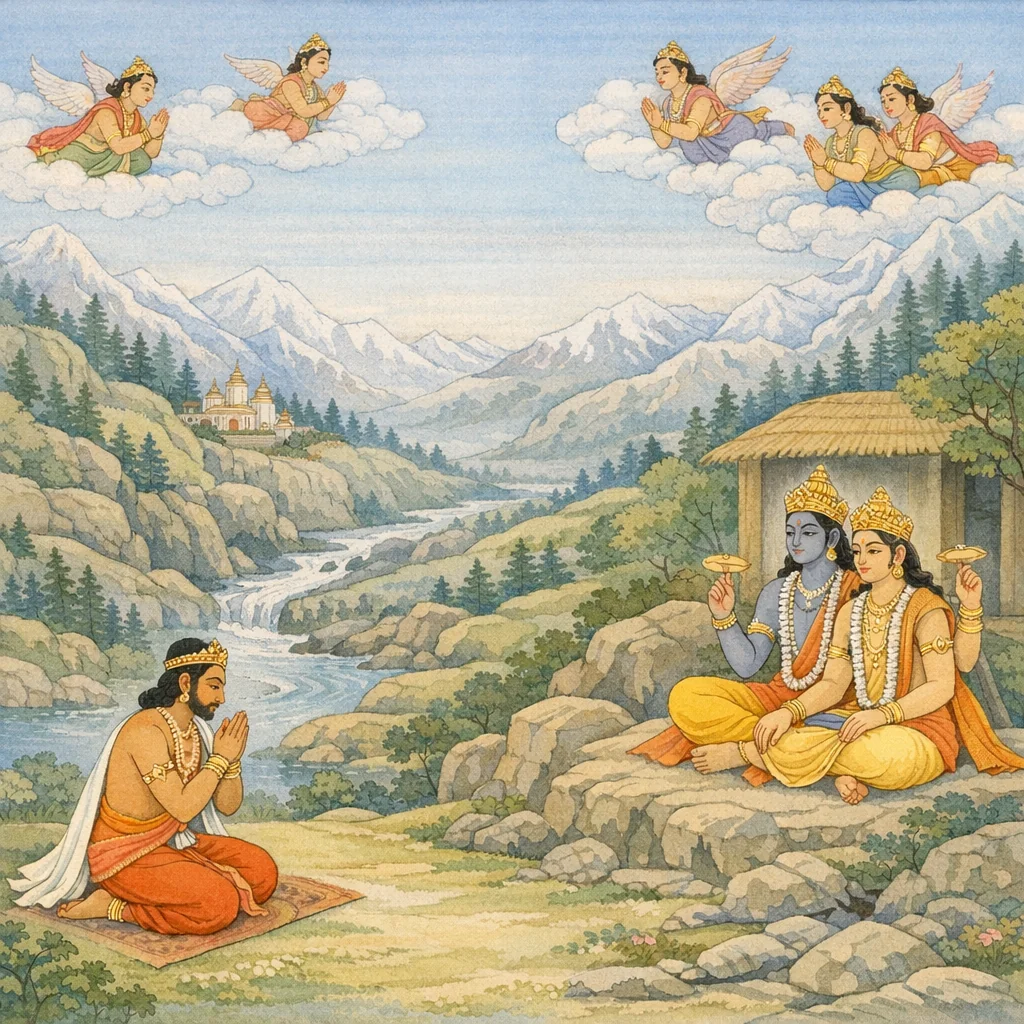
Adhyaya 7: Prahlada’s Defeat by Nara-Narayana and Victory through Bhakti
प्रह्लादस्य नरा-नारायणयुद्धं भक्तिविजयश्च (Prahlādasya Narā-Nārāyaṇa-yuddhaṃ Bhakti-vijayaśca)
Defeat and Victory through Bhakti
In this Adhyāya, framed as Pulastya’s narration to Nārada, the Vāmana Purāṇa presents a sustained martial encounter between the Dānava king Prahlāda and the divine pair Nara–Nārāyaṇa (with Nārāyaṇa explicitly identified as Hari, Śārṅgapāṇi, and Puruṣottama). The episode develops an asura-dharma tension: Prahlāda’s kṣātra resolve and vow to conquer is repeatedly checked by the invincibility of the “Dharmaja” Sādhya, culminating in a theological pivot from physical prowess to devotional efficacy. After a long, stylized exchange of weapons (gadā, bows, parigha, mudgara, prāsa, śakti), Prahlāda is instructed by Pītavāsā (a Viṣṇu-epithet) that victory lies not in yuddha but in bhakti and śuśrūṣā toward the Dharma-born. Prahlāda’s stotra becomes an iconographic catalogue of Viṣṇu’s cosmic forms (Varāha, Nṛsiṃha, etc.) and a syncretic cosmology wherein major deities and elements are subsumed within the supreme Nārāyaṇa. The chapter closes with Prahlāda’s renunciatory turn—delegating rule to Andhaka, seeking Badarikāśrama, and stabilizing his mind in dhātṛ—modeling a bhakti-inflected kingship and yogic purification rather than sectarian rivalry.
Divine Beings
Sacred Geography
Mortal & Asura Figures
Key Content Points
- Pulastya–Nārada narrative frame: Pulastya recounts Prahlāda’s prolonged combat with Nara–Nārāyaṇa, emphasizing the ‘Dharmaja’ Sādhya’s invincibility and the spectatorship of devas in the sky.
- Martial escalation and divine superiority: successive weapons (gadā, śara-vṛṣṭi, multiple bows, parigha, mudgara, prāsa, śakti) are neutralized; Prahlāda is struck in the heart and temporarily collapses, underscoring the futility of mere asura-valor against Puruṣottama.
- Bhakti as the decisive ‘victory’: Pītavāsā teaches that Prahlāda will ‘conquer’ by devotion, leading to Prahlāda’s stotra, the granting of boons (sin-dissolution; unwavering Viṣṇu-oriented buddhi), and Prahlāda’s ethical reorientation of daitya governance and personal renunciation.
Shlokas in Adhyaya 7
Verse 1
इति श्रीवामनपुराणे षष्ठो ऽध्यायः पुलस्त्य उवाच ततो ऽनङ्गं विभुर्द्दष्ट्वा ब्रह्मन् नारायणो मुनिः प्रहस्यैवं वचः प्राह कन्दर्व इह आस्यताम्
Thus ends the sixth chapter of the Śrī Vāmana Purāṇa. Pulastya said: Then the mighty sage Nārāyaṇa, seeing Ananga (Kāma), smiled and spoke these words: “O Kandarpā (god of love), sit here.”
Verse 2
तदक्षुब्धत्वमीक्ष्यास्य कामो विस्मयमागतः वसन्तो ऽपि महाचिन्तां जगामाशु महामुने
Seeing his unshaken composure, Kāma became astonished; and even Vasanta (Spring) quickly fell into great worry, O great sage.
Verse 3
ततश्चाप्सरसो दृष्ट्वा स्वागतेनाभिपूज्य च वसन्तमाह भगवानेह्येहि स्थीयतामिति
Then, seeing the Apsarases, the Blessed One welcomed and honored them; and he said to Vasanta, “Come, come—remain (stay here).”
Verse 4
ततो विहस्य भगवान् मञ्जरीं कुसुमावृताम् आदाय प्राक्सुवर्णाङ्गीमूर्वोर्बालां विनिर्ममे
Then the Blessed Lord, smiling, took a flower-cluster covered with blossoms and fashioned from his thighs a young maiden whose body was formerly golden-hued.
Verse 5
ऊरूद्भवां स कन्दर्पो दृष्ट्वा सर्वाङ्गसुन्दरीम् अमन्यत तदानङ्गः किमियं सा प्रिया रतिः
Seeing that maiden born from the thigh, beautiful in every limb, Kandarpa—the bodiless one—then thought: ‘Who is she? Is she my beloved Rati?’
Verse 6
तदेव वदनं चारु स्वक्षिभ्रूकुटिलालकम् सुनासावंशाधरोष्ठमालोकनपरायणम्
Her very face was lovely—marked by beautiful eyes, brows, and curling locks; with a fine nose-bridge and graceful lips—wholly captivating to behold (drawing one into gazing).
Verse 7
तावेवाहार्य विरलौ पीवरौ मग्नचूचुकौ राजेते ऽस्यः कुचौ पीनौ सज्जनावि संहतौ
Her two breasts—rarely to be matched in beauty—full, with nipples slightly recessed, shone forth: firm and ample, close-set like a pair of well-joined ornaments.
Verse 8
तदेव तनु चार्वङ्ग्या वलित्रयविभूषितम् उदरं राजते श्लक्ष्णं रोमावलिविभूषितम्
Likewise, the slender abdomen of that lovely-limbed woman shone—adorned with three delicate folds, smooth, and embellished by the line of hair.
Verse 9
रोमावलीच जघनाद् यान्ती स्तनतटं त्वियम् राजते भृङ्गमालेव पुलिनात् कमलाकरम्
And this line of hair, rising from her hips up toward the slope of her breasts, shone like a garland of bees moving from a sandy bank toward a lotus-filled lake.
Verse 10
जघनं त्वतिविस्तीर्ण भात्यस्या रशनावृतम् श्रीरोदमथने नद्धूं भूजङ्गेनेव मन्दरम्
Her hips are exceedingly broad and shine, encircled by a girdle—like Mount Mandara bound by the serpent during the churning of the Ocean of Milk.
Verse 11
कदलीस्तम्भसदृशैरूर्ध्वमूलैरथोरुभिः विभाति सा सुचार्वङ्गी पद्मकिढ्जल्कसन्निभा
With thighs like plantain trunks, rooted upward (i.e., tapering gracefully), she shines—beautiful-limbed—resembling the delicate shimmer associated with lotus-born creatures/insects (a lotus-like gleam).
Verse 12
जानुनी गूढगुल्फे च शुभे जङ्घे त्वरोमशे विभातो ऽस्यास्तथा पादावलक्तकसमत्विषौ
Her knees and well-formed ankles, and her auspicious calves—free from hair—shine; likewise her feet gleam with a radiance equal to red lac-dye.
Verse 13
इति संचिन्तयन् कामस्तामनिन्दितलोचनाम् कामातुरो ऽसौ संजातः किमुतान्यो जनो मुने
Thus, as he kept thinking of her—she whose eyes were beyond reproach—he became tormented by desire. How much more so would any other person be, O sage?
Verse 14
माधवो ऽप्युर्वशीं दृष्ट्वा संचिन्तयत नारद किंस्वित् कामनरेन्द्रस्य राजधानी स्वयं स्थिता
Even Mādhava, on seeing Urvāśī, began to ponder, O Nārada: ‘Is it that the capital city of King Kāma has itself come to stand here?’
Verse 15
आयाता शशिनो नूनमियं कान्तिर्निशाक्षये रविरश्मिप्रतापार्तिभीता शरणमागता
Surely this radiance of the moon has come here at the end of the night, frightened by the scorching pain of the sun’s rays, seeking refuge.
Verse 16
इत्थं संचितयन्नेव अवष्टभाप्सरोगणम् तस्थौ मुनिरिव ध्यानमास्थितः स तु माधवः
Thus, while reflecting in this manner, having restrained the host of apsarās, Mādhava stood firm—like a sage established in meditation.
Verse 17
ततः स विस्मितान् सर्वान् कन्दर्पादीन् महामुने दृष्ट्वा प्रोवाच वचनं स्मितं कृत्वा शुभव्रतः
Then, O great sage, seeing all of them—Kandarpa and the rest—astonished, that observer of auspicious vows spoke, first smiling, a word (to them).
Verse 18
इयं ममोरुसंभृता कामाप्सरस माधव नीयतां सुरलोकाय दीयतां वासवाय च
“This kāmāpsarasā—raised (as it were) upon my thigh—O Mādhava, let her be taken to the world of the gods; let her be given to Vāsava (Indra) as well.”
Verse 19
इत्युक्ताः कम्पमानास्ते जग्मुर्गृह्योर्वशीं दिवम् सहस्राक्षाय तां प्रादाद् रूपयौवनशालिनीम्
Thus addressed, those (two), trembling, went and brought the apsaras Urvaśī from heaven; and they presented that maiden—endowed with beauty and youth—to Sahasrākṣa (Indra).
Verse 20
आचक्षुश्चरितं ताभ्यां धर्मजाभ्यां महामुने देवाराजाय कामाद्यास्ततो ऽभृद् विस्मयः परः
O great sage, those two—born of Dharma—reported the account of what happened to the king of the gods; and then, beginning with Kāma (desire), there arose supreme astonishment.
Verse 21
एताद्शं हि चरितं ख्यातिमग्र्यां जगाम ह पातालेषु तथा मर्त्यै दिक्ष्वष्टासु जगाम च
Indeed, such a deed attained the highest renown; it spread in the nether regions (Pātāla), among mortals, and in all the eight directions as well.
Verse 22
एकदा निहते रौद्रो हिरण्यकशिपौ मुने अभिषिक्तस्तदा राज्ये प्रह्लादौ नाम दानवः
O sage, once the fierce Hiraṇyakaśipu had been slain, a Dānava named Prahlāda was then consecrated to the kingship.
Verse 23
तस्मिञ्शासति दैत्येन्द्रे देवब्राह्मणपूजके मखानि भुवि राजानो यजन्ते विधिवत्तदा
When that Daitya lord ruled—one who honored the gods and the brāhmaṇas—then kings on earth performed sacrifices (makhas) according to proper rite.
Verse 24
ब्राह्मणाश्च तपो धर्मं तीर्थयात्राश्च कुर्वते वैश्याश्च पशुवृत्तिस्थाः शूद्राः शुश्रूषणे रताः
Brāhmaṇas practiced austerity and dharma and undertook pilgrimages to sacred places; Vaiśyas were engaged in livelihoods centered on cattle; Śūdras were devoted to service.
Verse 25
चातुर्वर्ण्यं ततः स्वे स्वे आश्रमे धर्मकर्मणि आवर्त्तत ततो देवा वृत्त्या युक्ताभवान् मुने
Then the four social orders, each in its own āśrama, returned to their righteous duties; and thereafter, O sage, the gods became properly established in their rightful modes of livelihood/maintenance.
Verse 26
ततस्तु च्यवनो नाम भार्गवेन्द्रो महातपाः जगाम नर्मदां स्नातुं तीर्थं चैवाकुलीश्वरम्
Then the great ascetic Cyavana, foremost among the Bhārgavas, went to bathe in the Narmadā, and also to (visit) the tīrtha called Ākulīśvara.
Verse 27
तत्र दृष्ट्वा महादेवं नदीं स्नातुमवातरत् अवतीर्णं प्रजग्राह नागः केकरलोहितः
There, having seen Mahādeva, he descended to the river to bathe. When he had descended, a serpent named Kekara-lohita seized him.
Verse 28
गृहीतस्तेन नागेन सस्मार मनसा हरिम् संस्मृते पुण्डरीकाक्षे निर्विषो ऽभून्महोरगः
Seized by that serpent, he remembered Hari in his mind. When Puṇḍarīkākṣa (the Lotus-eyed Lord) was thus remembered, the great serpent became free of venom.
Verse 29
नीतस्तेनातिरौद्रेण पन्नगेन रसातलम् निर्विषश्चापि तत्याज च्यवनं भुजगोत्तमः
Carried by that exceedingly fierce serpent to Rasātala, the best of serpents—now venomless—then released Cyavana.
Verse 30
संत्यक्तमात्रो नागेन च्यवनो भार्गवोत्तमः चचार नागकन्याभिः पूज्यचमानः समन्ततः
As soon as he was released by the serpent, Cyavana—the foremost of the Bhārgavas—moved about, being honored on all sides by the serpent-maidens.
Verse 31
विचारन् प्रविवेशाथ दानवानां महत् पुरम् संपूज्यमानो दैत्येन्द्रः प्रह्लादो ऽथ ददर्श तम्
Then, while moving about thoughtfully, he entered the great city of the Dānavas. There, Prahlāda—the lord of the Daityas—who was being honored, saw him.
Verse 32
भृगुपुत्रे महातेजाः पूजां चक्रे यथार्हतः संपूजितोपविष्टश्च पृष्टश्चागमनं प्रति
To the son of Bhṛgu, the great and radiant one offered worship as was fitting. And after he had been honored and seated, he was asked about the purpose of his coming.
Verse 33
स चोवाच महाराज महातीर्थं महाफलम् स्नातुमेवागतो ऽस्म्यद्य द्रष्टुञ्चैवाकुलीश्वरम्
And he said: ‘O great king, (this is) a great sacred ford with great reward. I have come today precisely to bathe (there) and also to behold Ākulīśvara.’
Verse 34
नद्यामेवावतीर्णो ऽस्मि गृहीतश्चाहिना बलान् समानीतो ऽस्मि पाताले दृष्टश्चात्र भवानपि
“I descended into the river itself, and then I was forcibly seized by a serpent. I was brought down to Pātāla, and here I have also seen you.”
Verse 35
एतच्छ्रुत्वा तु वचनं च्यवनस्य दितीश्वरः प्रोवाच धर्मसंयुक्तं स वाक्यं वाक्यकोविदः
“Having heard these words of Cyavana, the lord of the Daityas spoke—skilled in speech—an utterance endowed with righteousness.”
Verse 36
प्रह्लाद उवाच भगवन् कानि तीर्थानि पृथिव्यां कानि चाम्बरे रसातले च कानि स्युरेतद् वक्तुं ममार्हसि
Prahlāda said: “O Blessed One, which are the sacred fords (tīrthas) on the earth, which are in the sky, and which may be in Rasātala? You ought to tell me this.”
Verse 37
च्यवन उवाच पृथिव्यां नैमिषं तीर्थमन्तरिक्षे च पुष्करम् चक्रतीर्थं महाबाहो रसातलतले विदुः
Cyavana said: “On the earth is the sacred ford called Naimiṣa; in the mid-region (antarikṣa) is Puṣkara. And the holy place called Cakratīrtha, O mighty-armed one, is known to be in the plane of Rasātala.”
Verse 38
पुलस्त्य उवाच श्रुत्वा तद्भार्गववचो दैत्यराजो महामुने नेमिषै गन्तुकामस्तु दानवानितदब्रवीत्
Pulastya said: “Having heard those words of the Bhārgava (Cyavana), the king of the Daityas, O great sage, wishing to go to Naimiṣa, then spoke this to the Dānavas.”
Verse 39
प्रह्लाद उवाच उत्तिष्ठध्वं गमिष्यामः स्नातुं तीर्थं हि नैमिषम् द्रक्ष्यामः पुण्डरीकाक्षं पीतवाससमच्युतम्
Prahlāda said: “Rise up; we shall go to bathe at the sacred ford of Naimiṣa. We shall behold Puṇḍarīkākṣa—the lotus-eyed, the wearer of yellow garments—Acyuta (the unfailing Lord).”
Verse 40
पुलस्त्य उवाच इत्युक्ता दानवेन्द्रेण सर्वे ते दैत्यदानवाः चक्रुरुद्योगमतुलं निर्जग्मुश्च रसातलात्
Pulastya said: Thus addressed by the lord of the Dānavas, all those Daityas and Dānavas undertook an incomparable preparation and set forth from Rasātala.
Verse 41
ते समभ्येत्य दैतेया दानवाश्च महाबलाः नेमिषारण्यमागत्य स्नानं चक्रुर्मुदान्विताः
Those mighty Daiteyas and Dānavas, having come together and reached Naimiṣāraṇya, performed ritual bathing, filled with delight.
Verse 42
ततो दितीश्वरः श्रीमान् मृगव्यां स चचार ह चरन् सरस्वतीं पुण्यां ददर्श विमलोदकाम्
Then that illustrious lord of Diti’s line wandered in the hunting ground; and while moving about, he beheld the holy Sarasvatī, whose waters were clear and pure.
Verse 43
तस्यादूरे महाशाखं शलवृक्षं शरैश्चितम् ददर्श बाणानपरान् मुखे लग्नान् परस्परम्
Not far from him, he saw a śala tree with great branches, filled with arrows; and he saw other arrows, their points lodged into one another.
Verse 44
ततस्तानद्भुताकारान् बाणान् नागोपवीतकान् दृष्ट्वातुलं तदा चक्रे क्रोधं दैत्येश्वरः किल
Then, seeing those arrows of wondrous form, like having serpents as their sacred girdles, the lord of the Daityas, it is said, became exceedingly angry.
Verse 45
स ददर्श ततो ऽदूरात्कृष्णाजिनधरौ मुनी समुन्नतजटाभारौ तपस्यासक्तमानसौ
Then, not far away, he saw two sages wearing black antelope skins, with their masses of matted hair raised up, their minds absorbed in austerity.
Verse 46
तयोश्च पार्श्वयोर्दिव्ये धनुषी लक्षणान्विते शार्ङ्गमागवं चैव अक्ष्य्यौ च महेषुधी
At their two sides were two divine bows, marked with auspicious characteristics—Śārṅga and Āgava—and also two inexhaustible great quivers.
Verse 47
तौ दृष्ट्वामन्यत तदा दामिबिकाविति दानवः ततः प्रोवाच वचनं तावुभौ पुरुषोत्तमौ
Seeing them, the Dānava then thought, ‘(They are) mere impostors/pretenders.’ Then he spoke words to those two—both excellent persons.
Verse 48
किं भवद्भ्यां समारःधं दम्भं धर्मविनाशनम् क्व तपः क्व जटाभारः क्व चेमौ प्रवरायुधौ
Why have you undertaken this hypocrisy that destroys dharma? What has asceticism to do with a mass of matted hair—and what have these two excellent weapons to do with it?
Verse 49
अथोवाच नरो दैत्यं का ते चिन्ता दितीश्वर सामर्थ्ये सति यः कुर्यात् तत्संपद्येत तस्य हि
Then Nara said to the Daitya: “O lord of Diti’s line, what worry have you? For one who acts when ability is present—his intended result surely comes to be.”
Verse 50
अथोवाच दितीशस्तौ का शक्तिर्युवयोरिह मयि तिष्ठति दैत्येन्द्रे धर्मसेतुप्रवर्तके
Then the lord of Diti’s line said to those two: “What power do you have here, when I stand (before you)—I, the Daitya lord, the establisher of the bridge/embankment of dharma?”
Verse 51
नरस्तं प्रत्युवाचाथ आवाभ्यां शक्तिरूर्जिता न कश्चिच्छक्नुयाद् योद्धुं नरनारायणौ युधि
Nara replied to him: “Our power is mighty. No one would be able to fight Nara and Nārāyaṇa in battle.”
Verse 52
दैत्येश्वरस्तस्तः क्रुद्धः प्रतिज्ञामारुरोह च यथा कथञ्चिज्जेष्यामि नरनारायणौ रणे
Then the lord of the Daityas, enraged, mounted a vow: “Somehow or other, I shall defeat Nara and Nārāyaṇa in battle.”
Verse 53
इत्येवमुक्त्वा वचनं महात्मा दितीश्वरः स्थाप्य बलं वनान्ते वितत्य चापं गुणमाविकृष्य तलध्वनिं घोरतरं चकार
Having spoken thus, the great-souled lord of Diti’s line stationed his army at the edge of the forest; then, stretching his bow and drawing the bowstring, he produced a most dreadful twang.
Verse 54
ततो नरस्त्वाजगवं हि चापमानम्य बाणान् सुबहुञ्शिताग्रान् मुमोच तानप्रतिमैः पृषत्कैश्चिच्छेद दैत्यस्तपनीयपुङ्खैः
Then Nara, bending his Ājagava bow, released many arrows with sharpened tips; the Daitya, however, cut them down with incomparable darts whose shafts were fitted with golden feathers.
Verse 55
छिन्नान् समीक्ष्याथ नरः पृषत्कान् दैत्येश्वरेणाप्रतिमेव संख्ये क्रुद्धः समानम्य महाधनुस्ततो मुमोच चान्यान् विविधान् पृषत्कान्
Then Nara, seeing his arrows cut down by the lord of the Daityas in that unequalled battle, became enraged; bending his great bow, he released other arrows of many kinds.
Verse 56
एकं नरो द्वौ दितिजेश्वरश्च त्रीन् धर्मसूनुश्चतुरो दितीशः नरस्तु बाणान् प्रमुमोच पञ्च षड् द्रत्यनाथो निशितान् पृषत्कान्
Nara released one (arrow); the lord of the Diti-born released two; the son of Dharma released three; the lord of Diti released four. Then Nara discharged five arrows, and the leader of the Daityas released six sharp arrows.
Verse 57
सप्तर्षिमुख्यो द्विचतुश्च दैत्यो नरस्तु षट् त्रीणि च दैत्यमुख्ये षट्त्रीणि चैकं च दितीश्वरेण मुक्तानि बाणानि नराय विप्र
O brāhmaṇa, the foremost among the Seven Ṛṣis (released arrows); the Daitya (released) two and four; and Nara released six and three at the chief of the Daityas. And by the lord of the Diti-born, arrows—six, three, and one—were discharged at Nara.
Verse 58
एकं च षट् पञ्च नरेण मुक्तास्त्वष्टौ शराः सप्त च दानवेन षट् सप्त चाष्टौ नव षण्नरेण द्विसप्ततिं दैत्यपतिः ससर्ज्ज
The Man shot one, six, and five (arrows); and the Dānava shot eight and seven arrows. Then the Man shot six, seven, eight, nine, and six; and the lord of the Daityas discharged seventy-two (arrows).
Verse 59
शतं नरस्त्रीणि शतानि दैत्यः षड् धर्मपुत्रो दश दैत्यराजः ततो ऽप्यसंख्येयतरान् हि बाणान् मुमोचतुस्तौ सुभृशं हि कोपात्
The Man released a hundred and three; the Daitya, hundreds (of arrows). The son of Dharma shot six; the Daitya-king, ten. Then, from intense anger, both of them let fly arrows even more innumerable.
Verse 60
ततो नरो बाणगणैरसख्यैरवास्तरद्भूमिमथो दिशः खम् स चापि दैत्यप्रवरः पृषत्कैश्चिच्छेद वेगात् तपनीयपुङ्खैः
Then the Man, with countless clusters of arrows, covered the earth, the directions, and the sky. And that foremost of Daityas, with swift golden-feathered shafts, cut them down at speed.
Verse 61
ततः पतत्त्रिभिर्वीरौ सुभृशं नरदानवौ युद्धे वरास्त्रैर्युध्येतां घोररूपैः परस्परम्
Then those two heroes—the man and the Dānava—fought fiercely in battle, striking one another with excellent missiles of dreadful form, amid flights of arrows.
Verse 62
ततस्तु दैत्येन वरास्त्रपाणिना चापे नियुक्तं तु पितामहास्त्रम् महेश्वरास्त्रं पुरुषोत्तमेव समं समाहत्य निपेततुस्तौ
Then the Daitya, bearing a superior missile-weapon, set the Pitāmaha-weapon (Brahmāstra) upon his bow. Puruṣottama, however, struck it equally with the Maheśvara-weapon, and the two (missiles) fell down together (neutralized).
Verse 63
ब्रह्मस्त्रे तु प्रशमिते प्रह्लादः क्रोधमूर्छितः गदां प्रगृह्य तरसा प्रचस्कन्द रथोत्तमात्
When the Brahmāstra had been quelled, Prahlāda, overcome by anger, seized his mace and, with force, leapt down from his excellent chariot.
Verse 64
गदापाणिं समायान्तं दैत्यं नारायणस्तदा दृष्ट्वाथ पृष्ठतश्चक्रे नरं योद्धूमनाः स्वयम्
Then Nārāyaṇa, seeing the Daitya approaching with a mace in his hand, placed Nara behind him and himself, intent on fighting, prepared (to face the attack).
Verse 65
ततो दीतीशः सगदः समाद्रवत् सशार्ङ्गपाणिं तपसां निधानम् ख्यातं पुराणर्षिमुदारविक्रमं नारायणं नारद लोकपालम्
Then the lord of Diti’s line (the Daitya), mace in hand, rushed at the bearer of Śārṅga (Viṣṇu), the treasure-house of austerities—Nārāyaṇa—renowned as an ancient ṛṣi, of noble prowess, O Nārada, the protector of the worlds.
Frequently Asked Questions
Prahlāda’s stotra identifies Nārāyaṇa as the all-encompassing supreme principle, subsuming major deities and cosmic functions (e.g., Brahmā, the three-eyed deity, Agni, Vāyu, Sūrya, Candra) within Viṣṇu’s being. This is a classic Purāṇic strategy of syncretic theology: it acknowledges the wider pantheon and their iconographic roles while asserting a unifying, non-competitive hierarchy in which devotion (bhakti) to Nārāyaṇa becomes the integrating axis.
Two pilgrimage geographies are explicitly named: Naimiṣāraṇya, where Prahlāda performs his morning rite (āhnika-kriyā), and Badarikāśrama, to which he proceeds for devotional encounter with Nara–Nārāyaṇa. While the chapter does not provide a full tīrtha-māhātmya catalogue, it uses these sites as topographical sanctification markers—linking ritual discipline (Naimiṣa) and ascetic-devotional attainment (Badarī) to the transformation of asura kingship into dharma-guided conduct.
Prahlāda moves from a vow-driven martial project (to defeat the ‘Dharmaja’ Sādhya) to the recognition that the divine cannot be conquered by force. Guided by Pītavāsā, he ‘wins’ through exclusive devotion, receives boons (eradication of bodily, mental, and verbal sin; steadfast Viṣṇu-oriented intellect), delegates sovereignty to Andhaka, and adopts a renunciatory-yogic stance—presenting bhakti and ethical governance as the mature resolution of asura-dharma.