Adhyaya 35: Harihara Revelation and the Kurukshetra Tirtha Cycle: Sthanu in Vishnu and the Sanctification of Saptasarasvata
हरिशङ्कर-ऐक्यदर्शनम् (Hariśaṅkara-Aikyadarśanam) / कुरुक्षेत्र-तीर्थमाहात्म्यम् (Kurukṣetra-Tīrthamāhātmyam)
Sthanu in Vishnu at Kurukshetra
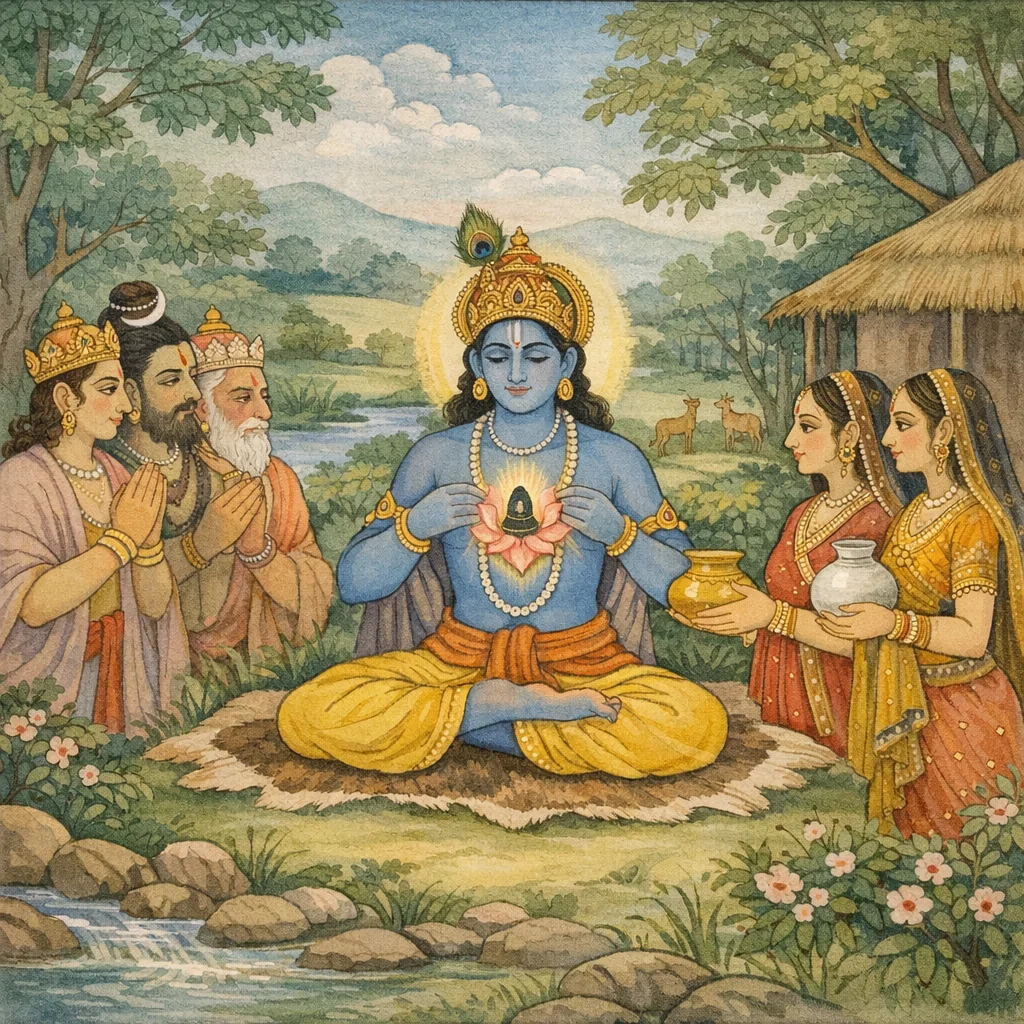
Within the Pulastya–Nārada narrative frame, this Adhyāya advances a syncretic theology by staging the devas’ crisis of perception: due to offense against Śiva, they become unable to see Maheśvara even when he stands before them. Vāsudeva prescribes bodily purification (taptakṛcchra) and a detailed Śaiva abhiṣeka-sequence (milk, curd, ghee, pañcagavya, honey, water), culminating in mantra-japa (Śatarudrīya) and iconographic worship with bilva and fragrant unguents. The theological climax is Hari’s disclosure of an Īśvara-liṅga abiding in his own heart-lotus, producing a Harihara vision that integrates Vaiṣṇava and Śaiva devotion without hierarchy. The chapter then pivots to Kurukṣetra’s topographical sanctification: Śiva’s movement through the region explains cosmic tremors as effects of ascetic power (Uśanas seeking Saṃjīvanī; Maṅkaṇaka’s ecstatic dance). Śiva stabilizes the earth by redirecting ascetic affect into tīrtha-formation, praising Saptasārasvata and enumerating Sarasvatī-linked rivers as enduring purifiers of pāpa.
Divine Beings
Sacred Geography
Mortal & Asura Figures
Key Content Points
- Devas, led by Śakra, approach Hari (Murāri) and are guided to Hara’s abode; their inability to perceive Śiva is diagnosed by Vāsudeva as the karmic result of offense, establishing a moral-ritual logic of divine vision (devadṛṣṭi).
- Ritual and expiatory protocol is specified: taptakṛcchra regimen (hot water, hot milk, hot ghee, then air-only), followed by a graded liṅga-abhiṣeka using quantified kumbhas of milk/curd/ghee/pañcagavya/honey/water, with bilva-patra, gandha, dhūpa, and Śatarudrīya-japa.
- Hari reveals the Īśvara-liṅga in his hṛtpadma, generating a Harihara iconographic synthesis; subsequently, Kurukṣetra is mapped through Śiva’s encounters with Uśanas (Saṃjīvanī-vidyā) and Ṛṣi Maṅkaṇaka, leading to the establishment and praise of Saptasārasvata and named Sarasvatī-streams as tīrthas.
Shlokas in Adhyaya 35
Verse 1
इति श्रीवामनपुराणे चतुस्त्रिंशो ऽध्यायः ब्रह्मोवाच परदाराभिगमनं पापीयांसोपसेवनम् पारुष्यं सर्वभूतानां प्रथमं नरकं स्मृतम्
(Colophon:) Thus ends the thirty-fourth chapter in the Śrī Vāmana Purāṇa. Brahmā said: “Approaching another man’s wife, association with the sinful, and harsh cruelty toward all beings—this is remembered as the first hell (i.e., the first category leading to hell).”
Verse 2
फलस्तेयं महापापं फलहीनं तथाटनम् छेदनं वृक्षजातीनां द्वितीयं नरकं स्मृतम्
“Stealing fruit is a great sin; likewise, wandering about without (offering/producing) fruit (i.e., living unproductively/without rightful yield), and cutting down kinds of trees—this is remembered as the second hell (the second category leading to hell).”
Verse 3
वर्ज्यादानं तथा दुष्टमवध्यवधबन्धनम् विवादमर्थहेतूत्थं तृतीयं नरकं स्मृतम्
Giving what ought not to be given; wicked conduct; killing or imprisoning one who must not be killed; and fomenting disputes arising from motives of wealth—these are said to constitute the third hell.
Verse 4
भयदं सर्वसत्त्वानां भवभूति विनाशनम् भ्रंशनं निजधर्माणां चतुर्थं नरकं स्मृतम्
That which causes fear to all beings, destroys one’s worldly prosperity, and makes one fall away from one’s own dharmas—this is said to be the fourth hell.
Verse 5
मारणं मित्रकौटिल्यं लिथ्याभिशपनं च यत् मिष्टौकाशनमित्युक्तं पञ्चमं तु नृपाचनम्
Murder; treachery toward friends; and whatever consists in slanderous cursing (abhiśapana) and the like—this is called ‘Miṣṭaukāśana’; and the fifth (hell) is ‘Nṛpācana’.
Verse 6
यन्त्रः फलादिहरणं यमनं योगनाशनम् यानयुग्यस्य हरणं षष्ठमुक्तं नृपाचनम्
“(The hell called) Yantra is for the stealing of fruits and the like; (the hell called) Yamana is for the destruction of another’s ‘yoga’ (i.e., spiritual discipline/means of livelihood); and (the hell called) Yānayugya-haraṇa is for the theft of conveyances and draught-animals. The sixth (hell) is said to be Nṛpācana.”
Verse 7
राजभागहरं मूढं राजजायानिषेवणम् राज्ये त्वहितकारित्वं सप्तमं निरयं स्मृतम्
“(For) the fool who steals the king’s due (tax/royal share), who has intercourse with the king’s wife, and who acts against the welfare of the kingdom—(this is) remembered as the seventh hell (niraya).”
Verse 8
लुब्धत्वं लोलुपत्वं च लब्धधर्मार्थनाशनम् लालासंकीर्णमेवोक्तमष्टमं नरकं स्मृतम्
“Greed (lubdhatva), rapacity (lolupatva), and the squandering/destruction of dharma and wealth once obtained—this is said to be ‘Lālāsaṃkīrṇa’, remembered as the eighth hell.”
Verse 9
विप्रोष्यं ब्रह्महरणं ब्राह्मणानां विनिन्दनम् विरोधं बन्धुभिश्चोक्तं नवमं नरपाचनम्
“(The hell called) Narapācana, the ninth, is declared (for those guilty of): harming a brāhmaṇa; taking away (or stealing) sacred knowledge/‘brahman’ (i.e., robbing a brāhmaṇa or appropriating Vedic wealth/learning); reviling brāhmaṇas; and fomenting hostility with one’s own kinsmen.”
Verse 10
शिष्टाचारविनाशं च शिष्टद्वेषं शिशोर्वधम् शास्त्रस्तेयं धर्मनाशं दशमं परिकीर्तितम्
“The tenth (hell/offense) is proclaimed for: destroying the established conduct of the cultured (śiṣṭācāra); hating the virtuous (śiṣṭadveṣa); killing a child; stealing the śāstras (scriptural knowledge); and causing the ruin of dharma.”
Verse 11
षडङ्गनिधनं घोरं षाङ्गुण्यप्रतिषेधनम् एकादशममेवोक्तं नरकं सद्भिरुत्तमम्
“The eleventh hell, declared by the good as ‘pre-eminent’ (in severity), is for the dreadful destruction of the six aṅgas and for the rejection/obstruction of ‘ṣāṅguṇya’ (the proper sixfold/virtuous qualities or the sixfold discipline).”
Verse 12
सत्सु नित्यं सदा वैरमनाचारमसत्क्रिया संस्कारपरिहीनत्वमिदं द्वादशमं स्मृतम्
“Perpetual enmity toward the good, improper conduct, base actions, and the condition of being devoid of purificatory rites—this is remembered as the twelfth (fault).”
Verse 13
हानिर्धर्मार्थकामनामपवर्गस्य हारणम् संभेदः संविदामेतत् त्रयोदशममुच्यते
“The loss of dharma, artha, and kāma, the deprivation of apavarga (liberation), and the breaking/confusion of agreements—this is called the thirteenth (fault).”
Verse 14
कृपणं धर्महीनं च यद् वर्ज्यं यच्च वह्निदम् चतुद्र्दशममोवोक्तं नरकं तद् विगर्हितम्
“Miserliness and being devoid of dharma; that which should be avoided; and that which ‘gives to fire’ (i.e., destructive, incendiary conduct)—this is stated as the fourteenth (fault); it is censured as leading to hell.”
Verse 15
अज्ञानं चाप्यमुयत्वमशौचमशुभावहम् स्मृतं तत् पञ्चदशममस्त्यवचनानि च
Ignorance, and also “amuyatva” (a state of delusion/being ‘as if not here’), and impurity (aśauca) which brings inauspicious results—these are remembered as the fifteenth (item in the list); and also false statements (untruthful utterances).
Verse 16
आलस्यं वै षोडशममाक्रोशं च विशेषतः सर्वस्य चाततायित्वलमावासेष्वग्निदीपनम्
Sloth is indeed the sixteenth (item), and especially abusive shouting/insult. And (there is) being an ‘ātatāyin’ toward all (i.e., acting as a violent aggressor), and the kindling of fire in the dwellings of the lame/helpless (i.e., arson against the vulnerable).
Verse 17
इच्छा च परदारेषु नरकाय निगद्यते ईर्षर्याभावश्च सत्येषु उद्धृत्तं तु विगर्हितम्
Desire for another man’s wife is declared to lead to hell. And envy—together with the absence of (reverence for) the truthful/virtuous—is censured; and arrogance/insolence (uddhṛtta) is indeed condemned.
Verse 18
एतैस्तु पापैः पुरुषः पुन्नमाद्यैर्न संशयः संयुक्तः प्रीणयेद् देवं संतत्या जगतः पतिम्
A man, surely, when burdened with such sins—beginning with (those leading to) Puṃnāma (hell)—should, without doubt, propitiate the Lord, the Master of the world, through (the merit of) progeny (i.e., by begetting a son and sustaining lineage).
Verse 19
प्रीतः सृष्ट्या तु शुभया स पापाद्येन मुच्यते पुंनामनरकं घोरं विनाशयति सर्वतः
Pleased by that auspicious ‘creation’ (i.e., the bringing forth of progeny), he is freed from sins and the like; and (that merit) destroys the dreadful Puṃnāma hell entirely.
Verse 20
एतस्मात् कारणात् साध्य सुतः पुत्रेति गद्यते अतः परं प्रवक्ष्यामि शेषपापस्य लक्षणम्
For this reason, O worthy one, a son is spoken of as ‘putra’. Now, further, I shall explain the characteristics of the remaining sins.
Verse 21
ऋमं देवर्षिभूतानां मनुष्याणां विशेषतः पितृणां च द्विजश्रेष्ठ सर्वर्वणेषु चैकता
“[This is] the debt/obligation (ṛṇa) owed to the gods, seers, and beings—and especially to human beings—and also to the ancestors, O best of twice-born. In all the varṇas there is a single (common) principle [regarding this obligation].”
Verse 22
ओङ्कारादपि निर्वृत्तिः पापकार्यकृतश्च यः मत्स्यादश्च महापापमगम्यागमनं तथा
“Turning away even from the syllable Oṃ, and one who performs sinful acts; eating fish as well is a great sin; likewise, going to (i.e., having intercourse with) those with whom one must not go (agamya).”
Verse 23
घृतादिविक्रयं घोरं चण्डालादिपरिग्रहः स्वदोषाच्छादनं पापं परदोषप्रकाशनम्
“The dreadful trade in ghee and the like; accepting (gifts/association) from a Caṇḍāla and the like; concealing one’s own faults is sinful; and publicizing another’s faults [is also sinful].”
Verse 24
मत्सरित्वं वाग्दुष्टत्वं निष्टुरत्वं तथा परम् टाकित्वं तालवादित्वं नाम्ना वाचाप्यधर्मजम्
“Envy; corrupt or malicious speech; harshness (cruelty of words) and, further, abusive heckling; and noisy clapping/boisterous display—these, by name, are (faults) born of adharma, even in one’s speech.”
Verse 25
दारुणत्वमधार्मिक्यं नरकावहमुच्यते एतैश्च पापैः संयुक्तः प्रीणयेद् यदि शङ्करम्
“Ferocity and unrighteousness are said to lead to hell. And if a person, joined with these sins, should (still) seek to please Śaṅkara (Śiva)…”
Verse 26
ज्ञानाधिरमशेषेण शेषपापं जयेत् ततः शारीरं वाचिकं यत् तु मानसं कायिकं तथा
“Then, by taking delight in knowledge wholly, one should conquer the remaining sin. (Sin/act is) that which is bodily, verbal, and mental—likewise physical (deeds).”
Verse 27
पितृमातृकृतं यच्च कृतं यच्चाश्रितैर्नरैः भ्रातृभिर्बान्धवैश्चापि तस्मिन् जन्मनि धर्मज
“O Dharmaja, whatever has been done by one’s father and mother, and whatever has been done by dependent persons, and also by brothers and kinsmen—(all that bears fruit) in that very birth.”
Verse 28
तत्सर्वं विलयं याति स धर्मः सुतशिष्ययोः विपरीते भवेत् साध्य विपरीतः पदक्रमः
“All that (support) comes to dissolution; that dharma depends upon a son and a disciple. If the order is reversed, the intended result is not accomplished—the sequence of steps becomes contrary.”
Verse 29
तस्मात् पुत्रश्च शिष्यश्च विधातव्यौ विपश्चिता एतदर्थमभिध्याय शिष्याच्छ्रेष्ठतरः सुतः सेषात् तारयते शिष्यः सर्वतो ऽपि हि पुत्रकः
“Therefore, the wise should provide (i.e., establish) both a son and a disciple. Considering this purpose, a son is superior to a disciple; yet a disciple delivers (one) from what remains (unfulfilled/left over). Indeed, in every way, a disciple is also a ‘son’.”
Verse 30
पुलस्त्य उवाच पितामहवचः श्रुत्वा साध्यः प्राह तपोधनः त्रिः सत्यं तव पुत्रो ऽहं देव योगं वदस्व मे
Pulastya said: Having heard the words of the Grandfather (Brahmā), the accomplished ascetic, rich in austerity, spoke: “Thrice I affirm the truth—O god, I am your son. Teach me the (true) yoga.”
Verse 31
तमुवाच महायोगी त्वन्मातापिररौ यदि दास्येते च ततः सूनुर्दायादो मे ऽसि पुत्रक
The great yogin said to him: “If your mother and father will give (you) [to me/into my charge], then you will be my son—my heir, dear child.”
Verse 32
सनत्कुमारः प्रोवाच दायादपरिकल्पना येयं हि भवता प्रोक्ता तां मे व्याख्यातुमर्हसि
Sanatkumāra said: “This notion/arrangement concerning ‘heirship’ (dāyāda) that has been stated by you—please explain it to me.”
Verse 33
तदुक्तं साध्यमुख्येन वाक्यं श्रुत्वा पितामहः प्राह प्रहस्य भगवान् क्श्रुणु वत्सेति नारद
Having heard the statement spoken by the foremost of the Sādhyas, the Grandfather (Brahmā), the Blessed Lord, smiled and said: “Listen, dear child, O Nārada.”
Verse 34
ब्रह्मोवाच औरसः क्षेत्रजश्चैव दत्तः कृत्रिम एव च गुढोत्पन्नो ऽपविद्धश्च दायादा बान्धवास्तु षट्
Brahmā said: ‘The heirs and kinsmen are six: the legitimate son (aurasa), the son begotten on the wife (kṣetraja), the given/adopted son (datta), the made/artificial son (kṛtrima), the secretly born son (guḍhotpanna), and the abandoned son (apaviddha).’
Verse 35
अमीषु षट्पु पुत्रेषु ऋमपिण्डधनक्रियाः गोत्रस्म्यं कुले वृत्तिः प्रतिष्ठ शाश्वती तथा
Among these six kinds of sons, the acts concerning debt, the funeral piṇḍa-offerings, and property are to be carried out; likewise, the preservation of gotra-identity, the continuance of the family line’s livelihood/usage, and enduring social standing (pratiṣṭhā) are maintained.
Verse 36
कानीनश्च सहोढश्च क्रीतः पौनर्भवस्तथा स्वयेदत्तः पारशवः षडदायादबन्धवाः
“The kānīna, the sahoḍha, the krīta, the paunarbhava, the self-given (svayaṃdatta), and the pāraśava—these six are (reckoned as) heirs/kinsmen (ādāyāda-bandhava).”
Verse 37
अमीभिरृणपिण्डादिकथा नैवेह विद्यते नामधारका एवेह न गोत्रकुलसंमताः
“In their case, discourse concerning debts, piṇḍa-offerings, and the like is not applicable here. Here they are merely bearers of a name; they are not acknowledged as belonging to (the adopter’s) gotra and kula.”
Verse 38
तत् तस्य वचनं श्रुत्वा ब्रह्मणः सनकाग्रजः उवाचैषां विशेषं मे ब्रह्मन् व्याख्यातुमहसि
“Having heard his statement, Sanaka’s elder brother (a son of Brahmā) said: ‘O Brahman, you should explain to me the particular distinction (viśeṣa) of these.’”
Verse 39
ततो ऽब्रवीत् सुरपतिर्विशेषं शृणु पुत्रक औरसो यः स्वयं जातः प्रतिबिम्बमिवात्मनः
Then the lord of the gods said: “Listen, dear child, to the specific distinctions. The ‘aurasa’ son is he who is born from one’s own body—like a reflection of oneself.”
Verse 40
क्लीबोन्मत्ते व्यसनिनि पत्यौ तस्याज्ञया तु या भार्या ह्यनातुरा पुत्रं जनयेत् क्षेत्रजस्तु सः
When the husband is impotent, mad, or afflicted by calamity, then a wife—if she is not herself unwell—who, by his authorization, bears a son: that son is called ‘kṣetraja’.”
Verse 41
मातापितृभ्यां यो दत्तः स दत्तः परिगीयते मित्रपुत्रं मित्रदत्तं कृत्रिमं प्राहुरुत्तमाः
He who is given (in adoption) by his mother and father is celebrated as a ‘datta’ son. The wise also speak of the ‘kṛtrima’ (artificial) son as one who is the son of a friend, or one given by a friend.”
Verse 42
न ज्ञायते गृहे केन जातस्त्विति स गूञकः बाह्मतः स्वयमानीतः सो ऽपविद्धः प्रकीर्तितः
If, in a household, it is not known by whom a child was begotten, he is called a gūḍhaja (one of concealed paternity). And one who is brought (into the family) by himself from outside is proclaimed to be an apaviddha (a foundling/abandoned child taken in).
Verse 43
कन्याजातस्तु कानीनः सगर्भोढः सहोकः मूल्यैर्गृहीतः क्रीतः स्याद् द्विविधः स्यात् पुनर्भवः
A child born to an unmarried girl is called a kānīna. One who is taken (as a wife) while already pregnant is (the child) called sahodha; and one taken together with her child is called sahoka. One obtained for a price is termed krīta (purchased). The punarbhava (child of a remarried woman) is said to be of two kinds.
Verse 44
दत्त्वैकस्य च या कन्या हृत्वान्यस्य प्रदीयते तज्जालस्तनयो ज्ञेयो लोके पौनर्भवो मुने
O sage, if a maiden—having been given to one man—is taken away and given to another, the son born from that (second union) is to be known in the world as a paunarbhava.
Verse 45
दुर्भिक्षे व्यसने चापि येनात्मा विनिवेदितः स स्वयन्दत्त इत्युस्तथान्यः कारणान्तरैः
Even in a famine or in times of calamity, one who has offered (or surrendered) his own person is called ‘self-given’ (svayaṃdatta); likewise, another may be termed so due to other causal circumstances.
Verse 46
ब्राह्मणस्य सुतः शूद्रयां जायते यस्तु सुव्रत ऊढायां वाप्यनूढायां स पारशव उच्यते
O well-vowed one, a son of a Brāhmaṇa who is born from a Śūdra woman—whether she is wedded or not wedded—is called a Pāraśava.
Verse 47
एतस्मात् कारणात् पुत्र न स्वयं दातुमर्हसि स्वमात्मानं गच्छ शीघ्रं पितरौ समुपाह्वय
For this reason, my son, you are not fit to give yourself away on your own. Go quickly yourself and summon your father and mother.
Verse 48
ततःस मातापितरौ सस्मार वचनाद् विभोः तावाजग्मतुरीशानं द्रष्टुं वै दम्पती मुने
Then, in accordance with the command of the Lord, he remembered (summoned) his mother and father. O sage, that husband and wife came to behold Īśāna (Śiva).
Verse 49
धर्मो ऽहिंसा च देवेशं प्रणिपत्य न्यषीदताम् उपविष्टौ सुखासीनौ साध्यो वचनमब्रवीत्
Dharma and Ahiṃsā, having bowed to the Lord of the gods, sat down. When they were seated comfortably, Sādhya spoke these words.
Verse 50
सनत्कुमार उवाच योगं जिगमिषुस्तात व्रह्माणं समचूचुदम् स चोक्तवान् मां पुत्रार्थे तस्मात् त्वं दातुमर्हसि
Sanatkumāra said: ‘O dear one, desiring to attain yoga, I approached Brahmā. He spoke to me concerning the obtaining of a son; therefore you should grant (it).’
Verse 51
तावेवमुक्तौ पुत्रेण योगाचार्यं पितामहम् उक्तवन्तौ प्रभो ऽयं हि आवयोस्तनयस्तव
Thus addressed by their son, the two spoke to the Grandfather, the teacher of yoga: “O Lord, this one is indeed your son—(born) of us.”
Verse 52
अद्यप्रभृत्ययं पुत्रस्तव ब्रह्मन् भविष्यति इत्युक्त्वा जग्मतुर्सूर्ण येनैवाब्यागतौ यथा
Saying, “From today onward, O Brahman, this son shall be yours,” they departed swiftly, returning by the very way they had come.
Verse 53
पितामहो ऽपि तं पुत्रं साध्यं सद्धिनयान्वितम् सनत्कुमारं प्रोवाच योगं द्वादशपत्रकम्
Then the Grandfather, too, instructed that son—fit for attainment and endowed with good discipline—Sanatkumāra, in a yoga (teaching) set forth in twelve ‘sections/leaves’.
Verse 54
शिखासंश्थं तु ओङ्कारं मेषो ऽस्य शिरसि स्थितः मासो वैशाखनामा च प्रथमं पत्रकं स्मृतम्
The syllable Oṃ is situated at its topknot (crest). The sign Meṣa (Aries) is established upon its head. The month named Vaiśākha is remembered as its first petal (of the lotus/diagram).
Verse 55
नकारो मुखसंस्थो हि वृषस्तत्र प्रकीर्तितः ज्येष्ठमासाश्च तत्पत्रं द्वितीयं परिकीर्तितम्
The syllable ‘na’ is situated in its mouth; there the sign Vṛṣa (Taurus) is declared. The month Jyeṣṭha is proclaimed as that (corresponding) petal—the second one.
Verse 56
मोकारो भुजयोर्युग्मं मिथुनस्तत्र संस्थितः मासो आषाढनामा च तृतीयं पत्रकं स्मृतम्
The syllable ‘mo’ (i.e., the ‘ma’-sound with ‘o’) is (placed upon) the pair of arms; there the sign Mithuna (Gemini) is situated. The month named Āṣāḍha is remembered as the third petal.
Verse 57
भकारं नेत्रयुगलं तत्र कर्कटकः स्थितः मासः श्रावण इत्युक्तश्चतुर्थं पत्रकं स्मृतम्
The syllable “bha” is said to correspond to the pair of eyes; there the zodiacal sign Cancer (Karkaṭaka) is situated. The month is declared to be Śrāvaṇa, and this is remembered as the fourth ‘leaf/segment’ (patraka).
Verse 58
गकारं हृदयं प्रोक्तं सिंहो वसति तत्र च मासो भाद्रस्तथा प्रोक्तः पञ्चमं पत्रकं स्मृतम्
The syllable “ga” is declared to be the heart; and there the Lion (Siṃha) dwells. The month is likewise stated to be Bhādra (Bhādrapada), and this is remembered as the fifth ‘leaf/segment’ (patraka).
Verse 59
वकारं कवचं विद्यात् कन्या तत्र प्रतिषिठता मासश्चाश्वयुजो नाम ष्ष्ठं तत् पत्रकं स्मृतम्
One should understand the syllable “va” as the ‘armor/protective covering’ (kavaca); there the Maiden (Kanyā) is established. The month is called Āśvayuja (Āśvina), and that is remembered as the sixth ‘leaf/segment’ (patraka).
Verse 60
तेकारमस्त्रग्रामं च तुलाराशिः कृताश्रयः मासश्च कार्तिको नाम सप्तमं पत्रकं स्मृतम्
The syllable “ta” is said to be the ‘cluster of weapons’; Libra (Tulā-rāśi) is established there as its support. The month is called Kārtika; this is remembered as the seventh ‘patraka’ (leaf/segment).
Verse 61
वाकारं नाभिसंयुक्तं स्थितस्तत्र तु वृश्चिकः मासो मार्गशिरो नाम त्वष्टमं पत्रकं स्मृतम्
The syllable “va” is joined with the navel (nābhi). There, indeed, Scorpio (Vṛścika) is situated. The month is called Mārgaśīrṣa; this is remembered as the eighth patraka (segment).
Verse 62
सुकारं जघनं प्रोक्तं तत्रस्थश्च धनुर्धरः पौषति गदितो मासो नवमं परिकीर्तितम्
The syllable “su” is declared to be the ‘jaghana’ (the hips/loins). There stands the Archer (Dhanurdhara, i.e., Sagittarius). The month is said to be Pauṣa; it is proclaimed as the ninth (patraka/segment).
Verse 63
देकारश्चोरुयुगलं मकरो ऽप्यत्र संस्थितः माघो निगदितो मासः पत्रकं दशमं स्मृतम्
The syllable ‘de’ is (assigned to) the pair of thighs; and here the makara (crocodile/sea-monster) is also stationed. The month is declared to be Māgha; this is remembered as the tenth ‘patraka’ (division/leaf) (of Keśava).
Verse 64
वाकारो जनुयुग्मं च कुम्भस्तत्रादिसंस्थितः पत्रकं फाल्गुनं प्रोक्तं तदेकादशमुत्तमम्
The syllable ‘vā’ is (assigned to) the pair of knees; and the kumbha (water-pot) is established there at the beginning (in that position). The month is said to be Phālguna; that is the excellent eleventh patraka.
Verse 65
पादौ यकारो मीनो ऽपि स चैत्रे वसते मुने इदं द्वादशमं प्रोक्तं पत्रं वै केशवस्य हि
The syllable ‘ya’ is (assigned to) the feet; and the mīna (fish) also dwells there in the month of Caitra, O sage. This is declared to be the twelfth patraka—indeed, of Keśava.
Verse 66
द्वादशारं तथा चक्रं षष्णाभि द्वियुतं तथा त्रिव्यूहमेकमूर्तिश्च तथोक्तः परमेश्वरः
“(He bears) a discus with twelve spokes, and likewise (a form) with six hubs joined in pairs; and (He is) the single embodied form of the three vyūhas—thus is the Supreme Lord described.”
Verse 67
एतत् तवोक्तं देवस्य रूपं द्वादशपत्रकम् यस्मिन् ज्ञाते मुनिश्रेष्ठ न भूयो मरणं भवेत्
“This form of the God, described by you, is the twelve-petalled (form). When it is known, O best of sages, there will be no further death.”
Verse 68
द्वितीयमुक्तं सत्त्वाढ्यं चतुर्वर्णं चतुर्मुखम् चतुर्बाहुमुदाराङ्गं श्रीवत्सधरमव्ययम्
“A second (form) is declared: rich in sattva, of four colours, four-faced, four-armed, of noble limbs, bearing the Śrīvatsa mark, imperishable.”
Verse 69
तृतीयस्तमसो माम शेषमूर्तिः सहस्रपात् सहस्रवदनः श्रीमान् प्रजाप्रलयकारकः
“The third (manifest principle) is of tamas. It is My form as Śeṣa—thousand-footed, thousand-faced, glorious—who brings about the dissolution of creatures (at the time of pralaya).”
Verse 70
चतुर्थो राजसो नाम रक्तवर्णश्चतुर्मुखः द्विभुजो धारयन् मालं सृष्टिकृच्चादिपूरुषः
“The fourth is called ‘rājasa’: red-hued, four-faced, two-armed, bearing a garland—he is the maker of creation, the primordial Person.”
Verse 71
अव्याक्तात् मभवन्त्येते त्रयो व्यक्ता महामुने अतो मरीचिप्रमुखास्तथान्ये ऽपि सहस्रशः
“From the Unmanifest these three become manifest, O great sage. From them arise Marīci and the other (progenitors), and likewise many others, by the thousand.”
Verse 72
एतत् तवोक्तं मुनिवर्य रूपं विभोः पुराणं मतिपुष्टिवर्धनम् चुतुर्भुजं तं स मुरुर्दुरात्मा कृतान्तवाक्यात् पुनराससाद
“This ancient form of the all-pervading Lord, O best of sages—nourishing and increasing understanding—(namely) that four-armed form: the wicked Mura, compelled by the decree of Death (Kṛtānta), approached Him again.”
Verse 73
तमागतं प्राह मुने मधुघ्नः प्राप्तो ऽसि केनासुर कारणेन स प्राह योद्धुं सह वै त्वयाद्य तं प्राह भूयः सुरशत्रुहन्ता
“Seeing him arrive, Madhughna (the slayer of Madhu) said, ‘O sage, for what reason have you come, O asura?’ He replied, ‘Today I have come to fight with you.’ Then the slayer of the enemies of the gods spoke to him again.”
Verse 75
यदीह मां योद्धुमुपागतो ऽसि तत् कम्पेत ते हृदयं किमर्थम् ज्वरातुरस्येव मुहुर्मुहुर्वै तन्नास्मि योत्स्ये सह कातरेण / 35.74 इत्येवमुक्तो मधुसूदनेन मुरुस्तदा स्वे हृदये स्वहस्तम् कथं क्व कस्येति मुहुस्तथोक्त्वा निपातयामास विपन्नबुद्धिः
“‘If you have come here to fight with me, why then does your heart tremble—again and again—like that of one afflicted with fever? I will not fight with a coward.’ Thus addressed by Madhusūdana, Mura then placed his own hand upon his heart and, repeatedly saying, ‘How? Where? Of whom (am I afraid/what is this)?’, he fell down, his mind undone.”
Verse 76
हरिश्च चक्रं मृदुलाघवेन मुमोच तद्धतकमलस्य शत्रोः चिच्छेद देवास्तु गतव्यथाभवन् देवं प्रसंसन्ति च पद्मनाभम्
Hari, with gentle swiftness, released his discus; it severed (the head of) the enemy of Hāṭaka-kamala. Then the gods became free from distress, and they praised that Lord, Padmanābha.
Verse 77
एतत् तवोक्तं मुरदैत्यनाशनं कृतं हि युक्त्या शितचक्रपाणिना अतः प्रसिद्धिं समुपाजगाम मुरारिरित्येव विभुर्नृसिंहः
This, as you have said, is the destruction of the demon Mura, accomplished fittingly by the wielder of the sharp discus. Therefore the all-pervading Lord Nṛsiṃha attained renown precisely by the name ‘Murāri’ (the foe of Mura).
Frequently Asked Questions
It presents a syncretic theology in which Vāsudeva himself prescribes Śaiva expiation and liṅga-worship, and then reveals an Īśvara-liṅga residing in his own heart-lotus. The devas thus encounter Hari and Śaṅkara not as rivals but as mutually indwelling principles (Harihara), where correct ritual purity and humility restore ‘devadṛṣṭi’ (the capacity to perceive Śiva).
The chapter functions as Kurukṣetra tīrtha-mapping: Śiva traverses Kurukṣetra, encounters Uśanas on the Oghavatī bank, and then proceeds to the sacred Saptasārasvata. It enumerates Sarasvatī-linked streams—Suprabhā, Kāñcānākṣī, Suveṇu, Vimalodakā, Manoharā, Caughavatī, Viśālā, and Sarasvatī—declaring their continual sanctity, pāpa-removing power, and merit comparable to eminent tīrthas.
No. This Adhyāya is primarily a Harihara-centered ritual and tīrtha-mahātmya unit within the Pulastya–Nārada framework, focusing on expiation, iconographic revelation, and the sanctification of Kurukṣetra and the Sarasvatī basin rather than the Bali–Vāmana cycle.