Sarga 12
युद्धकाण्डे द्वादशः सर्गः — रावणस्य परिषद्-सम्बोधनं कुम्भकर्णस्य नीत्युपदेशश्च (Ravana’s Council Address and Kumbhakarna’s Counsel)
युद्धकाण्ड
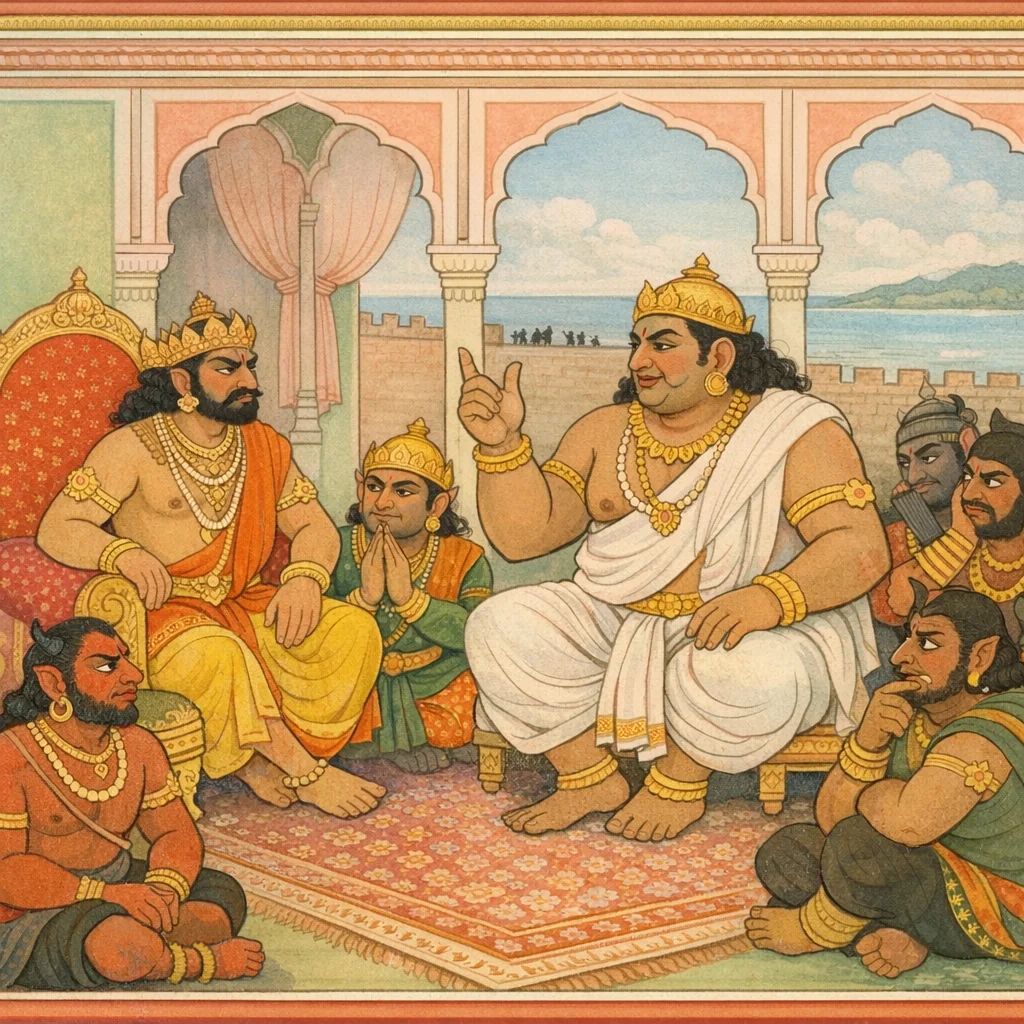
Sarga 12 presents a courtly strategy session in Laṅkā. Rāvaṇa surveys the full rākṣasa assembly and orders Prahasta, the army chief, to intensify city defense by deploying the fourfold divisions inside and outside the fortifications. After Prahasta reports readiness, Rāvaṇa addresses his intimates, asserting that his undertakings are counsel-led and unfailing, and explains that Kumbhakarṇa had been uninformed due to prolonged sleep. Rāvaṇa then rationalizes his seizure of Sītā from Daṇḍakāraṇya and describes his desire and frustration at her refusal, revealing a governance crisis where kāma distorts judgment. He raises strategic anxieties about the ocean crossing, yet simultaneously claims invulnerability to humans, noting Rāma and Lakṣmaṇa have reached the shore with Sugrīva and the Vānara forces to reclaim Sītā. Kumbhakarṇa, hearing this passion-laden lament, rebukes the lack of prior deliberation, articulates nīti: actions without proper means and sequencing fail, and hasty decisions ignore enemy strength. He nevertheless offers to rectify the situation through force, vowing to kill Rāma and Lakṣmaṇa and crush the Vānara leaders, urging Rāvaṇa to resume confidence and pleasures while he prosecutes the war.
Shlokas
Verse 1
सतांपरिषदंकृत्स्नांसमीक्ष्यसमितिञ्जयः ।प्रचोदयामासतदाप्रहस्तंवाहिनीपतिम् ।।6.12.1।।
Then Rāvaṇa, famed for triumph in battle, surveyed the entire assembly and urged Prahasta, the commander of the host, to act.
Verse 2
सेनापतेयथातेस्युःकृतविद्याश्चतुर्विधाः ।योधानगररक्षायांतथाव्यादेष्टुमर्हसि ।।6.12.2।।
O commander, you should assign—according to their proper roles—the well-trained warriors of the fourfold army to the defense of the city, and issue the necessary orders for heightened vigilance.
Verse 3
सप्रहस्तःप्रणीतात्माचिकीर्षन् राजशासनम् ।विनिक्षिपद्बलंसर्वंबहिरन्तश्चमन्दिरे ।।6.12.3।।
That renowned Prahasta, intent on carrying out the king’s command, stationed the entire force both outside and within the city.
Verse 4
ततोविनिक्षिप्यबलंसर्वनगरगुप्तये ।प्रहस्तःप्रमुखेराज्ञोनिषसादजगादच ।।6.12.4।।
Then Prahasta, having stationed the forces to guard the entire city, sat down before the king and addressed him.
Verse 5
विहितंबहिरन्तश्चबलंबलवतस्तव ।कुरुष्याविमनाःक्षिप्रंयदभिप्रेतमस्तुते ।।6.12.5।।
You are powerful, and your forces have been stationed both outside and within. Tell me at once, with a steady and undistracted mind, what it is you intend to do.
Verse 6
प्रहस्तस्यवचश्श्रुत्वाराजाराज्यहितैषिणः ।सुखेप्सुस्सुहृदांमध्येव्याजहारसरावणः ।।6.12.6।।
Hearing Prahasta’s words, King Rāvaṇa—professing concern for the kingdom’s welfare and seeking what he deemed happiness—spoke out in the midst of his trusted companions.
Verse 7
प्रियाप्रियेसुखंदुःखंलाभालाभेहिताहिते ।धर्मकामार्थकृच्छ्रेषुयूयमर्हथवेदितुम् ।।6.12.7।।
In dilemmas concerning dharma, kāma, and artha, you are competent to discern the desirable from the undesirable, happiness from sorrow, gain from loss, and what is beneficial from what is harmful.
Verse 8
सर्वकृत्यानियुष्माभिस्समारब्धानिसर्वथा ।मन्त्रकर्मनियुक्तानिनजातुविफलानिमे ।।6.12.8।।
All my undertakings, in every case, are begun with your involvement—set in motion through counsel and deliberate planning; and, to my knowledge, they have never proved fruitless.
Verse 9
ससोमग्रहनक्षत्रैर्मरुद्भिरिववासवः ।भवद्भिरहमत्यर्थंवृतश्रियमवाप्नुयाम् ।।6.12.9।।
As Vāsava (Indra), with the Maruts and the hosts that move with the moon, planets, and stars, attains splendor—so too, supported by you, may I attain exceeding prosperity.
Verse 10
अहंतुखलुसर्वान्वस्समर्थयितुमुद्यतः ।कुम्भकर्णस्यतुस्वप्नान्नेममर्थमचोदयम् ।।6.12.10।।
Indeed, I was ready to brief all of you; but since Kumbhakarṇa was asleep, I did not apprise him of this matter.
Verse 11
अयंहिसुप्तःषण्मासान्कुम्भकर्णोमहाबलः ।सर्वशस्त्रभृतांमुख्यस्सइदानींसमुत्थितः ।।6.12.11।।
For this mighty Kumbhakarṇa—foremost among all weapon-bearers—had slept for six months; now he has risen.
Verse 12
इयंचदण्डकारण्याद्रामस्यमहिषीमया ।रक्षोभिश्चरितोद्देशादानीताजनकात्मजा ।।6.12.12।।
This Janaka’s daughter, Sītā—the queen of Rāma—was brought by me from Daṇḍakāraṇya, from a region frequented by rākṣasas.
Verse 13
सामेवशय्यामारोढुमिच्छत्यलसगामिनी ।त्रिषुलोकेषुचान्यामेनसीतासदृशीमता ।।6.12.13।।
That modest-paced woman would not consent to mount my bed; and in the three worlds I consider no other woman to be like this Sītā.
Verse 14
तनुमध्यापृथुश्रोणीशरदिन्दुनिभानना ।हेमबिम्बनिभासौम्यामायेवमयनिर्मिता ।।6.12.14।।
She was slender-waisted and broad-hipped, her face like the full moon of autumn; gentle, shining like a golden image—like an enchantment, as though fashioned by Māyā itself.
Verse 15
सुलोहिततलौश्लक्ष् णौचरणौसुप्रतिष्ठितौ ।दृष्ट्वाताम्रनखौतस्यादीप्यतेमेशरीरजः ।।6.12.15।।
Seeing her feet—smooth, with richly red soles, well-formed, and with coppery-pink nails—desire, born within my body, flares up all the more.
Verse 16
हुताग्निरर्चिस्सङ्काशामेनांसौरीमिवप्रभाम् ।उन्नसंविमलंवल्गुविपुलांचारुलोचनम् ।।6.12.16।।पश्यंस्तदवशस्तस्याःकामस्यवशमेयिवान् ।
Beholding her—radiant like the flame of the sacrificial fire, like the sun’s own splendor—her nose uplifted, her face pure and charming, broad, with beautiful eyes, I, helpless, have fallen under the dominion of desire.
Verse 17
क्रोधहर्षसमानेनदुर्वर्णकरणेनच ।।6.12.17।।शोकसन्तापनित्येनकामेनकलुषीकृतः ।
Defiled am I by passion—ever accompanied by grief and burning anguish—by that force which makes one pallid and swings alike between anger and exultation.
Verse 18
सातुसंवत्सरंकालंमामयाचतभामिनी ।।6.12.18।।प्रतीक्षमाणाभर्तारंराममायतलोचना ।तन्मयाचारुनेत्रायःप्रतिज्ञातंवचश्शुभम् ।।6.12.19।।श्रान्तोऽहंसततंकामाद्यातोहयइवाध्वनि ।
That broad-eyed lady, awaiting her husband Rāma, asked me for a year’s time; and I, in return, gave that beautiful-eyed woman an auspicious promise. Yet, driven by desire, I am continually worn out—like a horse exhausted on the road.
Verse 19
सातुसंवत्सरंकालंमामयाचतभामिनी ।।6.12.18।।प्रतीक्षमाणाभर्तारंराममायतलोचना ।तन्मयाचारुनेत्रायःप्रतिज्ञातंवचश्शुभम् ।।6.12.19।।श्रान्तोऽहंसततंकामाद्यातोहयइवाध्वनि ।
That broad-eyed lady, awaiting her husband Rāma, asked me for a year’s time; and I, in return, gave that beautiful-eyed woman an auspicious promise. Yet, driven by desire, I am continually worn out—like a horse exhausted on the road.
Verse 20
कथंसागरमक्षोभ्यंतरिष्यन्तिवनौकसः ।।6.12.20।।बहुसत्त्वसमाकीर्णंतौवादशरथात्मजौ ।
How will the forest-dwelling Vānara hosts—indeed, even the two sons of Daśaratha—cross the unassailable ocean, teeming with many fearsome creatures?
Verse 21
अथवाकपिनैकेनकृतंनःकदनंमहत् ।।6.12.21।।दुर् ज्ञेयाःकार्यगतयोब्रूतयस्ययथामति ।
And yet, even a single monkey has inflicted great devastation upon us. The courses of their actions are hard to foresee—say what you think, each according to his own judgment.
Verse 22
मानुष्यान्नोभयंनास्तितथापितुविमृश्यताम् ।।6.12.22।।तदादेवासुरेयुद्धेयुष्माभिस्सहितोऽजयम् ।तेमेभवन्तश्चतथासुग्रीवप्रमुखान्हरीन् ।।6.12.23।।परेपारेसमुद्रस्यपुरस्कृत्यनृपात्मजौ ।सीतायाःपदवींप्राप्यसम्प्राप्तौवरुणालयाम् ।।6.12.24।।
I have no fear of mere humans—yet still, let this be carefully considered. In the war of gods and asuras, together with you I won victory; so you too must now stand firm. For Rāma and Lakṣmaṇa, placing Sugrīva and the Vānara leaders at the forefront, have reached the farther shore of the ocean—Varuṇa’s abode—having found the path that leads to Sītā.
Verse 23
मानुष्यान्नोभयंनास्तितथापितुविमृश्यताम् ।।6.12.22।।तदादेवासुरेयुद्धेयुष्माभिस्सहितोऽजयम् ।तेमेभवन्तश्चतथासुग्रीवप्रमुखान्हरीन् ।।6.12.23।।परेपारेसमुद्रस्यपुरस्कृत्यनृपात्मजौ ।सीतायाःपदवींप्राप्यसम्प्राप्तौवरुणालयाम् ।।6.12.24।।
“I have no fear of human beings; yet, let the matter be carefully considered. Formerly, in the war between the Devas and the Asuras, I won victory together with you. And now those very heroes—Sugrīva and the foremost of the Vānaras—stand there. The two princes, the sons of a king (Rāma and Lakṣmaṇa), having placed the Vānaras in the forefront, have reached the far shore of the ocean—Varuṇa’s abode—seeking the path that will lead to Sītā. Therefore, counsel a way out (a course of action).”
Verse 24
मानुष्यान्नोभयंनास्तितथापितुविमृश्यताम् ।।6.12.22।।तदादेवासुरेयुद्धेयुष्माभिस्सहितोऽजयम् ।तेमेभवन्तश्चतथासुग्रीवप्रमुखान्हरीन् ।।6.12.23।।परेपारेसमुद्रस्यपुरस्कृत्यनृपात्मजौ ।सीतायाःपदवींप्राप्यसम्प्राप्तौवरुणालयाम् ।।6.12.24।।
“I have no fear of human beings; yet, let the matter be carefully considered. Formerly, in the war between the Devas and the Asuras, I won victory together with you. And now those very heroes—Sugrīva and the foremost of the Vānaras—stand there. The two princes, the sons of a king (Rāma and Lakṣmaṇa), having placed the Vānaras in the forefront, have reached the far shore of the ocean—Varuṇa’s abode—seeking the path that will lead to Sītā. Therefore, counsel a way out (a course of action).”
Verse 25
अदेयाचयथासीतावध्यौदशरथात्मजौ ।भवद्भिर्मन्त्र्यतांमन्त्रस्सुनीतंचाभिधीयताम् ।।6.12.25।।
Deliberate, then, on a plan by which Sītā need not be returned, and the sons of Daśaratha may be slain; consider well, and propose to me a strategy that seems sound.
Verse 26
नहिशक्तिंप्रपश्यामिजगत्यन्यस्यकस्यचित् ।सागरंवानरैस्तीर्वानिश्चयेनजयोमम ।।6.12.26।।
I do not see in this world anyone else with the power to cross the ocean with the Vānaras; therefore, my victory is certain.
Verse 27
तस्यकामपरीतस्यनिशम्यपरिदेवितम् ।कुम्भकर्णःप्रचुक्रोधवचनंचेदमब्रवीत् ।।6.12.27।।
Hearing the lament of him who was overwhelmed by passion, Kumbhakarṇa grew enraged and spoke these words.
Verse 28
यदातुरामस्यसलक्ष्मणस्यप्रसह्यसीताखलुसाइहाऽहृता ।सकृत्समीक्ष्यैवसुनिश्चितंतदाभजेतचित्तंयमुनेवयामुनम् ।।6.12.28।।
When Sītā was indeed seized by force from Rāma, who was with Lakṣmaṇa, you ought to have reflected even once beforehand; then your mind would have settled into firm resolve—like the Yamunā filling its channel.
Verse 29
सर्वमेतन्महाराजकृतमप्रतिमंतव ।विधीयेतसहास्माभिरादावेवास्यकर्मणः ।।6.12.29।।
All this, great king, has been done by you alone; it would have been far better had this course of action been undertaken in consultation with us from the very beginning.
Verse 30
न्यायेनराजकार्याणियःकरोतिदशानन: ।नससन्तप्यतेपश्चान्निश्चितार्थमतिर्नृपः ।।6.12.30।।
O Daśānana, the king whose judgment is settled and who performs royal duties in accordance with justice does not grieve afterward.
Verse 31
अनुपायेनकर्माणिविपरीतानियानिच ।क्रियमाणानिदुष्यन्तिहवींष्यप्रयतेष्विव ।।6.12.31।।
Actions undertaken without proper means—and those done contrary to right order—become spoiled in the doing, like oblations offered in an ill-prepared sacrifice.
Verse 32
यःपश्चात्पूर्वकार्याणिकर्माण्यभिचिकीर्षति ।पूर्वंचापरकार्याणिनसवेदनयानयौ ।।6.12.32।।
Whoever tries to do later what should be done first, and does first what ought to be done later—he does not understand right policy and wrong policy.
Verse 33
चपलस्यतुकृत्येषुप्रसमीक्ष्याधिकंबलम् ।क्षिप्रमन्येप्रपद्यन्तेक्रौञ्चस्यखमिवद्विजाः ।।6.12.33।।
But when a hasty man undertakes actions without properly weighing the enemy’s greater strength, he quickly falls into danger—like birds entering the cleft of Mount Krauñca.
Verse 34
त्वयेदंमहादारब्धंकार्यमप्रतिचिन्तितम् ।दिष्ट्यात्वांनावधीद्रामोविषमिश्रमिवामिषम् ।।6.12.34।।
This great course has been begun by you without reflection; fortunately Rama did not kill you—like flesh mixed with poison (kills the one who eats it).
Verse 35
तस्मात्त्वयासमारब्धंकर्मह्यप्रतिमंपरैः ।अहंसमीकरिष्यामिहत्वाशत्रूंस्तवानघ ।।6.12.35।।
Therefore, since you have undertaken a deed that none other can match, I will see it through—killing your enemies, O blameless one.
Verse 36
अहमुत्सादयिष्यामिशत्रूंस्तवनिशाचर ।यदिशक्रविवस्वन्तौयदिपावकमारुतौ ।।6.12.36।।तावहंयोधयिष्यामिकुबेरवरुणावपि ।
O night-roaming one, I will annihilate your enemies. Even if those two were Indra and the Sun, even if they were Fire and Wind, I would fight them—yes, even if they were Kubera and Varuṇa.
Verse 37
गिरिमात्रशरीरस्यमहापरिघयोधिनः ।नर्दतस्तीक्ष्णदंष्ट्रस्यबिभीयाद्वैपुरन्दरः ।।6.12.37।।
At the roar of one whose body is like a mountain, who fights wielding a massive iron club, and whose fangs are sharp—even Indra the fortress-slayer would indeed be afraid.
Verse 38
पुनर्मांसद्वितीयेनशरेणनिहनिष्यति ।ततोऽहंतस्यपास्यामिरुधिरंकाममाश्वस ।।6.12.38।।
Before he can strike me again with a second arrow, I will drink his blood at once—be at ease; take confidence.
Verse 39
वधेनवैदाशरथेस्सुखावहंजयंतवाहर्तुमहंयतिष्ये ।हत्वाचरामंसहलक्ष्मणेनखादामिसर्वान्हरियूथमुख्यान् ।।6.12.39।।
By killing the son of Daśaratha, I will bring you joy and secure victory for you. And after killing Rama together with Lakshmana, I will devour all the foremost leaders of the monkey-hosts.
Verse 40
रमस्वकामम् पिबचाग्य्रवारुणींकुरष्वकार्याणिहितानिविज्वरः ।मयातुरामेगमितेयमक्षयंचिरायसीतावशगाभविष्यति ।।6.12.40।।
Sport as you please; drink the finest wine; do whatever pleases you, free from anxiety. For when I have sent Rama to Yama’s abode, Sita will remain under your power for a long time.
Frequently Asked Questions
The chapter centers on Rāvaṇa’s attempt to consolidate political strategy while remaining bound to an unethical act—the coercive abduction of Sītā—and his further intent to kill Rāma and Lakṣmaṇa without returning her, exposing a conflict between expediency and dharma.
Kumbhakarṇa’s nīti emphasizes that actions begun without proper deliberation (upāya), right principles, and correct sequencing degrade and invite regret; passion-driven decisions cloud discernment and undermine kingship even before the enemy strikes.
Key landmarks include Laṅkā as the fortified capital under heightened defense, Daṇḍakāraṇya as the forest region from which Sītā was taken, and Varuṇālaya (the ocean) as the strategic barrier where Rāma and the Vānara forces assemble to recover her.