Sarga 99
चित्रकूटप्राप्तिः — Bharata Reaches Chitrakuta and Beholds Rama
अयोध्याकाण्ड
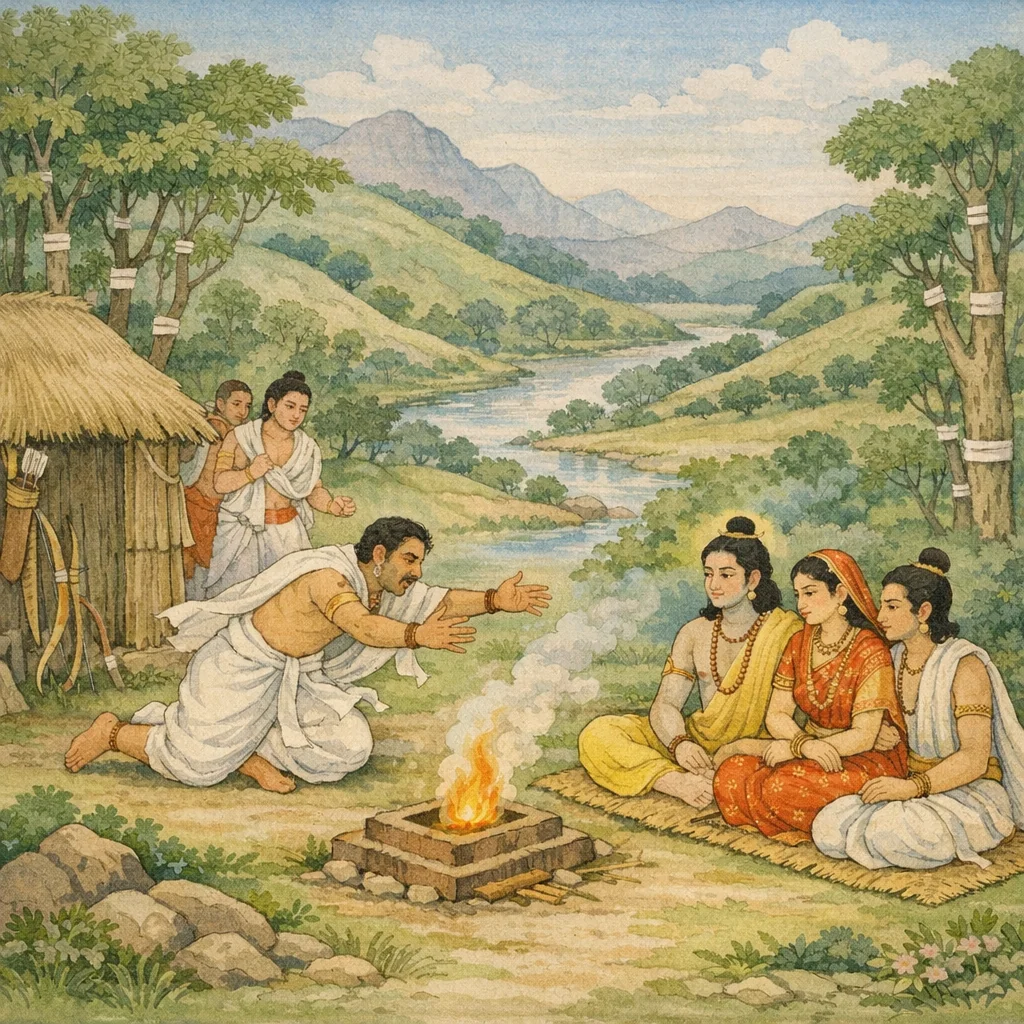
Sarga 99 traces Bharata’s final approach to Rāma’s forest residence near Citrakūṭa, turning the landscape into a navigational archive of exile. After encamping the army, Bharata hastens ahead and instructs Vasiṣṭha to bring the queens (2.99.1–3). En route he identifies the hermitage by material and ecological markers: shattered firewood and gathered flowers near the hut, dung-cake heaps prepared against cold, and path-signs on trees—kusa and bark strips, including bark garments fastened high as identification for movement at odd times (2.99.5–12). He notes the Mandākinī’s proximity and the ascetics’ perpetual fire by its thick smoke (2.99.9–12). Overcome with remorse, Bharata anticipates meeting the ‘maharṣi-like’ Rāma and laments the inversion of royal dignity—Rāma seated on the ground in vīrāsana in a secluded forest (2.99.13–17). He then beholds the parṇaśālā described with ritual and martial imagery—leaf-covered like a sacrificial altar, adorned with bows, quivers of sun-bright arrows, swords in silver scabbards, shields, and iguana-skin finger-guards—‘impregnable’ like a lion’s cave (2.99.18–23). Bharata sees the sacred altar sloping northeast with a burning fire (2.99.24), and finally Rāma himself: clad in antelope skin and bark garments, radiant like fire, seated with Sītā and Lakṣmaṇa on darbha-strewn ground, likened to eternal Brahmā (2.99.25–28). Bharata rushes forward weeping, repeatedly crying “Ārya,” collapses before reaching Rāma’s feet, and is embraced along with Śatrughna; the meeting expands to include Sumantra and Guha, witnessed by forest-dwellers who shed tears rather than joy (2.99.29–42).
Shlokas
Verse 1
निविष्टायां तु सेनायामुत्सुको भरतस्तदा।जगाम भ्रातरं द्रष्टुं शत्रुघ्नमनुदर्शयन्।।2.99.1।।
When the army had encamped, Bharata—eager—went to see his brother, guiding Śatrughna along (the way).
Verse 2
ऋषिं वसिष्ठं सन्दिश्य मातृ़र्मे शीघ्रमानय।इति त्वरितमग्रे स जगाम गुरुवत्सलः।।2.99.2।।
Having instructed the sage Vasiṣṭha, “Bring my mothers quickly,” Bharata—devoted to his elders—hurried on ahead.
Verse 3
सुमन्त्रस्त्वपि शत्रुघ्नमदूरादन्वपद्यत।रामदर्शनजस्तर्षो भरतस्येव तस्य च।।2.99.3।।
Sumantra too followed Śatrughna at no great distance; for he also felt the same eager longing as Bharata, born of the desire to behold Rama.
Verse 4
गच्छन्नेवाथ भरतस्तापसालय संस्थिताम्।भ्रातुः पर्णकुटीं श्रीमानुटजं च ददर्श ह।। 2.99.4।।
As he walked on, the majestic Bharata beheld his brother’s leaf-hut—a thatched dwelling set like the cottage of ascetics.
Verse 5
शालायास्त्वग्रत स्तस्या ददर्श भरत स्तदा।काष्ठानि चावभग्नानि पुष्पाण्युपचितानि च।।2.99.5।।
Then, before that hut, Bharata saw broken pieces of wood and also flowers that had been gathered.
Verse 6
स लक्ष्मणस्य रामस्य ददर्शाऽश्रममीयुषः।कृतं वृक्षेष्वभिज्ञानं कुशचीरैः क्वचित्क्वचित्।।2.99.6।।
He saw, here and there on the trees, signs made with kuśa-grass and strips of bark—markers indicating the path taken toward the hermitage of Rama and Lakṣmaṇa.
Verse 7
ददर्श वने तस्मिन्महत स्सञ्चयान्कृतान्।मृगाणां महिषाणां च करीषै शशीतकारणात्।।2.99.7।।
In that forest he also saw large heaps made of dried dung—of deer and buffalo—stored as protection against the cold.
Verse 8
गच्छन्नेव महाबाहुर्द्युतिमान्भरत स्तदा।शत्रुघ्नं चाब्रवीद्धृष्टस्तानमात्यांश्च सर्वशः।।2.99.8।।
Walking on, the mighty-armed and radiant Bharata—gladdened—spoke to Śatrughna and to the ministers gathered all around.
Verse 9
मन्ये प्राप्ताः स्म तं देशं भरद्वाजो यमब्रवीत्।नातिदूरे हि मन्येऽहं नदीं मन्दाकिनीमितः।।2.99.9।।
“I think we have reached the region of which Bharadvāja spoke; from here, I believe the river Mandākinī is not far.”
Verse 10
उच्चैर्बद्धानि चीराणि लक्ष्मणेन भवेदयम्।अभिज्ञानकृतः पन्था अकाले गन्तुमिच्छता।।2.99.10।।
These bark garments have been tied high up; this must be the route marked for recognition by Lakshmana, for finding the way when one wishes to move at unusual hours.
Verse 11
इदं चोदात्तदन्तानां कुञ्जराणां तरस्विनाम्।शैलपार्श्वे परिक्रान्तमन्योन्यमभिगर्जताम्।।2.99.11।।
This is the tract on the mountain’s flank where swift, great-tusked elephants roam—trumpeting as they charge at one another.
Verse 12
यमेवाधातुमिच्छन्ति तापसा स्सततं वने।तस्यासौ दृश्यते धूम स्सङ्कुलः कृष्णवर्त्मनः।।2.99.12।।
See there the dense smoke rising from the dark-trailing sacred fire that the forest ascetics wish to keep perpetually maintained.
Verse 13
अत्राहं पुरुषव्याघ्रं गुरुसत्कारकारिणम्।आर्यं द्रक्ष्यामि संहृष्टो महर्षिमिव राघवम्।।2.99.13।।
Here I shall behold with a gladdened heart Rāghava—venerable, a tiger among men—one who honors elders, like a great sage in his very bearing.
Verse 14
अथ गत्वा मुहूर्तन्तु चित्रकूटं स राघवः।मन्दाकिनीमनुप्राप्तस्तं जनं चेदमब्रवीत्।।2.99.14।।
Then, after going on for a short while toward Chitrakūṭa, Rāghava (Bharata) reached the river Mandākinī and spoke these words to his people.
Verse 15
जगत्यां पुरषव्याघ्र आस्ते वीरासने रतः।जनेन्द्रो निर्जनं प्राप्य धिङ्मे जन्म सजीवितम्।।2.99.15।।
That tiger among men—the lord of people—sits on the bare earth, absorbed in the heroic posture, having come to a lonely wilderness. Fie upon my birth and even my living!
Verse 16
मत्कृते व्यसनं प्राप्तो लोकनाथो महाद्युतिः।सर्वान्कामान्परित्यज्य वने वसति राघवः।।2.99.16।।
Because of me, the radiant lord of the world has met with calamity: Rāghava, renouncing every desire, dwells in the forest.
Verse 17
इति लोकसमाक्रुष्टः पादेष्वद्य प्रसादयन्।रामस्य निपतिष्यामि सीताया लक्ष्मणस्य च।।2.99.17।।
Thus, reviled by people, I shall today fall at the feet of Rāma—and of Sītā and Lakṣmaṇa—seeking their gracious forgiveness.
Verse 18
एवं संविलपं स्तस्मिन्वने दशरथात्मजः।ददर्श महतीं पुण्यां पर्णशालां मनोरमाम्।।2.99.18।।सालतालाश्वकर्णानां पर्णैर्बहुभिरावृताम्।विशालां मृदुभिस्तीर्णां कुशैर्वेदिमिवाध्वरे।।2.99.19।।शक्रायुधनिकाशैश्च कार्मुकैर्भारसाधनैः।रुक्मपृष्ठैर्महासारै श्शोभितां शत्रुबाधकैः।।2.99.20।।अर्क रश्मि प्रतीकाशैर्घोरैस्तूणीगतैश्शरैः।शोभितां दीप्तवदनै स्सर्पैर्भोगवतीमिव।।2.99.21।।महारजतवासोभ्यामसिभ्यां च विराजिताम्।रुक्मबिन्दुविचित्राभ्यां चर्मभ्यां चापि शोभिताम्।।2.99.22।।गोधाङ्गुळित्रैरासक्तैश्चित्रैः काञ्चनभूषितैः।अरिसंघैरनाधृष्यां मृगै स्सिंहगुहा मिव।।2.99.23।।
While lamenting thus in that forest, Daśaratha’s son (Bharata) beheld a large, sacred, and delightful leaf-hut—covered thickly with leaves of śāla, tāla, and aśvakarṇa trees—spacious, and strewn with soft kuśa grass like an altar in a sacrifice. It was adorned with mighty bows, gold-backed, enemy-subduing, and resembling Indra’s thunderbolt; and with dreadful arrows stored in quivers, radiant like the sun’s rays, like blazing-hooded serpents lighting up Bhogavatī. It shone with two swords in bright silver scabbards, and with shields of varied hues speckled with golden drops. There hung finger-guards of iguana-skin, ornate and gold-decorated. Against hordes of foes it was unassailable—like a lion’s cave is to deer.
Verse 19
एवं संविलपं स्तस्मिन्वने दशरथात्मजः।ददर्श महातीं पुण्यां पर्णशालां मनोरमाम्।।2.99.18।।सालतालाश्वकर्णानां पर्णैर्बहुभिरावृताम्।विशालां मृदुभिस्तीर्णां कुशैर्वेदिमिवाध्वरे।।2.99.19।।शक्रायुधनिकाशैश्च कार्मुकैर्भारसाधनैः।रुक्मपृष्ठैर्महासारै श्शोभितां शत्रुबाधकैः।।2.99.20।।अर्क रश्मि प्रतीकाशैर्घोरैस्तूणीगतैश्शरैः।शोभितां दीप्तवदनै स्सर्पैर्भोगवतीमिव।।2.99.21।।महारजतवासोभ्यामसिभ्यां च विराजिताम्।रुक्मबिन्दुविचित्राभ्यां चर्मभ्यां चापि शोभिताम्।।2.99.22।।गोधाङ्गुळित्रैरासक्तैश्चित्रैः काञ्चनभूषितैः।अरिसंघैरनाधृष्यां मृगै स्सिंहगुहा मिव।।2.99.23।।
While lamenting thus in that forest, Daśaratha’s son (Bharata) beheld a large, sacred, and delightful leaf-hut—covered thickly with leaves of śāla, tāla, and aśvakarṇa trees—spacious, and strewn with soft kuśa grass like an altar in a sacrifice. It was adorned with mighty bows, gold-backed, enemy-subduing, and resembling Indra’s thunderbolt; and with dreadful arrows stored in quivers, radiant like the sun’s rays, like blazing-hooded serpents lighting up Bhogavatī. It shone with two swords in bright silver scabbards, and with shields of varied hues speckled with golden drops. There hung finger-guards of iguana-skin, ornate and gold-decorated. Against hordes of foes it was unassailable—like a lion’s cave is to deer.
Verse 20
एवं संविलपं स्तस्मिन्वने दशरथात्मजः।ददर्श महातीं पुण्यां पर्णशालां मनोरमाम्।।2.99.18।।सालतालाश्वकर्णानां पर्णैर्बहुभिरावृताम्।विशालां मृदुभिस्तीर्णां कुशैर्वेदिमिवाध्वरे।।2.99.19।।शक्रायुधनिकाशैश्च कार्मुकैर्भारसाधनैः।रुक्मपृष्ठैर्महासारै श्शोभितां शत्रुबाधकैः।।2.99.20।।अर्क रश्मि प्रतीकाशैर्घोरैस्तूणीगतैश्शरैः।शोभितां दीप्तवदनै स्सर्पैर्भोगवतीमिव।।2.99.21।।महारजतवासोभ्यामसिभ्यां च विराजिताम्।रुक्मबिन्दुविचित्राभ्यां चर्मभ्यां चापि शोभिताम्।।2.99.22।।गोधाङ्गुळित्रैरासक्तैश्चित्रैः काञ्चनभूषितैः।अरिसंघैरनाधृष्यां मृगै स्सिंहगुहा मिव।।2.99.23।।
While lamenting thus in that forest, Daśaratha’s son (Bharata) beheld a large, sacred, and delightful leaf-hut—covered thickly with leaves of śāla, tāla, and aśvakarṇa trees—spacious, and strewn with soft kuśa grass like an altar in a sacrifice. It was adorned with mighty bows, gold-backed, enemy-subduing, and resembling Indra’s thunderbolt; and with dreadful arrows stored in quivers, radiant like the sun’s rays, like blazing-hooded serpents lighting up Bhogavatī. It shone with two swords in bright silver scabbards, and with shields of varied hues speckled with golden drops. There hung finger-guards of iguana-skin, ornate and gold-decorated. Against hordes of foes it was unassailable—like a lion’s cave is to deer.
Verse 21
एवं संविलपं स्तस्मिन्वने दशरथात्मजः।ददर्श महातीं पुण्यां पर्णशालां मनोरमाम्।।2.99.18।।सालतालाश्वकर्णानां पर्णैर्बहुभिरावृताम्।विशालां मृदुभिस्तीर्णां कुशैर्वेदिमिवाध्वरे।।2.99.19।।शक्रायुधनिकाशैश्च कार्मुकैर्भारसाधनैः।रुक्मपृष्ठैर्महासारै श्शोभितां शत्रुबाधकैः।।2.99.20।।अर्क रश्मि प्रतीकाशैर्घोरैस्तूणीगतैश्शरैः।शोभितां दीप्तवदनै स्सर्पैर्भोगवतीमिव।।2.99.21।।महारजतवासोभ्यामसिभ्यां च विराजिताम्।रुक्मबिन्दुविचित्राभ्यां चर्मभ्यां चापि शोभिताम्।।2.99.22।।गोधाङ्गुळित्रैरासक्तैश्चित्रैः काञ्चनभूषितैः।अरिसंघैरनाधृष्यां मृगै स्सिंहगुहा मिव।।2.99.23।।
While lamenting thus in that forest, Daśaratha’s son (Bharata) beheld a large, sacred, and delightful leaf-hut—covered thickly with leaves of śāla, tāla, and aśvakarṇa trees—spacious, and strewn with soft kuśa grass like an altar in a sacrifice. It was adorned with mighty bows, gold-backed, enemy-subduing, and resembling Indra’s thunderbolt; and with dreadful arrows stored in quivers, radiant like the sun’s rays, like blazing-hooded serpents lighting up Bhogavatī. It shone with two swords in bright silver scabbards, and with shields of varied hues speckled with golden drops. There hung finger-guards of iguana-skin, ornate and gold-decorated. Against hordes of foes it was unassailable—like a lion’s cave is to deer.
Verse 22
एवं संविलपं स्तस्मिन्वने दशरथात्मजः।ददर्श महातीं पुण्यां पर्णशालां मनोरमाम्।।2.99.18।।सालतालाश्वकर्णानां पर्णैर्बहुभिरावृताम्।विशालां मृदुभिस्तीर्णां कुशैर्वेदिमिवाध्वरे।।2.99.19।।शक्रायुधनिकाशैश्च कार्मुकैर्भारसाधनैः।रुक्मपृष्ठैर्महासारै श्शोभितां शत्रुबाधकैः।।2.99.20।।अर्क रश्मि प्रतीकाशैर्घोरैस्तूणीगतैश्शरैः।शोभितां दीप्तवदनै स्सर्पैर्भोगवतीमिव।।2.99.21।।महारजतवासोभ्यामसिभ्यां च विराजिताम्।रुक्मबिन्दुविचित्राभ्यां चर्मभ्यां चापि शोभिताम्।।2.99.22।।गोधाङ्गुळित्रैरासक्तैश्चित्रैः काञ्चनभूषितैः।अरिसंघैरनाधृष्यां मृगै स्सिंहगुहा मिव।।2.99.23।।
While lamenting thus in that forest, Daśaratha’s son (Bharata) beheld a large, sacred, and delightful leaf-hut—covered thickly with leaves of śāla, tāla, and aśvakarṇa trees—spacious, and strewn with soft kuśa grass like an altar in a sacrifice. It was adorned with mighty bows, gold-backed, enemy-subduing, and resembling Indra’s thunderbolt; and with dreadful arrows stored in quivers, radiant like the sun’s rays, like blazing-hooded serpents lighting up Bhogavatī. It shone with two swords in bright silver scabbards, and with shields of varied hues speckled with golden drops. There hung finger-guards of iguana-skin, ornate and gold-decorated. Against hordes of foes it was unassailable—like a lion’s cave is to deer.
Verse 23
एवं संविलपं स्तस्मिन्वने दशरथात्मजः।ददर्श महातीं पुण्यां पर्णशालां मनोरमाम्।।2.99.18।।सालतालाश्वकर्णानां पर्णैर्बहुभिरावृताम्।विशालां मृदुभिस्तीर्णां कुशैर्वेदिमिवाध्वरे।।2.99.19।।शक्रायुधनिकाशैश्च कार्मुकैर्भारसाधनैः।रुक्मपृष्ठैर्महासारै श्शोभितां शत्रुबाधकैः।।2.99.20।।अर्क रश्मि प्रतीकाशैर्घोरैस्तूणीगतैश्शरैः।शोभितां दीप्तवदनै स्सर्पैर्भोगवतीमिव।।2.99.21।।महारजतवासोभ्यामसिभ्यां च विराजिताम्।रुक्मबिन्दुविचित्राभ्यां चर्मभ्यां चापि शोभिताम्।।2.99.22।।गोधाङ्गुळित्रैरासक्तैश्चित्रैः काञ्चनभूषितैः।अरिसंघैरनाधृष्यां मृगै स्सिंहगुहा मिव।।2.99.23।।
While lamenting thus in that forest, Daśaratha’s son (Bharata) beheld a large, sacred, and delightful leaf-hut—covered thickly with leaves of śāla, tāla, and aśvakarṇa trees—spacious, and strewn with soft kuśa grass like an altar in a sacrifice. It was adorned with mighty bows, gold-backed, enemy-subduing, and resembling Indra’s thunderbolt; and with dreadful arrows stored in quivers, radiant like the sun’s rays, like blazing-hooded serpents lighting up Bhogavatī. It shone with two swords in bright silver scabbards, and with shields of varied hues speckled with golden drops. There hung finger-guards of iguana-skin, ornate and gold-decorated. Against hordes of foes it was unassailable—like a lion’s cave is to deer.
Verse 24
प्रागुदक्प्रवणां वेदिं विशालां दीप्तपावकाम्।ददर्श भरतस्तत्र पुण्यां रामनिवेशने।।2.99.24।।
There, at Rama’s dwelling, Bharata saw a sacred, spacious altar sloping toward the northeast, with its fire burning bright.
Verse 25
निरीक्ष्य स मुहूर्तं तु ददर्श भरतो गुरुम्।उटजे राममासीनं जटामण्डलधारिणम्।।2.99.25।।
After looking about for a moment, Bharata saw his revered elder brother Rama seated in the hut, wearing his hair in matted locks.
Verse 26
तं तु कृष्णाजिनधरं चीरवल्कलवाससम्।ददर्श राममासीनमभितः पावकोपमम्।।2.99.26।।सिंहस्कन्धं महाबाहुं पुण्डरीकनिभेक्षणम्।पृथिव्यास्सागरान्तायाः भर्तारं धर्मचारिणम्।।2.99.27।।उपविष्टं महाबाहुं ब्रह्माणमिव शाश्वतम्।स्थण्डिले दर्भसंस्तीर्णे सीतया लक्ष्मणेन च।।2.99.28।।
He saw Rama seated there, clad in black antelope-skin and garments of bark—radiant and intense like fire.
Verse 27
तं तु कृष्णाजिनधरं चीरवल्कलवाससम्।ददर्श राममासीनमभितः पावकोपमम्।।2.99.26।।सिंहस्कन्धं महाबाहुं पुण्डरीकनिभेक्षणम्।पृथिव्यास्सागरान्तायाः भर्तारं धर्मचारिणम्।।2.99.27।।उपविष्टं महाबाहुं ब्रह्माणमिव शाश्वतम्।स्थण्डिले दर्भसंस्तीर्णे सीतया लक्ष्मणेन च।।2.99.28।।
Lion-shouldered, mighty-armed, lotus-eyed—he beheld Rama, the rightful lord of the ocean-bounded earth, who walked the path of dharma.
Verse 28
तं तु कृष्णाजिनधरं चीरवल्कलवाससम्।ददर्श राममासीनमभितः पावकोपमम्।।2.99.26।।सिंहस्कन्धं महाबाहुं पुण्डरीकनिभेक्षणम्।पृथिव्यास्सागरान्तायाः भर्तारं धर्मचारिणम्।।2.99.27।।उपविष्टं महाबाहुं ब्रह्माणमिव शाश्वतम्।स्थण्डिले दर्भसंस्तीर्णे सीतया लक्ष्मणेन च।।2.99.28।।
That mighty-armed Rama sat upon bare ground strewn with darbha grass, with Sītā and Lakṣmaṇa beside him—like the eternal Brahmā in serene repose.
Verse 29
तं दृष्ट्वा भरत श्श्रीमान् दुःखशोकपरिप्लुतः।अभ्यधावत धर्मात्मा भरतः कैकेयी सुतः।।2.99.29।।
On seeing him, Bharata—majestic yet overwhelmed by grief and sorrow—rushed forward; that righteous son of Kaikeyī ran toward Rama.
Verse 30
दृष्ट्वैव विललापाऽर्तो बाष्पसन्दिग्धया गिरा।अशक्नुवन् धारयितुं धैर्याद्वचनमब्रवीत्।।2.99.30।।
As soon as he saw Rāma, Bharata—overwhelmed with anguish—lamented. Unable to restrain himself even with resolve, he spoke, his words choked with tears.
Verse 31
य स्संसदि प्रकृतिभिर्भवेद्युक्त उपासितुम्।वन्यैर्मृगैरुपासीन स्सोऽयमास्ते ममाग्रजः।।2.99.31।।
He who deserves to be attended in the royal assembly by ministers and citizens—my elder brother—now sits here, as though attended only by the wild beasts of the forest.
Verse 32
वासोभिर्बहुसाहस्रैर्यो महात्मा पुरोचितः।मृगाजिने सोऽयमिह प्रवस्ते धर्ममाचरन्।।2.99.32।।
That great-souled Rāma, once accustomed to countless garments, now wears deer-skins here, practicing dharma.
Verse 33
अधारयद्यो विविधाश्चित्रास्सुमनसस्तदा।सोऽयं जटाभारमिमं वहते राघवः कथम्।।2.99.33।।
He who once wore many kinds of bright flowers—how does this Rāghava now bear the heavy burden of matted locks?
Verse 34
यस्य यज्ञैर्यथादिष्टैर्युक्तो धर्मस्य सञ्चयः।शरीरक्लेशसम्भूतं स धर्मं परिमार्गते।।2.99.34।।
For him, the accumulation of religious merit was properly attainable through duly prescribed sacrifices; yet now he seeks dharma born of bodily hardship.
Verse 35
चन्दनेन महार्हेण यस्याङ्गमुपसेवितम्।मलेन तस्याङ्गमिदं कथमार्यस्य सेव्यते।।2.99.35।।
How is it that the body of that noble one—once tended with precious sandal paste—is now tended by dust and grime?
Verse 36
मन्निमित्तमिदं दुःखं प्राप्तो रामः सुखोचितः।धिग्जीवितं नृशंसस्य मम लोकविगर्हितम्।।2.99.36।।
Because of me, Rāma—accustomed to comfort—has fallen into this suffering. Fie upon my life: cruel, and condemned by the world.
Verse 37
इत्येवं विलपन्दीनः प्रस्विन्नमुखपङ्कजः।पादावप्राप्य रामस्य पपात भरतो रुदन्।।2.99.37।।
Lamenting thus, wretched with sorrow—his lotus-like face wet with sweat—Bharata, weeping, fell down before he could even reach Rāma’s feet.
Verse 38
दुःखाभितप्तो भरतो राजपुत्रो महाबलः।उक्त्वाऽर्येति सकृद्दीनं पुनर्नोवाच किञ्चन।।2.99.38।।
Bharata, the mighty prince, scorched by grief, uttered only once—piteously—“Ārya!” and could not say anything more.
Verse 39
बाष्पाभिहतकण्ठश्च प्रेक्ष्य रामं यशस्विनम्।आर्येत्येवाभिसङ्क्रुश्य व्याहर्तुं नाशकत्तदा।।2.99.39।।
Seeing the illustrious Rāma, his throat choked by tears, he cried out only “Ārya!”—and then was unable to speak further.
Verse 40
शत्रुघ्नश्चापि रामस्य ववन्दे चरणौ रुदन्।तावुभौ स समालिङ्ग्य रामश्चाश्रूण्यवर्तयत्।।2.99.40।।
Śatrughna too, weeping, bowed at Rama’s feet; Rama embraced both of them and shed tears as well.
Verse 41
ततस्सुमन्त्रेण गुहेन चैव समीयतु राजसुतावरण्ये।दिवाकरश्चैव निशाकरश्च यथाऽम्बरे शुक्रबृहस्पतिभ्याम्।।2.99.41।।
Thereafter, in the forest, the two princes met with Sumantra and Guha—like the Sun and the Moon in the sky drawing near to Śukra and Bṛhaspati.
Verse 42
तान्पार्थिवान्वारणयूथपाभान्समागतां स्तत्र महत्यरण्ये।वनौकसस्तेऽपि समीक्ष्य सर्वेऽप्यश्रूण्यमुञ्चन्प्रविहाय हर्षम्।।2.99.42।।
Seeing those royal princes assembled there in the great forest—resplendent like leaders of elephant herds—even the forest-dwellers, setting aside joy, could only shed tears.
Frequently Asked Questions
The pivotal action is Bharata’s self-indictment and renunciatory approach to authority: he frames Rāma’s forest hardship as ‘on my account’ and seeks grace at the feet of Rāma, Sītā, and Lakṣmaṇa. The sarga stages legitimacy as moral responsibility, not possession—Bharata’s grief and humility function as a public correction to the succession rupture.
The chapter teaches that dharma is legible through conduct and environment: exile does not erase kingship’s ethical radiance, and remorse is a disciplined recognition of harm rather than a mere emotion. Rāma’s ascetic posture and Bharata’s collapse together dramatize that rightful order is sustained by restraint, reverence, and truth-aligned action.
Key landmarks include Citrakūṭa and the Mandākinī River, with forest wayfinding encoded through kusa-and-bark markers placed on trees by Lakṣmaṇa. Cultural-ritual markers include the northeast-sloping vedi with a burning fire, and the parṇaśālā described in sacrificial and martial terms, linking ascetic residence to both yajña-space and protective readiness.