Sarga 96
चित्रकूटे सैन्यधूलिशब्ददर्शनम् (Alarm at Chitrakūṭa: Lakṣmaṇa sights the approaching army)
अयोध्याकाण्ड
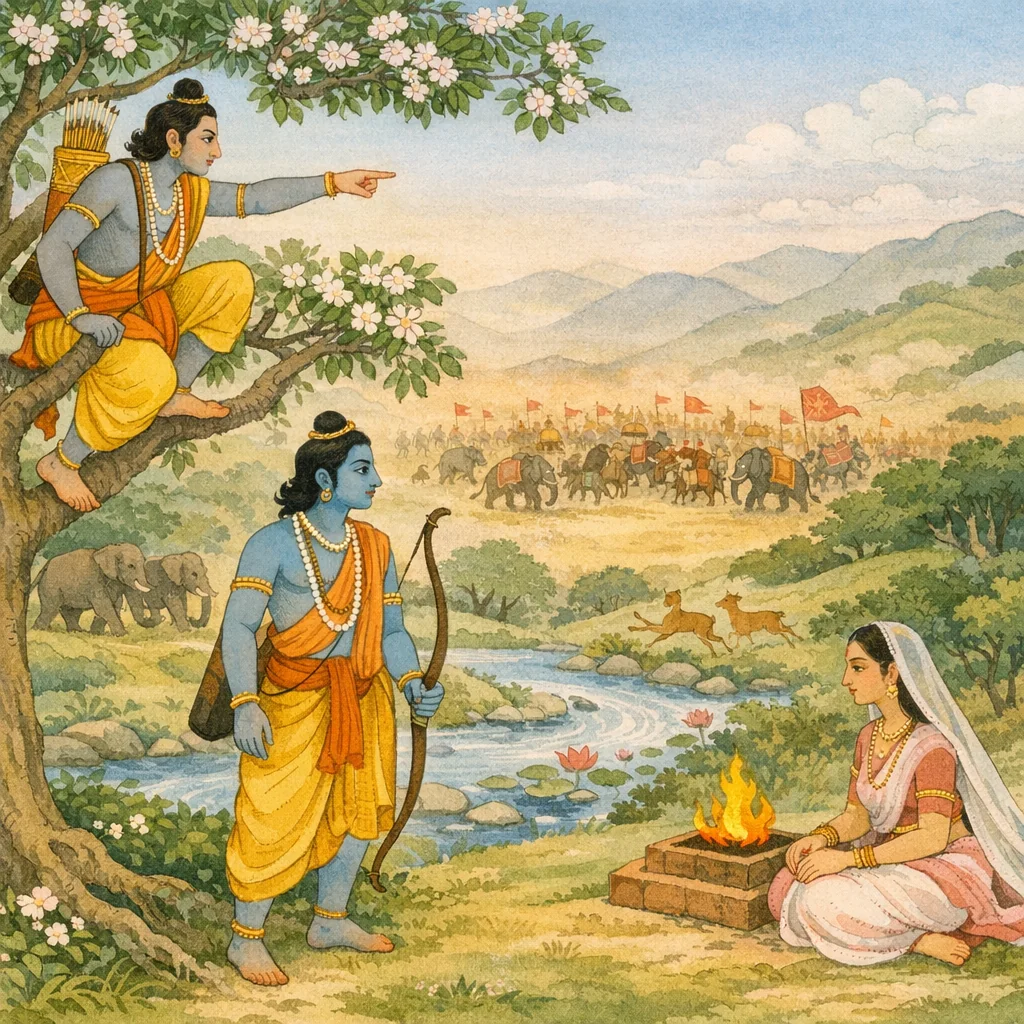
At Citrakūṭa, Rāma shows Sītā the Mandākinī mountain-river and, in a domestic-ritual register, offers roasted meat while seated with her. The calm is interrupted by sky-reaching dust and a tumult raised by an approaching force, which panics elephant-herd leaders and other forest animals. Rāma instructs Lakṣmaṇa to reconnoiter—framing the uncertainty as possibly a royal hunt or a dangerous beast—and emphasizes swift, exact assessment despite the mountain’s inaccessibility. Lakṣmaṇa climbs a flowering śāla tree, scans the horizons, and identifies a vast, well-equipped army with chariots, horses, elephants, infantry, and banners; he urges immediate precautions: extinguishing the sacred fire, securing Sītā in a cave, stringing the bow, readying arrows, and donning armor. When Rāma asks whose army it is, Lakṣmaṇa—angered like a blazing fire—misreads the approach as Bharata’s hostile attempt to eliminate them for uncontested kingship, citing the Kovidāra-tree emblem on the chariot standard. The sarga thus juxtaposes pastoral exile-life with sudden political-military anxiety, highlighting reconnaissance, restraint vs. wrath, and the ethical risk of acting on incomplete information.
Shlokas
Verse 1
तां तथा दर्शयित्वा तु मैथिलीं गिरिनिम्नगाम्।निषसाद गिरिप्रस्थे सीतां मांसेन छन्दयन्।।2.96.1।।
After showing the mountain-stream to Maithilī in that manner, Rāma sat down on the mountainside, pleasing Sītā by providing meat for food.
Verse 2
इदं मेध्यमिदं स्वादु निष्टप्तमिदमग्निना।एवमास्ते स धर्मात्मा सीतया सह राघवः।।2.96.2।।
Sitting there with Sītā, righteous Rāghava (Rāma) spoke in this manner, offering food: “This is ritually pure; this is delicious; this has been roasted by fire.”
Verse 3
तथा तत्राऽसतस्तस्य भरतस्यौपयायिनः।सैन्यरेणुश्च शब्दश्च प्रादुरास्तां नभस्पृशौ।।2.96.3।।
While Rāma was seated there, the dust raised by Bharata’s approaching army and its tumult suddenly arose—both seeming to touch the sky.
Verse 4
एतस्मिन्नन्तरे त्रस्ता श्शब्देन महता ततः।अर्दिता यूथपा मत्ता स्सयूथा दुद्रुवुर्दिशः।।2.96.4।।
Meanwhile, terrified by a great uproar, the mighty leaders of elephant-herds—agitated along with their groups—fled off in all directions.
Verse 5
स तं सैन्यसमुद्धूतं शब्दं शुश्राव राघवः।तां श्च विप्रद्रुतान्सर्वान्यूथपानन्ववैक्षत।।2.96.5।।
Rāghava heard that uproar raised by the army, and he also saw all those herd-leaders fleeing in haste.
Verse 6
तांश्च विद्रुवतो दृष्ट्वा तं च श्रुत्वा च निस्वनम्।उवाच राम स्सौमित्रिं लक्ष्मणं दीप्ततेजसम्।।2.96.6।।
Seeing them running away and hearing that clamour, Rama spoke to Lakshmana, son of Sumitra, radiant with energy.
Verse 7
हन्त लक्ष्मण पश्येह सुमित्रासुप्रजास्त्वया।भीमस्तनितगम्भीरस्तुमुलः श्रूयते स्वनः।।2.96.7।।
“Come, Lakshmana—look here! Sumitra is blessed in you as a worthy son. A tumultuous sound is heard, deep and dreadful like thunder.”
Verse 8
गजयूथानि वाऽरण्ये महिषा वा महावने।वित्रासिता मृगा स्सिंहै स्सहसा प्रद्रुता दिशः।।2.96.8।।
“Whether herds of elephants in the forest, or buffalo in these great woods—animals, frightened by lions, are suddenly running off in every direction.”
Verse 9
राजा वा राजपुत्रो वा मृगयामटते वने।अन्यद्वा श्वापदं किञ्चित्सौमित्रे ज्ञातुमर्हसि।।2.96.9।।
“It may be a king or a prince roaming the forest on a hunt, or else some other fierce beast—Saumitra, you should ascertain what it is.”
Verse 10
सुदुश्चरो गिरिश्चायं पक्षिणामपि लक्ष्मण।सर्वमेतद्यथातत्त्वमचिरात् ज्ञातुमर्हसि।।2.96.10।।
Lakṣmaṇa, this mountain is hard to traverse—even for birds. You should quickly learn the truth of what is happening here, exactly as it is.
Verse 11
स लक्ष्मण स्सन्त्वरित स्सालमारुह्य पुष्पितम्।प्रेक्षमाणो दिश स्सर्वाः पूर्वां दिशमुदैक्षत।।2.96.11।।
Then Lakṣmaṇa, hastening, climbed a flowering śāla tree; surveying all directions, he fixed his gaze toward the east.
Verse 12
उदङ्मुखः प्रेक्षमाणो ददर्श महतीं चमूम्।रथाश्वगजसम्बाधां यत्तैर्युक्तां पदातिभिः।।2.96.12।।
Turning northward and looking carefully, he saw a vast army—thick with chariots, horses, and elephants—together with well-armed infantry.
Verse 13
तामश्वगजसम्पूर्णां रथध्वजविभूषिताम्।शशंस सेनां रामाय वचनं चेदमब्रवीत्।।2.96.13।।
He reported to Rāma about that army—full of horses and elephants and adorned with chariots and banners—and then spoke these words.
Verse 14
अग्निं संशमयत्वार्य स्सीता च भजतां गुहाम्।सज्यं कुरुष्व चापं च शरांश्च कवचं तथा।।2.96.14।।
“O noble one, extinguish the sacred fire, and let Sītā take shelter in the cave. String your bow, keep the arrows ready, and put on your armour as well.”
Verse 15
तं रामः पुरुषव्याघ्रो लक्ष्मणं प्रत्युवाच ह।अङ्गावेक्षस्व सौमित्रे कस्येमां मन्यसे चमूम्।।2.96.15।।
Rāma, tiger among men, replied to Lakṣmaṇa: “Look carefully, Saumitra, and tell me—whose army do you think this is?”
Verse 16
एवमुक्तस्तु रामेण लक्ष्मणो वाक्यमब्रवीत्।दिधक्षन्निव तां सेनां रुषितः पावको यथा।।2.96.16।।
Thus addressed by Rāma, Lakṣmaṇa answered—wrathful like fire, as though he would burn that army down.
Verse 17
सम्पन्नं राज्यमिच्छंस्तु व्यक्तं प्राप्याभिषेचनम्।आवां हन्तुं समभ्येति कैकेय्या भरतस्सुतः।।2.96.17।।
“It is plain: Kaikeyī’s son Bharata, having obtained consecration, is coming to kill us both—seeking an untroubled, prosperous kingship.”
Verse 18
एष वै सुमहाञ्छ्रीमान्विटपी सम्प्रकाशते।विराजत्युद्गतस्कन्धं कोविदारध्वजो रथे।।2.96.18।।
“There—bright and splendid—appears the standard of a great, majestic tree; on the chariot the Kovidāra-tree banner shines, with its trunk rising high.”
Verse 19
असौ हि सुमहास्कन्धो विटपी च महाद्रुमः।विराजते महासैन्ये कोविदारध्वजो रथे।।2.96.19।।
“Yes—there is that great tree with a mighty trunk and spreading branches; in the midst of the great host, the Kovidāra-tree standard shines upon the chariot.”
Verse 20
भजन्त्येते यथाकाममश्वानारुह्य शीघ्रगान्।एते भ्राजन्ति संहृष्टा गजानारुह्य सादिनः।।2.96.20।।
“These men, mounted on swift horses, move about at will; and these elephant-riders, mounted on elephants, gleam with high spirits.”
Verse 21
गृहीतधनुषौ चावां गिरिं वीर श्रयावहै।अथवेहैव तिष्ठाव स्सन्नद्धावुद्यतायुधौ।।2.96.21।।
O mighty warrior, let the two of us take up our bows and take shelter on this mountain; or else, let us remain right here—fully armed, prepared for battle.
Verse 22
अपि नौ वशमागच्छेत्कोविदारध्वजो रणे।अपि द्रक्ष्यामि भरतं यत्कृते व्यसनं महत्।।2.96.22।।त्वया राघव सम्प्राप्तं सीतया च मया तथा।
O Rāghava, will that one—marked by the kovidāra-banner—fall into our power in battle? Shall I even behold Bharata, on whose account a great calamity has come upon you, and upon Sītā, and upon me as well?
Verse 23
यन्निमित्तं भवान्राज्याच्छ्युतो राघव शाश्वतात्।।2.96.23।।सम्प्राप्तोऽयमरिर्वीर भरतो वध्य एव मे।
O Rāghava, for whose sake you were cast out from the enduring kingdom—here that very Bharata has arrived as an enemy. O mighty one, to me he is fit only to be slain.
Verse 24
भरतस्य वधे दोषं नाहं पश्यामि राघव।पूर्वापकारिणं हत्वा न ह्यधर्मेण युज्यते।।2.96.24।।
O Rāghava, I see no fault in killing Bharata; for to slay one who has previously done harm is not, indeed, to be joined with unrighteousness.
Verse 25
पूर्वापकारी भरतस्त्यक्तधर्मश्च राघव।एतस्मिन्निहते कृत्स्नामनुशाधि वसुन्धराम्।।2.96.25।।
O Rāghava, Bharata is an earlier wrongdoer and one who has abandoned dharma. When he is slain, rule the entire earth.
Verse 26
अद्य पुत्रं हतं संख्ये कैकेयी राज्यकामुका।मया पश्येत्सुदुःखार्ता हस्तिभग्नमिव द्रुमम्।।2.96.26।।
Let Kaikeyī—greedy for the kingdom—today behold her son slain by me in battle, and be stricken with extreme grief, like one seeing a tree broken by an elephant.
Verse 27
कैकेयीं च वधिष्यामि सानुबन्धां सबान्धवाम्।कलुषेणाद्य महता मेदिनी परिमुच्यताम्।।2.96.27।।
And I will kill Kaikeyī too—along with her followers and kinsmen—so that today the earth may be cleansed of this great defilement.
Verse 28
अद्येमं संयतं क्रोधमसत्कारं च मानद।मोक्ष्यामि शत्रुसैन्येषु कक्षेष्विव हुताशनम्।।2.96.28।।
O guardian of honour, today I will unleash this long-restrained anger and the insult I have borne upon the enemy’s forces—like fire released into dry thickets.
Verse 29
अद्यैतच्छित्रकूटस्य काननं निशितै श्शरैः।छिन्दञ्चत्रुशरीराणि करिष्ये शोणितोक्षितम्।।2.96.29।।
Today, by my sharpened arrows, I will tear apart the bodies of the enemies and make this forest of Citrakūṭa drenched and spattered with blood.
Verse 30
शरैर्निर्भिन्नहृदयान्कुञ्जरांस्तुरगांस्तथा।श्वापदाः परिकर्षन्तु नरांश्च निहतान्मया।।2.96.30।।
“Let wild beasts drag away the elephants, horses, and even the men—slain by me, their hearts pierced through by arrows.”
Verse 31
शराणां धनुषश्चाहमनृणोऽस्मिन्महावने।ससैन्यं भरतं हत्वा भविष्यामि न संशयः।।2.96.31।।
“In this great forest, after slaying Bharata together with his army, I shall—without doubt—have repaid my debt to my bow and arrows.”
Frequently Asked Questions
The dilemma is whether to treat the approaching force as an enemy and preemptively strike or to verify facts first; Lakṣmaṇa advocates immediate martial readiness and assumes hostility, while Rāma insists on careful identification—an ethical test of action under uncertainty.
The sarga warns that fear and anger can distort inference: prudent leaders prioritize accurate knowledge (yathātattvam jñātum) before violence, while still maintaining protective preparedness—balancing kṣānti (restraint) with rakṣā (defense).
Citrakūṭa and the Mandākinī river frame the exile’s sacred landscape; culturally, the Agnihotra fire and the instruction to secure Sītā in a cave reflect household-ritual continuity and protective protocol within forest life.