Sarga 34
रामदर्शनार्थं दारानयनम् — The Queens Summoned; Rama’s Leave-Taking and Dasaratha’s Collapse
अयोध्याकाण्ड
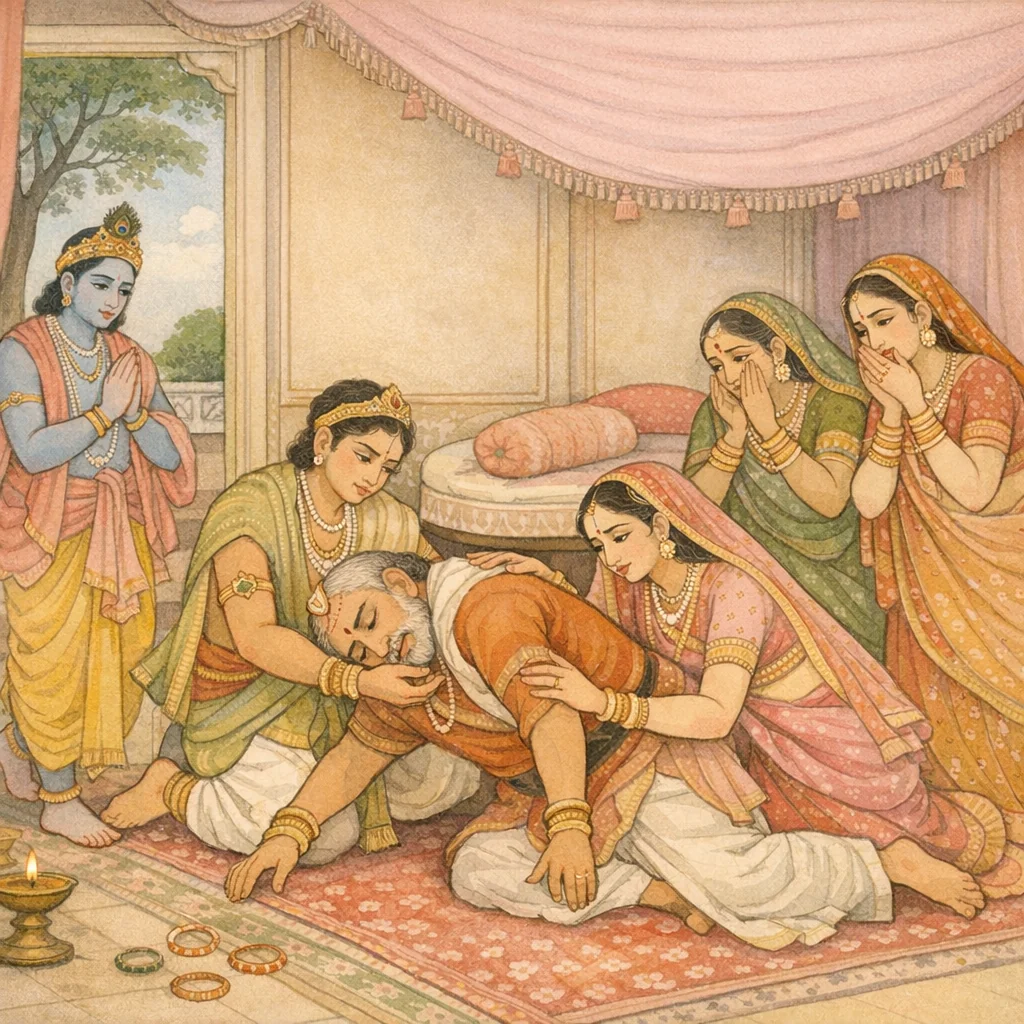
This sarga stages a tightly ordered palace sequence that turns into a crisis of consciousness. Rāma instructs Sumantra to inform Daśaratha of his arrival (2.34.1–2). Sumantra enters and finds the king depleted by grief, described through layered similes (eclipsed sun, ash-covered fire, dried tank) that function as a diagnostic poetics of kingship in decline (2.34.3). By royal command Sumantra summons the queens; Kausalyā arrives surrounded by a large retinue, visually indexing collective mourning (2.34.10–13). Upon their arrival Daśaratha orders Rāma brought in (2.34.14–15). Seeing Rāma approach with folded hands, the king rises, rushes forward, and collapses unconscious before reaching him; the palace erupts in the lament of many women and the clinking of ornaments, an acoustic marker of catastrophe (2.34.16–19). Rāma, Lakṣmaṇa, and Sītā lift him to a couch; when consciousness returns, Rāma formally seeks leave for Daṇḍakāraṇya and requests permission for Lakṣmaṇa and Sītā to accompany him (2.34.20–24). Daśaratha, bound by the ‘cord of truth’ and pressured by Kaikeyī, proposes instead that Rāma seize the throne—an inversion meant to escape the vow (2.34.26). Rāma refuses, reasserting satya, renouncing kingdom and pleasures, and insisting the boons be fulfilled in full; Bharata should receive the realm (2.34.28–45). Daśaratha oscillates between blessing and pleading for delay, asking at least one night’s stay (2.34.31–36). Rāma reiterates that father is divine even to the gods, that his resolve will not change, and that after fourteen years he will return (2.34.40–59). The sarga closes with Daśaratha again overwhelmed, embracing Rāma and losing consciousness; the queens (except Kaikeyī) and even Sumantra faint amid universal wailing—an ethical tragedy rendered as collective bodily and sonic breakdown (2.34.60–61).
Shlokas
Verse 1
ततः कमलपत्राक्षः श्यामो निरुपमो महान्।उवाच राम स्तं सूतं पितुराख्याहि मामिति।।।।
Then Rāma—lotus-eyed, dark-hued, great and peerless—said to the charioteer, “Inform my father about me (that I have come).”
Verse 2
स रामप्रेषितः क्षिप्रं सन्तापकलुषेन्द्रियः।प्रविश्य नृपतिं सूतो निश्वसन्तं ददर्श ह ।।।।
Sent by Rama, the charioteer Sumantra—his senses clouded by grief—quickly entered the king’s chamber and saw the ruler heaving deep sighs.
Verse 3
उपरक्तमिवादित्यं भस्मच्छन्नमिवानलम्।तटाकमिव निस्तोयमपश्यज्जगतीपतिम्।।।।
He beheld the lord of the earth (Daśaratha) grown dim—like the sun under eclipse, like fire smothered in ash, like a tank dried of water.
Verse 4
आलोक्य तु महाप्राज्ञः परमाकुलचेतसम्।राममेवानुशोचन्तं सूतः प्राञ्जलिरासदत्।।।।
Seeing Rāma grieving, his mind utterly agitated, the wise charioteer approached him with folded hands.
Verse 5
तं वर्धयित्वा राजानं पूर्वं सूतो जयाशिषा।भयविक्लबया वाचा मन्दया श्लक्ष्णमब्रवीत्।।।।
First, the charioteer greeted the king with a blessing of victory; then, trembling with fear, he spoke softly in a faint and gentle voice.
Verse 6
अयं स पुरुषव्याघ्रो द्वारि तिष्ठति ते सुतः।ब्राह्मणेभ्यो धनं दत्वा सर्वञ्चैवोपजीविनाम्।।।।
That son of yours—Rāma, the tiger among men—stands at the doorway, having given away all his wealth in charity to the brahmins and to all who depended on him.
Verse 7
स त्वा पश्यतु भद्रं ते रामस्सत्यपराक्रमः।सर्वान् सुहृद आपृच्छ्य त्वामिदानीं दिदृक्षते।।1.34.7।।
May you grant audience to Rāma, whose valour is proven in truth; having taken leave of all his friends, he now wishes to see you.
Verse 8
गमिष्यति महारण्यं तं पश्य जगतीपते।वृतं राजगुणै स्सर्वैरादित्यमिव रश्मिभिः।।।।
O lord of the world, behold him—adorned with every royal virtue like the sun encircled by its rays—now setting out for the great forest.
Verse 9
स सत्यवादी धर्मात्मा गाम्भीर्यात्सागरोपमः।आकाश इव निष्पङ्को नरेन्द्रः प्रत्युवाच तम्।।।।
That king—truth-speaking, righteous at heart, deep as the ocean, and pure like the sky—replied to him.
Verse 10
सुमंन्त्रानय मे दारान् ये केचिदिह मामकाः।दारैः परिवृतस्सर्वैर्द्रष्टुमिच्छामि धार्मिकम्।।।।
“Sumantra, bring all my consorts who are here. Surrounded by all my wives, I wish to see the righteous Rāma.”
Verse 11
सोऽन्तःपुरमतीत्यैव स्त्रियस्ता वाक्यमब्रवीत्।आर्याह्वयति वो राजा गम्यतां तत्र मा चिरम्।।।।
Crossing into the inner apartments, Sumantra spoke to the women: “Venerable ladies, the king summons you; go there—do not delay.”
Verse 12
एवमुक्ताः स्त्रिय स्सर्वाः सुमन्त्रेण नृपाज्ञया।प्रचक्रमु स्तद्भवनं भर्तुराज्ञाय शासनम्।।।।
Thus addressed by Sumantra, in accordance with the king’s command, all the women set out for that palace, having understood their husband’s directive.
Verse 13
अर्धसप्तशतास्तास्तु प्रमदास्ताम्रलोचनाः।कौसल्यां परिवार्याथ शनैर्जग्मुर्धृतव्रताः।।।।
Then those women—three hundred and fifty in number—eyes reddened with grief, faithful to their vows, moved slowly, surrounding Kausalyā.
Verse 14
आगतेषु च दारेषु समवेक्ष्य महीपतिः।उवाच राजा तं सूतं सुमन्त्राऽनय मे सुतम्।।।।
When his consorts had arrived, the king—lord of the earth—looking upon them, said to the charioteer: “Sumantra, bring in my son.”
Verse 15
स सूतो राममादाय लक्ष्मणं मैथिलीं तदा।जगामाभिमुखस्तूर्णं सकाशं जगतीपतेः।।।।
Then the charioteer brought Rāma along with Lakṣmaṇa and Maithilī (Sītā), and without delay went forward to the presence of the lord of the world (the king).
Verse 16
स राजा पुत्रमायान्तं दृष्ट्वा दूरात्कृताञ्जलिम्।उत्पपातासनात्तूर्णमार्त स्त्रीजनसंवृतः।।।।
Seeing from afar his son approaching with folded hands, the king—encircled by the palace women and stricken with grief—rose hastily from his seat.
Verse 17
सोऽभिदुद्राव वेगेन रामं दृष्ट्वा विशाम्पतिः।तमसंप्राप्य दुःखार्तः पपात भुवि मूर्छितः।।।।
At the sight of Rama, the lord of men rushed forward in haste; but, unable to reach him, the king—tormented by sorrow—collapsed unconscious upon the ground.
Verse 18
तं रामोऽभ्यपतत् क्षिप्रं लक्ष्मणश्च महारथः।विसंज्ञमिव दुःखेन सशोकं नृपतिं तदा।।।।
Then Rama and Lakshmana, the great chariot-warrior, hurried to the king—grief-stricken and as if bereft of consciousness.
Verse 19
स्त्रीसहस्रनिनादश्च संजज्ञे राजवेश्मनि।हा हा रामेति सहसा भूषणध्वनिमूर्छितः।।।।
Suddenly, within the royal palace arose the wailing of a thousand women—“Alas, alas, Rama!”—blended with the confused clinking of their ornaments.
Verse 20
तं परिष्वज्य बाहुभ्यां तावुभौ रामलक्ष्मणौ।पर्यंङ्के सीतया सार्धं रुदन्तः समवेशयन्।।।।
Rama and Lakshmana together embraced him with their arms; with Sita beside them, they weepingly placed the king upon a couch.
Verse 21
अथ रामो मुहूर्तेन लब्धसंज्ञं महीपतिम्।उवाच प्राञ्जलिर्भूत्वा शोकार्णवपरिप्लुतम्।।।।
Then, when the lord of the earth regained consciousness after a short while, Rama—standing with folded palms—addressed him, though he was still submerged in an ocean of sorrow.
Verse 22
आपृच्छे त्वां महाराज सर्वेषामीश्वरोऽसि नः।प्रस्थितं दण्डकारण्यं पश्य त्वं कुशलेन माम्।।।।
O great king, I seek your leave—for you are the lord of us all. I am setting out for the Daṇḍaka forest; look upon me as I depart, with a composed and auspicious heart.
Verse 23
लक्ष्मणं चानुजानीहि सीता चान्वेति मां वनम्।कारणैर्बहुभि स्तथ्यैर्वार्यमाणौ न चेच्छतः।।।।
Grant permission also to Lakshmana; and Sita, too, insists on following me to the forest. Though I tried to dissuade them with many true and reasonable arguments, they would not consent to stay back.
Verse 24
अनुजानीहि सर्वान्नः शोकमुत्सृज्य मानद।लक्ष्मणं मां च सीतां च प्रजापतिरिव प्रजाः।।।।
O bestower of honor, casting aside grief, grant leave to all of us—to Lakshmana, to me, and to Sita—just as Prajāpati permits his creatures.
Verse 25
प्रतीक्षमाणमव्यग्रमनुज्ञां जगतीपतेः।उवाच राजा सम्प्रेक्ष्य वनवासाय राघवम्।।।।
Seeing Rāghava standing calm and waiting for the king’s permission to depart for forest-dwelling, the king—lord of the earth—spoke.
Verse 26
अहं राघव कैकेय्या वरदानेन मोहितः।अयोध्यायास्त्वमेवाद्य भव राजा निगृह्य माम्।।।।
“O Rāghava, I have been deluded by Kaikeyī through the granting of boons. Constrain me, and you yourself become king of Ayodhyā today.”
Verse 27
एवमुक्तो नृपतिना रामो धर्मभृतां वरः।प्रत्युवाचाञ्जलिं कृत्वा पितरं वाक्यकोविदः।।।।
Thus addressed by the king, Rāma—foremost among upholders of dharma, skilled in speech—replied to his father with folded hands.
Verse 28
भवान्वर्ष सहस्राय पृथिव्या नृपते पतिः।अहं त्वरण्येवत्स्यामि न मे कार्यं त्वयाऽनृतम्।।।।
“O king, you shall remain lord of this earth for a thousand years. As for me, I will live in the forest; for my sake, let no untruth be committed by you.”
Verse 29
नव पञ्च च वर्षाणि वनवासे विहृत्य ते।पुनःपादौ ग्रहीष्यामि प्रतिज्ञान्ते नराधिप।।।।
“After spending nine and five years—fourteen—in forest-dwelling, and thus fulfilling the vow, I shall return and once again take hold of your feet, O lord of men.”
Verse 30
रुदन्नार्तः प्रियं पुत्रं सत्यपाशेन संयतः।कैकेय्या चोद्यमानस्तु मिथो राजा तमब्रवीत्।।।।
Wailing in anguish, the king—bound by the noose of truth and prodded by Kaikeyī—spoke to that beloved son in strained exchange.
Verse 31
श्रेयसे वृद्धये तात पुनरागमनाय च।गच्छस्वारिष्टमव्यग्रः पन्थानमकुतोभयम्।।।।
“For your welfare and growth, my child—and for your return—go: may your path be auspicious, untroubled, and free from fear from any quarter.”
Verse 32
न हि सत्यात्मनस्तात धर्माभिमनस स्तव।विनिवर्तयितुं बुद्धिः शक्यते रघुनन्दन।।।।
“For you, dear child—whose very self is truth, whose mind is set upon dharma—cannot easily be turned back from your resolve, O delight of the Raghus.”
Verse 33
अद्य त्विदानीं रजनीं पुत्र मा गच्छ सर्वथा।एकाहदर्शनेनापि साधु तावच्चराम्यहम्।।।।
“But today—this very night, my son—do not go at all. If only I may see you even for one more day, I can endure a little longer in peace.”
Verse 34
मातरं मां च सम्पश्यन् वसेमामद्य शर्वरीम्।तर्पित स्सर्वकामैस्त्वं श्वः काले साधयिष्यसि।।।।।
Stay tonight, seeing your mother and me. With all our wishes satisfied, you may set out tomorrow at the proper time.
Verse 35
दुष्करं क्रियते पुत्र सर्वथा राघव त्वया।मत्प्रियार्थं प्रियांस्त्यक्त्वा यद्यासि विजनं वनम्।।।।
O son, O Rāghava—by every measure you are undertaking a hard deed: for my sake you are leaving your dear ones and going to the lonely forest.
Verse 36
न चैतन्मे प्रियं पुत्र शपे सत्येन राघव।छन्नया चलितस्त्वस्मि स्त्रिया छन्नाग्निकल्पया।।।।
This is not pleasing to me, my son—I swear by truth, O Rāghava. I have been deceived by a woman with hidden intent, like fire concealed beneath ashes.
Verse 37
वञ्चना या तु लब्धा मे तां त्वं निस्तर्तुमिच्छसि।अनया वृत्तसादिन्या कैकेय्याऽभिप्रचोदितः।।.।।
The deceit that has befallen me—you wish to overcome it, having been urged on by this Kaikeyī, the destroyer of right conduct and lineage-tradition.
Verse 38
न चैतदाश्चर्यतमं यत्तज्येष्ठस्सुतो मम।अपानृतकथं पुत्र पितरं कर्तुमिच्छसि।।।।
And this is not at all the most surprising thing—that you, my eldest son, wish to make your father one whose word is not false, O son.
Verse 39
अथ रामस्तथा श्रुत्वा पितुरार्तस्य भाषितम्।लक्ष्मणेन सह भ्रात्रा दीनो वचनमब्रवीत्।।।।
Then Rāma, having heard those words of his distressed father, spoke in sorrow, with his brother Lakṣmaṇa beside him.
Verse 40
प्राप्स्यामि यानद्य गुणान्को मे श्वस्तान् प्रदास्यति।अपक्रमणमेवातः सर्वकामैरहं वृणे।।।।
Whatever merit I can gain today—who will grant it to me tomorrow? Therefore I choose departure itself, letting go of all desires.
Verse 41
इयं सराष्ट्रा सजना धनधान्यसमाकुला।मया विसृष्टा वसुधा भरताय प्रदीयताम्।।।।
Let this earth—together with the kingdom, its people, and its abundance of wealth and grain—be given to Bharata, for I have renounced it.
Verse 42
वनवासकृता बुद्धिर्न च मेऽद्य चलिष्यति।यस्तुष्टेन वरो दत्तः कैकेय्यै वरद त्वया।।।।दीयतां निखिलेनैव सत्यस्त्वं भव पार्थिव।
My resolve for forest-dwelling will not waver now. O king, bestower of boons—whatever boon you, pleased, granted to Kaikeyī, let it be fulfilled entirely; be true to your word.
Verse 43
अहं निदेशं भवतो यथोक्तमनुपालयन्।।।।चतुर्दश समा वत्स्ये वने वनचरैस्सह।
Obeying your command exactly as it was spoken, I shall dwell in the forest for fourteen years, living among the forest-dwellers.
Verse 44
मा विमर्शो वसुमती भरताय प्रदीयताम्।।।।न हि मे काङ्क्षितं राज्यं सुखमात्मनि वा प्रियम्।यथानिदेशं कर्तुं वै तवैव रघुनन्दन।।।।
Do not brood over this. Let the sovereignty of the earth be given to Bharata. I do not desire the kingdom, nor any personal pleasure; what is dearest to me is only to carry out your command, O joy of the Raghu line.
Verse 45
मा विमर्शो वसुमती भरताय प्रदीयताम्।।2.34.44।।न हि मे काङ्क्षितं राज्यं सुखमात्मनि वा प्रियम्।यथानिदेशं कर्तुं वै तवैव रघुनन्दन।।2.34.45।।
Do not brood over this. Let the sovereignty of the earth be given to Bharata. I do not desire the kingdom, nor any personal pleasure; what is dearest to me is only to carry out your command, O joy of the Raghu line.
Verse 46
अपगच्छतु ते दु:खं माभूर्बाष्पपरिप्लुतः।न हि क्षुभ्यति दुर्धर्षः समुद्रः सरितां पतिः।।।।
Let your grief depart; do not be flooded with tears. The indomitable ocean—the lord of rivers—is not shaken.
Verse 47
नैवाहं राज्यमिच्छामि न सुखं न च मेदिनीम्।नैव सर्वानिमान् कामा न्नस्वर्गं नैव जीवितम्।।।।
I desire no kingdom, no comfort, not even dominion over the earth—nor any of these pleasures, nor heaven, nor even life itself.
Verse 48
त्वामहं सत्यमिच्छामि नानृतं पुरुषर्षभ।प्रत्यक्षं तव सत्येन सुकृतेन च ते शपे।।।।
I want you, O best of men, to stand by truth and not by falsehood. Here before you, I swear by truth itself and by whatever merit I have earned.
Verse 49
न च शक्यं मया तात स्थातुं क्षणमपि प्रभो।स शोकं धारयस्वेमं न हि मेऽस्ति विपर्ययः।।।।
Nor is it possible for me, father—O lord—to remain here even for a moment. Restrain this grief, for there can be no reversal in my resolve.
Verse 50
अर्थितो ह्यस्मि कैकेय्या वनं गच्छेति राघव।मया चोक्तं व्रजामीति तत्सत्यमनुपालये।।।।
Kaikeyī has indeed asked me, ‘Rāghava, go to the forest.’ And I have said, ‘I will go’; therefore I shall abide by that truth—my pledged word.
Verse 51
मा चोत्कण्ठां कृथा देव वने रंस्यामहे वयम्।प्रशान्तहरिणाकीर्णे नानाशकुनिनादिते।।।।
Do not be anxious, O lord. We shall find joy in the forest—peaceful, filled with deer, and ringing with the calls of many kinds of birds.
Verse 52
पिता हि दैवतं तात देवतानामपि स्मृतम्।तस्माद्दैवतमित्येव करिष्यामि पितुर्वचः।।।।
A father is declared to be a divinity—even for the gods. Therefore, regarding my father as my very deity, I shall carry out my father’s command.
Verse 53
चतुर्दशसु वर्षेषु गतेषु नरसत्तम।पुनर्द्रक्ष्यसि मां प्राप्तं सन्तापोऽयं विमुच्यताम्।।।।
When fourteen years have passed, O best of men, you will see me returned again. Let this grief be set aside.
Verse 54
येन संस्तम्भनीयोऽयं सर्वो बाष्पगलो जनः।स त्वं पुरुषशार्दूल किमर्थं विक्रियां गतः।।।।
You are the one by whom this whole people—throats choked with tears—should be steadied. Why then, O tiger among men, have you fallen into such a change?
Verse 55
पुरं च राष्ट्रं च मही च केवलामया निसृष्टा भरताय दीयताम्।अहं निदेशं भवतोऽनुपालयन्वनं गमिष्यामि चिराय सेवितुम्।।।।
Let this city, this kingdom, and even the whole earth that I relinquish be given to Bharata. Obeying your command, I shall go to the forest to dwell there for a long time.
Verse 56
मया निसृष्टां भरतो महीमिमांसशैलषण्डां सपुरां सकाननाम्।शिवां सुसीमामनुशास्तु केवलंत्वया यदुक्तं नृपते तथास्तु तत्।।।।
Let Bharata alone govern this auspicious land I have relinquished—complete with mountain ranges, cities, and forests, and bordered by well-set frontiers. O king, let what you have spoken be so.
Verse 57
न मे तथा पार्थिव धीयते मनोमहत्सु कामेषु न चात्मनःप्रिये।यथा निदेशे तव शिष्टसम्मतेव्यपैतु दुःखं तव मत्कृतेऽनघ।।।।
O king, my mind does not find such contentment in great pleasures or in what is personally dear as it does in carrying out your command—approved by the wise. Let your sorrow on my account pass away, O blameless one.
Verse 58
तदद्य नैवानघ राज्यमव्ययंन सर्वकामान्न सुखं न मैथिलीम्।न जीवितं त्वामनृतेन योजयन्वृणीय सत्यं व्रतमस्तु ते तथा।।।।
Therefore now, O blameless one, I would choose neither an enduring kingdom, nor all desired objects, nor happiness, nor even Maithilī—nor life itself—if it meant binding you to falsehood. I choose only that your vow stand true as spoken.
Verse 59
फलानि मूलानि च भक्षयन्वनेगिरींश्च पश्यन् सरितस्सरांसि च।वनं प्रविश्यैव विचित्रपादपम्सुखी भविष्यामि तवास्तु निर्वृतिः।।।।
Eating fruits and roots in the forest, and gazing on mountains, rivers, and lakes—entering that woodland of varied trees—I shall be happy. Let there be peace for you.
Verse 60
एवं स राजा व्यसनाभिपन्नःशोकेन दुःखेन च ताम्यमानः।आलिङ्ग्य पुत्रं सुविनष्टसंज्ञोमोहं गतो नैव चिचेष्ट किंञ्चित्।।।।
Thus the king, overwhelmed by calamity and wasting away with grief and sorrow, embraced his son; then, losing consciousness, he sank into a faint and did not move at all.
Verse 61
देव्यस्तत स्संरुरुदुस्समेतास्तां वर्जयित्वा नरदेवपत्नीम्।रुदन् सुमन्त्रोऽऽपि जगाम मूर्छांहाहाकृतं तत्र बभूव सर्वम्।।।।
Then the queens, gathered together—leaving aside the king’s wife (Kaikeyī)—wailed aloud. Sumantra too, weeping, fell into a swoon; everywhere there arose cries of “Alas! Alas!”
Frequently Asked Questions
The dilemma is whether a king may escape a pledged boon by reversing succession. Daśaratha urges Rāma to imprison him and take the throne, but Rāma rejects any remedy that would make the father’s promise untrue, insisting the boons to Kaikeyī be honored fully.
Dharma is shown as fidelity to truth under emotional pressure: Rāma prioritizes satya over sovereignty, pleasure, and even life, and treats the father’s command as divine authority, modeling maryādā as disciplined adherence to rightful order.
The palace complex (inner apartments, audience space, throne/couch) functions as the cultural setting for royal protocol, while Daṇḍakāraṇya is named as the destination that transforms the narrative from courtly governance to forest-based dharma and ascetic endurance.