
Bhagavad Gita — Vibhuti Yoga, Shloka 29
Vibhuti Yoga
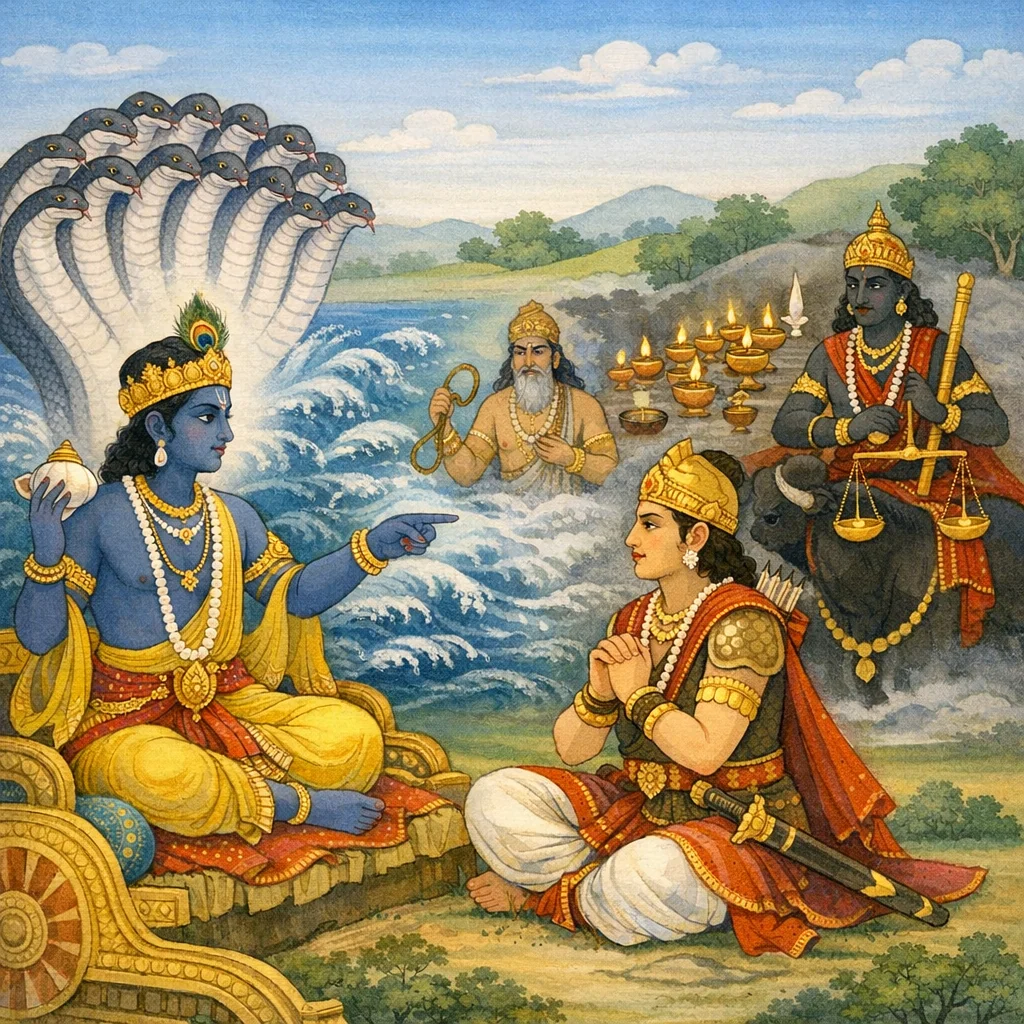
अनन्तश्चास्मि नागानां वरुणो यादसामहम् । पितॄणामर्यमा चास्मि यमः संयमतामहम् ॥ १०.२९ ॥
anantaś cāsmi nāgānāṃ varuṇo yādasām aham | pitṝṇām aryamā cāsmi yamaḥ saṃyamatām aham || 10.29 ||

Among nāgas I am Ananta; among aquatic beings I am Varuṇa. Among the ancestors I am Aryaman; among those who restrain and govern I am Yama.
I am Ananta among nāgas; among aquatic beings I am Varuṇa. Among the ancestors I am Aryaman; among those who restrain and govern I am Yama.
Among the nāgas I am Ananta; among water-dwellers I am Varuṇa; among the Pitṛs I am Aryaman; among those who exercise control (discipline/judgment) I am Yama.
Most printed recensions agree on the identifications. Translation differences mainly concern the semantic range of saṃyamatām (“those who restrain/discipline” vs. “controllers/punishers”), often framed ethically rather than punitively in modern renderings.
FAQs
The verse frames self-regulation (saṃyama) as a sacred capacity: disciplined attention, impulse-control, and ethical restraint are presented as expressions of an underlying, integrating principle.
Krishna identifies the divine with exemplary archetypes across domains, suggesting a metaphysics of immanence: the ultimate reality is present as the highest potency within each class of beings.
Within the Vibhūti-yoga catalogue, these identifications function as mnemonic pointers—recognizable cultural figures (Ananta, Varuṇa, Aryaman, Yama) used to indicate divine pervasiveness.
One may read the verse as encouraging reverence for systems that sustain life—ecological waters, ancestral continuity, and ethical self-governance—without requiring literal belief in the named deities.