
Bhagavad Gita — Vibhuti Yoga, Shloka 30
Vibhuti Yoga
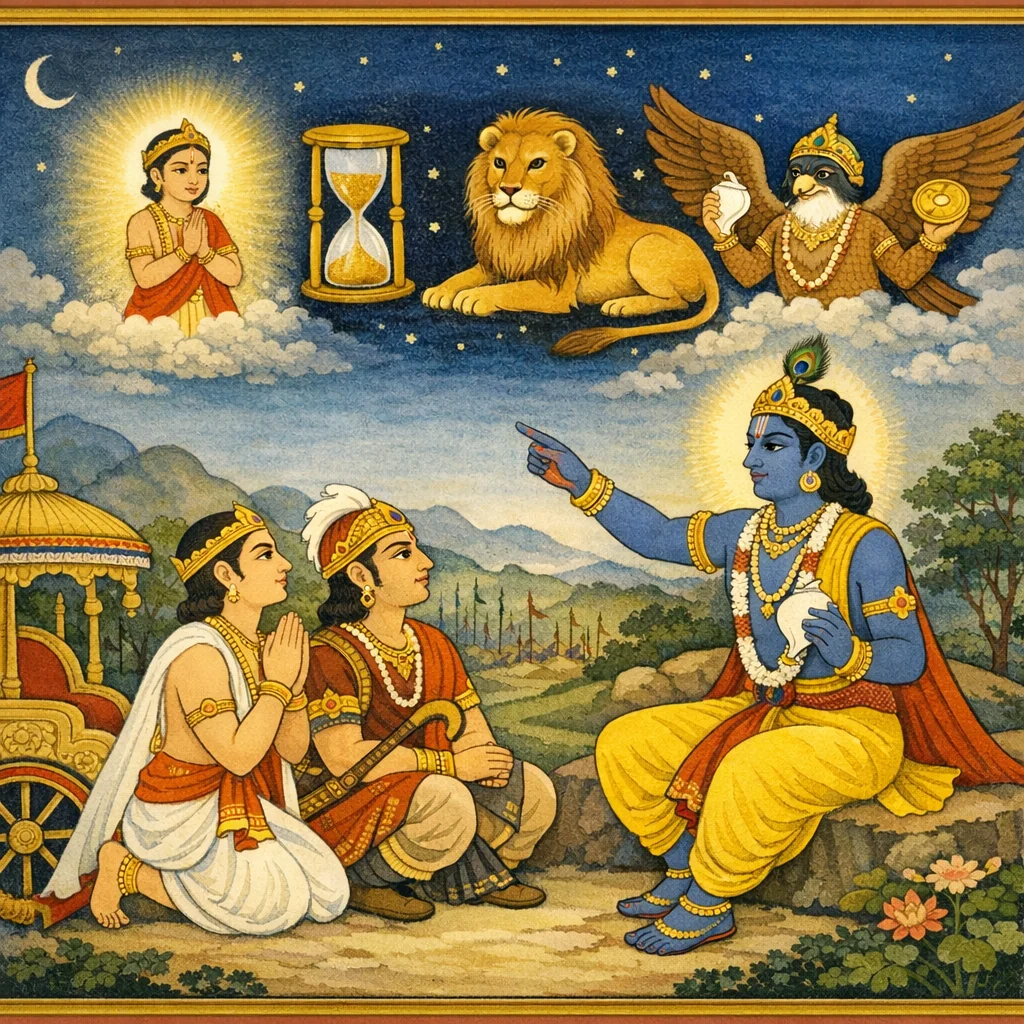
प्रह्लादश्चास्मि दैत्यानां कालः कलयतामहम् । मृगाणां च मृगेन्द्रोऽहं वैनतेयश्च पक्षिणाम् ॥ १०.३० ॥
prahlādaś cāsmi daityānāṃ kālaḥ kalayatām aham | mṛgāṇāṃ ca mṛgendro 'haṃ vainateyaś ca pakṣiṇām || 10.30 ||

Among the Daityas I am Prahlāda; among those who reckon, I am Time. Among beasts I am the lord of beasts; among birds I am Vainateya (Garuḍa).
Among the Daityas I am Prahlāda; among reckoners I am Time. Among animals I am the king of beasts; among birds I am Vainateya (Garuḍa).
Among the Daityas I am Prahlāda; among those who compute/measure I am Time; among beasts I am the lord of beasts (lion); among birds I am Vainateya (Garuḍa).
The key interpretive point is kalayatām: it can mean “those who count/measure” (astronomical, calendrical, or evaluative) rather than “those who deceive.” Many translations gloss mṛgendra as “lion.”
FAQs
Time (kāla) can be read as the mind’s organizing constraint—deadlines, aging, and change—prompting prioritization and humility; Prahlāda symbolizes steadfast values under pressure.
By identifying with kāla, the text links divinity to the ordering principle of change and measurement, not merely to static being; the divine is both value and process.
Prahlāda is a well-known figure of devotion within a lineage portrayed as adversarial to the gods; his inclusion underscores that spiritual excellence can appear in any group.
The verse can be used to reflect on exemplary traits—integrity (Prahlāda), respect for time, and recognizing ‘best-in-class’ qualities as occasions for contemplation rather than comparison.