
Bhagavad Gita — Vibhuti Yoga, Shloka 28
Vibhuti Yoga
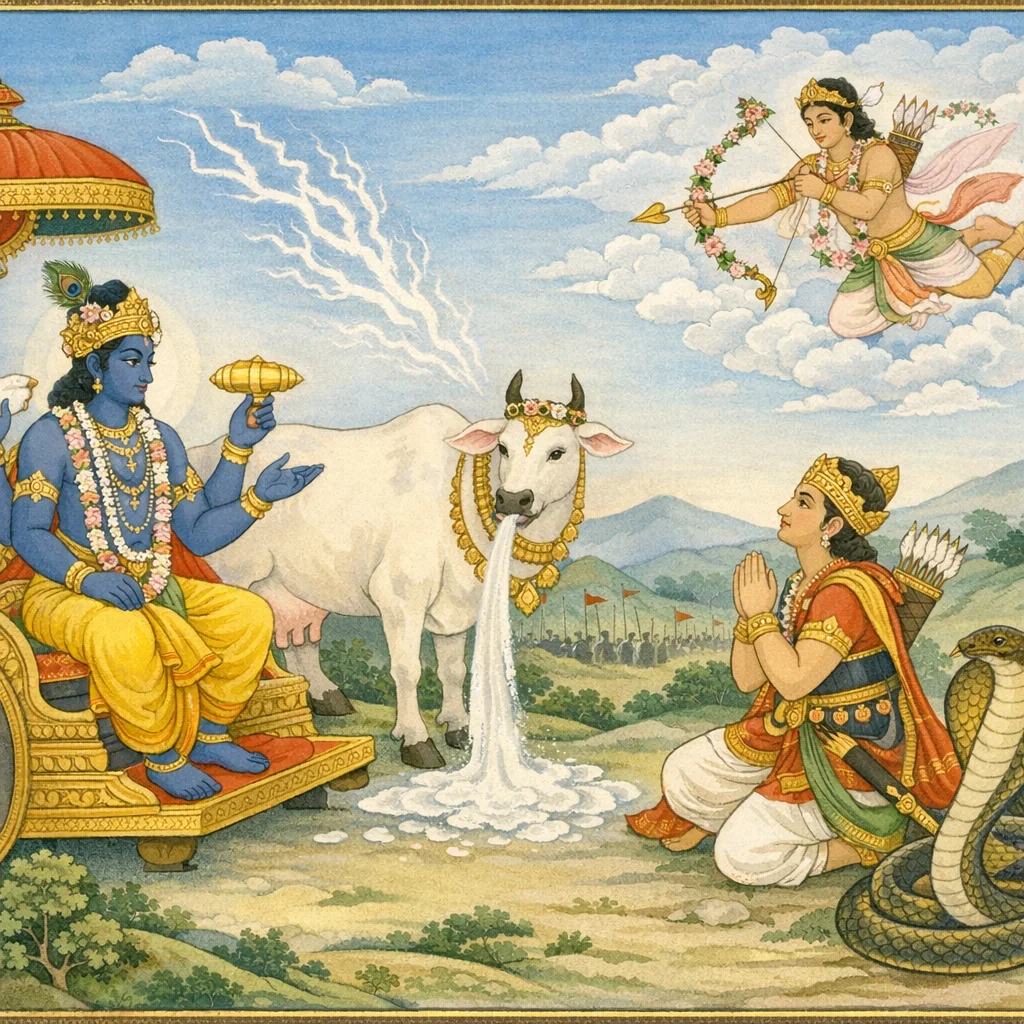
आयुधानामहं वज्रं धेनूनामस्मि कामधुक् । प्रजनश्चास्मि कन्दर्पः सर्पाणामस्मि वासुकिः ॥ १०.२८ ॥
āyudhānām ahaṃ vajraṃ dhenūnām asmi kāmadhuk | prajanaś cāsmi kandarpaḥ sarpāṇām asmi vāsukiḥ || 10.28 ||

Among weapons I am the Vajra (thunderbolt); among cows I am Kāmadhuk, the wish-fulfilling cow. I am procreation, and I am Kandarpa (the god of love); among serpents I am Vāsuki.
Among weapons I am the thunderbolt (Vajra); among cows I am the wish-fulfilling cow (Kāmadhuk); I am procreation, and I am Kandarpa (the god of love); among serpents I am Vāsuki.
Of instruments of power I am the vajra; of cows I am Kāmadhenu; I am procreative generation, and I am Kandarpa; of serpents I am Vāsuki.
‘āyudha’ can be translated ‘weapon,’ but in this chapter the intent is typological eminence, not advocacy of harm; ‘vajra’ also symbolizes irresistible force/authority. ‘prajana’ and ‘Kandarpa’ connect desire and generativity to cosmic continuity.
FAQs
It acknowledges multiple human drives—power, nourishment, desire, continuity—suggesting they can be understood and integrated rather than merely suppressed.
The verse presents divine presence in compelling force (vajra) and in life’s generative principle (prajana/Kandarpa), indicating a sacral dimension to both order and creativity.
Continuing the vibhūti catalogue, it spans social-symbolic power, abundance motifs, eros/generation, and mythic serpent lineages.
Can be read as encouraging ethical channeling of power and desire—recognizing their potency while aligning them with responsibility and well-being.