
Bhagavad Gita — Vibhuti Yoga, Shloka 2
Vibhuti Yoga
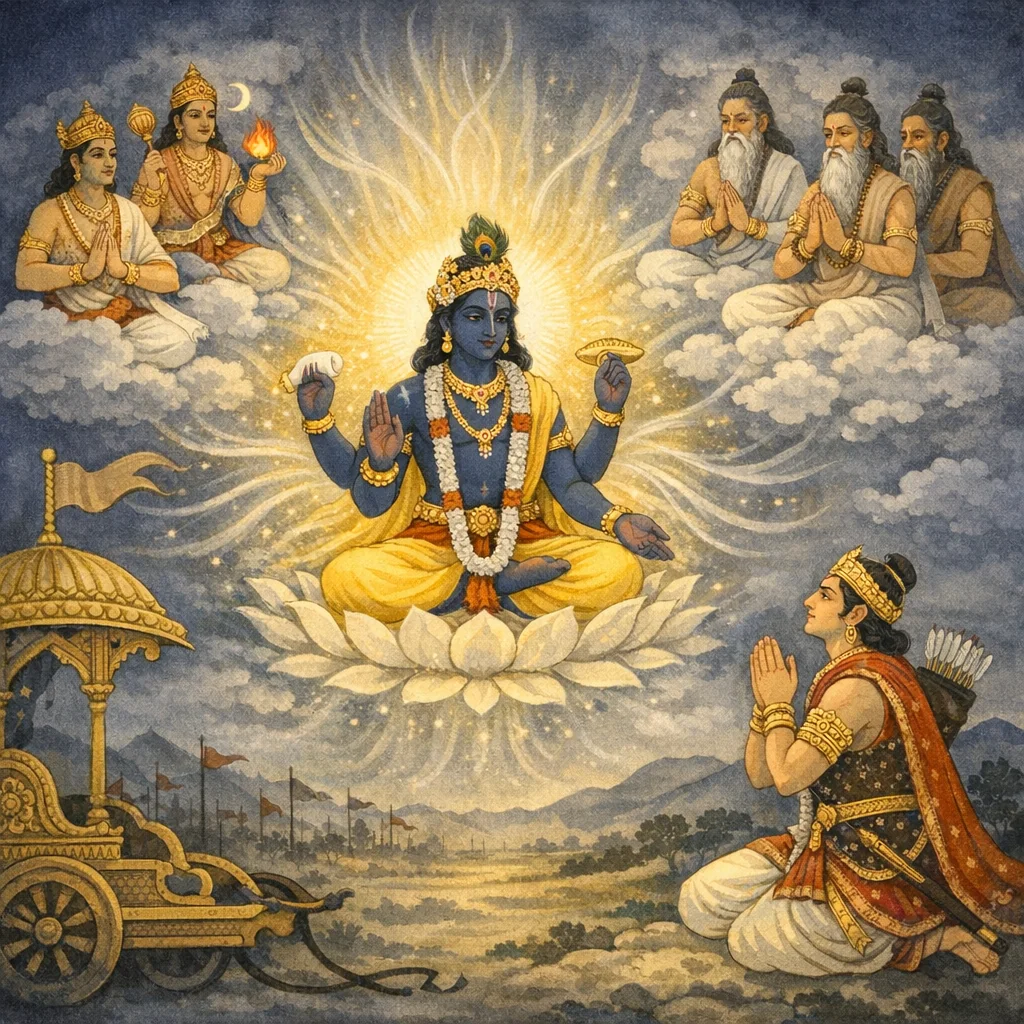
न मे विदुः सुरगणाः प्रभवं न महर्षयः । अहमादिर्हि देवानां महर्षीणां च सर्वशः ॥ १०.२ ॥
na me viduḥ sura-gaṇāḥ prabhavaṁ na maharṣayaḥ | aham ādir hi devānāṁ maharṣīṇāṁ ca sarvaśaḥ || 10.2 ||

Neither the hosts of gods nor the great seers know My origin; for in every way I am the source of the gods and the great seers.
Neither the hosts of gods nor the great seers know My origin; for I am the source of the gods and the great seers in every way.
The groups of gods do not know My emergence, nor do the great seers; for I am indeed the origin of the gods and of the great seers entirely.
‘prabhava’ may be translated ‘origin,’ ‘emergence,’ or ‘sourcehood.’ The claim is theological and hierarchical: even exalted beings are derivative relative to Krishna’s ultimacy. Interpretations differ on whether this is personal-theistic (a supreme deity) or metaphysical (the absolute ground of being).
FAQs
It cautions against overreliance on authority figures: even the most revered sources may have limits, encouraging intellectual humility and openness to deeper inquiry.
It asserts a first-principle status for Krishna: all celestial and sage-like powers are derivative, implying an ultimate causal ground that is not fully objectifiable by subordinate beings.
This sets up the vibhūti discourse by establishing Krishna’s primacy over the cosmos and its intelligences, legitimizing the ensuing catalog of manifestations.
As a general principle, it supports epistemic humility: complex systems (nature, consciousness, society) may exceed the grasp of any single expert community.