
Bhagavad Gita — Vibhuti Yoga, Shloka 3
Vibhuti Yoga
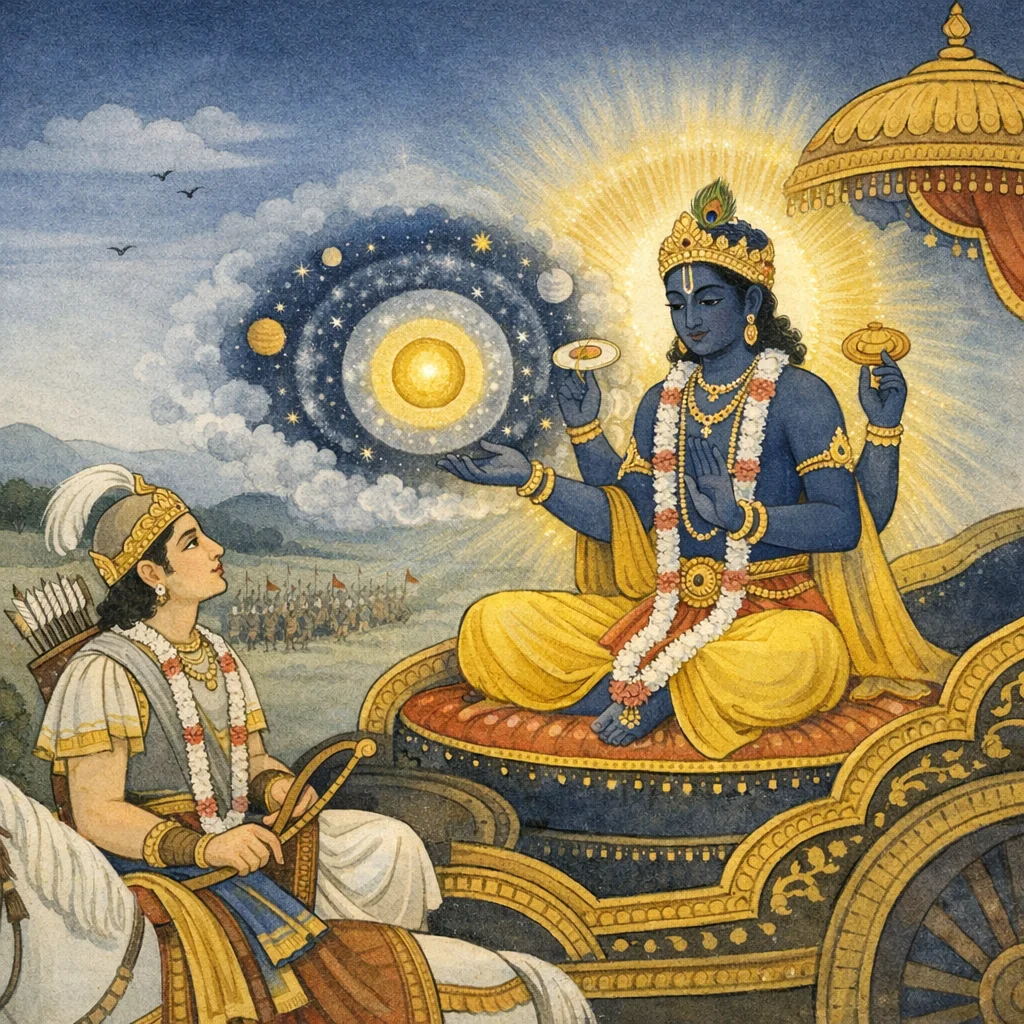
यो मामजमनादिं च वेत्ति लोकमहेश्वरम् । असंमूढः स मर्त्येषु सर्वपापैः प्रमुच्यते ॥ १०.३ ॥
yo mām ajam anādiṁ ca vetti loka-maheśvaram | asaṁmūḍhaḥ sa martyeṣu sarva-pāpaiḥ pramucyate || 10.3 ||

He who knows Me as unborn and beginningless, as the great Lord of the worlds—he, undeluded among mortals, is freed from all sins.
He who knows Me as unborn and beginningless, as the great Lord of the worlds—he, undeluded among mortals, is freed from all sins.
Whoever knows Me as unborn and without beginning, as the great lord of the world(s)—he, not bewildered among mortals, is released from all wrongdoing.
‘pāpa’ is often translated ‘sin’ in devotional registers; academically it can be rendered ‘wrongdoing’ or ‘demerit,’ aligned with karmic consequence rather than a purely juridical notion. The verse links correct metaphysical recognition of Krishna’s status with moral-spiritual purification.
FAQs
‘Delusion’ here can be read as cognitive distortion about what is ultimate; correcting that distortion can reorganize priorities and reduce guilt or fear tied to impermanent identities.
To know Krishna as unborn and beginningless is to apprehend an ultimate reality not subject to temporal origination; such knowledge is presented as transformative for karmic bondage.
Following the claim that even gods and seers do not know Krishna’s origin, this verse states the spiritual benefit for the human who does recognize Krishna’s transcendence.
It can be applied as the idea that deep worldview-shifts—toward what one takes as ultimate—often generate ethical recalibration and release from self-defeating habits.