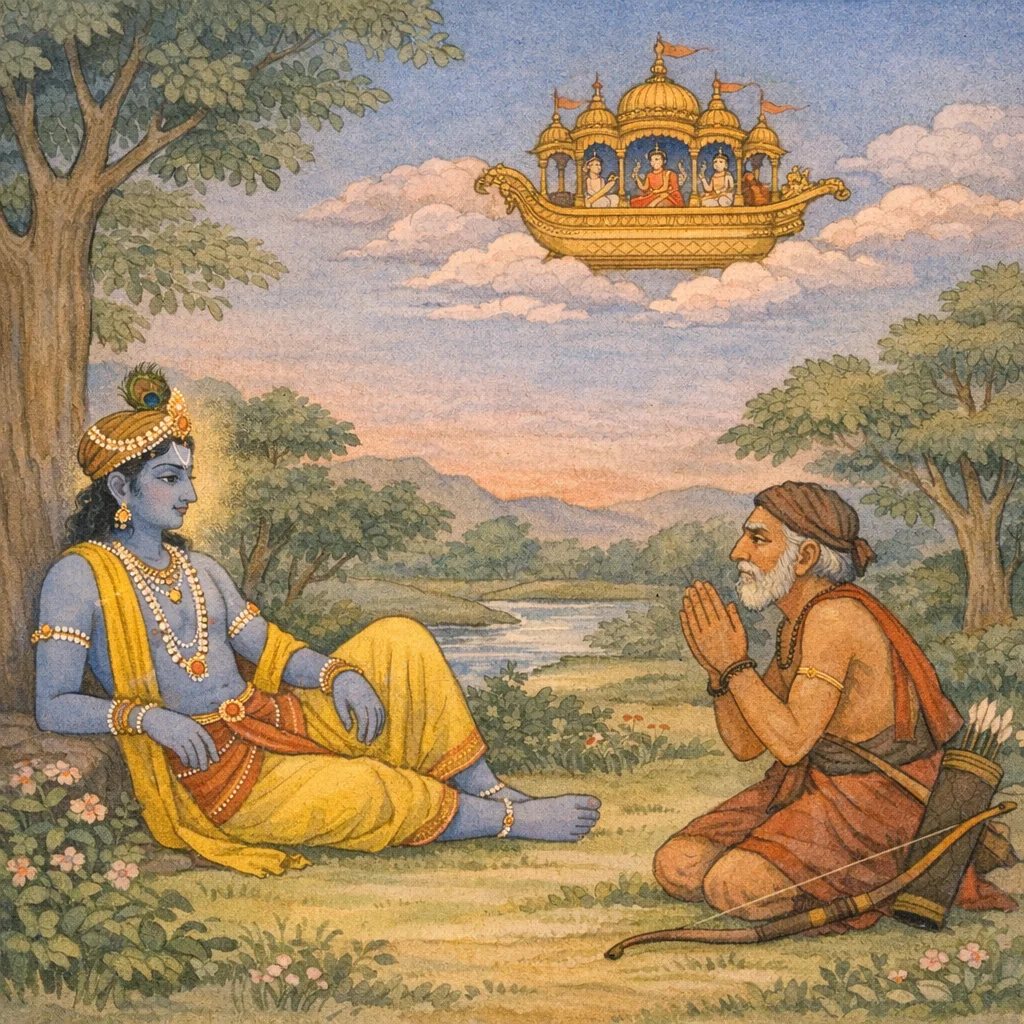
Adhyaya 211: The Hunter Jarā, Krishna’s Final Līlā, and the Lord’s Ascension
อัธยายะ ๒๑๑ กล่าวถึงตอนปลายแห่งลีลาบนโลกของพระศรีกฤษณะ และวางไว้ในกรอบธรรมะว่าเป็นการถอนคืนโดยสมัครใจสู่พรหมันอันไม่เสื่อมสลาย ตามพระบัญชาของพระองค์ ดารุกะไปยังทวารกาและพาอรชุนพร้อมทั้งวัชระ ผู้ถูกกล่าวถึงว่าเป็นผู้สืบราชบัลลังก์ กลับมา จากนั้นโควินทะทรงดำรงหลักวาสุเทวะไว้ในสรรพสัตว์ เคารพถ้อยคำของพราหมณ์ทุรวาสะ และประทับในอาสนะโยคะ ขณะนั้นนายพรานชื่อชรา มาพร้อมลูกศรที่ปลายทำด้วยโลหะซึ่งเหลือจากมุศละ เข้าใจพระบาทของพระผู้เป็นเจ้าผิดว่าเป็นกวางแล้วจึงยิง เมื่อเห็นพระรูปสี่กร ชราจึงกราบทูลขออภัยซ้ำแล้วซ้ำเล่าด้วยความไม่รู้ พระศรีกฤษณะทรงให้อภัยและประทานให้ขึ้นสวรรค์โดยวิมานในทันที ต่อมาพระผู้มีพระภาคทรงรวมอาตมันเข้ากับพรหมันอันบริสุทธิ์ ไร้ที่คาดคิด และไม่เสื่อม—วาสุเทวะผู้แผ่ซ่านทั่ว—ทรงละสังขารมนุษย์และบรรลุคติอันยิ่งยวดสามประการ
Chapter Arc
{"opening_hook":"The chapter opens in the wake of the Yādava collapse: Dāruka, obeying Kṛṣṇa’s final directive, hastens toward Dvārakā to summon Arjuna, while Vajra is positioned as a continuity-figure for royal succession—an immediate narrative bridge from catastrophe to dharmic aftermath.","rising_action":"Attention turns inward: Govinda is portrayed as the indwelling support of all beings, establishing the supreme Vāsudeva-principle within the self. In fidelity to the brāhmaṇa-word of Durvāsas, Kṛṣṇa assumes a yogic posture, and the ominous detail is introduced—an arrow tipped with the remaining iron of the muśala, now in the hands of the hunter Jarā.","climax_moment":"Jarā mistakes the Lord’s foot for a deer and releases the arrow; the revelation follows instantly when Jarā beholds the four-armed form. The theological peak is Kṛṣṇa’s untroubled absolution—transforming an apparent “accident” into a deliberate, sovereign closure of līlā and a demonstration of the Lord’s freedom from karma.","resolution":"Kṛṣṇa removes Jarā’s fear, grants him immediate heavenly ascent by vimāna, and then relinquishes the human body, uniting the self with the stainless, unthinkable, undecaying Brahman—described as Vāsudeva-pervading all—thus concluding the avatāra’s terminal movement as voluntary withdrawal into the imperishable.","key_verse":"“Seeing the Lord’s four-armed form, the hunter fell again and again, begging pardon; the Blessed One dispelled his fear and, having granted him heaven, Himself entered the stainless, undecaying Brahman—Vāsudeva, the Self of all.” (sense-translation; chapter’s central teaching)"}
Thematic Essence
{"primary_theme":"Kṛṣṇa’s voluntary withdrawal (līlā-saṃhāra) into Vāsudeva-Brahman","secondary_themes":["Succession and continuity after the Yādava end (Arjuna and Vajra)","Brāhmaṇa-vāk and dharma as cosmic constraint honored even by the Lord","Grace overriding apparent fault: Jarā’s fear removed and heaven granted","Muśala-iron as narrative causality: the remnant of internecine ruin becomes the final instrument"],"brahma_purana_doctrine":"The chapter crystallizes a Brahma Purāṇa-style metaphysical reading of avatāra: Kṛṣṇa is the indwelling Vāsudeva who sustains all beings and, at the end, does not ‘die’ but consciously re-identifies with the stainless, unthinkable, undecaying Brahman—making the event a yogic, sovereign consummation rather than karmic defeat.","adi_purana_significance":"As ‘Ādi Purāṇa,’ it models how primordial Purāṇic narration absorbs epic history into a cosmological-theological frame: the end of Kṛṣṇa’s earthly līlā is presented as a paradigmatic template for understanding divine descent and withdrawal within the larger Purāṇic vision of dharma and the Absolute."}
Emotional Journey
{"opening_rasa":"करुण (karuṇa)","climax_rasa":"अद्भुत (adbhuta)","closing_rasa":"शान्त (śānta)","rasa_transitions":["करुण → भयानक (Jarā’s fearful mistake) → अद्भुत (four-armed revelation and grace) → शान्त (Brahman-union)"],"devotional_peaks":["Govinda as inner support of all beings: contemplative bhakti grounded in metaphysics","Jarā’s repeated prostrations upon seeing the four-armed form","The Lord’s fear-dispelling absolution and gift of vimāna","Final union with the stainless Vāsudeva-Brahman as a śānta-bhakti summit"]}
Tirtha Focus
{"tirthas_covered":["द्वारका"],"jagannath_content":null,"surya_content":null,"cosmology_content":"Implicit dissolution motif at the microcosmic level: the avatāra’s embodied līlā is ‘withdrawn’ into the imperishable Brahman (Vāsudeva as all-pervading Self), echoing Purāṇic saṃhāra logic without a full sarga/pralaya excursus."}
Shlokas in Adhyaya 211
Verse 1
व्यास उवाच इत्य् उक्तो दारुकः कृष्णं प्रणिपत्य पुनः पुनः प्रदक्षिणं च बहुशः कृत्वा प्रायाद् यथोदितम् //
โศลกแรกแห่งบทที่ 211—เพื่อธรรมะ พึงสดับวจนะที่กล่าวไว้ในปุราณะด้วยศรัทธา।
Verse 2
स च गत्वा तथा चक्रे द्वारकायां तथार्जुनम् आनिनाय महाबुद्धिं वज्रं चक्रे तथा नृपम् //
โศลกที่สอง—ผู้ใดสวดอ่านหรือสดับด้วยศรัทธา ย่อมได้ผลบุญ; ปราศจากความสงสัย।
Verse 3
भगवान् अपि गोविन्दो वासुदेवात्मकं परम् ब्रह्मात्मनि समारोप्य सर्वभूतेष्व् अधारयत् //
โศลกที่สาม—ด้วยสัทสังคะย่อมเกิดวิเวกะ และด้วยวิเวกะย่อมเกิดความมั่นคงในมรรคาแห่งธรรมะ।
Verse 4
स मानयन् द्विजवचो दुर्वासा यद् उवाच ह योगयुक्तो ऽभवत् पादं कृत्वा जानुनि सत्तमाः //
โศลกที่สี่—ดังนี้ ด้วยการสดับและสวดอ่านปุราณะ ปัญญาย่อมเจริญ และภักติย่อมตั้งมั่นในดวงใจ।
Verse 5
संप्राप्तो वै जरा नाम तदा तत्र स लुब्धकः मुशलशेषलोहस्य सायकं धारयन् परम् //
คาถาที่ห้า—ถ้อยคำปุราณะอันศักดิ์สิทธิ์นี้ควรสาธยายด้วยศรัทธา।
Verse 6
स तत्पादं मृगाकारं समवेक्ष्य व्यवस्थितः ततो विव्याध तेनैव तोमरेण द्विजोत्तमाः //
คาถาที่หก—สิ่งที่กล่าวเพื่อธรรมะนี้พึงพิจารณาด้วยปัญญา।
Verse 7
गतश् च ददृशे तत्र चतुर्बाहुधरं नरम् प्रणिपत्याह चैवैनं प्रसीदेति पुनः पुनः //
คาถาที่เจ็ด—ผลแห่งการสดับและการสาธยายคือความบริสุทธิ์แห่งจิตภายใน ดังกล่าวไว้।
Verse 8
अजानता कृतम् इदं मया हरिणशङ्कया क्षम्यताम् आत्मपापेन दग्धं मा दग्धुम् अर्हसि //
คาถาที่แปด—การนอบน้อมแด่เทพ ฤๅษี และบรรพชน แล้วกระทำหน้าที่ เป็นสิ่งสรรเสริญ।
Verse 9
व्यास उवाच ततस् तं भगवान् आह नास्ति ते भयम् अण्व् अपि गच्छ त्वं मत्प्रसादेन लुब्ध स्वर्गेश्वरास्पदम् //
คาถาที่เก้า—ดังนี้โดยหนทางแห่งปุราณะ ความรู้เพื่อประโยชน์แก่โลกย่อมแผ่ไหลไป।
Verse 10
व्यास उवाच विमानम् आगतं सद्यस् तद्वाक्यसमनन्तरम् आरुह्य प्रययौ स्वर्गं लुब्धकस् तत्प्रसादतः //
ที่นี่ระบุเพียงเลขศลก ‘10’; ไม่มีบทสันสกฤตต้นฉบับ จึงไม่อาจแปลความได้
Verse 11
गते तस्मिन् स भगवान् संयोज्यात्मानम् आत्मनि ब्रह्मभूते ऽव्यये ऽचिन्त्ये वासुदेवमये ऽमले //
มีเพียงการระบุเลขศลก ‘11’; ไม่ได้ให้บทต้นฉบับ จึงไม่สามารถแปลได้
Verse 12
अजन्मन्य् अजरे ऽनाशिन्य् अप्रमेये ऽखिलात्मनि त्यक्त्वा स मानुषं देहम् अवाप त्रिविधां गतिम् //
ที่นี่มีเพียงเลขศลก ‘12’; เมื่อไม่มีต้นฉบับ จึงไม่อาจจัดทำคำแปลได้
Frequently Asked Questions
The chapter centers on divine sovereignty and compassion within the framework of karmic inevitability: an apparent tragedy (Jarā’s strike) is reinterpreted as the Lord’s voluntary conclusion of embodied līlā, paired with an ethic of forgiveness in which ignorance is met by grace and liberation-oriented reassurance.
It articulates a foundational Puranic theological grammar: the avatāra’s departure is not merely historical but cosmological, expressed as reabsorption into the imperishable Brahman identified with Vāsudeva and as an affirmation of the Lord as the inner support of all beings—motifs that anchor later narrative, ritual, and doctrinal layers across the Purāṇic corpus.
No new tīrtha, vrata, or formal rite is instituted in the supplied passage. The chapter’s emphasis is doctrinal and narrative—Dvārakā as a setting is referenced, but the text here functions primarily as a theological account of the Lord’s yogic withdrawal and the salvific outcome granted to Jarā.