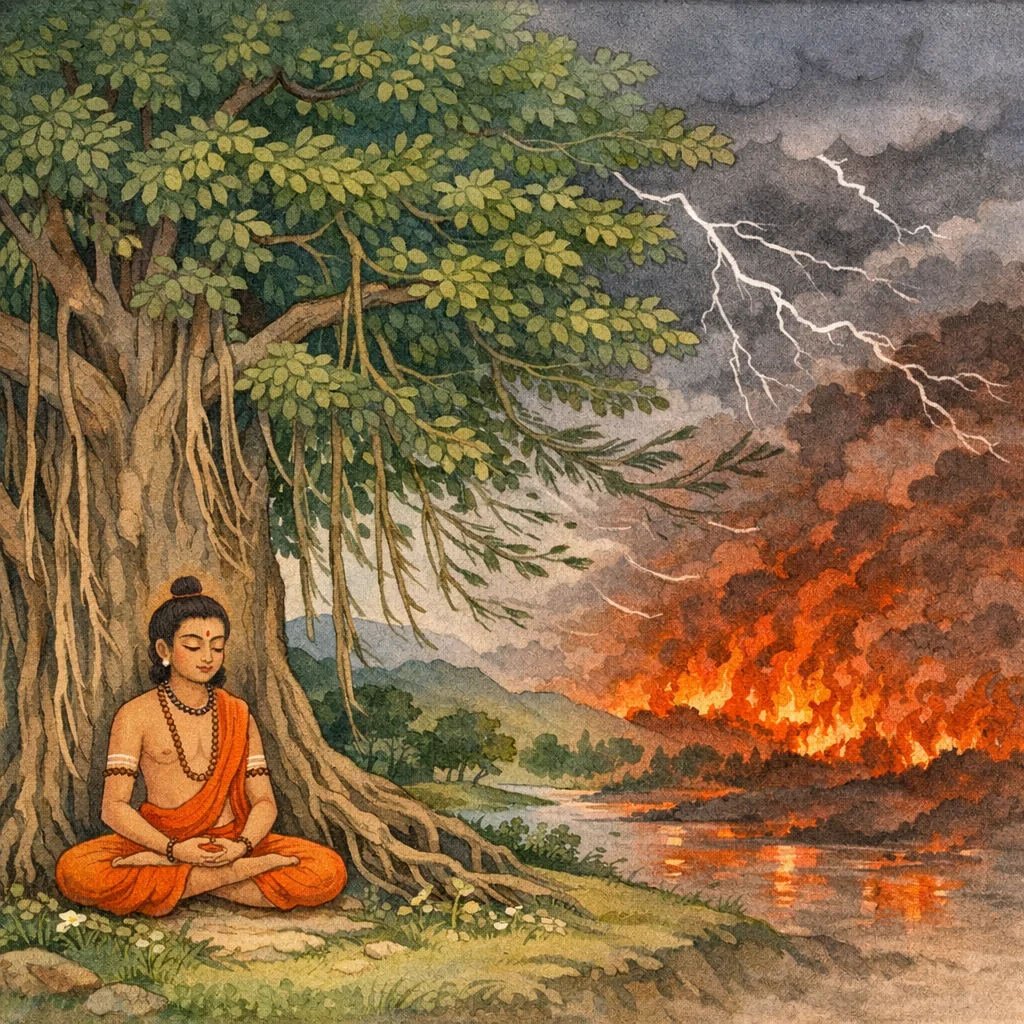
Adhyaya 52: The Conflagration of the Great Dissolution and Markandeya’s Refuge at the Eternal Banyan
อัธยายะ 52 พรรณนาภาพมหาปรลัยอันน่าสะพรึงกลัว เมื่อสุริยะและจันทราหายไป และสรรพสิ่งทั้งเคลื่อนไหวและไม่เคลื่อนไหวดับสูญ เสียงคำราม ฟ้าแลบ และลางอาเพศอันทำลายล้างเป็นสัญญาณแห่งการสลายสิ้นทั้งปวง ไฟสํวรรตกะพร้อมลมกรรโชกแผ่ซ่านไปทั่วโลก ทะลุผ่านแผ่นดินลงสู่รสาตละ เผาแดนใต้พิภพรวมทั้งนาคโลก ทำให้เหล่าเทพและกึ่งเทพหวาดผวา ไฟกัลปะอัคคีอันเลื่องชื่อสว่างดุจสุริยะนับไม่ถ้วน เผาผลาญไตรโลกพร้อมผู้อาศัยอย่างรวดเร็ว ท่ามกลางความพินาศนั้น ฤๅษีมารกัณฑेयยืนเดียวดาย—สูงส่งทางจิตวิญญาณแต่ทุกข์ด้วยความกระหายและความหลง—รำลึกถึงปุรุเษศะผู้เป็นนิตย์เพื่อแสวงที่พึ่งสูงสุด แล้วไปถึงสถานศักดิ์สิทธิ์อันเกี่ยวเนื่องกับเหตุแห่งปรลัย คือ ‘วฏราช’ ต้นไทรนิรันดร์ ณ โคนต้นปรากฏแดนคุ้มครองที่ไฟและอสนีบาตเอื้อมไม่ถึง เป็นศูนย์กลางแห่งความปลอดภัยท่ามกลางการล่มสลายของจักรวาล
Chapter Arc
{"opening_hook":"The chapter opens in a cosmic register: the familiar supports of order fail—sun and moon vanish, directions lose their bearings, and the world’s rhythms collapse, immediately pulling the listener into mahāpralaya’s dread.","rising_action":"Portents intensify: thunder and lightning tear the sky; hurricane-like winds drive the saṃvartaka fire through the worlds. The conflagration penetrates the earth, descends into rasātala, and consumes nāgaloka, spreading panic among devas, asuras, gandharvas, dānavas, yakṣas, uragas, and rākṣasas.","climax_moment":"At the height of universal burning—kalpāgni blazing like countless suns—the narrative pivots to the lone surviving sage Mārkaṇḍeya. Overcome by thirst and disorientation yet anchored in dhyāna, he fixes his mind on the eternal Puruṣeśa and reaches the timeless refuge: Vaṭarāja (the eternal banyan), where pralaya’s terrors do not operate.","resolution":"The chapter concludes by establishing a theological ‘safe zone’ amid dissolution: at the root of Vaṭarāja, the saṃvartaka fire and thunderbolts cannot harm the sage, implying that devotion and contemplative refuge in the Eternal Lord transcends cosmic cycles.","key_verse":null}
Thematic Essence
{"primary_theme":"Pralaya-varṇana (the description of cosmic dissolution) culminating in yogic refuge at Vaṭarāja.","secondary_themes":["Saṃvartaka fire and winds as instruments of kāla (time)","The collapse of cosmic order (lights, directions, atmospherics)","The netherworlds (rasātala/nāgaloka) are not exempt from dissolution","Bhakti-dhyāna as a metaphysical shelter beyond cosmic cycles"],"brahma_purana_doctrine":"Even when trailokya is consumed by kalpāgni, a locus of protection exists through remembrance of the Eternal Lord—symbolized by Vaṭarāja—indicating that sacred refuge is not merely geographic but ontological (beyond pralaya’s jurisdiction).","adi_purana_significance":"As an ‘Adi Purāṇa’ movement, it frames the universe’s end not as nihilism but as a doctrinal demonstration: cosmology serves theology, and the earliest Purāṇic voice links pralaya to the discovery of an eternal refuge-principle."}
Emotional Journey
{"opening_rasa":"bhayānaka","climax_rasa":"adbhuta","closing_rasa":"śānta","rasa_transitions":["bhayānaka → raudra → bhayānaka → adbhuta → śānta"],"devotional_peaks":["Mārkaṇḍeya’s inward turn to dhyāna on Puruṣeśa amid total collapse","Arrival at Vaṭarāja where pralaya’s weapons (fire/thunderbolts) lose efficacy"]}
Tirtha Focus
{"tirthas_covered":["वट / न्यग्रोध (Vaṭa / Nyagrodha; Vaṭarāja as a divine refuge-locus)"],"jagannath_content":null,"surya_content":null,"cosmology_content":"A full mahāpralaya tableau: disappearance of sun and moon; atmospheric portents; saṃvartaka winds; kalpāgni burning trailokya; fire penetrating earth into rasātala and consuming nāgaloka; universal terror across divine and semi-divine classes; a protected zone at Vaṭarāja accessed through contemplation of the Eternal Lord."}
Shlokas in Adhyaya 52
Verse 1
ब्रह्मोवाच आसीत् कल्पे मुनिश्रेष्ठाः संप्रवृत्ते महाक्षये नष्टे ऽर्कचन्द्रे पवने नष्टे स्थावरजङ्गमे //
ที่นี่ไม่มีบทสันสกฤตต้นฉบับ มีเพียงเลข “1” เท่านั้น กรุณาส่งข้อความโศลกภาษาสันสกฤต แล้วจึงจะแปลอย่างถูกต้องได้
Verse 2
उदिते प्रलयादित्ये प्रचण्डे घनगर्जिते विद्युदुत्पातसंघातैः संभग्ने तरुपर्वते //
ที่นี่ไม่มีบทสันสกฤตต้นฉบับ มีเพียงเลข “2” เท่านั้น กรุณาส่งข้อความโศลกภาษาสันสกฤต แล้วจึงจะแปลอย่างถูกต้องได้
Verse 3
लोके च संहृते सर्वे महदुल्कानिबर्हणे शुष्केषु सर्वतोयेषु सरःसु च सरित्सु च //
ที่นี่บาทที่สามของโศลกชี้ความหมายอันศักดิ์สิทธิ์ และเผยความรุ่งเรืองแห่งธรรมะ
Verse 4
ततः संवर्तको वह्निर् वायुना सह भो द्विजाः लोकं तु प्राविशत् सर्वम् आदित्यैर् उपशोभितम् //
ที่นี่บาทที่สี่ของโศลกอธิบายความหมายตามคัมภีร์โดยย่อ และเพิ่มพูนศรัทธา
Verse 5
पश्चात् स पृथिवीं भित्त्वा प्रविश्य च रसातलम् देवदानवयक्षाणां भयं जनयते महत् //
ที่นี่บาทที่ห้าของโศลกแสดงว่ากรรมบุญให้ผล และมุ่งประโยชน์แก่โลก
Verse 6
निर्दहन् नागलोकं च यच् च किंचित् क्षिताव् इह अधस्तान् मुनिशार्दूलाः सर्वं नाशयते क्षणात् //
ที่นี่บาทที่หกของโศลกสรรเสริญญาณและไวรागยะ และชี้หนทางสู่โมกษะ
Verse 7
ततो योजनविंशानां सहस्राणि शतानि च निर्दहत्य् आशुगो वायुः स च संवर्तको ऽनलः //
ที่นี่บาทที่เจ็ดของโศลกพรรณนาพลังแห่งภักติแด่พระผู้เป็นเจ้า และก่อให้เกิดความสงบ
Verse 8
सदेवासुरगन्धर्वं सयक्षोरगराक्षसम् ततो दहति संदीप्तः सर्वम् एव जगत् प्रभुः //
คาถาที่แปด—ในปุราณะนี้ได้อธิบายสัจธรรมอันศักดิ์สิทธิ์โดยสังเขปอย่างเป็นระเบียบ
Verse 9
प्रदीप्तो ऽसौ महारौद्रः कल्पाग्निर् इति संश्रुतः महाज्वालो महार्चिष्मान् संप्रदीप्तमहास्वनः //
คาถาที่เก้า—หนทางแห่งธรรม อรรถ กาม และโมกษะ ถูกเผยด้วยศรัทธาอย่างชัดเจน
Verse 10
सूर्यकोटिप्रतीकाशो ज्वलन्न् इव स तेजसा त्रैलोक्यं चादहत् तूर्णं ससुरासुरमानुषम् //
คาถาที่สิบ—ด้วยสัทสังคะ ปัญญาย่อมเจริญ และบาปย่อมเสื่อมสิ้น
Verse 11
एवंविधे महाघोरे महाप्रलयदारुणे ऋषिः परमधर्मात्मा ध्यानयोगपरो ऽभवत् //
คาถาที่สิบเอ็ด—พึงประพฤติเพื่อประโยชน์แก่โลกด้วยยัญญะ ทาน และตบะอันเป็นกรรมศักดิ์สิทธิ์
Verse 12
एकः संतिष्ठते विप्रा मार्कण्डेयेति विश्रुतः मोहपाशैर् निबद्धो ऽसौ क्षुत्तृष्णाकुलितेन्द्रियाः //
คาถาที่สิบสอง—เมื่อสดับดังนี้แล้ว มนุษย์ย่อมบริสุทธิ์ และบรรลุสู่ปรมบทอันสูงสุด
Verse 13
स दृष्ट्वा तं महावह्निं शुष्ककण्ठौष्ठतालुकः तृष्णार्तः प्रस्खलन् विप्रास् तदासौ भयविह्वलः //
ที่นี่เป็นคาถาหมายเลข 13; มิได้ให้บทสันสกฤตต้นฉบับ จึงไม่อาจแปลได้อย่างถูกต้องตามความหมายแท้จริง।
Verse 14
बभ्राम पृथिवीं सर्वां कांदिशीको विचेतनः त्रातारं नाधिगच्छन् वै इतश् चेतश् च धावति //
นี่คือคาถาหมายเลข 14; เมื่อไม่มีคาถาต้นฉบับ จึงไม่สามารถแปลความหมายได้อย่างเหมาะสม।
Verse 15
न लेभे च तदा शर्म यत्र विश्राम्यता द्विजाः करोमि किं न जानामि यस्याहं शरणं व्रजे //
คาถาหมายเลข 15 นี้ไม่มีบทต้นฉบับให้มา จึงไม่อาจจัดทำคำแปลที่เชื่อถือได้।
Verse 16
कथं पश्यामि तं देवं पुरुषेशं सनातनम् इति संचिन्तयन् देवम् एकाग्रेण सनातनम् //
คาถาหมายเลข 16 นี้ หากไม่มีบทสันสกฤตต้นฉบับ ก็ไม่เหมาะที่จะจัดทำคำแปล।
Verse 17
प्राप्तवांस् तत् पदं दिव्यं महाप्रलयकारणम् पुरुषेशम् इति ख्यातं वटराजं सनातनम् //
คาถาหมายเลข 17 นี้ เมื่อไม่มีบทต้นฉบับ ก็ไม่อาจกำหนดความหมายได้ จึงไม่สามารถแปลได้।
Verse 18
त्वरायुक्तो मुनिश् चासौ न्यग्रोधस्यान्तिकं ययौ आसाद्य तं मुनिश्रेष्ठास् तस्य मूले समाविशत् //
โศลกที่ 18 แห่งบทที่ 52
Verse 19
न कालाग्निभयं तत्र न चाङ्गारप्रवर्षणम् न संवर्तागमस् तत्र न च वज्राशनिस् तथा //
โศลกที่ 19 แห่งบทที่ 52
Frequently Asked Questions
The chapter centers on the contrast between cosmic impermanence (mahāpralaya) and an enduring theological refuge: the eternal Puruṣeśa symbolized by the Vaṭarāja. It frames dissolution as total at the level of worlds, yet not absolute with respect to the divine ground that remains untouched.
By foregrounding a cosmogonic-cycle endpoint (pralaya) and naming the kalpāgni/saṃvartaka mechanism, the chapter anchors Purāṇic chronology in recurring creation–dissolution rhythms. This reinforces the Brahma Purana’s archival posture as a foundational text mapping cosmic time and its governing principles.
No explicit tīrtha, vrata, or procedural rite is instituted in the supplied passage. Instead, the chapter establishes a sacral motif—Vaṭarāja/nyagrodha as a protected divine locus during pralaya—functioning more as a theological landmark than as a described pilgrimage protocol.