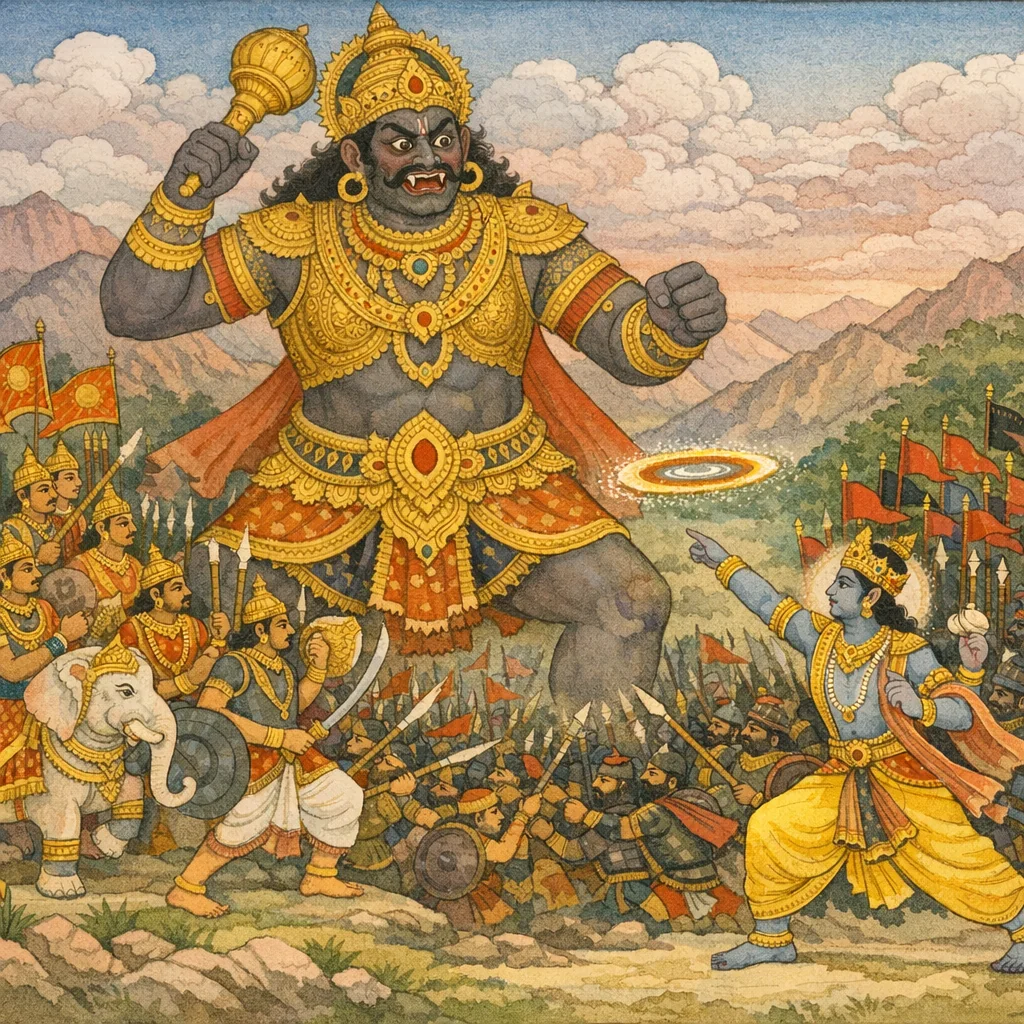
Adhyaya 47: Vishnu Enters the Deva–Asura War and Slays Kalanemi
कालनेमिवधः (Kālanemi-vadhaḥ)
The Deva-Asura War
Within the Pulastya–Nārada dialogue-frame, this adhyāya pivots from Bali’s consecration to the outbreak of a full-scale Deva–Asura campaign. The Daitya polity is presented through asura-dharma: Bali is installed as king, with Prahlāda as mantra-bestower and Śukra as purohita, signaling ritual legitimacy even in an anti-deva regime. A catalogue of ancestral losses (Hiraṇyakaśipu, Virocana, Jambha, etc.) functions as a genealogical memory that fuels collective mobilization. The devas respond with a pan-cosmic coalition—Ādityas, Vasus, Rudras, Sādhyas, Siddhas, Vidyādharas, Yakṣas, Rākṣasas, and Nāgas—while Viṣṇu’s arrival marks the decisive theological center of the battle. The narrative culminates in iconographic violence: Kālanemi’s monstrous expansion and Viṣṇu’s cakra intervention, severing weapon, arms, and head, after which the daitya host collapses. Though Śaiva elements appear mainly as remembered interventions (Śaṅkara with triśūla), the chapter still reflects syncretic theology by acknowledging multiple divine agencies within a single cosmic order.
Divine Beings
Sacred Geography
Mortal & Asura Figures
Key Content Points
- Bali’s royal consecration and the asura court’s ritual infrastructure: Prahlāda as mantra-pradātā and Śukra as purohita; elders counsel Bali by recalling prior deva victories over daitya ancestors.
- Mobilization and battle-array narratives: named asura commanders (Maya, Śālava, Tāraka, Kālanemi) and the devas’ multi-class coalition; Skanda and Indra lead with Viṣṇu as the decisive protector and striker.
- Kālanemi’s terrifying expansion and Viṣṇu’s iconographic triumph: Viṣṇu counters the gadā with the cakra, severs Kālanemi’s arms and head, and triggers the rout of the daitya forces.
Shlokas in Adhyaya 47
Verse 1
इति श्रीवामुपुराणे षट्चत्विरिंशो ऽध्यायः पुलस्त्य उवाच एतदर्थं बलिर्दैत्यः कृतो राजा कलिप्रिय मन्त्रप्रदाता प्रह्लादः शुक्रश्चासीत् पुरोहितः
“Pulastya said: For this purpose, the Daitya Bali was made king—(he who is) dear to Kali. Prahlāda was the giver of counsel/mantras, and Śukra served as the priest (purohita).”
Verse 2
ज्ञात्वाभिषिक्तं दैतेयं विरोचनसुतं बलिम् दिदृक्षवः समायाताः समयाः सर्व एव हि
“Knowing that the Daitya Bali, son of Virocana, had been consecrated, all those concerned (the assembled parties) came together at the appointed time, desiring to see (him).”
Verse 3
तानागतान्निरीक्ष्यैव पूजयित्वा यताक्रमम पप्रच्छ कुलजान् सर्वान् किंनु श्रेयस्करं मम
Seeing them arrive, he honored them in due order and then asked all his kinsmen: “What, indeed, would be most beneficial (śreyas) for me?”
Verse 4
तमुचुः सर्व एवैनं शृणुष्व सुरमर्दन यत् ते श्रेयस्करं कर्म यदस्माकं हितं तथा
They all said to him: “Listen, O crusher of the gods. We shall speak of that action which is beneficial for you—and likewise conducive to our welfare.”
Verse 5
पितामहस्तव 7ली आसीद् दानवपालकः हिरण्यकशिपुर्वीरः स शक्रो ऽभूज्जगत्त्रये
“Your grandfather was a protector and ruler among the Dānavas— the heroic Hiraṇyakaśipu. He became, as it were, a Śakra (Indra) across the three worlds.”
Verse 6
तमागम्य सुरश्रेष्ठो विष्णुः सिंहवपुर्धरः प्रत्यक्षं दानवेन्द्राणां नखैस्तं हि व्यदारयत्
Then the foremost of the gods, Viṣṇu—assuming a lion-form—approached him and, in the very presence of the lords of the Dānavas, tore him apart with His claws.
Verse 7
अपकृष्टं तथा राज्यमान्धकस्य महात्मनः तेषामर्थे महाबाहो शङ्करेम त्रिशूलिना
Thus the sovereignty of the great-souled Āndhaka was diminished; and for their sake, O mighty-armed one, we (acted) with Śaṅkara, the trident-bearer.
Verse 8
तथा तव पितृव्यो ऽपि जम्भः शक्रेण घातितः कुजम्भो विष्णुना चापि प्रत्यक्षं पशुवत् तव
Likewise, your paternal uncle Jambha was slain by Śakra; and Kujambha too was slain by Viṣṇu—openly, like a beast, before you.
Verse 9
शम्भुः पाको महेन्द्रेण भ्राता तव सुदर्शनः विरोचनस्तव पिता निहतः कथयामि ते
“Śambhu and Pāka were slain by Mahendra (Indra). Your brother was Sudarśana. Virocana—your father—was also killed. I shall recount it to you.”
Verse 10
श्रुत्वा गो6क्षयं ब्रह्मन् कृत शक्रेण दानवः उद्योगं कारयामास सह सर्वैर्महासुरैः
“Hearing, O Brahmin, of the slaughter of cows brought about by Śakra (Indra), the Dānava set preparations in motion together with all the great Asuras.”
Verse 11
रथैरन्ये गजैरन्ये वाजिभिश्चापरे ऽसुराः पदातयस्तथैवान्ये जग्मुर्युद्धाय दैवतैः
“Some Asuras went with chariots, others with elephants, and others with horses; still others went as infantry. They marched to battle with the Devas.”
Verse 12
मयो ऽग्रे याति बलवान् सेनानाथो भयङ्करः सैन्यस्य मध्ये च बलिः कालनेमिश्च षृष्ठतः
At the front marched the mighty Maya, the fearsome commander of the host. In the middle of the army were Bali and Kālanemi, set in their respective positions.
Verse 13
वामपार्श्वमवष्टभ्य शालवः प्रथितविक्रमः प्रयाति दक्षिणं घोरं तारकाख्यो भयङ्करः
Holding the left flank stood Śālava, renowned for his prowess. To the dreadful right advanced the fearsome one named Tāraka.
Verse 14
दानवानां सहस्राणि प्रयुतान्यर्बुदानि च/ संप्रयातानि युद्धाय देवैः सह कलिप्रिय
Thousands of Dānavas—tens of thousands and even crores—marched forth to battle together with the gods, O one fond of strife.
Verse 15
श्रुत्वासुराणामुद्योगं शक्रः सुरपतिः सुरान् उवाच याम दैत्यांस्तान् योद्धुं सबलसंयुतान्
Hearing of the Asuras’ preparations, Śakra (Indra), the lord of the gods, addressed the Devas: “Let us go to fight those Daityas, who are assembled with their forces.”
Verse 16
इत्येवमुक्त्वा वचनं सुरराट् स्यन्दनं बली समारुरोह भगवान् यतमातलिवाजिनम्
Having spoken thus, the sovereign of the gods mounted his powerful chariot—divine, drawn by horses controlled by Mātali (his charioteer).
Verse 17
समारूढे सहस्राक्षे स्यन्दनं देवतागणः स्वं स्वं वाहनमारुह्य निश्चेरुर्युद्धकाङ्क्षिमः
When the thousand-eyed one had mounted his chariot, the host of gods—each ascending his own vehicle—set forth, eager for battle.
Verse 18
आदित्या वसवो रुद्राः साध्या विश्वे ऽश्विनौ तथा विद्याधरा गुह्यकाश्च यक्षराक्षसपन्नगाः
The Ādityas, the Vasus, the Rudras, the Sādhyas, the Viśvedevas, and likewise the two Aśvins; also the Vidyādharas, the Guhyakas, and the Yakṣas, Rākṣasas, and Pannagas (serpent-beings) (assembled as part of the host).
Verse 19
राजर्षयस्तथा सिद्धा नानाभूताश् च संहताः गजानन्ये रथानन्ये हयानन्ये समारुहन्
Royal seers (rājarṣis) and Siddhas, and various other beings gathered together; some mounted elephants, some chariots, and others mounted horses.
Verse 20
विमानानि च सुभ्राणि पक्षिवाह्यानि नारद समारुह्याद्रवन् सर्वे यतो दैत्यबलं स्थितम्
And, O Nārada, mounting splendid vimānas borne by birds, they all rushed forth to where the army of the Daityas was stationed.
Verse 21
एतस्मिन् विष्णुः सुरश्रेष्ठ अधिरुह्य समभ्यगात्
Then, mounting that (vehicle/seat), Viṣṇu—the foremost among the gods—came forward/approached.
Verse 22
तमागतं सहस्राक्षस्त्रैलोक्यपतिमव्ययम् ववन्द मूर्ध्नावनतः सह सर्वैः सुरोत्तमैः
When he had arrived, Sahasrākṣa (Indra), bowing his head, paid homage to that imperishable Lord of the three worlds, together with all the foremost gods.
Verse 23
ततो ऽग्रे देवसैन्यस्य कार्तिकेयो गदाधरः पालयञ्जघनं विष्णुर्याति मध्ये सहस्रदृक्
Then, at the front of the army of the gods was Kārtikeya, the wielder of the mace; Viṣṇu, guarding the rear, proceeded in the middle, while Sahasradṛk (Indra) was (positioned) in the midst.
Verse 24
वामं पार्श्वंमवष्भ्य जन्तो व्रजते मुने दक्षिणं वरुणः पार्श्वमवष्टभ्याव्रजद् बली
“O sage, the leader of beings advanced, bracing (his force) on the left flank; and Bali advanced, bracing (his force) on the right flank of Varuṇa.”
Verse 25
ततो ऽमराणां पृतना यशस्विनी स्कन्देन्द्रविष्णुवम्बुपसूर्यपालिता नानास्त्रशस्त्रोद्यतदोःसमूहा समाससादारिबलं महीध्रे
“Then the glorious army of the immortals—protected by Skanda, Indra, Viṣṇu, Varuṇa, and Sūrya—raising masses of arms bearing diverse weapons and missiles, closed in upon the enemy host on the mountain.”
Verse 26
उदयाद्रितटे रम्ये शुभे समशिलातले निर्वृक्षे पक्षिरहिते जातो देवासुरो रणः
“On the lovely, auspicious slope of Mount Udaya, on an even rocky ground—devoid of trees and free of birds—there arose the battle between devas and asuras.”
Verse 27
संनिपातस्तयो रौद्रः सैन्ययोरभवन्मुने महीधरोत्तमे पूर्वं यथा वानरहस्तिनोः
O sage, a fierce clash then arose between those two armies—like, in former times, the encounter on the best of mountains between a monkey and an elephant.
Verse 28
रणरेणु रथोद्धूतः पिङ्गलो रणमूर्धनि संद्यानुरक्तः सदृशो मेघः खे सुरतापस
The dust of battle, stirred up by chariots, became tawny at the height of the fight—like a cloud in the sky, reddened by twilight, O ascetic among the gods.
Verse 29
तदासीत् तुमुलं युद्धं न प्राज्ञायत किञ्चन श्रूयते त्वनिशं शब्दः छिन्धि भिन्धीति सर्वतः
Then the battle became utterly tumultuous; nothing could be clearly made out. Only incessant cries were heard everywhere: “Cut!” “Pierce!”
Verse 30
ततो विशसनो रौद्रो दैत्यानां दैवतैः सह जातो रुधिरनिष्यन्दो रजःसयमनात्मकः
Then there arose a fierce and dreadful slaughter between the Daityas and the gods—one that poured forth streams of blood and was of the nature of dust and darkness (raised by the battle).
Verse 31
शान्ते रजसि देवाद्यास्तद् दानवबलं महत् अभिद्रवन्ति सहिताः समं स्कन्देन धीमता
When the dust had settled, the gods and the other divine beings together charged upon that great host of Dānavas, in concert with the wise Skanda.
Verse 32
निजघ्नुर्दानवान् देवाः कुमारभुजपालिताः देवान् निजघ्नुर्दैत्याश्च मयगुप्ताः प्रहारिणः
The gods, protected by the arms of Kumāra, struck down the Dānavas; and the Daityas too struck down the gods—assailants concealed by illusion (māyā).
Verse 33
ततो ऽमृतरसास्वादाद् विना भूताः सुरत्तमाः निर्जिताः समरे दैत्यैः समं स्कन्देन नारद
Then, deprived of the tasting of the nectar’s essence, the foremost gods were defeated in battle by the Daityas—together with Skanda, O Nārada.
Verse 34
विनिर्जितान् सुरान् दृष्ट्वा वैनतेयध्वजो ऽरिहा शार्ङ्गमानम्य बाणैघैर्निजघान ततस्ततः
Seeing the gods routed, the enemy-slayer—he whose banner bears Vainateya—bent his Śārṅga bow and struck them down with arrows, here and there.
Verse 35
ते विष्णुना हन्यमानाः पतत्त्रिभिरयोमुखैः दैतेयाः शरणं जग्मुः कालनेमिं महासुराम्
Struck down by Viṣṇu with iron-pointed, winged arrows, those Daiteyas went for refuge to Kālanemi, the great Asura.
Verse 36
तेभ्यः स चाभयं दत्त्वा ज्ञात्वाजेयं च माधवम् विवृद्धिमगमद् ब्रह्मन् यथा व्याधिरुपेक्षितः
Having granted them fearlessness, and having understood Mādhava (Viṣṇu) to be unconquerable, he nevertheless increased in fury, O Brāhmaṇa—like a disease that grows when neglected.
Verse 37
यं यं करेण स्पृशति देवं यक्षं सकिन्नरम् तं तमादाय चिक्षेप विस्तृते वदने बली
Whomever he touched with his hand—whether a god, a Yakṣa, or a Kinnara—Bali seized that one and hurled him into his gaping, wide-open mouth.
Verse 38
संरम्भाद् दानवेन्द्रो विमृदति दितिजैः संयुतो देवसैन्यं सेन्द्रं सार्क सचन्द्रं करचरणनखैरस्क्षत्रहीनो ऽपि वेगात् चक्रैर्वैश्वानराभैस्त्ववनिगगनयोस्तिर्यगूर्ध्वं समन्तात् प्राप्ते ऽन्ते कालवह्नेर्जगदखिलमिदं रूपमासीद् दिधक्षोः
In a surge of rage, the lord of Dānavas—joined by the sons of Diti—crushed the army of the gods, together with Indra, with Sūrya, and with Candra. Though deprived of his royal dominion, he struck swiftly with hands, feet, and nails; and with discus-weapons blazing like Vaiśvānara (fire), he raged across earth and sky, sideways and upward in every direction. As the end approached with the Fire of Time, this entire universe took on the appearance of one intent on burning everything.
Verse 39
तं दृष्ट्वा वर्द्धमानं रिपमतिबलिनं देवगन्धर्वमुख्याः सिद्धाःसाध्याश्विमुख्या भयतरलदृशः प्राद्रवन् दिक्षु सर्वे पोप्लूयन्तश्च दैत्या हरिममरगणैरर्चितं चारुमौलिं नानाशस्त्रास्त्रपातैर्विगलितयशसंचक्रुरुत्सिक्तदर्पाः
["Rāgiṇī", "Jāyaśrī", "Śrī", "pratijñā", "sādhu-sammata", "dānava-pati", "Bali", "Adhyaya 49.41"]
Verse 41
तैर्वाणैश्छाद्यमाना हरिकरनुदितैः कालदण्डप्रकाशैर्नाराचैरर्धचन्द्रैर्बालिमयपुरागा भीतभीतास्त्वारन्तः प्रारम्बे दानवेन्द्रं शतवदनमथो प्रेषयन् कालनेमिं स प्रायाद् देवसैन्यप्रभुममितबलं केशवं लोकनाथम्
Covered by those arrows—driven forth by Hari’s hand, gleaming like the staff of Death—by Nārācas and crescent-shaped shafts, the Daityas who had come from the cities of Bali and Maya, terrified again and again, fell into confusion. Then the lord of the Dānavas, the hundred-faced one, dispatched Kālanemi; and he advanced against Keśava, the immeasurably mighty master of the army of the gods, the Lord of the worlds.
Verse 42
तं दृष्ट्वा शतशीर्षमुद्यतगदं शैलेन्द्रशृङ्गाकृतिं विष्णुः शार्ङ्गमपास्य सत्वरमथो जग्राह चक्रं करे सो ऽप्येनं प्रसमीक्ष्य दैत्यविटपप्रच्छेदनं मानिनं प्रोवाचाथ विहस्य तं च सुचिरं मेघस्वनो दानवः
Seeing him—hundred-headed, with mace upraised, shaped like a mountain-king’s peak—Viṣṇu, casting aside the Śārṅga bow, swiftly took the discus into his hand. That proud Dānava, beholding him—the cutter-down of the demon-forest—then spoke, laughing for a long while, his voice rumbling like thunderclouds.
Verse 45
अयं स दनुपुत्रसैन्यवित्रासकृद्रिषुः परमकोपितः स मधोर्विघातकृत् हिरण्यनयनान्तकः कुसुमपूजारतिः क्व याति मम दृष्टिगोचरे निपतितः खलः वम्प्_47.43 यद्येष संप्रति ममाहवमभ्युषैति नृनं न याति निलयं निजमम्बुजाक्षः मन्मुष्टिपिष्टशिथिलाङ्गमुपात्तभस्म संद्रक्ष्यते सुरजनो भयकातराक्षः // वम्प्_47.44 इत्येवमुक्त्वा मधुसूदनं वै स कालनेमिः स्फुरिताधरोष्ठः गदां खगेन्द्रोपरि जातकोपो मुमोच शैले कुलिशं यथेन्द्रः
“This is that foe—the one who terrifies the armies of Danu’s sons; the supremely enraged one; the slayer of Madhu; the destroyer of Hiraṇyanayana; the one who delights in worship with flowers. Where can that wretch go, fallen within the range of my sight? (VamP 47.43) If now this lotus-eyed one dares to approach my battle, he will not return to his own abode. The host of gods will behold him, his limbs loosened and crushed by my fists, smeared with ash, their eyes trembling with fear. (VamP 47.44) Having spoken thus to Madhusūdana, that Kālanemi—his lower lip quivering—became enraged and hurled his mace from atop the king of birds, as Indra hurls the thunderbolt upon a mountain.”
Verse 48
गदां छित्त्वा दानवाभ्याशमेत्य भुजौ पीनौ संप्रचिच्छेद वेगात् भुजाभ्यां कृत्ताभ्यां दग्धशैलप्रकाशः संदृश्येताप्यपरः कालनेमि // वम्प्_47.47 ततो ऽस्य माधवः कोपात् शिरश्चक्रेण भूतले छित्त्वा निपातयामास पक्वं तालफलं यथा
Having cut down the mace, (the Lord) approached the dānava and swiftly severed his stout arms. With both arms cut off, he appeared like another Kālanemi, resembling a mountain scorched by fire. Then Mādhava, in wrath, with his discus, cut off his head and caused it to fall upon the earth—like a ripe fruit of the tāla palm.
Verse 49
तथा विबाहुर्विशिरा मुण्डतालो यथा वने तस्थौ मेरुरिवाकम्प्यः कबन्धः क्ष्माधरेश्वरः
Thus, armless and headless, like a lopped tāla palm in a forest, the trunk stood—unshaking like Mount Meru—the headless body of that lord among mountain-bearers (i.e., the mighty one).
Frequently Asked Questions
The chapter foregrounds Viṣṇu as the decisive cosmic protector while still acknowledging Śaṅkara’s agency in the wider mythic memory (e.g., triśūla intervention against Andhaka). This layered attribution—multiple deities operating within one dharmic cosmos—reflects the Purāṇic syncretic theology typical of the Vāmana Purāṇa, where sectarian supremacy is narrated without denying parallel divine powers.
This passage is primarily martial rather than tīrtha-oriented; it locates the battle on the pleasant, level, treeless slab-like ground at the flank of Udayādri (Udaya mountain). No sarovara, river, or Kurukṣetra/Sarasvatī-basin tīrtha catalogue is specified in the provided verses.
Bali’s kingship is formally established (abhiṣeka implied), and his regime is legitimized through asura-dharma institutions—Prahlāda as mantra-pradātā and Śukra as purohita. The chapter then shows the immediate geopolitical consequence: daitya mobilization against the devas, culminating in Viṣṇu’s intervention and the fall of Kālanemi, which weakens Bali’s side and sets the stage for later developments in the Bali–Viṣṇu cycle.